Tag: WWII

  • The Battle of Kursk: How 6,000 Tanks Crushed Hitler’s Last Blitzkrieg

    The Battle of Kursk: How 6,000 Tanks Crushed Hitler’s Last Blitzkrieg

    In the summer of 1943, the German army had a plan. Operation Citadel called for a double-pronged assault to slice through the Kursk salient, a 150-mile-wide bulge in the front line, and trap over a million Soviet soldiers. It was to be a rerun of the great encirclements of 1941 only faster, sharper, and deadlier, powered by a new generation of tanks: the Panther, the Tiger, and the Ferdinand.

    But the Soviets knew. Through spy rings in Switzerland and intercepted radio traffic, they had the German plan in hand, down to the day of the attack. So instead of rushing to meet the enemy, they dug. Over months, they carved the earth into a fortress of minefields, anti-tank ditches, and artillery strongpoints, stretching up to 100 miles deep. When the Germans finally struck on July 5, they drove straight into a meat grinder.

    Over the next seven weeks, more than two million soldiers and six thousand tanks would clash in a battle that broke the Wehrmacht’s back. By the time the guns fell silent on August 23, the strategic initiative in the East had passed to the Red Army forever. This is the story of how the largest tank battle in history unfolded—and why it sealed Nazi Germany’s fate.

    A Salient in the Steppe

    The front line in the spring of 1943 was a scar across western Russia. After Stalingrad, the Red Army had pushed westward, only to overextend. The result was a bulge centered on the city of Kursk—a finger of Soviet territory jutting 100 miles into German lines. To Hitler, it was an invitation. A pincer attack from the north and south could cut off the salient, bag a million prisoners, and shorten the line. It would also restore German prestige and, Hitler hoped, buy time for the new wonder weapons rolling off the assembly lines.

    The plan was audacious, but it had a fatal flaw: delay. Originally scheduled for May, Citadel was postponed to July to wait for the Panther tanks and Ferdinand assault guns. Every week of waiting gave the Soviets more time. And the Soviets used it.

    By July, the salient had become a fortress. Defensive belts ran in layers, each studded with anti-tank guns, mortars, and dense minefields—up to 4,000 mines per mile in the most critical sectors. Entire villages were fortified, and tank units were held in reserve to counterattack. The Steppe Front, a massive reserve army, waited behind the lines, ready to plug any breach.

    The Soviet plan was not to hold forever. It was to bleed the German army white, then unleash their own offensives. Marshal Georgy Zhukov, who had learned the art of defensive warfare at Stalingrad, put it bluntly: “We will exhaust the enemy in defensive battles, destroy his tanks, and then, by introducing fresh reserves, go over to a general offensive.”

    The Northern Face: Stalled in the Mud

    The German attack began at dawn on July 5, 1943. In the north, Field Marshal Walter Model’s 9th Army hurled itself at the Soviet Central Front, led by Konstantin Rokossovsky. The Germans had massed nearly 2,000 tanks and assault guns for the assault, but they had already lost the element of surprise. Soviet artillery had opened fire on their assembly areas the night before, and the infantry was waiting.

    Model’s tanks advanced into a killing zone. The minefields were so dense that sappers had to clear paths under fire, and the Soviet anti-tank guns were dug into reverse slopes, firing from hidden positions. In the first six days, the Germans gained only 6 to 9 miles—a fraction of their objective. By July 10, the northern pincer had ground to a halt. The 9th Army had lost over 50,000 men and hundreds of tanks, and it had failed to break through.

    The Southern Face: Prokhorovka and the Tank Clash

    In the south, the spearhead was Army Group South, led by Field Marshal Erich von Manstein, the Wehrmacht’s most brilliant tactician. His 4th Panzer Army, under General Hermann Hoth, pushed harder. By July 12, the Germans had advanced 20 to 25 miles, threatening the town of Prokhorovka, a key rail junction. If they took it, they could break into the operational depths.

    Soviet intelligence had foreseen this, and the Steppe Front’s 5th Guards Tank Army, under Pavel Rotmistrov, was rushed to the area. On the morning of July 12, the two armored masses collided near Prokhorovka. What followed was chaos at close range.

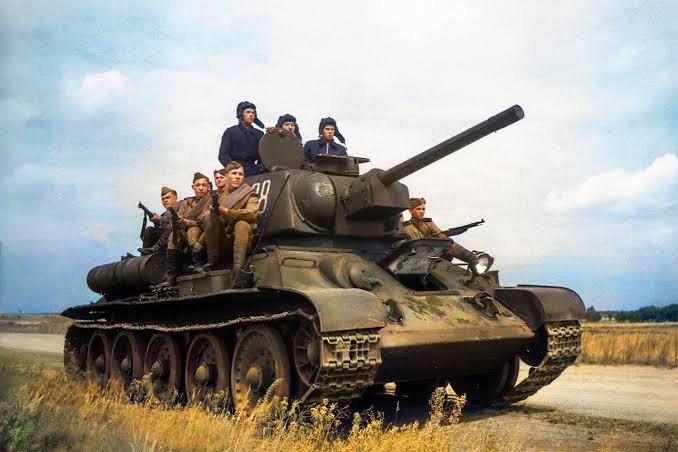
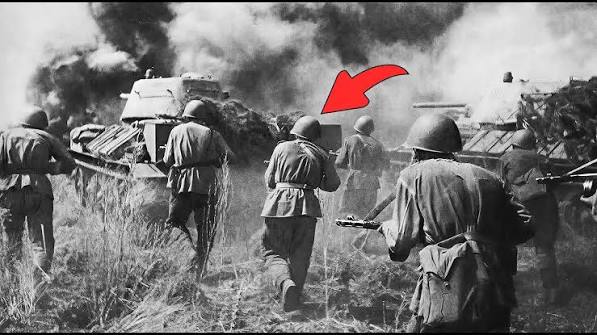
    Accounts of the battle describe hundreds of tanks swirling in a dust-choked plain, so close that German tank guns could not depress enough to hit the lower-hulled T-34s. The Luftwaffe and Soviet air force fought overhead, and the ground shook with the detonation of thousands of shells. For a full day, the two sides hammered each other. German Tiger tanks proved nearly invulnerable to Soviet 76mm guns at long range, but the sheer numbers of T-34s, many closing to point-blank range, took a toll.

    The outcome was not the German breakthrough Manstein needed. His forces had taken heavy losses, and the 5th Guards Tank Army, though badly battered, had held the line. The southern pincer had exhausted itself.

    The Counter-Offensives: Turning the Tide

    Even as the tank battle raged at Prokhorovka, the Soviets launched their own offensives. On July 12, Operation Kutuzov struck the German-held city of Orel, north of the salient, threatening the rear of the 9th Army. On August 3, Operation Rumyantsev hit the Belgorod–Kharkov axis in the south.

    Hitler had already begun to lose his nerve. The Allied invasion of Sicily on July 10 had forced him to divert troops to Italy, and on July 13 he ordered a halt to Citadel. Manstein protested, arguing that his forces were on the verge of a breakthrough, but the Führer was done. The German army would now go over to the defensive for the rest of the war in the East.

    The Soviet counter-offensives rolled forward, exploiting the gaps the German pincers had left. By August 23, the Red Army had recaptured Kharkov, the third-largest city in the Soviet Union. The German front had been pushed back over 100 miles in places, and the initiative had passed to the Soviets.

    The Cost of the Largest Tank Battle in History

    The numbers are staggering. The Soviet Union lost between 180,000 and 250,000 dead and missing, with over 600,000 wounded. Germany lost between 50,000 and 75,000 dead and missing. Tank losses are even harder to pin down. Soviet losses ranged from 1,600 to over 6,000 tanks; German losses from 700 to over 1,200. The exact figures remain contested, but the strategic result is not.

    The Battle of Kursk was the last time the Wehrmacht launched a major offensive in the East. After Kursk, the German army never regained the operational initiative. The Red Army, despite its staggering losses, went on the march westward, and nothing would stop it until Berlin.

    Why Kursk Matters

    The battle is often described as the turning point of the Second World War, and for good reason. It was the moment when the German war machine, which had seemed invincible in 1941 and 1942, was permanently broken. The Soviet defense-in-depth doctrine, learned at the cost of millions of lives, proved devastatingly effective. The industrial might of the Soviet Union, aided by Lend-Lease supplies, overwhelmed German production.

    But Kursk also matters for what it reveals about war itself. The battle was a clash of systems—German precision and tactical brilliance against Soviet mass and strategic patience. It was a battle of metal and flesh, of hundreds of thousands of men and machines grinding each other into dust. And it was a battle that decided the fate of Europe.

    The Battle of Kursk ended on August 23, 1943, with the recapture of Kharkov. The German army had been dealt a defeat from which it would never recover. The myth of German invincibility lay shattered in the mud and smoke of the Kursk salient. For the Red Army, it was the beginning of the end of a war that would take them to Berlin. For the world, it was the moment the tide of history turned decisively against Nazi Germany.

    Summary

    • The Battle of Kursk (July 5–August 23, 1943) was the largest tank battle in history, involving over 2 million troops and 6,000 tanks.
    • Operation Citadel, the German offensive, was delayed to wait for new tanks, giving the Soviets time to build massive defenses.
    • The Soviets’ defense-in-depth strategy blunted the German attack, culminating in the tank clash at Prokhorovka on July 12.
    • Soviet counter-offensives (Kutuzov and Rumyantsev) threw the Germans back, recapturing Kharkov by August 23.
    • Kursk was a decisive Soviet victory and the last major German offensive on the Eastern Front, permanently shifting the initiative to the Red Army.

    FAQ

    Q: Was the Battle of Prokhorovka the largest tank battle in history?
    A: It is often described as the largest tank battle, but the exact claim is debated. Some historians argue that it was a series of smaller engagements rather than a single, massive clash. The overall Battle of Kursk, however, is unquestionably the largest tank battle of the war, with over 6,000 tanks committed.

    Q: Why did the Germans delay the attack?
    A: Hitler postponed Operation Citadel from May to July to wait for new tanks, including the Panther, Tiger, and Ferdinand heavy assault guns. This delay gave the Soviets more time to build their defenses, which contributed to the German failure.

    Q: How did the Soviets know about the German plan?
    A: The Soviets had extensive intelligence from spy rings, including the “Lucy” ring in Switzerland, and from intercepted German communications. They learned the timing and scope of the offensive, allowing them to prepare their defenses in depth.

    Q: What was the impact of the Allied invasion of Sicily?
    A: The invasion of Sicily on July 10, 1943, forced Hitler to divert resources to Italy and contributed to his decision to halt Operation Citadel on July 13. It was a factor, but the main reason was the Soviet resistance and the need to conserve forces.

    Q: How many casualties were there?
    A: Estimates vary. Soviet casualties were around 180,000–250,000 killed/missing and over 600,000 wounded. German casualties were about 50,000–75,000 killed/missing and around 200,000 wounded. Tank losses were also heavy on both sides.
  • 36 Days on a Volcanic Rock: The Brutal Calculus of Iwo Jima

    36 Days on a Volcanic Rock: The Brutal Calculus of Iwo Jima

    On February 19, 1945, the first wave of Marines hit the black sand beaches of Iwo Jima. They expected a quick fight—planners had given the island five days. Thirty-six days later, nearly 7,000 Americans were dead, and the island had cost more Marine lives than it would ever save in B-29 landings. The battle became a symbol of American grit, a Japanese masterpiece of defense, and a strategic decision that historians still argue about.

    This is the story of how a tiny volcanic island, 750 miles from Tokyo, turned into one of the bloodiest encounters of the Pacific War—and why the debate over its necessity has never fully settled.

    The Island That Shouldn’t Have Mattered

    Iwo Jima is a lump of volcanic rock and sulfur, roughly eight square miles. In early 1945, it was a Japanese radar outpost and a base for fighters that harassed American B-29s flying from the Marianas to bomb Tokyo. The U.S. Joint Chiefs wanted it: an emergency landing field for damaged bombers, a home for P-51 Mustang escorts, and a staging ground for the invasion of Japan itself.

    The plan, Operation Detachment, assumed five days to secure the island. The Japanese had other ideas.

    Lieutenant General Tadamichi Kuribayashi had studied American tactics. He knew the beaches would be hammered by naval guns, so he abandoned the beach defense. Instead, his 21,000 troops dug into 11 miles of tunnels, built 800 pillboxes, and zeroed their artillery on the landing zones. He banned banzai charges, ordering his men to fight from cover and make the Americans pay for every yard.

    The pre-invasion bombardment—three days, the heaviest of the Pacific War—did little. The shells churned the surface but missed the buried fortifications.

    The First 36 Days

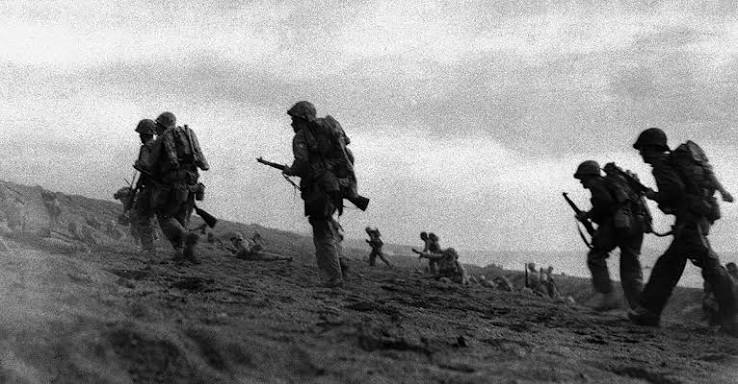
    On February 19, the 4th and 5th Marine Divisions hit the southeastern beaches. The black volcanic ash was loose, like walking in sand, and provided no cover. Japanese guns from Mount Suribachi to the south and the northern highlands opened up. The first day ended with 550 dead and more than 1,800 wounded—the worst single day in Marine Corps history up to that point.

    The fighting was relentless. The Marines advanced yard by yard, using flamethrowers, demolition charges, and grenades to clear bunkers. Kuribayashi’s men, well-supplied and hidden, inflicted casualties at a rate that stunned the Americans. By March 3, the airfield was in use, but the island was far from secure.

    On February 23, a patrol reached the summit of Mount Suribachi. A small flag went up, photographed by Marine photographer Lou Lowery. Hours later, a larger flag replaced it. Associated Press photographer Joe Rosenthal captured that second raising—an image that would become the Marine Corps War Memorial. Of the six men in the photo, three—Harlon Block, Franklin Sousley, and Mike Strank—were killed later in the battle. It took 71 years to correct the identity of another man in the picture: Harold Schultz, not John Bradley, as misidentified for decades.

    The Toll and the Aftermath

    The battle dragged on. The 3rd Marine Division joined the fight. By March 16, the island was declared secure, but organized resistance continued until March 26, when the last Japanese defenders launched a final attack. At the end, 6,821 Americans were dead and 19,217 wounded. Japanese dead numbered about 20,000, with only 216 taken prisoner. This was the only major Pacific battle where U.S. casualties exceeded Japanese.

    Twenty-seven Medals of Honor were awarded—more than in any other single battle in American history. The cost was staggering for an island that, in the end, did not prove decisive.

    The Strategic Debate

    Supporters point to the numbers: more than 2,200 B-29s made emergency landings on Iwo Jima, saving an estimated 24,000 airmen. The radar station was silenced, and the fighter base allowed P-51s to escort bombers.

    Critics argue the numbers are misleading. Many of those landings were routine, not emergencies, and the P-51 escorts had limited impact. The cost—nearly 7,000 dead—was too high for what was gained. Some historians suggest the invasion was driven by interservice rivalry and momentum rather than strategic necessity.

    Kuribayashi’s defense is studied today as a model of how to fight against overwhelming odds. In Japan, the battle is remembered as a symbol of sacrifice, though its meaning has been contested in nationalist narratives.

    Thirty-six days on a volcanic rock changed the course of the Pacific War, but not in the way planners expected. The island was taken, but at a cost that still raises questions about whether it was worth it.

    The battle of Iwo Jima remains a study in contrasts: a tactical victory, a strategic question mark, and a human tragedy. The flag raising on Suribachi became an icon of American resolve, but the island’s cost in lives demands a closer look at the decisions that led there. For the Marines who fought, the island was simply a job to do. For historians, it is a lesson in the brutal arithmetic of war—where the value of a piece of ground is measured in lives, not miles.

    Summary

    • The battle lasted 36 days, from February 19 to March 26, 1945, far beyond the 5 days planned.
    • U.S. casualties: 6,821 killed, 19,217 wounded; Japanese: about 20,000 killed, only 216 captured.
    • Kuribayashi’s tunnel defense and ban on banzai charges made the island a fortress.
    • The iconic flag raising on Mount Suribachi had six men; three were killed later, and one was misidentified for decades.
    • The strategic value of the island is debated: 2,200 B-29 landings vs. nearly 7,000 U.S. dead.

    FAQ

    Q: Why did the U.S. want Iwo Jima?
    A: To provide an emergency landing field for B-29 bombers, a base for P-51 fighter escorts, and a staging area for the planned invasion of Japan.

    Q: How did the Japanese defend the island?
    A: Under Lieutenant General Tadamichi Kuribayashi, they built over 11 miles of tunnels, 800 pillboxes, and used artillery positioned to fire on the beaches. They avoided banzai charges and fought from prepared positions.

    Q: How many Medals of Honor were awarded?
    A: 27 Medals of Honor were awarded, more than any other single battle in U.S. history.

    Q: What was the significance of the flag raising?
    A: The second flag raising, photographed by Joe Rosenthal, became a symbol of the battle and inspired the Marine Corps War Memorial. Three of the six men in the photo were killed later in the battle.

    Q: Was the invasion of Iwo Jima necessary?
    A: The debate continues. Supporters cite over 2,200 B-29 landings and the elimination of the radar station. Critics argue the cost in lives outweighed the benefits, and the invasion may have been driven by momentum rather than necessity.

  • Five Minutes Over Midway: How Codebreakers and Courage Turned the Tide in the Pacific

    Five Minutes Over Midway: How Codebreakers and Courage Turned the Tide in the Pacific

    How Codebreakers Helped Secure U.S. Victory in the Battle of Midway | HISTORYAt 10:22 on the morning of June 4, 1942, the fate of the Pacific War hung on a sliver of sky above a pair of coral islands. Below, four Japanese aircraft carriers the vanguard of an empire that had swept across Asia and the Pacific in six monthswere turning into the wind to launch a second strike against Midway Atoll. Their decks were crammed with fueled planes, armed bombs, and torpedoes. Then, from 20,000 feet, three squadrons of American dive bombers plunged out of the sun. In five minutes, they turned the tide of World War II.

    This was no accident of luck. It was the product of a secret intelligence coup, a commander’s calculated gamble, and the desperate sacrifice of young pilots who flew straight into death to buy those five minutes. The Battle of Midway, fought June 4–7, 1942, was the moment Japan’s offensive momentum broke—when the U.S. Navy, outnumbered and battle-worn, struck a blow from which the Imperial Japanese Navy never recovered.

    The Road to the Reef

    Midway Atoll sits at the northwestern edge of the Hawaiian chain, 1,300 miles from Oahu. It is a speck of sand and reef, but by 1942 it was an unsinkable American aircraft carrier—a forward base for bombers and submarines that could threaten Japanese operations. For Admiral Isoroku Yamamoto, commander of Japan’s Combined Fleet, Midway was a lure. He planned to seize the island and, in the process, draw out the U.S. carriers he had failed to sink at Pearl Harbor on December 7, 1941.

    Yamamoto’s plan was grandiose and complicated. He would send a diversionary force to attack the Aleutians in the north, a main carrier strike force under Vice Admiral Chuichi Nagumo to soften Midway, an invasion force to land troops, and a massive battleship fleet lurking hundreds of miles behind—ready to crush the American carriers once they surfaced. It was a plan built on the assumption that the U.S. carriers would react predictably, steaming from Pearl Harbor only after Midway was attacked. It was a fatal assumption.

    The Codebreakers’ Secret

    While Yamamoto planned, a cramped basement at Pearl Harbor—Station HYPO—was quietly unraveling his strategy. Commander Joseph Rochefort and his team of cryptanalysts had been working on the Japanese JN-25 naval code for months. By May 1942, they had pieced together that a major operation was aimed at a target designated “AF.” But what was AF?

    Rochefort had a hunch it was Midway. To prove it, he devised a simple ruse. He ordered Midway to send an uncoded radio message stating that its freshwater distillation plant had broken down. Two days later, Japanese intelligence intercepted a message reporting that “AF” was short of fresh water. The trap was sprung. Nimitz knew exactly where the enemy was going.

    This intelligence gave the U.S. Pacific Fleet a priceless advantage. Nimitz could position his three carriers—Enterprise, Hornet, and the hastily repaired Yorktown—northeast of Midway, out of Japanese reconnaissance range, ready to spring an ambush. The Yorktown, which had been severely damaged at the Battle of the Coral Sea a month earlier, was patched in just 72 hours at Pearl Harbor. Shipyard workers, working around the clock, made her seaworthy enough to fight. She would sail into history.

    The Morning of June 4

    Nagumo’s four carriers—Akagi, Kaga, Soryu, and Hiryu—launched their first strike on Midway at dawn on June 4. The attack was successful but not decisive; Midway’s airfield remained operational, and its bombers were already in the air, searching for the Japanese fleet. Meanwhile, Nagumo’s scout planes were searching for the U.S. carriers. They found nothing.

    At 7:10 AM, Midway-based aircraft began attacking the Japanese carriers. Torpedo bombers, dive bombers, and B-17s came in waves, but they were slow, vulnerable, and poorly coordinated. Japanese Zero fighters and anti-aircraft fire cut them down. Not a single bomb hit a Japanese ship. But the attacks had a profound effect: they convinced Nagumo that Midway posed a greater threat than expected, and they delayed his decision on whether to strike again.

    At 8:20 AM, a scout plane from the cruiser Tone finally reported the presence of a U.S. carrier force. Nagumo was caught in a dilemma. His planes were armed with bombs for a second strike on Midway. To attack the carriers, they needed torpedoes. The process of rearming would take time—precious time. He ordered the rearming to begin, and then, at 8:37, he changed his mind and ordered the planes to be rearmed again. The decks of his carriers became a chaotic jumble of bombs, torpedoes, and fueled aircraft.

    The Sacrifice of the Torpedo Squadrons

    While Nagumo dithered, U.S. carrier aircraft were closing in. The first to arrive were the torpedo bombers—slow, low-flying TBD Devastators. They came in at wave height, without fighter cover, their torpedoes outdated and often malfunctioning. They flew straight into the teeth of the Japanese defenses.

    Torpedo Squadron 8 from the Hornet, led by Lieutenant Commander John Waldron, was the first to attack. All fifteen of its aircraft were shot down. Only one pilot, Ensign George Gay, survived—he floated in the water, watching the battle unfold, as his comrades died around him. Torpedo Squadrons from Enterprise and Yorktown followed, and they too were massacred. Of the 41 torpedo bombers that attacked, only six returned. They scored no hits. But they did something more important: they drew the Japanese Zero fighters down to sea level, leaving the sky above clear.

    The Five Minutes That Changed the War

    At 10:22 AM, the Japanese carriers were at their most vulnerable. Their decks were full of aircraft being rearmed, with bombs and torpedoes stacked carelessly, fuel lines snaking across the flight deck. Zeroes that had been scrambled to shoot down the torpedo bombers were low on fuel and ammunition, circling at low altitude. No one was looking up.

    Then, from 20,000 feet, the dive bombers arrived. They were from Enterprise and Yorktown—two squadrons of SBD Dauntlesses, about 50 aircraft total. They had arrived late, having missed the initial contact, but their timing was perfect. Led by Lieutenant Commander Wade McClusky, who had made a critical navigation decision to continue searching rather than turn back, they found the Japanese fleet by following a single destroyer’s wake.

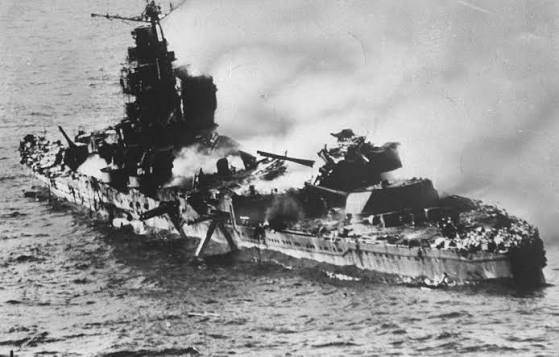
    They pushed over into their dives. In the next five minutes, bombs struck Akagi, Kaga, and Soryu. The explosions ignited the fuel and ordnance on their decks. Fires raged out of control. The three carriers were doomed. Only Hiryu, further north, escaped the initial attack.

    The Final Act

    Hiryu launched a counterstrike that afternoon. Her bombers found Yorktown and hit her with three bombs and two torpedoes. The Yorktown was crippled, and she was later sunk by a Japanese submarine, along with the destroyer Hammann, which was alongside her during salvage efforts. But Hiryu’s victory was short-lived. U.S. scout planes located her, and a strike from Enterprise and Hornet found her in the late afternoon. Four bombs hit Hiryu’s flight deck, turning her into an inferno. She sank the next morning.

    By June 7, the battle was over. The U.S. had lost the Yorktown and the Hammann, but all four of Japan’s fleet carriers—the core of its naval air power—lay at the bottom of the Pacific. More than 250 carrier aircraft and their experienced pilots had gone down with them, a blow from which Japan’s air arm would never recover. The U.S. lost about 150 aircraft, but most of its aircrew survived to fight again.

    The Aftermath

    Midway was a turning point. Japan lost not only ships and men but the strategic initiative. Admiral Yamamoto’s dream of a decisive battle had ended in disaster. The U.S. went on the offensive, landing at Guadalcanal in August 1942, the first step in a long island-hopping campaign that would end at Tokyo Bay. The battle also vindicated the U.S. intelligence community and the carrier-centric naval doctrine that would dominate the rest of the war.

    For the men who fought there, the memory was stark. Ensign George Gay, floating in the Pacific, watched his squadron die and then watched the Japanese carriers burn. He was rescued the next day, his body burned and his spirit forever marked. A generation of American pilots had been sacrificed to buy those five minutes, but the sacrifice bought victory.

    Midway was not a battle that was won by a single genius or a single lucky break. It was won by intelligence, by risk-taking, and by the raw courage of men who flew into the face of death. The codebreakers who cracked JN-25, the commanders who gambled on a flanking position, and the torpedo pilots who gave their lives to set up the dive bombers—all of them were necessary. The Battle of Midway remains a testament to the fact that, in war, information and sacrifice can overcome superior numbers and brute force. It was the moment the Pacific War truly turned, and it has never been forgotten.

    Summary

    • The U.S. Navy’s codebreakers confirmed Midway as the Japanese target by faking a water shortage, enabling Admiral Nimitz to set an ambush.
    • The Japanese plan was overcomplicated and dispersed, violating the principle of concentration of force.
    • The sacrifice of U.S. torpedo squadrons, which suffered near-total losses, drew Japanese fighters down and left the sky clear for dive bombers.
    • At 10:22 AM on June 4, 1942, U.S. dive bombers struck three Japanese carriers in five minutes, turning the tide of the battle.
    • All four Japanese fleet carriers were sunk; Japan lost ~3,000 men and the initiative in the Pacific, while the U.S. lost one carrier and ~360 men.

    FAQ

    Q: Why did the Japanese attack Midway?
    A: Admiral Yamamoto wanted to draw out and destroy the U.S. carrier fleet in a decisive battle, and also to seize Midway as a forward airbase to threaten Hawaii and force a favorable peace.

    Q: How did the U.S. know the Japanese were coming?
    A: U.S. Navy cryptanalysts, led by Commander Joseph Rochefort, had partially broken the Japanese JN-25 code. They confirmed Midway as the target by having Midway send a false message about a broken water distillation plant, and then intercepting a Japanese report that ‘AF’ was short of water.

    Q: What was the ‘five minutes’ that changed the war?
    A: On June 4, 1942, at 10:22 AM, U.S. dive bombers from Enterprise and Yorktown attacked the Japanese carriers Akagi, Kaga, and Soryu while their decks were full of fueled and armed aircraft. In five minutes, they hit all three, causing catastrophic fires that doomed the carriers.

    Q: How many ships were lost on each side?
    A: Japan lost all four fleet carriers (Akagi, Kaga, Soryu, Hiryu) and a heavy cruiser. The U.S. lost the carrier Yorktown and the destroyer Hammann.

    Q: Why was the Battle of Midway a turning point?
    A: It was Japan’s first decisive defeat in 350 years. The loss of four fleet carriers and their irreplaceable aircrews ended Japan’s offensive capability, and the U.S. went on the strategic offensive, starting with the Guadalcanal campaign in August 1942.

  • The Two Swords: Did the Atomic Bomb or the Soviet Invasion End Japan’s War?

    The Two Swords: Did the Atomic Bomb or the Soviet Invasion End Japan’s War?

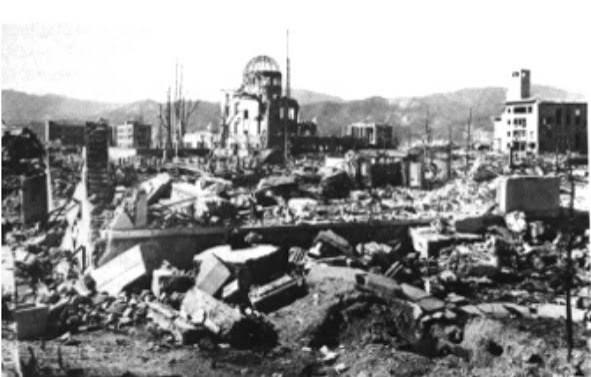
    At 11:02 on the morning of August 9, 1945, a plutonium bomb nicknamed ‘Fat Man’ detonated 500 meters above the streets of Nagasaki. The blast killed tens of thousands instantly, leveling factories, homes, and a cathedral. Halfway around the world, in Moscow, the Soviet Foreign Minister was handing the Japanese ambassador a declaration of war. The date was no coincidence: the Red Army had rolled into Manchuria just hours earlier, and the second atomic bomb fell as Soviet tanks crossed the border. Within six days, Japan announced its surrender.

    For decades, the standard American narrative held that the bombs alone forced Japan to its knees. But historians have long debated whether the Soviet entry into the Pacific War a massive, swift offensive that shattered Japan’s last military hopes was the true final blow. The evidence from Japanese decision-making suggests a more complex story: both events, separated by hours, combined to break a deadlocked government that had been preparing to fight to the death.

    The Summer of 1945: A Nation on the Brink

    By mid-1945, Japan’s situation was dire. The Imperial Navy was crippled; the merchant fleet had been decimated by American submarines, cutting off oil and food imports. The U.S. Army Air Forces had firebombed dozens of cities, including the March 9 raid on Tokyo that killed an estimated 100,000 people. Yet the government had not surrendered. The military leadership, particularly the Army, had staked its honor on fighting a decisive battle on Japanese soil. They believed they could inflict such heavy casualties on an Allied invasion that the United States would offer more lenient terms than unconditional surrender.

    The Potsdam Declaration, issued July 26, 1945, demanded exactly that: unconditional surrender, or Japan would face “prompt and utter destruction.” Prime Minister Kantarō Suzuki initially responded with the word mokusatsu often translated as “ignore” or “treat with silent contempt.” Whether he meant to stall for time or outright reject, the Allies took it as a refusal. The war would continue.

    The Soviet Factor: A Diplomatic Lifeline Snapped

    Behind the scenes, Japan had been clutching at one last straw: the Soviet Union. Despite being allies with the United States and Britain, the Soviets had signed a neutrality pact with Japan in April 1941. Japan’s foreign minister, Shigenori Tōgō, had been desperately trying to get Moscow to broker a negotiated peace with the Allies. As late as August 8, Ambassador Naotake Satō was still in Moscow, awaiting a reply.

    That reply came at midnight, August 8–9 (Japan time), when Soviet Foreign Minister Vyacheslav Molotov summoned Satō to the Kremlin and read a declaration of war. The Soviets had already launched Operation August Storm, a three-pronged offensive into Manchuria, Korea, and the islands north of Japan. Over 1.5 million Soviet troops, backed by more than 5,000 tanks and 4,000 aircraft, swept into Japanese-held territory. The Kwantung Army, once an elite force, was now a hollow shell, its best units stripped for the home island defense. Within days, the Red Army had advanced hundreds of kilometers, overwhelming Japanese positions.

    The declaration was a devastating blow to Japan’s diplomatic strategy. Tōgō had pinned his hopes on Soviet mediation; now that hope was gone. In his memoirs, Tōgō described the news as bringing a feeling of “despair.” The war, which had seemed unwinnable, now seemed hopeless.

    The Bombs Fall: August 6 and 9

    Three days before the Soviet declaration, the first atomic bomb had fallen on Hiroshima. On August 6, the B-29 Enola Gay dropped “Little Boy,” killing an estimated 90,000 to 166,000 people by the end of the year, many from radiation sickness. The Japanese government was stunned but did not immediately capitulate. The military leadership downplayed the destruction, insisting that the United States could not have many such bombs.

    Then came Nagasaki. At 11:02 AM on August 9, the second bomb killed 60,000 to 80,000 people. The timing—just hours after the Soviet invasion began created a one-two punch that would crack the government’s resolve.

    The Deadlock Breaks: August 9–10

    That night, the Supreme War Council met in an underground bunker. The six members Prime Minister Suzuki, Foreign Minister Tōgō, Army Minister Korechika Anami, Navy Minister Mitsumasa Yonai, and the two chiefs of staff were split. Three favored accepting the Potsdam terms, with the sole condition that the imperial system be preserved. Three, led by Anami and the Army, insisted on additional conditions: no Allied occupation, no war crimes trials, and the right to disarm Japanese forces themselves.

    The meeting dragged on for hours, but no consensus emerged. At 2:00 AM on August 10, Prime Minister Suzuki made an unprecedented move: he took the matter to the Emperor. Hirohito, who had been largely sidelined from decision-making, listened as the council laid out the options. Then he spoke. He said that continuing the war was “unbearable” for the people, and he could not bear to see them suffer further. He referenced the “new type of bomb” as a reason, but he also noted that the Soviet entry had made the situation “impossible.” He accepted the Potsdam terms with the condition of preserving the imperial line.

    The cabinet accepted, and a message was sent to the Allies later that day.

    The Byrnes Note and the Second Deadlock

    The Allied reply came on August 11, drafted by Secretary of State James Byrnes. It stated that the Emperor’s authority would be subject to the Supreme Commander of the Allied Powers—a subtle way of saying Hirohito could stay, but under MacArthur’s thumb. This triggered a second deadlock. The military hardliners balked, arguing that this was still a form of unconditional surrender. For three days, the cabinet dithered.

    Meanwhile, the war continued. American B-29s dropped leaflets over Japanese cities, revealing the surrender offer. Soviet forces swept through Sakhalin and the Kuril Islands, and the Kwantung Army was in full retreat. On August 14, the Emperor called another imperial conference. Again, he broke the tie. He told the ministers that he could not let his people suffer any longer. He asked them to “endure the unendurable” and accept the Allies’ terms. That night, the cabinet signed the acceptance, and the next day, Hirohito broadcast the surrender speech to the nation.

    What the Evidence Says

    So which was decisive? The traditional American narrative points to the atomic bombs, and it’s true that they shocked the leadership. But the Soviet invasion was equally—if not more—important in strategic terms. It eliminated Japan’s last diplomatic hope, destroyed its best remaining army, and threatened the home islands from the north. The bombs were untested weapons; the military might have dismissed them as one-off atrocities. But the Soviet entry was a conventional military defeat that could not be argued away.

    Modern historians often cite the Soviet invasion as the more decisive factor. Tsuyoshi Hasegawa, in his book Racing the Enemy, argues that the Soviet entry was the “final blow” that tipped the scales. Japanese officials themselves, in postwar interrogations, often cited the Soviet entry as the primary reason for surrender. They had been prepared to fight an American invasion, but the war with the Soviets made that impossible.

    Yet the bombs played a role too. They gave the Emperor a face-saving reason to surrender—a weapon of such terrible power that resistance was futile. They also demonstrated that the United States could and would use them again. The two events, separated by hours, created a psychological shock that shattered the government’s will.

    In the end, Japan’s surrender was the result of a convergence: the Soviet invasion destroyed Japan’s ability to continue the war, while the atomic bombs provided a compelling justification for the Emperor to intervene. Neither alone may have been sufficient. Together, they were overwhelming.

    The debate over why Japan surrendered will never have a single, simple answer. The bombs and the Soviet invasion were not rival causes but twin blows that landed within days of each other. They broke a deadlocked government, shattered a desperate diplomatic gambit, and gave the Emperor a reason to speak. As the world marks the anniversaries of these events, it’s worth remembering that history is rarely made by a single act—it’s made by the collision of forces, both human and mechanical, that together change the course of nations.

    Summary

    • The Japanese government was deadlocked in August 1945, with military hardliners refusing to accept unconditional surrender.
    • The atomic bombings of Hiroshima and Nagasaki killed an estimated 150,000–246,000 people and shocked the leadership.
    • The Soviet invasion of Manchuria on August 8–9 involved 1.5 million troops and eliminated Japan’s last hope for a negotiated peace.
    • Emperor Hirohito broke the deadlock twice, citing the “unbearable” suffering of his people and the new bomb.
    • Historians debate the relative weight of the bombs versus the Soviet entry; many argue the Soviet invasion was the decisive factor.

    FAQ

    Q: Was the atomic bomb the only reason Japan surrendered?
    A: No. The Soviet invasion of Manchuria was also a major factor, eliminating Japan’s last diplomatic option and defeating its main army. The bombs and the invasion together broke the government’s deadlock.

    Q: What was Japan’s initial response to the Potsdam Declaration?
    A: Prime Minister Suzuki responded with mokusatsu, which can mean “ignore” or “treat with silent contempt.” The Allies interpreted this as a rejection, leading to the atomic bombings.

    Q: How did the Soviet Union’s entry affect Japan’s diplomatic strategy?
    A: Japan had hoped the Soviets would mediate a negotiated peace. The Soviet declaration of war on August 8, 1945, shattered that hope, leaving Japan with no diplomatic exit.

    Q: What role did Emperor Hirohito play in the surrender?
    A: The Emperor broke two deadlocked cabinet votes (August 10 and August 14) to accept the Potsdam terms, citing the suffering of his people and the new weapon.

    Q: Did the Soviet invasion cause many casualties?
    A: The Soviet invasion involved over 1.5 million troops and resulted in the capture of hundreds of thousands of Japanese soldiers, many of whom were sent to Siberian labor camps. Exact casualty numbers are less documented than those of the atomic bombs.

  • I Spent 3 Months Researching the Night Witches. Here’s What Shocked Me.

    I Spent 3 Months Researching the Night Witches. Here’s What Shocked Me.

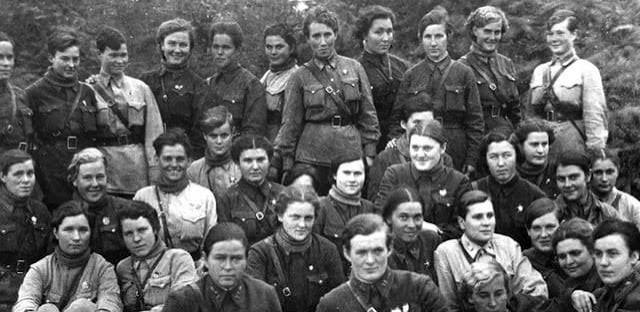
    When I first heard about the Night Witches, I assumed it was a myth a propaganda story cooked up to rally a desperate Soviet Union. Three months of digging through archives, memoirs, and combat reports later, I’m convinced they were real, and far more remarkable than any legend. These were teenage girls flying plywood biplanes in the dead of night, with no radar, no parachutes, and no armor, dropping bombs on the most powerful army in Europe. Here’s what stunned me most.

    They Flew Wooden CropDusters Against the Nazis

    The Polikarpov Po-2 was a 1920s training biplane, built from wood and canvas. It had a top speed of 150 km/h—slower than the wind resistance on a German Messerschmitt’s windshield. It had open cockpits, so the women froze at -40°C. It had no self-sealing fuel tanks, meaning one bullet could turn the entire aircraft into a fireball. And yet, these women flew it into combat, night after night.

    What made the Po-2 a weapon was its stall speed just 65 km/h. It could fly so slowly and so low that German fighters literally couldn’t engage it. A Bf 109 would stall and crash if it tried to match the Po-2’s speed. That’s not an excuse; that’s physics. The Germans couldn’t touch them.

    They Didn’t Just Bomb They Terrorized

    The German soldiers called them “Nachthexen” Night Witches because the Po-2’s wooden frame made it invisible to radar, and its engines made a distinctive whooshing sound as it glided overhead. The name was meant as an insult. The women wore it as a badge of honor.

    But the real shocker was the psychological impact. German commanders were so desperate that they offered the Iron Cross to any pilot who shot down a Night Witch. None ever did. The constant night raids sometimes 8 to 12 sorties per pilot per night left German troops exhausted, jumpy, and demoralized. The Po-2 carried only 200-300 kg of bombs per mission, but the harassment value was immense. They weren’t just destroying supply depots; they were destroying sleep.

    They Were Teenagers, and They Volunteered

    The average age of a Night Witch was 20 to 22. Some were as young as 16. These weren’t hardened soldiers; they were university students, flying club enthusiasts, and factory workers who answered Marina Raskova’s call after Stalin authorized three women’s aviation regiments in October 1941. Many had only months of flight training before they were sent to the front.

    One of them, Irina Sebrova, flew 1,008 missions. That’s more than any pilot in the regiment, and more than most male pilots in any air force. Nadezhda Popova flew 852 missions and later married a fighter pilot she met during the war. Natalya Meklin flew 980. These weren’t outliers they were typical of the regiment’s dedication.

    The Tactics Were Genius

    The hallmark of the Night Witches was the engine-cut glide bombing. They would approach a target, cut the engine, and glide silently the only sound a soft whistle from the wind over the wings. At 200-400 meters, they’d release their bombs and restart the engine, often under heavy anti-aircraft fire. They also used diversion tactics: one plane would circle to draw searchlights and flak, while others attacked from a blind spot.

    They flew in all weather, without radios, navigating by stars and landmarks. Their only instruments were a compass, a stopwatch, and a map. If they got lost, they were lost.

    The Cost Was Real

    The regiment flew over 23,000 sorties and dropped about 3,000 tons of bombs. In return, 32 women were killed in action some in crashes, some shot down. Among them was Marina Raskova, the regiment’s founder, who died in a training accident in January 1943. Her death was a devastating blow, but the regiment continued under Yevdokia Bershanskaya, the only woman to command a regiment in the Soviet Air Forces.

    Twenty-three pilots and navigators received the Hero of the Soviet Union, the nation’s highest honor. Some were posthumous.

    Why We Forgot Them

    After the war, the Soviet Union downplayed the role of women in combat. The Night Witches were celebrated briefly, then quietly erased from official history. It wasn’t until the 1990s that their story resurfaced, thanks to memoirs and historians. The German nickname stuck, and now it’s the only name most people know.

    But here’s what shocked me most: these women weren’t just brave they were effective. They flew more sorties than many male regiments, and they did it with inferior equipment and no expectation of glory. They weren’t asking for recognition. They just wanted to fight for their country. And they did.

    The Night Witches were not a myth, and they weren’t a novelty act. They were one of the most effective bombing units of World War II, and they did it in the most unlikely aircraft imaginable. Three months of research left me in awe of their courage, their ingenuity, and their determination. They weren’t witches they were warriors.

    Summary

    • The Night Witches flew 23,000+ combat missions in wooden Po-2 biplanes, with no radar, no parachutes, and no armor.
    • They used engine-cut glide bombing and diversion tactics to evade German defenses, and no Night Witch was ever shot down by a German fighter.
    • The regiment was composed of ~400 women, mostly in their early 20s, who volunteered and flew up to 12 sorties per night.
    • They dropped ~3,000 tons of bombs and suffered 32 deaths, earning 23 Heroes of the Soviet Union.
    • Their story was largely forgotten after the war, but their legacy as one of the most effective harassment bombing units endures.

    FAQ

    Q: Did any Night Witch get shot down by a German pilot?
    A: No. German fighters couldn’t engage the Po-2 effectively due to its extremely low stall speed, and no pilot was ever awarded the Iron Cross for shooting one down. 32 women died in accidents and crashes, but not from enemy fighter attacks.

    Q: Why did they fly so many missions per night?
    A: Because the Po-2 could only carry 200-300 kg of bombs, pilots often flew 8-12 sorties per night to make up for the small payload. Some flew more.

    Q: Were there other women’s aviation regiments?
    A: Yes, Marina Raskova formed three: the 586th Fighter Regiment, the 587th Dive Bomber Regiment, and the 588th Night Bomber Regiment (later the 46th Guards Night Bomber Aviation Regiment). The 588th became the most famous.

    Q: What happened to the regiment after the war?
    A: Many survivors returned to civilian life. The Soviet Union largely erased women’s combat roles from official history, and the regiment was not widely recognized until recent decades.

    Q: Where did the name “Night Witches” come from?
    A: German soldiers coined it because the wooden Po-2 was invisible to radar and made a whooshing sound in flight, like a witch’s broomstick. It was meant as an insult, but the women embraced it.

  • Between Defeat and Dawn: Daily Life in Occupied France, 1940-1944

    Between Defeat and Dawn: Daily Life in Occupied France, 1940-1944

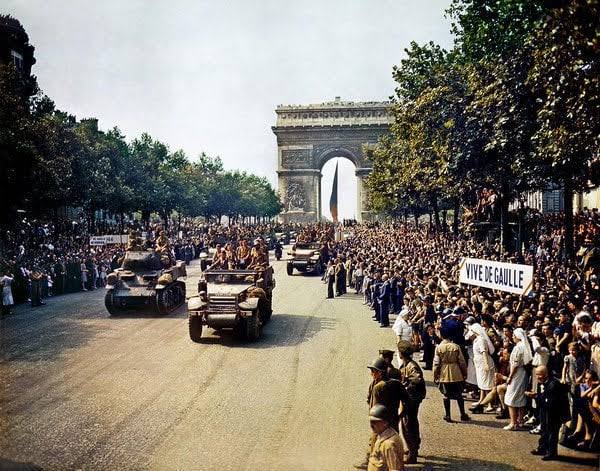
    On June 14, 1940, German troops marched down the Champs-Élysées in Paris. Within days, the French government signed an armistice that split the country in two: the Occupied Zone in the north, under direct German military control, and the southern Free Zone, governed by the collaborationist Vichy regime. For the next four years, the French lived under a shadow of occupation that reached into every corner of public and private life from the ration books that dictated meals to the curfews that silenced streets after dark.

    This is the story of how ordinary people navigated that shadow: the choices they made, the compromises they accepted, and the small acts of defiance that kept hope alive. It is a story of collaboration, resistance, and survival not as abstract categories, but as daily realities shaped by hunger, fear, and the stubborn will to endure.

    The Liberation and Its Aftermath

    The D-Day landings in June 1944 and the liberation of Paris in August brought hope, but the occupation did not end overnight. As the Allies pushed through France, the Vichy regime collapsed, and the collaborators were exposed.

    In the aftermath, roughly 300,000 people were investigated for collaboration. About 100,000 were sentenced, and around 7,000 were executed. Some were punished for crimes, others for opportunism, and still others were simply in the wrong place at the wrong time. The process was imperfect, but it allowed France to confront the choices made during the occupation.

    France emerged from the war with deep scars. Approximately 600,000 French people had died military, civilian, and Holocaust victims. The country had been divided, humiliated, and morally compromised. Yet it also had the legacy of the Resistance, a small but significant number of people who had chosen to fight back against the occupier and the collaborationist state.

    Life in occupied France was a daily negotiation between survival and conscience. Some collaborated, some resisted, and most simply tried to get by. The choices were rarely clear-cut, and the lines between collaboration and resistance blurred in the gray zone of everyday life. But the stories of those who lived through it the denunciations and the hidden Jews, the black market and the Maquis remind us that even in the darkest times, people find ways to endure, to help others, and to reclaim their dignity.

    Summary

    • The occupation split France into the Occupied Zone and the Free Zone, with Vichy collaborating in the south.
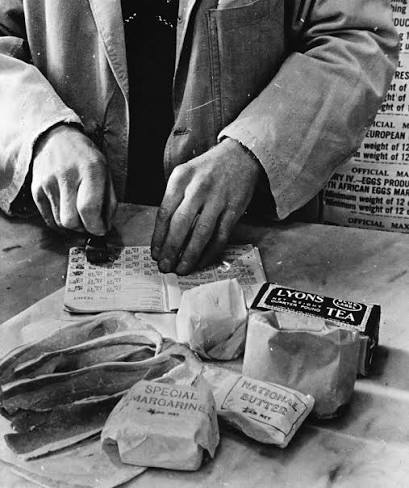
    • Rationing and shortages reduced caloric intake to nearly half of normal, fueling a black market.
    • Collaboration ranged from state policy to everyday denunciations, with millions of letters sent.
    • Resistance grew from small acts to organized networks, especially after the STO forced laborers into hiding.
    • Liberation brought justice but also imperfect reckoning, with thousands executed for collaboration.

    FAQ

    Q: What was the difference between the Occupied Zone and the Free Zone?
    A: The Occupied Zone, in the north and along the Atlantic coast, was directly controlled by German military authorities. The Free Zone, in the south, was governed by the Vichy regime under Marshal Pétain, who collaborated with Germany. In November 1942, Germany occupied the Free Zone as well, ending the division.

    Q: How did ordinary French people survive the rationing?
    A: They relied on ration books, but rations were far below normal caloric needs—around 1,500 calories a day. Many turned to the black market, which offered goods at high prices, while rural families often had better access to food. People also grew their own vegetables and bartered with neighbors.

    Q: What was the Milice, and what did it do?
    A: The Milice was Vichy’s paramilitary police force, created in January 1943. It actively hunted Resistance members and Jews, often using torture and summary executions. Its brutality was notorious, and it was feared more than the German Gestapo in some areas.

    Q: How did the STO lead to the growth of the Maquis?
    A: The STO (Service du Travail Obligatoire) required hundreds of thousands of young French men to work in German factories. Many refused and fled to rural areas, joining guerrilla bands known as the Maquis. These groups conducted sabotage and ambushes, and they became a significant part of the Resistance.

    Q: What happened to collaborators after the liberation?
    A: After liberation, roughly 300,000 people were investigated for collaboration. About 100,000 were sentenced, and around 7,000 were executed. The process was often chaotic and sometimes unjust, but it was an attempt to hold people accountable for their actions during the occupation.

  • The Gate at El Alamein: How a Bottleneck in the Sand Became the War’s Turning Point

    The Gate at El Alamein: How a Bottleneck in the Sand Became the War’s Turning Point

    In the late summer of 1942, the British Eighth Army was a force in retreat. Chased across Libya by Erwin Rommel’s Afrika Korps, they had lost Tobruk in a humiliating surrender, and the German commander stood at the edge of Egypt, a mere 100 kilometers from Alexandria. The Royal Navy had already evacuated the port, sending its warships to the Red Sea. Cairo was burning its archives, preparing for occupation. But geography, more than any general, was about to draw a line in the sand.

    Between the Mediterranean coast and the impassable Qattara Depression, the desert narrows to a corridor just 60 kilometers wide. That bottleneck, a place called El Alamein, was where the Axis advance would either break through to the Suez Canal or grind to a halt. It was there that the war in North Africa and arguably the fortunes of the Allies in 1942 would be decided.

    The Desert’s Sieve

    The first collision at El Alamein was not a planned offensive but a desperate stand. In July 1942, General Claude Auchinleck, commanding the Eighth Army, threw his forces into a defensive line at the bottleneck, fighting Rommel’s exhausted Panzer Army Africa to a bloody stalemate from July 1 to 27. The German supply lines, stretched thousands of kilometers back to Tripoli, were fraying. The British, by contrast, had Alexandria just down the road. Auchinleck halted the Axis drive, but Winston Churchill, hungry for a decisive victory, saw caution as a failure. In August, he replaced Auchinleck with Lieutenant-General Bernard Montgomery.

    Montgomery was a different breed of commander. He had no taste for Rommel’s fluid, improvisational warfare. Instead, he insisted on a set-piece battle: overwhelming superiority in men, tanks, artillery, and air power, and a plan that left little to chance. He drilled his troops, rebuilt their morale, and refused to attack until every condition was met. By October, he had assembled roughly 195,000 troops, 1,029 tanks (including American Grants and Shermans), and 900 guns. Against him, Rommel fielded about 104,000 men and 547 tanks, many of them outdated Italian models. The Luftwaffe could muster only around 350 operational aircraft against the Desert Air Force’s 1,500.

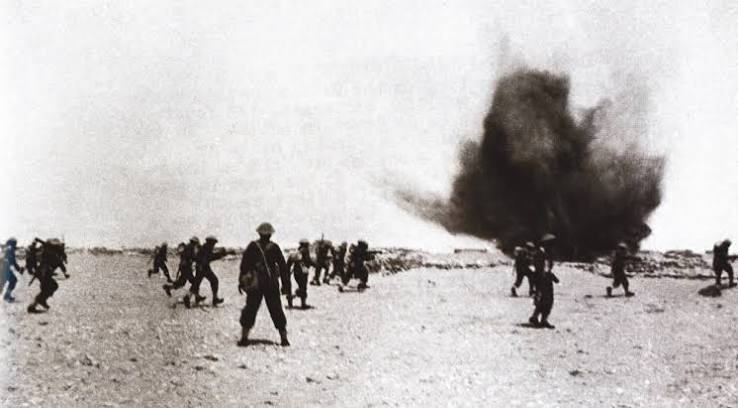
    Rommel, meanwhile, was not even present when the storm broke. He had flown to Germany on sick leave, leaving General Georg Stumme in command. On the night of October 23, 1942, the silence of the desert was shattered by the simultaneous roar of over 1,000 British guns. Operation Lightfoot had begun.

    Breaking the Devil’s Gardens

    Montgomery’s plan was methodical. Under the cover of darkness, infantry would advance through the extensive Axis minefields—dubbed the “Devil’s Gardens”—clearing lanes for the armor to pass. The attack was a gamble: the minefields were dense, and the defenders were dug in. But the sheer weight of artillery, firing a creeping barrage ahead of the infantry, was designed to suppress the Axis gunners.

    For the first two days, the battle was a slog. The Eighth Army breached the minefields but met fierce resistance. Stumme died of a heart attack on October 24, and Rommel, summoned from Germany, returned on October 25 to find the situation slipping. He launched counterattacks, but the British air superiority and artillery dominance ground them down. The turning point came with Operation Supercharge, the breakout phase launched on November 2. With the Axis lines fatally weakened, the armor pushed through, and Rommel ordered a retreat westward into Libya. By November 11, the Second Battle of El Alamein was over.

    Casualties told the story of a hard-won victory: the Allies lost about 13,500 killed, wounded, or missing. The Axis lost 30,000 to 37,000 men, plus roughly 30,000 prisoners, most of them Italian. The threat to Egypt and the Suez Canal was ended. The Eighth Army pursued the retreating Axis forces, but the immediate victory was what mattered.

    Why It Was a Turning Point

    El Alamein was not the largest battle of World War II, nor the most strategically complex. But it was the first major, permanent land victory by the Allies over a German-led army. Earlier successes, like Operation Compass in 1940, had been against Italians alone. Here, the Afrika Korps was broken and pushed back.

    The broader context made the victory resonate far beyond the desert. In the same months, the Red Army was bleeding at Stalingrad, holding on by a thread. The Allies had yet to land in North Africa (Operation Torch would come on November 8, 1942). Churchill, speaking in November 1942, summed up the shift: “Before Alamein we never had a victory. After Alamein we never had a defeat.” It was an overstatement—there were setbacks ahead—but it captured the psychological change. El Alamein proved that the Axis could be beaten on land, and it gave the British public a victory to rally behind.

    The Tools of Victory

    Two factors were decisive. First, intelligence: Ultra decrypts gave the Allies a detailed picture of Axis supply shortages, troop positions, and Rommel’s intentions. Montgomery knew where the weak points were. Second, air power: the Desert Air Force relentlessly attacked supply convoys and provided close support to ground troops. The Axis could not move supplies safely, and their tanks, starved of fuel, became static targets.

    But the human element mattered too. The desert was a brutal theater—heat, flies, dysentery, and sandstorms, with the constant threat of mines and shelling. The Eighth Army that fought at El Alamein was not the demoralized force that had fled from Tobruk. Montgomery had rebuilt its confidence with training, new equipment, and a clear plan. The soldiers knew they had superiority; they just needed the leadership to use it. And they did.

    El Alamein was a hinge of the war—a place where the geography of a narrow strip of desert, the logistics of supply lines, and the resolve of a rebuilt army combined to halt the Axis tide. The victory did not end the war in North Africa, but it ended the Axis threat to the Suez Canal and gave the Allies their first decisive, enduring land triumph. In the long arc of World War II, it was the moment the pendulum began to swing.

    Summary

    • The First Battle of El Alamein (July 1942) was a defensive stand by Auchinleck that halted Rommel’s advance into Egypt.
    • The Second Battle (October–November 1942), commanded by Montgomery, was a decisive offensive that broke the Axis lines and forced Rommel’s retreat.
    • Montgomery’s set-piece tactics, overwhelming Allied numbers (195,000 troops, 1,029 tanks), and air superiority were decisive.
    • Ultra intelligence and the Desert Air Force’s dominance over Axis supply lines were critical to victory.
    • El Alamein was the first major permanent Allied land victory over a German-led army, boosting Allied morale ahead of Operation Torch and during the Battle of Stalingrad.

    FAQ

    Q: Why was El Alamein a turning point in World War II?
    A: It was the first major, permanent land victory by the Allies over a German-led army. It ended the Axis threat to Egypt and the Suez Canal, and it proved that the Axis could be beaten on land, giving a massive morale boost to the Allies globally.

    Q: What made the El Alamein position so defensible?
    A: The front narrowed to about 60 kilometers between the Mediterranean coast and the Qattara Depression, making a wide flanking maneuver impossible. The British also had short supply lines to Alexandria, while Rommel’s stretched thousands of kilometers back to Tripoli.

    Q: Who commanded the forces at the Second Battle of El Alamein?
    A: Lieutenant-General Bernard Montgomery commanded the British Eighth Army. The Axis forces were led by Generalfeldmarschall Erwin Rommel, though he was on sick leave in Germany when the battle began and returned on October 25.

    Q: What was Operation Lightfoot?
    A: Operation Lightfoot was the codename for the initial assault of the Second Battle of El Alamein, launched on October 23, 1942, with a massive artillery barrage and an infantry-led breach of the Axis minefields. The breakout phase was Operation Supercharge.

    Q: How many casualties were there at El Alamein?
    A: At the Second Battle, Allied casualties were about 13,500 killed, wounded, or missing. Axis casualties were 30,000–37,000, plus about 30,000 prisoners, mostly Italian.

  • The Ultra Secret: How Codebreaking Shortened the War

    The Ultra Secret: How Codebreaking Shortened the War

    In the summer of 1939, a few weeks before Germany invaded Poland, a small group of Polish mathematicians handed their British and French counterparts a gift that would change the course of the war: working replicas of the German Enigma machine, along with the techniques they had used to break its codes. That act of trust set in motion a secret war that would unfold in a Victorian mansion 50 miles northwest of London, where thousands of men and women would labor in silence to read the enemy’s most guarded thoughts. The intelligence they produced, codenamed Ultra, would help reroute convoys around U-boat wolfpacks, shape the timing of the Normandy invasion, and, by most estimates, shorten the war by years.

    This is the story of that secret war how a machine designed to be unbreakable was cracked, how a team of eccentric geniuses and diligent clerks turned intercepted radio signals into actionable military intelligence, and how the Allies managed to keep it all hidden for nearly three decades after the war ended.

    The Unbreakable Machine

    The Enigma machine was a marvel of engineering. About the size of a portable typewriter, it used a series of rotors and a plugboard to scramble plaintext into ciphertext. With roughly 10^23 possible settings for the three-rotor version, the Germans believed it was mathematically impossible to crack by hand. They changed the settings daily, and sometimes more often, so that even if one message was read, the next would be a fresh puzzle. German cryptographers had tested it and were confident: this was a cipher that would hold.

    But confidence can be a weakness. The Poles, who had been intercepting German radio traffic since the 1920s, refused to accept that the machine was invulnerable. In 1932, Marian Rejewski, a young mathematician at the Polish Cipher Bureau, used group theory and a method of pattern-matching to reconstruct the wiring of the Enigma rotors. He didn’t have the machine itself; he worked from intercepts and a leaked German manual. By the late 1930s, the Poles had built a mechanical device called the Bomba that could test thousands of rotor settings automatically. But as the Germans upgraded their procedures, the Poles realized they were losing ground. In July 1939, just weeks before the outbreak of war, they made a decision that would prove pivotal: they shared everything they knew with British and French intelligence at a secret meeting in the Kabaty Woods near Pyry.

    Bletchley Park: The Factory of Secrets

    Bletchley Park, known as Station X, was a sprawling estate that had been purchased quietly by the Secret Intelligence Service in 1938. It was close to Oxford and Cambridge, which made it easy to recruit academics, and it was on the main telephone and telegraph lines between London and the north. By 1944, the site would house around 9,000 to 10,000 workers, three-quarters of them women, who lived in cramped huts and worked in shifts around the clock. The atmosphere was a curious mix of intense intellectual rigor and social informality, with senior codebreakers often wearing casual clothes and setting their own hours.

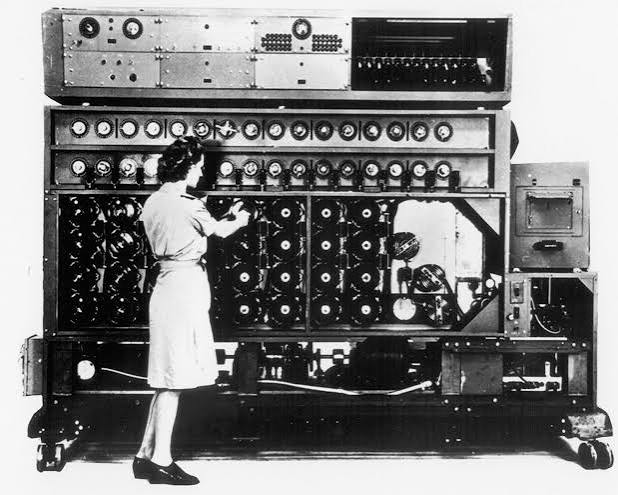
    The work was divided into specialized huts. Hut 6 handled Army and Air Force Enigma; Hut 8 tackled Naval Enigma. Alan Turing, a mathematician from Cambridge, led Hut 8 from 1940. Turing was not the stereotypical military officer. He cycled to work in a gas mask to avoid hay fever, chained his mug to a radiator to prevent theft, and sometimes wore his pajamas under his clothes. But his mind was razor-sharp. Along with Gordon Welchman, who ran Hut 6, Turing designed the Bombe, an electromechanical machine that improved on the Polish Bomba. The Bombe worked by testing possible rotor settings, using a technique called a “crib”—a guessed plaintext phrase that was likely to appear in a message, such as a weather report or “Heil Hitler.” By 1944, around 200 Bombes were humming in outbuildings across the UK, each one capable of testing thousands of combinations per second.

    Breaking the Codes

    The first sustained British breaks came in 1940, when Hut 6 began reading German Air Force Enigma traffic, codenamed “Dolphin.” This was a breakthrough, but the most critical target was the Navy. U-boats were strangling Britain’s supply lines, and the Battle of the Atlantic was a grim arithmetic of tonnage sunk versus ships built. In March 1941, Naval Enigma, codenamed “Shark,” was finally broken. The intelligence allowed convoys to be rerouted around wolfpacks, saving millions of tons of shipping. But the Germans were not static. In February 1942, they introduced a fourth rotor for the U-boat Enigma, plunging Bletchley Park into what was called the “Shark blackout.” For nearly a year, the codebreakers could not read the U-boats’ messages, and shipping losses spiked. It was not until December 1942 that the new rotor was broken, thanks to a combination of captured key material, traffic analysis, and the sheer persistence of women like Joan Clarke, a cryptanalyst in Hut 8 who had been hired despite the military’s initial reluctance to employ women in such roles.

    But Ultra was not just about breaking codes. Sometimes, even when messages could not be read, the mere volume and direction of radio traffic revealed German intentions. This was traffic analysis, and Gordon Welchman was its master. He developed the “diagonal board” for the Bombe, which allowed it to test more rotor combinations, and he pioneered the use of statistical methods to identify patterns in the intercepted traffic. Traffic analysis could reveal where a Panzer division was moving, even if the content of its orders remained encrypted.

    From Intelligence to Action

    Ultra was only useful if it reached the right people. The system that developed was elaborate and paranoid, for good reason. The Germans had to believe their codes were secure. If the Allies acted on Ultra intelligence in a way that revealed their source, the enemy would change their procedures, and the flow of information would dry up. So the intelligence was filtered through Special Liaison Units (SLUs) attached to Allied commanders. Only a handful of senior officers knew the full story; field commanders received sanitized reports, labeled “CX/MSS,” which did not reveal that they came from decrypted messages. The “Ultra rule” was simple: no operation could be launched or cancelled if doing so would tip off the enemy that their codes were broken. Sometimes, this meant allowing an attack to proceed or not acting on intelligence, even when it meant losses, to protect the secret.

    This rule was tested during the D-Day invasion. Ultra provided detailed intelligence on German troop dispositions, the location of Panzer divisions, and the enemy’s defensive plans. But the Allies could not always act on it immediately, for fear of compromising the source. For example, when Ultra revealed that the German 21st Panzer Division was moving toward the Normandy beaches on the afternoon of June 6, 1944, the Allied commanders had to weigh the risk of responding too quickly against the risk of losing the beachhead. In the end, they used sanitized reports and timing to mask the source, and the invasion succeeded. Ultra was a decisive advantage, but it was one that had to be wielded with care.

    The Debate Over the War’s Length

    How much shorter did Ultra make the war? This is a question that historians have argued about for decades. Sir Harry Hinsley, the official historian of British intelligence, estimated that Ultra shortened the war by two to four years. He pointed to the Battle of the Atlantic, where Ultra allowed convoys to avoid U-boats, and to the North Africa campaign, where Ultra intelligence helped Montgomery outmaneuver Rommel. Other historians, like David Kahn, are more cautious. They note that the Soviet Union did most of the fighting and dying on the Eastern Front, and that Allied industrial and military superiority were probably decisive in the long run. They argue that Ultra was a force multiplier, not a silver bullet.

    The truth is that Ultra was likely most decisive in the Atlantic. Without it, the U-boat campaign might have succeeded in cutting Britain’s supply lines, which would have made any invasion of Europe impossible. But even there, the advantage was not absolute. The Germans periodically changed their procedures, causing blackouts, and the balance of advantage shifted back and forth. The war’s outcome was probably not changed by Ultra—the Allies had the resources and the will to win—but the war’s length almost certainly was. Every month that the war was shortened meant fewer deaths, less destruction, and a faster return to peace.

    The Secret Kept

    After the war, the Ultra secret was buried. The codebreakers returned to their civilian lives, and many of them told no one, not even their spouses, what they had done. The equipment was dismantled, the files were classified, and the history of Bletchley Park was rewritten as a story of “operational research” or “administrative work.” The silence lasted for nearly 30 years. It was broken in 1974, when Group Captain F.W. Winterbotham, a former RAF intelligence officer, published The Ultra Secret. The book was a sensation, and it forced the British government to acknowledge what had happened. Slowly, the full story emerged: the Polish contribution, the role of Turing and Welchman, the thousands of women who worked in the huts, the sheer scale of the operation.

    Today, Bletchley Park is a museum, and the story of Ultra is celebrated as one of the great achievements of the war. But the lessons are not just historical. The codebreakers showed that when a group of brilliant, determined people are given a hard problem, not even a mathematical impossibility can stand in their way. They also showed the importance of secrecy, and the moral compromises that come with it. The Ultra rule, which sometimes meant sacrificing lives to protect the secret, is a reminder that intelligence is not a neutral tool. It has a cost, and that cost is often paid in human terms. But in the end, the secret was kept, and it helped win the war.

    The Ultra secret was one of the most closely guarded of the Second World War, and it remains one of the most consequential. It did not win the war by itself, but it shortened it, and in doing so, it saved lives that would otherwise have been lost. The codebreakers of Bletchley Park, from the genius of Turing to the diligence of the clerks, worked in obscurity and returned to obscurity, but their achievement is now part of the historical record. The war was a collective effort, and Ultra was one of its most effective weapons—a weapon made of mathematics, human ingenuity, and the will to win.

    Summary

    • Ultra was the codename for intelligence from breaking German Enigma communications, produced at Bletchley Park (Station X).
    • The work built on the earlier breakthroughs of Polish mathematicians, notably Marian Rejewski, who first cracked Enigma in 1932.
    • Key figures like Alan Turing and Gordon Welchman designed the Bombe, an electromechanical machine that accelerated codebreaking.
    • Ultra provided critical intelligence for the Battle of the Atlantic, the North Africa campaign, and D-Day, but its use was constrained by the need to protect the source.
    • Historians estimate Ultra shortened the war by 2-4 years, though the debate continues about its overall decisiveness.

    FAQ

    Q: What was the Enigma machine?
    A: The Enigma was a portable rotor cipher machine used by German military and intelligence services. It encrypted messages by scrambling letters through a series of rotors and a plugboard, with an enormous number of possible settings (around 10^23 for the three-rotor version), which the Germans believed made it unbreakable.

    Q: How did the Allies break Enigma?
    A: The Poles first broke Enigma in 1932, using mathematics and a mechanical device called the Bomba. They shared their work with the British and French in 1939. At Bletchley Park, Alan Turing and Gordon Welchman refined the Polish design to create the Bombe, which used “cribs” (guessed plaintext phrases) to test rotor settings rapidly.

    Q: Did Ultra actually shorten the war?
    A: Most historians agree it did, with estimates ranging from two to four years. Ultra was especially decisive in the Battle of the Atlantic, where it allowed convoys to avoid U-boat wolfpacks. However, some historians argue that Allied industrial and military superiority were more important in the long run.

    Q: Why was Ultra kept secret for so long?
    A: The British wanted to protect the source of the intelligence, and they also had a legal obligation to keep wartime secrets classified. Additionally, the techniques used in codebreaking, such as statistical analysis, were valuable for postwar intelligence work. The first public revelation came in 1974 with Winterbotham’s book The Ultra Secret.

    Q: What role did women play at Bletchley Park?
    A: Women made up about 75% of Bletchley Park’s workforce, around 9,000 to 10,000 people at its peak. They worked as codebreakers, like Joan Clarke in Hut 8, as well as in support roles such as operating Bombes, intercepting radio traffic, and translating messages. Their contributions were essential to the success of Ultra.

  • The OSS vs. the Gestapo: How America’s First Spies Took On Hitler’s Secret Police

    The OSS vs. the Gestapo: How America’s First Spies Took On Hitler’s Secret Police

    In the summer of 1942, a young American named John Doe parachuted into occupied France with forged papers and a mission to blow up a railway bridge. Within hours, he was being hunted by the Gestapo, whose agents had already turned the local café owner into an informant. Doe was one of the first operatives of the Office of Strategic Services (OSS), a brand-new agency that President Franklin D. Roosevelt had created just weeks earlier. The OSS was America’s first centralized intelligence service, and its agents were walking into a war against the most feared secret police in history.

    The Gestapo, Hitler’s secret state police, had a decade of experience in surveillance, infiltration, and brutal interrogation. By 1942, it had already crushed resistance movements across Europe. The OSS, by contrast, was a hastily assembled experiment staffed by Wall Street lawyers, academics, and Olympic athletes led by a Medal of Honor winner named William Donovan. What followed was a shadow war of radio games, double agents, and sabotage, fought in the back alleys of Paris and the mountains of Yugoslavia. This is the story of how a scrappy American upstart took on the Nazi terror machine and helped win a war.

    The Birth of an Agency

    Before World War II, the United States had no permanent foreign intelligence service. Information was scattered across the Army’s G-2, the Navy’s Office of Naval Intelligence, and the State Department, with little coordination. President Roosevelt was frustrated by the lack of actionable intelligence, especially as war loomed in Europe. In 1940, he sent a Wall Street lawyer and WWI hero, William “Wild Bill” Donovan, on a fact-finding trip to Britain. Donovan returned convinced that the U.S. needed a centralized, British-style intelligence organization one that could conduct espionage, sabotage, and psychological warfare.

    On June 13, 1942, Roosevelt signed the order creating the Office of Strategic Services, with Donovan as its director. The OSS was an experiment from the start. It recruited from unlikely places: professors from Ivy League universities, bankers, boxers, and even Hollywood set designers. At its peak, it employed around 13,000 people a fraction of the Gestapo’s 32,000 members, who were backed by an army of informants. The OSS was underfunded, understaffed, and often at odds with the military brass, but it had one thing going for it: Donovan’s willingness to take risks.

    The Gestapo’s Iron Grip

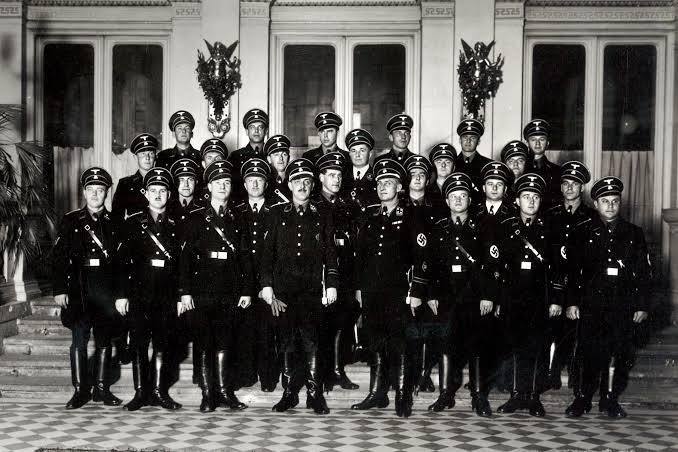
    The Gestapo, short for Geheime Staatspolizei, was Nazi Germany’s secret state police. Founded in 1933 by Hermann Göring, it was later taken over by Heinrich Himmler and folded into the Reich Security Main Office in 1939. The Gestapo’s power rested on surveillance, informants, and the legal authority to use “protective custody” imprisonment without trial. In occupied Europe, it was the hammer that crushed resistance networks. Its agents used torture, summary execution, and the Commando Order of 1942, which mandated the killing of captured saboteurs without trial.

    The Gestapo was everywhere. In France, it maintained a network of informants in every café, train station, and police precinct. It used radio direction-finding to track down clandestine transmitters. It ran double-agent operations that fed false intelligence to the Allies. One of its most infamous successes was the Englandspiel, a radio deception that led to the capture of dozens of Dutch agents. For any OSS operative, the Gestapo was the ever-present enemy, and capture almost always meant death.

    The Shadow War Begins

    OSS agents were dropped into this cauldron with minimal training. They carried forged papers, a pistol, and a cyanide pill. Their missions were simple in concept but deadly in practice: blow up bridges, arm the resistance, gather intelligence on enemy troop movements. In France, the OSS worked with the Maquis, supplying them with weapons and explosives. In Italy, they coordinated with partisans to sabotage German supply lines. In Yugoslavia, they supported both Chetniks and Partisans, trying to decide which side to back.

    The Gestapo, in turn, made hunting OSS agents a priority. They used informants to sniff out strangers in small towns. They set up roadblocks and checked papers. They tortured captured agents to extract names and locations. Many OSS operatives never made it back. Some were executed; others disappeared into concentration camps. Yet the OSS kept pushing, learning from each failure.

    The David vs. Goliath Dynamic

    The OSS was a David against a Goliath. The Gestapo had experience, resources, and a ruthlessness that knew no bounds. The OSS had improvisation and a willingness to break the rules. Donovan recruited academics who spoke multiple languages, athletes who could climb cliffs, and gamblers who could bluff their way past checkpoints. This unconventional approach often worked. OSS agents were trained in guerrilla warfare, and they developed tactics that the Gestapo found hard to counter, such as using local resistance fighters to ambush patrols.

    One key advantage was the OSS’s ability to adapt. When radio games backfired, it switched to more secure communication methods. When agents were captured, it changed codes and safe houses. The Gestapo, by contrast, relied on a rigid hierarchy and a culture of fear, which sometimes led to overconfidence. The OSS’s willingness to take risks—sometimes recklessly—paid off in the end.

    The Cost of the Conflict

    The war of spies came at a terrible cost. The OSS lost hundreds of agents in Europe, many of whom were never accounted for. The Gestapo’s brutal methods broke many under torture, but the OSS’s decentralized structure meant that capturing one agent rarely led to a network. By 1944, the OSS was operating effectively in France, Italy, and the Balkans, supporting the Allied advance. The Gestapo, meanwhile, was stretched thin, fighting a losing battle against the resistance and the Allied armies.

    When the war ended, the OSS was disbanded on October 1, 1945, just weeks after Japan’s surrender. President Truman, wary of a permanent intelligence agency, scattered its functions across the State and War Departments. But the lessons learned in the fight against the Gestapo were not forgotten. In 1947, Congress passed the National Security Act, creating the CIA—the OSS’s direct descendant. The Gestapo, declared a criminal organization at Nuremberg, was dissolved, and many of its leaders were executed or fled to South America. The conflict between the two agencies shaped the future of intelligence for decades.

    The OSS’s fight against the Gestapo was more than a military confrontation; it was a clash between two visions of power. The Gestapo represented totalitarian control, operating outside the law to enforce a brutal ideology. The OSS, for all its flaws, was an experiment in democratic espionage—not perfect, but accountable to a civilian government. The legacy of that experiment lives on in the CIA and in the very concept of American intelligence. The story of the OSS is a reminder that even the most powerful agencies start small, and that courage and improvisation can sometimes outmatch experience and terror.

    Summary

    • The OSS was the first U.S. centralized spy agency, created in 1942 by FDR and led by William “Wild Bill” Donovan.
    • The Gestapo was Nazi Germany’s secret police, a brutal force of 32,000 that targeted resistance and spies across occupied Europe.
    • The OSS operated in direct opposition to the Gestapo, using sabotage, espionage, and support for resistance movements.
    • The conflict was a David vs. Goliath struggle, with the OSS’s unconventional tactics eventually proving effective.
    • The OSS was disbanded after the war, but its legacy lives on in the CIA, while the Gestapo was condemned at Nuremberg.

    FAQ

    Q: What does OSS stand for?
    A: OSS stands for Office of Strategic Services, the United States’ first centralized intelligence agency, established in 1942.

    Q: Who led the OSS?
    A: William “Wild Bill” Donovan, a Medal of Honor recipient and Wall Street lawyer, led the OSS.

    Q: How was the OSS different from the CIA?
    A: The OSS was a wartime agency, disbanded in 1945, while the CIA was created in 1947 as a permanent peacetime agency.

    Q: What happened to captured OSS agents?
    A: Many were tortured and executed by the Gestapo, often under the Commando Order of 1942.

    Q: Did the OSS succeed in its missions?
    A: The OSS contributed to Allied victory by supporting resistance movements, gathering intelligence, and conducting sabotage, though it suffered heavy losses.

  • The Double-Cross System: How Britain Turned Nazi Spies into Its Greatest Weapon

    The Double-Cross System: How Britain Turned Nazi Spies into Its Greatest Weapon

    In the spring of 1944, as the Allies prepared for the invasion of Normandy, a Spanish double agent code-named Garbo sat in a London safe house, crafting a message that would help decide the fate of Europe. For years, he had been feeding the German Abwehr a stream of carefully fabricated intelligence from a network of fictitious sub-agents a network that existed only in his imagination. Now, on the eve of D-Day, his lies would convince Hitler that the real invasion was coming at Pas-de-Calais, not Normandy. The Germans trusted him so completely that they awarded him the Iron Cross. The British, for their part, gave him an MBE.

    Garbo was just one of dozens of Nazi agents who, after being captured or turning themselves in, became unwilling or sometimes willing allies of MI5. The Double-Cross System, as it was called (the Roman numeral XX, a pun on ‘double cross’), was a counter-espionage operation that flipped nearly every German spy sent to Britain during World War II. Of the roughly 115 to 120 agents dispatched by the Abwehr, all were captured or surrendered. None operated freely for any significant time. Instead, MI5 used them to feed false intelligence back to Germany, shaping the enemy’s strategic decisions and ultimately saving thousands of Allied lives.

    The Birth of a Deception

    Before the war, MI5 was a small, underfunded organization focused on domestic subversion Soviet espionage and Irish republicanism not on running double agents. It had little experience with such operations, and the idea of turning enemy spies into assets was untested. But the early war years forced a change.

    The turning point came in 1939 with a Welsh electrical engineer named Arthur Owens, code-named ‘Snow.’ Owens, a German agent, walked into MI5 and offered his services. He became the first major double agent, and his case proved that a captured or volunteer agent could be used to feed false information back to the Abwehr. Snow’s success led to a more systematic approach.

    In January 1941, the Twenty Committee was formally established to coordinate the growing number of double agents. Chaired by Sir John Masterman, a historian and MI5 officer, the committee met weekly. Its members included representatives from MI5, MI6, the armed services, and the Home Defence Executive. The committee’s name Twenty, or XX was a Roman numeral pun on ‘double cross.’ Its goal: to ensure that every double agent’s messages to Germany were carefully crafted to deceive the enemy, not inform them.

    The Agents: A Rogue’s Gallery

    The Double-Cross System relied on a colorful cast of characters, each with their own reasons for betraying their German handlers.

    Garbo (Juan Pujol García) was a Spanish double agent who invented an entire network of fictitious sub-agents. His misinformation helped convince the Germans that the D-Day landings at Normandy were a diversion. He was awarded both the Iron Cross (by Germany) and an MBE (by Britain).

    Zigzag (Eddie Chapman) was a British criminal and safecracker who volunteered to work for Germany, then turned himself in to MI5 upon returning to Britain. He was used to feed false intelligence about bombing damage, convincing the Germans that their V-1 and V-2 attacks were causing more destruction than they actually were.

    Tate (Wulf Schmidt) was a Danish agent who was captured and doubled. He maintained a consistent radio link with Germany for years, sending a steady stream of false reports that helped convince the Germans that British morale was low and that the country was on the brink of collapse.

    Mutt and Jeff (John Moe and Tor Glad) were two Norwegian agents who were doubled and used to convince Germany that Britain was preparing for an invasion of Norway part of Operation Fortitude North, the northern half of the D-Day deception.

    Tricycle (Duško Popov) was a Serbian playboy and lawyer who, while working as a double agent, alerted the FBI to German interest in Pearl Harbor. His warning was largely ignored, but his work for the British was invaluable.

    The Indispensable Partner: Bletchley Park

    The Double-Cross System could not have worked without the intelligence gleaned from Bletchley Park’s decryption of German Enigma traffic. Ultra, as it was called, allowed British intelligence to read Abwehr radio messages and verify what the Germans believed. This meant MI5 could confirm that their double agents were trusted, and calibrate the false information accordingly. Without Ultra, the Double-Cross System would have been flying blind.

    For example, when Garbo sent a message to Germany, the British could read the Abwehr’s response and see whether they bought his story. If they hesitated, MI5 could adjust the next message to reinforce their trust. This feedback loop made the deception nearly perfect.

    The Greatest Deception: Operation Fortitude

    The Double-Cross System’s crowning achievement was Operation Fortitude, the deception that preceded D-Day. The Allies needed to convince the Germans that the invasion would come at Pas-de-Calais, the closest point to England, rather than at Normandy. To do this, they created a fictional army—the First U.S. Army Group (FUSAG)—under General George S. Patton.

    Double agents, including Garbo, reported on the supposed movements of FUSAG, building a picture of an invasion force poised to strike at Calais. Garbo’s network of fictitious agents sent detailed reports—complete with sightings of troops, vehicles, and equipment—that the Germans found entirely credible. They even reported that the Normandy landings were a diversion, designed to draw forces away from the real invasion.

    Hitler fell for it. He kept German forces in the Pas-de-Calais region for weeks after the Normandy landings, convinced that the main attack was still coming. This delay gave the Allies a crucial advantage in establishing their beachhead and breaking out into France.

    The Legal and Moral Grey Zone

    The Double-Cross System operated in a legal grey area. Under the laws of war, captured enemy agents were liable to execution. By doubling them, MI5 spared their lives in exchange for cooperation. But not all agents cooperated. Some refused and were executed. Others were deemed too dangerous to keep alive, even after they had provided useful information. The British public was never told about the system during the war.

    The morality of using captured spies was debated at the time, but the results were undeniable. The system saved countless lives by reducing the effectiveness of German intelligence and enabling the success of D-Day.

    A Legacy of Success

    The Double-Cross System is widely regarded as one of the most successful deception operations in military history. It shaped German strategic assessments, misled them about Allied intentions, and contributed significantly to the Allied victory. The agents themselves, many of whom were criminals, traitors, or opportunists, became unlikely heroes of a war that demanded extraordinary measures.

    The Double-Cross System was a testament to the power of deception in warfare. By turning the enemy’s own spies against them, British intelligence not only neutralized the threat of German espionage but also used it as a weapon to win the war. The story of Garbo, Zigzag, Tate, and the others is a reminder that in war, truth is the first casualty—but sometimes, a well-crafted lie can save a nation.

    Summary

    • The Double-Cross System (XX System) was a British counter-espionage operation that flipped captured German agents into double agents, feeding false intelligence to the Abwehr.
    • Of the 115-120 German agents sent to Britain during WWII, all were captured or surrendered; about 40-50 were doubled.
    • Key agents included Garbo (Juan Pujol García), Zigzag (Eddie Chapman), Tate (Wulf Schmidt), Mutt and Jeff (Norwegian agents), and Tricycle (Duško Popov).
    • The Twenty Committee, chaired by Sir John Masterman, coordinated the operation, with crucial support from Bletchley Park’s Ultra decrypts.
    • The system played a central role in Operation Fortitude, convincing Hitler that D-Day would come at Pas-de-Calais, not Normandy, and aiding the Allied victory.

    FAQ

    Q: What was the Double-Cross System?
    A: The Double-Cross System (XX System) was a British intelligence operation during World War II that identified, captured, and ‘turned’ German agents in Britain, using them to feed false information back to Nazi Germany’s intelligence services.

    Q: How many German agents were doubled?
    A: Of the roughly 115-120 German agents sent to Britain, all were captured or turned themselves in. Approximately 40-50 were used for deception; the rest were executed or imprisoned.

    Q: Who was Garbo?
    A: Garbo was Juan Pujol García, a Spanish double agent who invented a fictitious network of sub-agents. His misinformation helped convince the Germans that the D-Day landings at Normandy were a diversion. He was awarded both the Iron Cross and an MBE.

    Q: How did Bletchley Park help the Double-Cross System?
    A: Bletchley Park’s decryption of German Enigma traffic (Ultra) allowed MI5 to read Abwehr messages, verify that their double agents were trusted, and calibrate false information accordingly.

    Q: What was Operation Fortitude?
    A: Operation Fortitude was the D-Day deception that convinced the Germans that the Allied invasion would land at Pas-de-Calais, not Normandy, using a fictional army (FUSAG) under General Patton. The Double-Cross System was central to this deception.

  • The Last Ration Book: How Britain’s Scraps Defined a Decade

    The Last Ration Book: How Britain’s Scraps Defined a Decade

    In January 1940, every household in Britain received a small buff-coloured book. Inside, pages of coupons promised a weekly allowance of bacon, butter, and sugar. No one knew then that the last coupon would not be torn out until 4 July 1954 nine years after the war in Europe ended.

    This is the story of those fourteen years, when a nation of 48 million learned to measure its life in ounces. It is a story of grey bread, dried eggs, and a vegetable pie named after a politician. But it is also a story of how scarcity, managed with ruthless fairness, reshaped what it meant to be British.

    The Fair Shares Principle

    When the Second World War began, Britain imported about 70% of its food. German U-boats quickly targeted those supply lines, sinking roughly 2,000 British merchant ships between 1939 and 1945. By 1943, imports had collapsed to 30%.

    Memories of the First World War haunted the government. Food riots and profiteering had damaged morale then. So, in 1939, the Ministry of Food was created with a single mission: make sure shortages did not lead to hoarding or class resentment. The solution was rationing, introduced on 8 January 1940 for bacon, butter, and sugar. Within two years, most foodstuffs were rationed.

    Every man, woman, and child received a colour-coded ration book: buff for adults, green for pregnant women and children, blue for under-fives. Registration was compulsory. You picked a grocer, a butcher, and a milkman, and you bought only from them. The system tracked every purchase, and inspectors could check your book against the shop’s records.

    The Weekly Allowance

    At the peak of rationing in 1942–43, an adult’s weekly allowance was stark:

    • Meat: about 450g of cheap cuts, often bone-in
    • Bacon or ham: 113g
    • Butter: 57g
    • Margarine: 113g
    • Sugar: 227g
    • Cheese: 57g (occasionally 113g)
    • Tea: 57g
    • Eggs: one fresh egg plus dried egg powder equivalent to about one egg per fortnight
    • Sweets: 113g
    • Milk: 1.7 litres, with more for children and expectant mothers

    These numbers meant constant arithmetic. A slice of bread and scrape of butter was a meal. A single egg was a luxury, stretched across a family breakfast.

    The government did not simply ration — it dictated what you could eat. The National Loaf, introduced in 1942, was mandatory. Made from high-extraction wholemeal flour, it was grey, dense, and widely hated. Yet it was nutritionally superior to white bread, and the Ministry of Food did not care that it tasted like cardboard.

    The Points System and the Black Market

    Canned goods, dried fruit, cereals, and biscuits were not part of the basic ration. Instead, from December 1941, a points system allowed some choice. Each person received a set number of points per month, and every non-perishable item had a points price. This flexibility prevented panic buying and let families save up for a treat.

    But scarcity bred temptation. The black market flourished. Contemporary estimates suggested it turned over £100–£200 million a year, though figures remain vague. Under-the-counter sales, coupon fraud, and theft from supply chains were common. “Spivs” — flashy men in wide-lapelled coats — sold nylons, cigarettes, and petrol on street corners.

    Ministry of Food inspectors pursued offenders with zeal. Fines and prison sentences were handed out. Yet the public’s attitude was complicated. Many saw the black market as a necessary evil, a way to feed a family or celebrate a wedding. The spiv became a folk anti-hero, a symbol of post-war cynicism.

    Digging for Victory

    The Ministry of Food did more than restrict. It also produced, with a propaganda machine that would make a modern PR firm blush. The “Dig for Victory” campaign launched in October 1939. By 1943, 1.4 million allotments were in use, producing about 10% of Britain’s food.

    Cartoon characters pushed the message. Dr. Carrot promised better night vision. Potato Pete sang the praises of the humble spud. The Ministry published recipes for Woolton Pie — a vegetable pie named after Minister of Food Lord Woolton, with a pastry or potato crust. It was designed to stretch scarce meat and cheese, and it became a symbol of make-do cooking.

    Lord Woolton himself, a former businessman, was the public face of austerity. His name attached to pies, bread, and an ethos of “making do.” He also oversaw British Restaurants — communal canteens serving cheap, nutritious meals. By 1943, there were more than 2,000 of them across the country.

    The Paradox of Post-War Austerity

    The war ended in May 1945, but rationing did not. In fact, it got worse. Lend-Lease was abruptly terminated in August 1945, leaving Britain bankrupt. A $3.75 billion US loan arrived in 1946, but with strings: sterling had to be convertible, which triggered a financial crisis in 1947.

    Bread, which had never been rationed during the war, was rationed in July 1946. Potatoes followed in 1947–48 after a brutal winter and harvest failure. The Attlee Labour government chose austerity deliberately, prioritising exports and rebuilding industry over domestic consumption.

    This was the “Age of Austerity” — a period that stretched until 1954. It included the 1947 austerity budget, the 1949 devaluation of the pound, and even the 1951 Festival of Britain, which was meant to look forward but could not escape the grey reality of the present.

    The End of the Line

    Rationing ended piecemeal. Tea came off in 1952. Sugar and sweets followed in 1953. But the final item was meat, which came off ration on 4 July 1954. Housewives queued at butchers that morning, and newspapers ran photos of people buying unrestricted chops.

    For nearly a decade after VE Day, Britons had lived on scraps. The ration book had been a constant companion — a small, dog-eared object that decided what was for dinner. When it was finally put away, something else went with it. The memory of queuing, of counting ounces, of making Woolton Pie from whatever the garden produced, stayed with a generation.

    The nutrition policy left a quieter legacy. Free milk, orange juice, and cod liver oil for children and pregnant women meant that, by some measures, the poorest Britons ate better during rationing than before the war. The fair shares principle had been a moral experiment, and it had worked — at a cost no one wanted to pay again.

    The ration book is a museum piece now, but its shadow lingers. It taught Britons to measure value in ounces, to distrust waste, and to believe that fairness could be administered from a government office. When the last coupon was torn on 4 July 1954, it was not just the end of austerity. It was the end of a shared national experiment in how to survive on less — and the beginning of a new era of plenty that no one quite trusted.

    Summary

    • Rationing began in January 1940 with bacon, butter, and sugar, and expanded until most food was rationed by 1942.
    • The weekly adult ration at its peak included 113g of bacon, 57g of butter, and one fresh egg — plus dried egg powder.
    • The National Loaf, dried egg, and Spam became iconic foods of the era, while the black market thrived despite enforcement.
    • Post-war austerity continued after 1945, with bread rationed in 1946 and meat rationing ending only on 4 July 1954.
    • The government’s nutrition policy — free milk, orange juice, and cod liver oil for children — improved health for many despite scarcity.

    FAQ

    Q: When did rationing start in Britain?
    A: Rationing began on 8 January 1940, with bacon, butter, and sugar. It expanded to most foodstuffs by 1942, and clothes rationing started in June 1941.

    Q: What was the weekly ration per adult at its peak?
    A: At the peak in 1942–43, an adult received about 113g of bacon or ham, 57g of butter, 113g of margarine, 227g of sugar, 57g of cheese, 57g of tea, one fresh egg, and 1.7 litres of milk, plus points for canned goods.

    Q: Why was bread rationed after the war?
    A: Bread was rationed in July 1946 because Britain was bankrupt after Lend-Lease ended, and the government prioritised exports over domestic consumption. It lasted until July 1948.

    Q: What was the black market like?
    A: The black market in rationed goods was significant, with contemporary estimates of £100–£200 million annually. Offences included under-the-counter sales and coupon fraud, punished by fines and imprisonment, but many saw it as a necessary evil.

    Q: Did rationing have any positive effects?
    A: Yes, the government used rationing to improve nutrition. Free milk, orange juice, and cod liver oil for children and pregnant women, plus the wholemeal National Loaf, meant many poorer Britons ate better than before the war.

  • The Arctic Convoys: The Deadliest Supply Route to the Soviet Union

    The Arctic Convoys: The Deadliest Supply Route to the Soviet Union

    These dangerous Arctic convoys saved Russia during World War II

    In the summer of 1941, as German forces surged into the Soviet Union, a new kind of naval operation was born. The Arctic convoys slow, vulnerable columns of merchant ships began threading their way through the icy waters north of Norway, carrying tanks, aircraft, and fuel to the beleaguered Red Army. The route was the shortest sea link between the Western Allies and the Soviet Union, but it was also the most lethal. Over the next four years, these convoys would become a crucible of courage and catastrophe, claiming the lives of thousands of seamen and testing the limits of Allied endurance.

    This is the story of how a few hundred merchant ships, escorted by the Royal Navy, braved polar darkness, German battleships, and relentless air attacks to keep the Soviet Union in the war and at what cost.

    A Route Carved by War

    The Arctic convoys began in August 1941, just two months after Germany invaded the Soviet Union. The first convoy, codenamed Dervish, sailed from Iceland to Arkhangelsk with a modest cargo of raw materials and aircraft. It was a test run, and it succeeded. But the stakes were immense. The Soviet Union was reeling from Operation Barbarossa, losing men and territory at a staggering rate. Stalin demanded supplies tanks, planes, guns, food and the Western Allies, still reeling from their own setbacks, had to find a way to deliver them.

    The shortest sea route ran from Iceland, around the North Cape of Norway, and into the Barents Sea to the ports of Murmansk and Arkhangelsk. It was a passage of extraordinary danger. In winter, the polar night plunged the region into total darkness for months, with temperatures dropping to -40°F and storms that could capsize a ship. In summer, the midnight sun meant 24-hour daylight, offering German aircraft and U-boats no respite. Sea spray froze on decks and guns, and ice accretion could make a ship top-heavy and roll it over.

    Yet the route was also a strategic necessity. The alternative the Persian Corridor or the Pacific route was longer and less direct, and the Soviet Union was in desperate need. So the convoys sailed, and the losses began to mount.

    The Ordeal of PQ-17

    The most infamous convoy of the war was PQ-17, which sailed from Iceland in late June 1942. It consisted of 35 merchant ships, escorted by a close escort of destroyers and corvettes, with a distant covering force of cruisers and battleships to guard against German surface raiders. Among the German threats was the battleship Tirpitz, a massive and feared vessel that lurked in Norwegian fjords.

    On July 4, 1942, the Admiralty received intelligence that Tirpitz had sortied. Fearing that the convoy would be annihilated, First Sea Lord Dudley Pound made a controversial decision: he ordered the convoy to scatter, dispersing the merchant ships so that the covering force could engage the German ships. But the intelligence was wrong—Tirpitz had not sailed, and the convoy was left without protection.

    The result was a massacre. German U-boats and aircraft attacked the scattered ships, sinking 24 of 35 merchant vessels. More than 150 seamen died, and thousands of tons of tanks and aircraft went to the bottom of the Barents Sea. The decision to scatter remains one of the most debated command choices of the war, and it highlighted the brutal calculus of the Arctic convoys: sometimes, the risk of losing the cargo was deemed worse than the risk of losing the men.

    Endurance and Valor: PQ-18 and the Battle of the Barents Sea

    Despite the disaster of PQ-17, the convoys resumed. Convoy PQ-18, in September 1942, was the largest yet, with 40 merchant ships. It faced a determined German assault from aircraft and U-boats, losing 13 ships, but it delivered vital cargo to Arkhangelsk. The escorting aircraft carrier HMS Avenger provided air cover, a lesson learned from PQ-17’s losses.

    The most dramatic surface engagement came in December 1942, when a German force led by the heavy cruiser Admiral Hipper and the pocket battleship Lützow attacked convoy JW-51B in the Barents Sea. The escort, commanded by Captain Robert Sherbrooke in the destroyer HMS Onslow, fought a brilliant defensive action. Despite being outgunned and outmatched, the destroyers laid smoke screens and launched torpedo attacks, forcing the German ships to withdraw. Rear Admiral Robert Burnett’s cruisers arrived to drive them off. The battle was a strategic humiliation for the Kriegsmarine—a convoy had been saved, and Hitler, furious, threatened to scrap the entire surface fleet.

    The Toll and the Forgotten

    The Arctic convoys continued until the end of the war, but they exacted a terrible price. Roughly 85 merchant ships and 16 Royal Navy warships were sunk, and over 3,000 British and Allied seamen lost their lives. The merchant crews—many of them civilian volunteers from Britain, the United States, Norway, and the Soviet Union—suffered the highest casualty rates of any Allied service branch. They endured freezing cold, constant danger, and the psychological strain of knowing that every voyage could be their last.

    Yet their sacrifice was often overlooked. After the war, the Soviet Union became an adversary, and the Arctic convoys were relegated to a footnote in the larger narrative of the Second World War. Many veterans returned to civilian life with no recognition, suffering from frostbite, trauma, and the indifference of a world eager to move on.

    A Legacy of Courage

    The Arctic convoys delivered roughly 4 million tons of cargo to the Soviet Union, including about 5,000 tanks, 7,000 aircraft, and 14,000 vehicles. This material helped sustain the Red Army during the darkest days of the war, but the cost was immense. The convoys were a testament to the endurance of ordinary men in extraordinary circumstances—men who faced not only the enemy but also the brutal indifference of the Arctic itself.

    Today, their story is remembered in museums and memorials, and in the words of veterans who finally received recognition in their later years. The Arctic convoys remain a stark reminder of the price of alliance and the courage of those who sailed into the frozen unknown.

    The Arctic convoys were more than a supply route; they were a lifeline that helped turn the tide on the Eastern Front. They were also a human tragedy of staggering proportions, where ordinary sailors faced extraordinary perils. Their story is one of courage, sacrifice, and the enduring bond between allies—even as the cold war that followed threatened to erase it. The men who sailed those icy waters deserve to be remembered not just as statistics, but as heroes who braved the worst that war and nature could throw at them.

    Summary

    • The Arctic convoys (1941–1945) delivered ~4 million tons of supplies to the Soviet Union, including ~5,000 tanks and ~7,000 aircraft.
    • The route was the most dangerous of the war, with polar night, midnight sun, and constant German attacks.
    • Convoy PQ-17 lost 24 of 35 ships after an order to scatter based on false intelligence.
    • The Battle of the Barents Sea (December 1942) saw a German surface force repelled, saving convoy JW-51B.
    • Over 3,000 Allied seamen died, and many survivors faced post-war neglect.

    FAQ

    Q: How many ships were lost on the Arctic convoys?
    A: Approximately 85 merchant ships and 16 Royal Navy warships were sunk during the Arctic convoys.

    Q: What was the most infamous convoy?
    A: Convoy PQ-17, which was ordered to scatter in July 1942 after a false fear of the German battleship Tirpitz, resulting in the loss of 24 of 35 merchant ships.

    Q: Why were the convoys so dangerous?
    A: The route passed within range of German air and naval forces in Norway, and the environment itself was lethal—polar darkness in winter, 24-hour daylight in summer, extreme cold, and ice accretion that could capsize ships.

    Q: What role did the Soviet Union play in the convoys?
    A: The Soviets provided local escort and port facilities, but did not commit major naval forces to protect the convoys at sea. Stalin repeatedly demanded faster deliveries, often downplaying the risks.

    Q: What was the outcome of the Battle of the Barents Sea?
    A: In December 1942, a German surface force attacked convoy JW-51B but was repelled by escorting destroyers, a strategic humiliation for the Kriegsmarine that led Hitler to threaten to scrap the surface fleet.

  • The Swiss Watch: How Neutrality Became an Intelligence Lifeline

    The Swiss Watch: How Neutrality Became an Intelligence Lifeline

    In 1942, a tall American walked into the Hotel Bellevue in Bern, Switzerland, carrying a briefcase of diplomatic cables and a cover story that would hold for three years. Allen Dulles, the OSS station chief, was not just another diplomat. He was the tip of an intelligence spear that relied on a simple, centuries-old Swiss invention: the watch.

    Switzerland’s watch industry, born in the 16th century and industrialized in the Jura Mountains, had become the world’s primary source of precision timepieces. But those watches were more than just instruments of time. They were the backbone of a neutral infrastructure that allowed spies, couriers, and money to move across a continent at war. This is the story of how Swiss neutrality, forged in 1815, became a lifeline for intelligence operations.

    The Neutrality That Made It Possible

    Switzerland’s neutrality was not passive. It was armed, defended by a citizen militia that made invasion costly. The Congress of Vienna in 1815 formalized this status, and the Treaty of Paris reaffirmed it. Geographically, Switzerland sat at the crossroads of Europe, bordered by Germany, France, Italy, and Austria. This position made it a natural listening post, a place where spies could meet, and a transit point for goods and information.

    The Hague Conventions permitted trade in civilian goods, even during wartime. Watches were civilian goods, though they had obvious military applications. Navigation, artillery timing, and aviation coordination all demanded precision timekeeping. Swiss watchmakers, with their decentralized network of workshops in the Jura, produced watches that were the most accurate in the world. Both Allied and Axis powers needed them.

    The Watch Industry as Cover

    The Swiss watch industry was not a single factory but a dense web of small workshops, each making a component. This decentralization made it nearly impossible for any power to control or disrupt the supply chain. It also created a perfect cover for intelligence operations. The constant movement of goods and personnel watch components, finished watches, salesmen, and couriers was normal. Swiss watch brands had agents and retailers worldwide, providing a legitimate network of contacts, shipments, and financial transactions.

    Intelligence agencies piggybacked on this network. A courier carrying a diplomatic pouch could easily pass as a watch salesman. A dead drop could be hidden in a shipment of watch movements. The sheer volume of traffic made surveillance difficult.

    Espionage in the Heart of Europe

    During World War II, Switzerland was a hive of espionage. The OSS operated out of Bern, with Allen Dulles as station chief. Dulles worked openly under diplomatic cover, using Swiss neutrality as a base for operations into Nazi Germany and occupied Europe. His network included contacts in the German resistance, including the plotters of Operation Valkyrie.

    The Germans were also active. The Abwehr and SD ran operations from Swiss cities. Both sides used Switzerland as a meeting ground, a place where spies could talk without fear of immediate arrest.

    One of the most remarkable operations was the Lucy Ring, a Soviet spy network run by Rudolf Roessler, a German émigré. Roessler used Swiss-based couriers and communications to transmit German military secrets to Moscow. The information was so sensitive that it often arrived within hours of being decided in Berlin.

    The Financial Complement

    Swiss banking secrecy, codified in the 1934 Banking Act, complemented the watch trade. Both industries formed what intelligence services called a “neutral infrastructure.” Banks allowed spies to move and store funds discreetly. Watches provided cover. Together, they made Switzerland an indispensable hub.

    In 1945, Operation Sunrise brought the war in Italy to an early end. Secret surrender negotiations between Allied forces and German commanders were facilitated through Swiss intermediaries in Lugano and Bern. The watch industry, with its reputation for precision and discretion, was the perfect metaphor for the operation.

    The Cold War and Beyond

    After 1945, Swiss neutrality continued to serve as a listening post. The CIA, the KGB, and other agencies used Geneva, Zurich, and Bern for meetings, dead drops, and signals intelligence. The Geneva Summit tradition, from 1955 to 1985, reflected Switzerland’s role as a neutral meeting ground.

    The watch industry remained a multi-billion-dollar export business, but the “watch as cover” became largely historical. Intelligence operations shifted to electronic surveillance and financial intrigue.

    In 2022, Switzerland faced a new challenge. When Western nations imposed sanctions on Russia, Switzerland agreed to adopt them, breaking with strict neutrality. The move highlighted the tension between neutrality and the demands of the West. The watch industry, once a lifeline for intelligence, now faces a world where neutrality itself is under pressure.

    The Swiss watch was never just a timepiece. It was a tool of statecraft, a cover for spies, and a symbol of a neutrality that made intelligence operations possible. From the Jura workshops to the banks of Geneva, Switzerland’s neutral infrastructure served as a lifeline for secrets in a world at war. Today, as neutrality is tested anew, the legacy of the watch endures—a reminder that precision and discretion can be powerful allies.

    Summary

    • Switzerland’s armed neutrality, formalized in 1815, made it a safe haven for spies and a crossroads for intelligence during both World Wars.
    • The Swiss watch industry, with its decentralized workshops and global distribution, provided perfect cover for couriers, dead drops, and clandestine communications.
    • Swiss banking secrecy complemented the watch trade, forming a “neutral infrastructure” that intelligence agencies exploited.
    • Key operations like Allen Dulles’s OSS network, the Lucy Ring, and Operation Sunrise all relied on Swiss soil and Swiss discretion.
    • The 2022 sanctions on Russia highlight the modern tension between neutrality and Western pressure, as the era of the watch as cover fades into history.

    FAQ

    Q: How did Swiss neutrality help intelligence operations during WWII?
    A: Switzerland’s armed neutrality, recognized by international law, allowed it to trade with all belligerents. Its geographic position at the heart of Europe made it a natural meeting point for spies, and its diplomatic presence in Bern provided cover for intelligence officers like Allen Dulles.

    Q: Why were Swiss watches so valuable for military purposes?
    A: Swiss watches were the most accurate timepieces available. Military coordination, naval navigation, and artillery timing all depended on precise timekeeping, making Swiss exports strategically essential to both Allied and Axis powers.

    Q: What role did the watch industry play as cover for spies?
    A: The industry was decentralized, with hundreds of small workshops in the Jura Mountains. The constant movement of components, finished watches, and salesmen created a legitimate cover for couriers and dead drops. Global distribution networks offered a ready-made infrastructure for intelligence operations.

    Q: How did Swiss banking secrecy complement the watch trade?
    A: The 1934 Banking Act codified banking secrecy, allowing intelligence agencies to move and store funds discreetly. Together with the watch trade, it formed a “neutral infrastructure” that both Allied and Axis powers exploited.

    Q: Is the watch industry still used as cover today?
    A: Largely historical. Modern intelligence relies on electronic surveillance and financial networks. However, Switzerland remains a meeting ground for diplomats and spies, and the 2022 sanctions on Russia show the ongoing tension between neutrality and Western demands.

  • The T-34 Tank: How Soviet Engineering Outmatched the German Panzer

    The T-34 Tank: How Soviet Engineering Outmatched the German Panzer

    In the summer of 1941, German panzer crews advancing through the Ukrainian steppes encountered a sight that unsettled even the most battle-hardened veterans. A squat, green tank, its armor angled like a diamond, shrugged off shells that should have killed it and kept coming. This was the T-34, a machine that would redefine armored warfare and help turn the tide on the Eastern Front.

    The T-34 was not the most powerful tank of World War II, nor the most heavily armored. But it was the right tank at the right time a synthesis of mobility, protection, and firepower that could be produced in staggering numbers. Against the technically impressive but often over-engineered German panzers, the T-34’s simplicity and ruggedness proved decisive.

    The Shock of 1941

    When Germany launched Operation Barbarossa in June 1941, its intelligence estimated the Soviet Union had about 10,000 tanks. In reality, the Red Army possessed over 23,000, including roughly 1,000 T-34s and KV-1 heavy tanks. These new Soviet tanks were a revelation. The T-34’s 45mm of sloped armor, angled at 60 degrees, provided the equivalent of 90mm of vertical protection enough to resist the standard German anti-tank guns of the time. German infantry anti-tank rounds bounced off, earning the T-34 the nickname “the invincible tank” among bewildered soldiers.

    The T-34’s 76.2mm gun could penetrate the armor of any German tank in 1941, including the Panzer III and IV. Its wide tracks and powerful diesel engine allowed it to traverse mud and snow that bogged down German vehicles. The psychological impact was immediate. German officers reported “T-34 shock” (T-34-Schreck), a term that captured the demoralizing effect of encountering a tank that seemed to outclass their own.

    Yet the T-34 was far from perfect. Early models lacked radios, forcing crews to communicate with flags. The two-man turret meant the commander had to load the gun, a serious tactical disadvantage. Poor optics made target acquisition difficult. These weaknesses, combined with poorly trained crews and disastrous Soviet tactics, resulted in horrific losses. In 1941, the Red Army lost thousands of tanks, often to mechanical breakdown or fuel shortage as much as to enemy fire.

    The Design That Changed the War

    The T-34’s design was the work of Mikhail Koshkin, an engineer at the Kharkiv Locomotive Factory. Koshkin and his team combined several innovative ideas into a single, coherent package. The Christie suspension, licensed from American designer J. Walter Christie, gave the T-34 outstanding cross-country mobility. The sloped armor, though not new, was applied more effectively than in any previous tank. The V-2 diesel engine, a 12-cylinder powerplant producing 500 horsepower, offered a range of 400 kilometers on roads double that of most German tanks—and was less likely to catch fire than gasoline engines.

    Perhaps most importantly, the T-34 was designed for mass production. Its hull was cast and welded from simple, flat armor plates. The engine was robust and easy to maintain. When German forces threatened Kharkiv in late 1941, entire factories were dismantled and moved east of the Ural Mountains. Workers in Chelyabinsk, Nizhny Tagil, and Omsk resumed production within months, often working in unheated buildings in subzero temperatures. This logistical miracle meant that Soviet factories could churn out T-34s faster than the Germans could destroy them.

    In 1942, Soviet industry produced approximately 24,000 T-34s. German tank production for all types that year was about 9,300. This disparity was the core of the T-34’s strategic impact. The Wehrmacht could win battles, but it could not survive a war of attrition. The T-34 was cheap, reliable, and available in numbers that overwhelmed German defenses.

    The T-34 vs. the Panzer

    German tanks were, in many ways, superior on a one-on-one basis. The Panzer III and IV were well-armed and well-protected for their time, and by 1943, the introduction of the Tiger I and Panther raised the bar further. The Tiger’s 88mm gun could destroy a T-34 at ranges beyond 2,000 meters, while its 100mm frontal armor was nearly impenetrable to the T-34’s 76mm gun. The Panther, with its long 75mm cannon and sloped armor, was arguably the best tank of the war in terms of firepower and protection.

    But these tanks were expensive and complex. The Tiger weighed 57 tons, consumed vast amounts of fuel, and required extensive maintenance. Production of the Tiger never exceeded 1,347 units total. The Panther, though more numerous at about 6,000 units, suffered from mechanical breakdowns and engine fires. German tanks were also built to a high standard, which meant they took longer to produce and were harder to repair in the field.

    The T-34, by contrast, was a study in pragmatism. It was less comfortable, less accurate, and less survivable in a direct duel. But it was available. When a German tank was knocked out, it stayed knocked out. When a T-34 was destroyed, another was often already rolling off the production line. Soviet losses in 1941–42 were staggering—some estimates put the ratio at 4:1 or worse but the Red Army could absorb those losses. The Wehrmacht could not.

    The T-34/85: Restoring the Balance

    By 1943, the appearance of the Tiger and Panther rendered the T-34’s 76mm gun obsolete. The Soviet response was the T-34/85, which mounted an 85mm gun derived from an anti-aircraft weapon. The new turret, larger and with a three-man crew, allowed the commander to focus on commanding rather than loading. The 85mm gun could penetrate the Tiger’s frontal armor at combat ranges, though the Tiger retained an advantage at long distances.

    The T-34/85 entered production in late 1943 and quickly became the standard Soviet tank. It retained the same hull and engine as its predecessor, so production lines were not disrupted. By 1945, it was the most numerous tank in the Red Army, and it continued to serve in Soviet and allied armies for decades after the war.

    The T-34’s influence extended far beyond World War II. Its design principles—sloped armor, diesel engine, Christie suspension—were adopted by post-war Soviet tanks like the T-54/55, which became the most-produced tank in history. Western designers also took note; the British Centurion and the German Leopard 1 incorporated lessons learned from the T-34’s success.

    The Human Cost

    Behind the statistics of production and loss are the men who crewed these machines. Soviet tank crews were often rushed through training, sometimes in just a few weeks. In the chaotic early years, many went into battle with little more than a basic understanding of their vehicle. The lack of radios meant that coordinated attacks were nearly impossible. The two-man turret of the T-34/76 forced the commander to double as loader, slowing the rate of fire and distracting him from observing the battlefield.

    Despite these handicaps, skilled crews achieved remarkable results. Dmitry Lavrinenko, the top Soviet tank ace, destroyed 58 German tanks in a T-34 before his death in 1941. Aleksandr Burda, another ace, used the T-34’s mobility to outmaneuver and destroy enemy armor. These men proved that in the right hands, the T-34 could match any tank in the world.

    But the cost was immense. Soviet tank crews suffered casualties that dwarfed those of their German counterparts, especially in the first two years of the war. The T-34’s armor, while effective against early German guns, was vulnerable to the Tiger’s 88mm and the Panther’s long 75mm. Crews had little protection if the tank caught fire; the ammunition stowage was poorly protected, and the diesel fuel, while less flammable than gasoline, could still ignite.

    The Verdict

    Was the T-34 truly superior to the German panzer? The answer depends on the measure. In a duel between individual vehicles, a Tiger or Panther would usually win. But war is not fought by individual vehicles; it is fought by armies, economies, and industrial capacities. The T-34 was designed not to win every engagement but to win the war. It was simple enough to be built by thousands of semi-skilled workers, reliable enough to operate in the brutal conditions of the Eastern Front, and cheap enough to be mass-produced. That combination proved decisive.

    The T-34’s legacy is not one of technological brilliance but of pragmatic engineering. It was a tank that could be built in the snow, driven by a farmer turned soldier, and repaired with basic tools. It was a tank that, in the hands of a determined crew, could outfight and outlast the finest panzers Germany could produce. And it was a tank that, in the end, helped win the largest land war in history.

    The T-34 was not the most sophisticated tank of World War II, but it was the most effective. Its design philosophy—simplicity, reliability, and mass production—outmatched the German approach of building smaller numbers of highly advanced machines. The T-34’s story is a reminder that in war, victory often goes not to the most brilliant weapon, but to the one that can be produced in the greatest numbers and used by ordinary soldiers to achieve extraordinary results.

    Summary

    • The T-34 combined sloped armor, a diesel engine, and Christie suspension into a design that was both mobile and well-protected for its era.
    • German intelligence underestimated Soviet tank numbers by more than half, leading to the “T-34 shock” in 1941.
    • Soviet factories produced about 24,000 T-34s in 1942 alone, while German tank production was only about 9,300 units.
    • The T-34/85, introduced in 1943, restored parity against the Tiger and Panther with its 85mm gun.
    • The T-34’s legacy influenced post-war tank design worldwide, including the T-54/55 and Western tanks like the Leopard 1.

    FAQ

    Q: Was the T-34 better than the German Tiger and Panther tanks?
    A: In a one-on-one duel, the Tiger or Panther usually had the advantage in firepower and armor. However, the T-34 was produced in much larger numbers, was more reliable, and was easier to maintain, which gave the Soviet Union a strategic advantage that outweighed individual tank superiority.

    Q: How many T-34 tanks were built?
    A: Over 84,000 T-34s were produced in all variants from 1940 to 1958, making it the second-most-produced tank in history after the T-54/55.

    Q: What made the T-34’s armor so effective?
    A: The T-34’s 45mm armor was sloped at a 60-degree angle, which increased its effective thickness to about 90mm. This slope also caused incoming shells to deflect, especially when combined with the tank’s speed and maneuverability.

    Q: Why did Soviet tank crews suffer such high casualties?
    A: Early T-34s lacked radios, had poor optics, and used a two-man turret, which made coordination and situational awareness difficult. Additionally, many crews were rushed through training, and the tank’s ammunition storage was not well protected, leading to catastrophic fires when hit.

    Q: What was the “T-34 shock”?
    A: “T-34 shock” (T-34-Schreck) was a term used by German forces to describe the psychological impact of encountering the T-34 in 1941. German anti-tank guns and tank guns often failed to penetrate its armor, while the T-34’s gun could destroy German tanks with ease, demoralizing crews and commanders.

  • The Flying Fortress: How the B-17 Redefined Strategic Bombing

    The Flying Fortress: How the B-17 Redefined Strategic Bombing

    On August 17, 1942, twelve B-17Es of the 97th Bomb Group lifted off from an English airfield, their target a rail yard in Rouen, France. It was the first combat mission for the US Army Air Forces in Europe, and it embodied a theory that had been two decades in the making: that a heavily armed bomber, flying high and in tight formation, could fight its way to a target and back without fighter escort.

    The B-17’s story is one of that theory’s rise, its brutal testing, and its eventual vindication though not in the way its designers had imagined. By the war’s end, 12,731 B-17s had rolled off assembly lines, and the aircraft had become the backbone of the American daylight bombing campaign. But the Fortress’s success came at a staggering human cost, and its ultimate effectiveness depended on a fighter it was originally built to make unnecessary.

    The Birth of an Idea

    In 1935, a Boeing prototype called the Model 299 took to the air for the first time. It was a four-engine behemoth, bristling with machine guns and capable of flying higher than any pursuit plane of its era. A reporter for the Seattle Daily Times, Richard Williams, took one look and dubbed it a “flying fortress.” Boeing knew a good name when it heard one and trademarked it.

    The B-17 was the physical embodiment of an interwar doctrine that had been brewing in the minds of airpower theorists like Giulio Douhet and Billy Mitchell. They argued that a bomber force, flying in formation, could generate enough overlapping defensive fire to make interception suicidal. With the Norden bombsight, they could place bombs on a pickle barrel from 20,000 feet. High altitude, long range, heavy guns the B-17 had all of it. The Air Corps bought the vision, ordering 13 YB-17s for testing in 1936 and ramping up mass production by 1938.

    There was just one problem: the theory had never been tested in combat. The B-17’s first real test would come over Europe, and it would nearly break the bomber force.

    The B-17’s Best Defense: Its Own Ruggedness

    The Fortress was built to take punishment. Its turbo-supercharged engines allowed it to cruise at 35,600 feet, far above most flak and enemy fighters. Its defensive armament, especially on the B-17G with 13 .50-caliber machine guns, made it a formidable target. But the aircraft’s real claim to fame was its ability to absorb damage and keep flying.

    Crews brought home Fortresses with wings shredded, engines dead, and tails barely attached. The most famous example: the “All American,” which collided with a German fighter over Tunisia in 1943. The collision tore off much of the tail section, yet the pilot managed to fly the bomber back to base and land it. Every crew member survived.

    This ruggedness wasn’t an accident. Boeing designed the B-17 with redundant systems and a sturdy airframe, knowing that a bomber hit by flak or fighters had to get its crew home. It was a lesson learned from the B-17’s predecessor, and it paid off in saved lives though not enough of them.

    The Crucible: Schweinfurt and Black Thursday

    In 1943, the Eighth Air Force began pushing deeper into Germany. The B-17s flew unescorted, relying on their formation and their guns. The Luftwaffe was waiting.

    On August 17, 1943, a double raid on Schweinfurt and Regensburg cost 60 B-17s. Two months later, on October 14, the Eighth sent 291 B-17s to Schweinfurt again. The Luftwaffe threw everything at them. Sixty bombers went down, and 600 airmen were killed, wounded, or captured. The mission became known as “Black Thursday.” The self-defending bomber theory lay in tatters.

    For a month, the Eighth halted deep-penetration missions. The B-17 could reach the targets, but it couldn’t guarantee the crews would come back. The math was brutal: a 25-mission tour was the goal, but the average crewman had roughly a one in three chance of becoming a casualty. The psychological toll was immense, with crews watching neighboring Fortresses explode in mid-air or spin down in flames.

    The Fighter That Changed Everything

    The B-17’s salvation came not from more guns, but from a new escort fighter: the P-51 Mustang. With external drop tanks, the Mustang could fly the entire mission profile—to the target and back. In December 1943, the first P-51s began flying escort for the Eighth Air Force.

    The impact was immediate. During “Big Week” in February 1944, the Eighth launched sustained deep-penetration raids against German aircraft factories. With Mustangs covering them, B-17 losses plummeted, and the Luftwaffe’s fighter force was broken in the air. The B-17, it turned out, wasn’t self-defending after all—but it was the perfect bomber to exploit fighter escort once that escort arrived.

    The Final Verdict

    The B-17’s contribution to the Allied victory is hard to overstate. From “Big Week” onward, the Fortress hammered German industry, oil production, and transportation. It flew tactical support on D-Day and continued striking strategic targets until the final mission of the war on April 25, 1945, against the Skoda works in Pilsen, Czechoslovakia.

    Of the 12,731 B-17s built, nearly 5,000 were lost in combat. Roughly 28,000 airmen died in the European theater, many of them flying Fortresses. The B-17 didn’t win the war alone, but it proved that strategic bombing could work—if paired with the right fighters and enough sacrifice. The theory that birthed it was flawed, but the aircraft itself was a masterpiece of engineering, and its legacy as the icon of American airpower endures.

    The B-17 Flying Fortress was more than a machine; it was a statement of intent. It carried the hopes of interwar airpower theorists into the brutal skies over Europe, and it paid for their overconfidence in blood. Yet it also adapted, evolved, and ultimately helped break the back of the Luftwaffe. Its story is a reminder that in war, the best-laid plans often fail—and that success belongs to those who can take a beating and keep flying.

    Summary

    • The B-17 was designed to embody the pre-war theory that heavily armed bombers could fly unescorted and destroy targets with precision daylight bombing.
    • The aircraft’s ruggedness became legendary, with crews surviving catastrophic damage that would have downed lesser planes.
    • The disastrous Schweinfurt raids of 1943 exposed the fallacy of the self-defending bomber, costing 60 B-17s and 600 airmen on “Black Thursday” alone.
    • The arrival of the P-51 Mustang with drop tanks in December 1943 transformed the B-17’s effectiveness, allowing deep missions with fighter cover.
    • By the end of the war, 12,731 B-17s had been built, and the aircraft had become the backbone of the US daylight bombing campaign.

    FAQ

    Q: Why was the B-17 called the “Flying Fortress”?
    A: The name came from a 1935 newspaper report by Richard Williams of the Seattle Daily Times, who saw the heavily armed Boeing Model 299 prototype and called it a “flying fortress.” Boeing adopted and trademarked the name.

    Q: How many B-17s were built?
    A: A total of 12,731 B-17s were produced between 1936 and 1945, with the B-17G being the most numerous variant at 8,680 aircraft.

    Q: What was the B-17’s maximum bomb load?
    A: The B-17 could carry a maximum of 17,600 lbs on short-range missions, but a typical combat load was 4,000–6,000 lbs to maintain altitude and range.

    Q: What were the consequences of the Schweinfurt raids?
    A: The raids of August 17 and October 14, 1943, resulted in massive losses—60 B-17s on the first and another 60 on “Black Thursday”—forcing a temporary halt to unescorted deep penetration missions and proving that bombers needed fighter escort.

    Q: How did the P-51 Mustang change the B-17’s role?
    A: The P-51, with its long range and drop tanks, could escort B-17s all the way to targets and back, dramatically reducing bomber losses and enabling the sustained campaign that broke the Luftwaffe in early 1944.