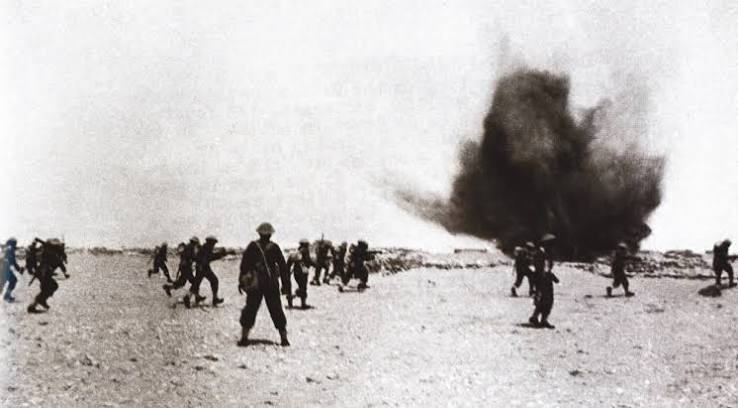
In the late summer of 1942, the British Eighth Army was a force in retreat. Chased across Libya by Erwin Rommel’s Afrika Korps, they had lost Tobruk in a humiliating surrender, and the German commander stood at the edge of Egypt, a mere 100 kilometers from Alexandria. The Royal Navy had already evacuated the port, sending its warships to the Red Sea. Cairo was burning its archives, preparing for occupation. But geography, more than any general, was about to draw a line in the sand.
Between the Mediterranean coast and the impassable Qattara Depression, the desert narrows to a corridor just 60 kilometers wide. That bottleneck, a place called El Alamein, was where the Axis advance would either break through to the Suez Canal or grind to a halt. It was there that the war in North Africa and arguably the fortunes of the Allies in 1942 would be decided.
The Desert’s Sieve
The first collision at El Alamein was not a planned offensive but a desperate stand. In July 1942, General Claude Auchinleck, commanding the Eighth Army, threw his forces into a defensive line at the bottleneck, fighting Rommel’s exhausted Panzer Army Africa to a bloody stalemate from July 1 to 27. The German supply lines, stretched thousands of kilometers back to Tripoli, were fraying. The British, by contrast, had Alexandria just down the road. Auchinleck halted the Axis drive, but Winston Churchill, hungry for a decisive victory, saw caution as a failure. In August, he replaced Auchinleck with Lieutenant-General Bernard Montgomery.
Montgomery was a different breed of commander. He had no taste for Rommel’s fluid, improvisational warfare. Instead, he insisted on a set-piece battle: overwhelming superiority in men, tanks, artillery, and air power, and a plan that left little to chance. He drilled his troops, rebuilt their morale, and refused to attack until every condition was met. By October, he had assembled roughly 195,000 troops, 1,029 tanks (including American Grants and Shermans), and 900 guns. Against him, Rommel fielded about 104,000 men and 547 tanks, many of them outdated Italian models. The Luftwaffe could muster only around 350 operational aircraft against the Desert Air Force’s 1,500.
Rommel, meanwhile, was not even present when the storm broke. He had flown to Germany on sick leave, leaving General Georg Stumme in command. On the night of October 23, 1942, the silence of the desert was shattered by the simultaneous roar of over 1,000 British guns. Operation Lightfoot had begun.
Breaking the Devil’s Gardens
Montgomery’s plan was methodical. Under the cover of darkness, infantry would advance through the extensive Axis minefields—dubbed the “Devil’s Gardens”—clearing lanes for the armor to pass. The attack was a gamble: the minefields were dense, and the defenders were dug in. But the sheer weight of artillery, firing a creeping barrage ahead of the infantry, was designed to suppress the Axis gunners.
For the first two days, the battle was a slog. The Eighth Army breached the minefields but met fierce resistance. Stumme died of a heart attack on October 24, and Rommel, summoned from Germany, returned on October 25 to find the situation slipping. He launched counterattacks, but the British air superiority and artillery dominance ground them down. The turning point came with Operation Supercharge, the breakout phase launched on November 2. With the Axis lines fatally weakened, the armor pushed through, and Rommel ordered a retreat westward into Libya. By November 11, the Second Battle of El Alamein was over.
Casualties told the story of a hard-won victory: the Allies lost about 13,500 killed, wounded, or missing. The Axis lost 30,000 to 37,000 men, plus roughly 30,000 prisoners, most of them Italian. The threat to Egypt and the Suez Canal was ended. The Eighth Army pursued the retreating Axis forces, but the immediate victory was what mattered.
Why It Was a Turning Point
El Alamein was not the largest battle of World War II, nor the most strategically complex. But it was the first major, permanent land victory by the Allies over a German-led army. Earlier successes, like Operation Compass in 1940, had been against Italians alone. Here, the Afrika Korps was broken and pushed back.
The broader context made the victory resonate far beyond the desert. In the same months, the Red Army was bleeding at Stalingrad, holding on by a thread. The Allies had yet to land in North Africa (Operation Torch would come on November 8, 1942). Churchill, speaking in November 1942, summed up the shift: “Before Alamein we never had a victory. After Alamein we never had a defeat.” It was an overstatement—there were setbacks ahead—but it captured the psychological change. El Alamein proved that the Axis could be beaten on land, and it gave the British public a victory to rally behind.
The Tools of Victory
Two factors were decisive. First, intelligence: Ultra decrypts gave the Allies a detailed picture of Axis supply shortages, troop positions, and Rommel’s intentions. Montgomery knew where the weak points were. Second, air power: the Desert Air Force relentlessly attacked supply convoys and provided close support to ground troops. The Axis could not move supplies safely, and their tanks, starved of fuel, became static targets.
But the human element mattered too. The desert was a brutal theater—heat, flies, dysentery, and sandstorms, with the constant threat of mines and shelling. The Eighth Army that fought at El Alamein was not the demoralized force that had fled from Tobruk. Montgomery had rebuilt its confidence with training, new equipment, and a clear plan. The soldiers knew they had superiority; they just needed the leadership to use it. And they did.
El Alamein was a hinge of the war—a place where the geography of a narrow strip of desert, the logistics of supply lines, and the resolve of a rebuilt army combined to halt the Axis tide. The victory did not end the war in North Africa, but it ended the Axis threat to the Suez Canal and gave the Allies their first decisive, enduring land triumph. In the long arc of World War II, it was the moment the pendulum began to swing.
Summary
- The First Battle of El Alamein (July 1942) was a defensive stand by Auchinleck that halted Rommel’s advance into Egypt.
- The Second Battle (October–November 1942), commanded by Montgomery, was a decisive offensive that broke the Axis lines and forced Rommel’s retreat.
- Montgomery’s set-piece tactics, overwhelming Allied numbers (195,000 troops, 1,029 tanks), and air superiority were decisive.
- Ultra intelligence and the Desert Air Force’s dominance over Axis supply lines were critical to victory.
- El Alamein was the first major permanent Allied land victory over a German-led army, boosting Allied morale ahead of Operation Torch and during the Battle of Stalingrad.
FAQ
Q: Why was El Alamein a turning point in World War II?
A: It was the first major, permanent land victory by the Allies over a German-led army. It ended the Axis threat to Egypt and the Suez Canal, and it proved that the Axis could be beaten on land, giving a massive morale boost to the Allies globally.
Q: What made the El Alamein position so defensible?
A: The front narrowed to about 60 kilometers between the Mediterranean coast and the Qattara Depression, making a wide flanking maneuver impossible. The British also had short supply lines to Alexandria, while Rommel’s stretched thousands of kilometers back to Tripoli.
Q: Who commanded the forces at the Second Battle of El Alamein?
A: Lieutenant-General Bernard Montgomery commanded the British Eighth Army. The Axis forces were led by Generalfeldmarschall Erwin Rommel, though he was on sick leave in Germany when the battle began and returned on October 25.
Q: What was Operation Lightfoot?
A: Operation Lightfoot was the codename for the initial assault of the Second Battle of El Alamein, launched on October 23, 1942, with a massive artillery barrage and an infantry-led breach of the Axis minefields. The breakout phase was Operation Supercharge.
Q: How many casualties were there at El Alamein?
A: At the Second Battle, Allied casualties were about 13,500 killed, wounded, or missing. Axis casualties were 30,000–37,000, plus about 30,000 prisoners, mostly Italian.
Leave a Reply