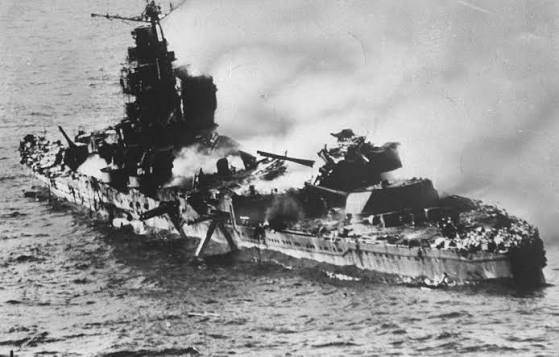
At 10:22 on the morning of June 4, 1942, the fate of the Pacific War hung on a sliver of sky above a pair of coral islands. Below, four Japanese aircraft carriers the vanguard of an empire that had swept across Asia and the Pacific in six monthswere turning into the wind to launch a second strike against Midway Atoll. Their decks were crammed with fueled planes, armed bombs, and torpedoes. Then, from 20,000 feet, three squadrons of American dive bombers plunged out of the sun. In five minutes, they turned the tide of World War II.
This was no accident of luck. It was the product of a secret intelligence coup, a commander’s calculated gamble, and the desperate sacrifice of young pilots who flew straight into death to buy those five minutes. The Battle of Midway, fought June 4–7, 1942, was the moment Japan’s offensive momentum broke—when the U.S. Navy, outnumbered and battle-worn, struck a blow from which the Imperial Japanese Navy never recovered.
The Road to the Reef
Midway Atoll sits at the northwestern edge of the Hawaiian chain, 1,300 miles from Oahu. It is a speck of sand and reef, but by 1942 it was an unsinkable American aircraft carrier—a forward base for bombers and submarines that could threaten Japanese operations. For Admiral Isoroku Yamamoto, commander of Japan’s Combined Fleet, Midway was a lure. He planned to seize the island and, in the process, draw out the U.S. carriers he had failed to sink at Pearl Harbor on December 7, 1941.
Yamamoto’s plan was grandiose and complicated. He would send a diversionary force to attack the Aleutians in the north, a main carrier strike force under Vice Admiral Chuichi Nagumo to soften Midway, an invasion force to land troops, and a massive battleship fleet lurking hundreds of miles behind—ready to crush the American carriers once they surfaced. It was a plan built on the assumption that the U.S. carriers would react predictably, steaming from Pearl Harbor only after Midway was attacked. It was a fatal assumption.
The Codebreakers’ Secret
While Yamamoto planned, a cramped basement at Pearl Harbor—Station HYPO—was quietly unraveling his strategy. Commander Joseph Rochefort and his team of cryptanalysts had been working on the Japanese JN-25 naval code for months. By May 1942, they had pieced together that a major operation was aimed at a target designated “AF.” But what was AF?
Rochefort had a hunch it was Midway. To prove it, he devised a simple ruse. He ordered Midway to send an uncoded radio message stating that its freshwater distillation plant had broken down. Two days later, Japanese intelligence intercepted a message reporting that “AF” was short of fresh water. The trap was sprung. Nimitz knew exactly where the enemy was going.
This intelligence gave the U.S. Pacific Fleet a priceless advantage. Nimitz could position his three carriers—Enterprise, Hornet, and the hastily repaired Yorktown—northeast of Midway, out of Japanese reconnaissance range, ready to spring an ambush. The Yorktown, which had been severely damaged at the Battle of the Coral Sea a month earlier, was patched in just 72 hours at Pearl Harbor. Shipyard workers, working around the clock, made her seaworthy enough to fight. She would sail into history.
The Morning of June 4
Nagumo’s four carriers—Akagi, Kaga, Soryu, and Hiryu—launched their first strike on Midway at dawn on June 4. The attack was successful but not decisive; Midway’s airfield remained operational, and its bombers were already in the air, searching for the Japanese fleet. Meanwhile, Nagumo’s scout planes were searching for the U.S. carriers. They found nothing.
At 7:10 AM, Midway-based aircraft began attacking the Japanese carriers. Torpedo bombers, dive bombers, and B-17s came in waves, but they were slow, vulnerable, and poorly coordinated. Japanese Zero fighters and anti-aircraft fire cut them down. Not a single bomb hit a Japanese ship. But the attacks had a profound effect: they convinced Nagumo that Midway posed a greater threat than expected, and they delayed his decision on whether to strike again.
At 8:20 AM, a scout plane from the cruiser Tone finally reported the presence of a U.S. carrier force. Nagumo was caught in a dilemma. His planes were armed with bombs for a second strike on Midway. To attack the carriers, they needed torpedoes. The process of rearming would take time—precious time. He ordered the rearming to begin, and then, at 8:37, he changed his mind and ordered the planes to be rearmed again. The decks of his carriers became a chaotic jumble of bombs, torpedoes, and fueled aircraft.
The Sacrifice of the Torpedo Squadrons
While Nagumo dithered, U.S. carrier aircraft were closing in. The first to arrive were the torpedo bombers—slow, low-flying TBD Devastators. They came in at wave height, without fighter cover, their torpedoes outdated and often malfunctioning. They flew straight into the teeth of the Japanese defenses.
Torpedo Squadron 8 from the Hornet, led by Lieutenant Commander John Waldron, was the first to attack. All fifteen of its aircraft were shot down. Only one pilot, Ensign George Gay, survived—he floated in the water, watching the battle unfold, as his comrades died around him. Torpedo Squadrons from Enterprise and Yorktown followed, and they too were massacred. Of the 41 torpedo bombers that attacked, only six returned. They scored no hits. But they did something more important: they drew the Japanese Zero fighters down to sea level, leaving the sky above clear.
The Five Minutes That Changed the War
At 10:22 AM, the Japanese carriers were at their most vulnerable. Their decks were full of aircraft being rearmed, with bombs and torpedoes stacked carelessly, fuel lines snaking across the flight deck. Zeroes that had been scrambled to shoot down the torpedo bombers were low on fuel and ammunition, circling at low altitude. No one was looking up.
Then, from 20,000 feet, the dive bombers arrived. They were from Enterprise and Yorktown—two squadrons of SBD Dauntlesses, about 50 aircraft total. They had arrived late, having missed the initial contact, but their timing was perfect. Led by Lieutenant Commander Wade McClusky, who had made a critical navigation decision to continue searching rather than turn back, they found the Japanese fleet by following a single destroyer’s wake.
They pushed over into their dives. In the next five minutes, bombs struck Akagi, Kaga, and Soryu. The explosions ignited the fuel and ordnance on their decks. Fires raged out of control. The three carriers were doomed. Only Hiryu, further north, escaped the initial attack.
The Final Act
Hiryu launched a counterstrike that afternoon. Her bombers found Yorktown and hit her with three bombs and two torpedoes. The Yorktown was crippled, and she was later sunk by a Japanese submarine, along with the destroyer Hammann, which was alongside her during salvage efforts. But Hiryu’s victory was short-lived. U.S. scout planes located her, and a strike from Enterprise and Hornet found her in the late afternoon. Four bombs hit Hiryu’s flight deck, turning her into an inferno. She sank the next morning.
By June 7, the battle was over. The U.S. had lost the Yorktown and the Hammann, but all four of Japan’s fleet carriers—the core of its naval air power—lay at the bottom of the Pacific. More than 250 carrier aircraft and their experienced pilots had gone down with them, a blow from which Japan’s air arm would never recover. The U.S. lost about 150 aircraft, but most of its aircrew survived to fight again.
The Aftermath
Midway was a turning point. Japan lost not only ships and men but the strategic initiative. Admiral Yamamoto’s dream of a decisive battle had ended in disaster. The U.S. went on the offensive, landing at Guadalcanal in August 1942, the first step in a long island-hopping campaign that would end at Tokyo Bay. The battle also vindicated the U.S. intelligence community and the carrier-centric naval doctrine that would dominate the rest of the war.
For the men who fought there, the memory was stark. Ensign George Gay, floating in the Pacific, watched his squadron die and then watched the Japanese carriers burn. He was rescued the next day, his body burned and his spirit forever marked. A generation of American pilots had been sacrificed to buy those five minutes, but the sacrifice bought victory.
Midway was not a battle that was won by a single genius or a single lucky break. It was won by intelligence, by risk-taking, and by the raw courage of men who flew into the face of death. The codebreakers who cracked JN-25, the commanders who gambled on a flanking position, and the torpedo pilots who gave their lives to set up the dive bombers—all of them were necessary. The Battle of Midway remains a testament to the fact that, in war, information and sacrifice can overcome superior numbers and brute force. It was the moment the Pacific War truly turned, and it has never been forgotten.
Summary
- The U.S. Navy’s codebreakers confirmed Midway as the Japanese target by faking a water shortage, enabling Admiral Nimitz to set an ambush.
- The Japanese plan was overcomplicated and dispersed, violating the principle of concentration of force.
- The sacrifice of U.S. torpedo squadrons, which suffered near-total losses, drew Japanese fighters down and left the sky clear for dive bombers.
- At 10:22 AM on June 4, 1942, U.S. dive bombers struck three Japanese carriers in five minutes, turning the tide of the battle.
- All four Japanese fleet carriers were sunk; Japan lost ~3,000 men and the initiative in the Pacific, while the U.S. lost one carrier and ~360 men.
FAQ
Q: Why did the Japanese attack Midway?
A: Admiral Yamamoto wanted to draw out and destroy the U.S. carrier fleet in a decisive battle, and also to seize Midway as a forward airbase to threaten Hawaii and force a favorable peace.
Q: How did the U.S. know the Japanese were coming?
A: U.S. Navy cryptanalysts, led by Commander Joseph Rochefort, had partially broken the Japanese JN-25 code. They confirmed Midway as the target by having Midway send a false message about a broken water distillation plant, and then intercepting a Japanese report that ‘AF’ was short of water.
Q: What was the ‘five minutes’ that changed the war?
A: On June 4, 1942, at 10:22 AM, U.S. dive bombers from Enterprise and Yorktown attacked the Japanese carriers Akagi, Kaga, and Soryu while their decks were full of fueled and armed aircraft. In five minutes, they hit all three, causing catastrophic fires that doomed the carriers.
Q: How many ships were lost on each side?
A: Japan lost all four fleet carriers (Akagi, Kaga, Soryu, Hiryu) and a heavy cruiser. The U.S. lost the carrier Yorktown and the destroyer Hammann.
Q: Why was the Battle of Midway a turning point?
A: It was Japan’s first decisive defeat in 350 years. The loss of four fleet carriers and their irreplaceable aircrews ended Japan’s offensive capability, and the U.S. went on the strategic offensive, starting with the Guadalcanal campaign in August 1942.
Leave a Reply