In the summer of 1942, a young American named John Doe parachuted into occupied France with forged papers and a mission to blow up a railway bridge. Within hours, he was being hunted by the Gestapo, whose agents had already turned the local café owner into an informant. Doe was one of the first operatives of the Office of Strategic Services (OSS), a brand-new agency that President Franklin D. Roosevelt had created just weeks earlier. The OSS was America’s first centralized intelligence service, and its agents were walking into a war against the most feared secret police in history.
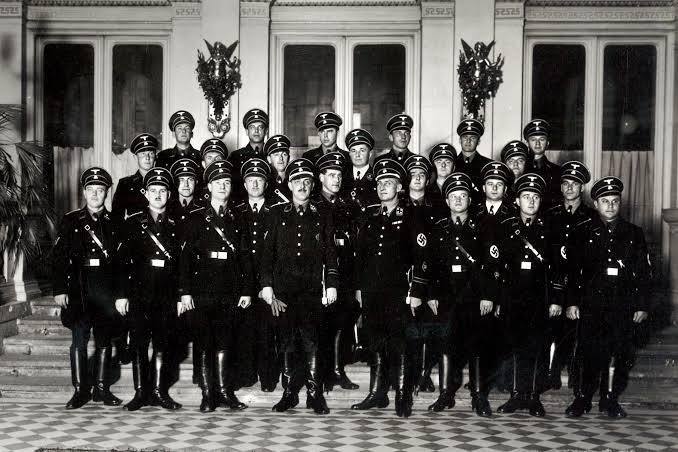
The Gestapo, Hitler’s secret state police, had a decade of experience in surveillance, infiltration, and brutal interrogation. By 1942, it had already crushed resistance movements across Europe. The OSS, by contrast, was a hastily assembled experiment staffed by Wall Street lawyers, academics, and Olympic athletes led by a Medal of Honor winner named William Donovan. What followed was a shadow war of radio games, double agents, and sabotage, fought in the back alleys of Paris and the mountains of Yugoslavia. This is the story of how a scrappy American upstart took on the Nazi terror machine and helped win a war.
The Birth of an Agency
Before World War II, the United States had no permanent foreign intelligence service. Information was scattered across the Army’s G-2, the Navy’s Office of Naval Intelligence, and the State Department, with little coordination. President Roosevelt was frustrated by the lack of actionable intelligence, especially as war loomed in Europe. In 1940, he sent a Wall Street lawyer and WWI hero, William “Wild Bill” Donovan, on a fact-finding trip to Britain. Donovan returned convinced that the U.S. needed a centralized, British-style intelligence organization one that could conduct espionage, sabotage, and psychological warfare.
On June 13, 1942, Roosevelt signed the order creating the Office of Strategic Services, with Donovan as its director. The OSS was an experiment from the start. It recruited from unlikely places: professors from Ivy League universities, bankers, boxers, and even Hollywood set designers. At its peak, it employed around 13,000 people a fraction of the Gestapo’s 32,000 members, who were backed by an army of informants. The OSS was underfunded, understaffed, and often at odds with the military brass, but it had one thing going for it: Donovan’s willingness to take risks.
The Gestapo’s Iron Grip
The Gestapo, short for Geheime Staatspolizei, was Nazi Germany’s secret state police. Founded in 1933 by Hermann Göring, it was later taken over by Heinrich Himmler and folded into the Reich Security Main Office in 1939. The Gestapo’s power rested on surveillance, informants, and the legal authority to use “protective custody” imprisonment without trial. In occupied Europe, it was the hammer that crushed resistance networks. Its agents used torture, summary execution, and the Commando Order of 1942, which mandated the killing of captured saboteurs without trial.
The Gestapo was everywhere. In France, it maintained a network of informants in every café, train station, and police precinct. It used radio direction-finding to track down clandestine transmitters. It ran double-agent operations that fed false intelligence to the Allies. One of its most infamous successes was the Englandspiel, a radio deception that led to the capture of dozens of Dutch agents. For any OSS operative, the Gestapo was the ever-present enemy, and capture almost always meant death.
The Shadow War Begins
OSS agents were dropped into this cauldron with minimal training. They carried forged papers, a pistol, and a cyanide pill. Their missions were simple in concept but deadly in practice: blow up bridges, arm the resistance, gather intelligence on enemy troop movements. In France, the OSS worked with the Maquis, supplying them with weapons and explosives. In Italy, they coordinated with partisans to sabotage German supply lines. In Yugoslavia, they supported both Chetniks and Partisans, trying to decide which side to back.
The Gestapo, in turn, made hunting OSS agents a priority. They used informants to sniff out strangers in small towns. They set up roadblocks and checked papers. They tortured captured agents to extract names and locations. Many OSS operatives never made it back. Some were executed; others disappeared into concentration camps. Yet the OSS kept pushing, learning from each failure.
The David vs. Goliath Dynamic
The OSS was a David against a Goliath. The Gestapo had experience, resources, and a ruthlessness that knew no bounds. The OSS had improvisation and a willingness to break the rules. Donovan recruited academics who spoke multiple languages, athletes who could climb cliffs, and gamblers who could bluff their way past checkpoints. This unconventional approach often worked. OSS agents were trained in guerrilla warfare, and they developed tactics that the Gestapo found hard to counter, such as using local resistance fighters to ambush patrols.
One key advantage was the OSS’s ability to adapt. When radio games backfired, it switched to more secure communication methods. When agents were captured, it changed codes and safe houses. The Gestapo, by contrast, relied on a rigid hierarchy and a culture of fear, which sometimes led to overconfidence. The OSS’s willingness to take risks—sometimes recklessly—paid off in the end.
The Cost of the Conflict
The war of spies came at a terrible cost. The OSS lost hundreds of agents in Europe, many of whom were never accounted for. The Gestapo’s brutal methods broke many under torture, but the OSS’s decentralized structure meant that capturing one agent rarely led to a network. By 1944, the OSS was operating effectively in France, Italy, and the Balkans, supporting the Allied advance. The Gestapo, meanwhile, was stretched thin, fighting a losing battle against the resistance and the Allied armies.
When the war ended, the OSS was disbanded on October 1, 1945, just weeks after Japan’s surrender. President Truman, wary of a permanent intelligence agency, scattered its functions across the State and War Departments. But the lessons learned in the fight against the Gestapo were not forgotten. In 1947, Congress passed the National Security Act, creating the CIA—the OSS’s direct descendant. The Gestapo, declared a criminal organization at Nuremberg, was dissolved, and many of its leaders were executed or fled to South America. The conflict between the two agencies shaped the future of intelligence for decades.
The OSS’s fight against the Gestapo was more than a military confrontation; it was a clash between two visions of power. The Gestapo represented totalitarian control, operating outside the law to enforce a brutal ideology. The OSS, for all its flaws, was an experiment in democratic espionage—not perfect, but accountable to a civilian government. The legacy of that experiment lives on in the CIA and in the very concept of American intelligence. The story of the OSS is a reminder that even the most powerful agencies start small, and that courage and improvisation can sometimes outmatch experience and terror.
Summary
- The OSS was the first U.S. centralized spy agency, created in 1942 by FDR and led by William “Wild Bill” Donovan.
- The Gestapo was Nazi Germany’s secret police, a brutal force of 32,000 that targeted resistance and spies across occupied Europe.
- The OSS operated in direct opposition to the Gestapo, using sabotage, espionage, and support for resistance movements.
- The conflict was a David vs. Goliath struggle, with the OSS’s unconventional tactics eventually proving effective.
- The OSS was disbanded after the war, but its legacy lives on in the CIA, while the Gestapo was condemned at Nuremberg.
FAQ
Q: What does OSS stand for?
A: OSS stands for Office of Strategic Services, the United States’ first centralized intelligence agency, established in 1942.
Q: Who led the OSS?
A: William “Wild Bill” Donovan, a Medal of Honor recipient and Wall Street lawyer, led the OSS.
Q: How was the OSS different from the CIA?
A: The OSS was a wartime agency, disbanded in 1945, while the CIA was created in 1947 as a permanent peacetime agency.
Q: What happened to captured OSS agents?
A: Many were tortured and executed by the Gestapo, often under the Commando Order of 1942.
Q: Did the OSS succeed in its missions?
A: The OSS contributed to Allied victory by supporting resistance movements, gathering intelligence, and conducting sabotage, though it suffered heavy losses.
Leave a Reply