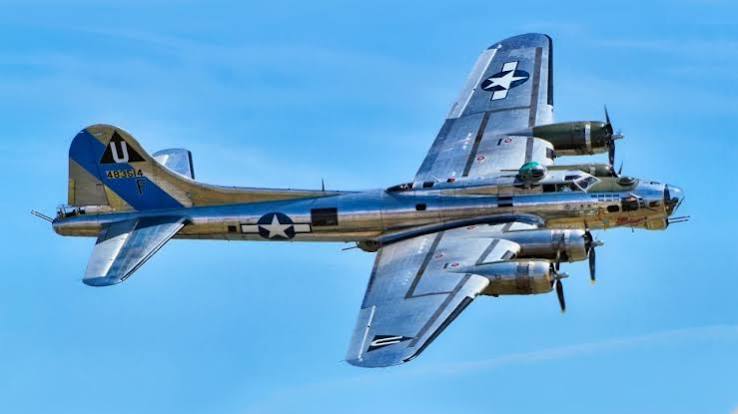
On August 17, 1942, twelve B-17Es of the 97th Bomb Group lifted off from an English airfield, their target a rail yard in Rouen, France. It was the first combat mission for the US Army Air Forces in Europe, and it embodied a theory that had been two decades in the making: that a heavily armed bomber, flying high and in tight formation, could fight its way to a target and back without fighter escort.
The B-17’s story is one of that theory’s rise, its brutal testing, and its eventual vindication though not in the way its designers had imagined. By the war’s end, 12,731 B-17s had rolled off assembly lines, and the aircraft had become the backbone of the American daylight bombing campaign. But the Fortress’s success came at a staggering human cost, and its ultimate effectiveness depended on a fighter it was originally built to make unnecessary.
The Birth of an Idea
In 1935, a Boeing prototype called the Model 299 took to the air for the first time. It was a four-engine behemoth, bristling with machine guns and capable of flying higher than any pursuit plane of its era. A reporter for the Seattle Daily Times, Richard Williams, took one look and dubbed it a “flying fortress.” Boeing knew a good name when it heard one and trademarked it.
The B-17 was the physical embodiment of an interwar doctrine that had been brewing in the minds of airpower theorists like Giulio Douhet and Billy Mitchell. They argued that a bomber force, flying in formation, could generate enough overlapping defensive fire to make interception suicidal. With the Norden bombsight, they could place bombs on a pickle barrel from 20,000 feet. High altitude, long range, heavy guns the B-17 had all of it. The Air Corps bought the vision, ordering 13 YB-17s for testing in 1936 and ramping up mass production by 1938.
There was just one problem: the theory had never been tested in combat. The B-17’s first real test would come over Europe, and it would nearly break the bomber force.
The B-17’s Best Defense: Its Own Ruggedness
The Fortress was built to take punishment. Its turbo-supercharged engines allowed it to cruise at 35,600 feet, far above most flak and enemy fighters. Its defensive armament, especially on the B-17G with 13 .50-caliber machine guns, made it a formidable target. But the aircraft’s real claim to fame was its ability to absorb damage and keep flying.
Crews brought home Fortresses with wings shredded, engines dead, and tails barely attached. The most famous example: the “All American,” which collided with a German fighter over Tunisia in 1943. The collision tore off much of the tail section, yet the pilot managed to fly the bomber back to base and land it. Every crew member survived.
This ruggedness wasn’t an accident. Boeing designed the B-17 with redundant systems and a sturdy airframe, knowing that a bomber hit by flak or fighters had to get its crew home. It was a lesson learned from the B-17’s predecessor, and it paid off in saved lives though not enough of them.
The Crucible: Schweinfurt and Black Thursday
In 1943, the Eighth Air Force began pushing deeper into Germany. The B-17s flew unescorted, relying on their formation and their guns. The Luftwaffe was waiting.
On August 17, 1943, a double raid on Schweinfurt and Regensburg cost 60 B-17s. Two months later, on October 14, the Eighth sent 291 B-17s to Schweinfurt again. The Luftwaffe threw everything at them. Sixty bombers went down, and 600 airmen were killed, wounded, or captured. The mission became known as “Black Thursday.” The self-defending bomber theory lay in tatters.
For a month, the Eighth halted deep-penetration missions. The B-17 could reach the targets, but it couldn’t guarantee the crews would come back. The math was brutal: a 25-mission tour was the goal, but the average crewman had roughly a one in three chance of becoming a casualty. The psychological toll was immense, with crews watching neighboring Fortresses explode in mid-air or spin down in flames.
The Fighter That Changed Everything
The B-17’s salvation came not from more guns, but from a new escort fighter: the P-51 Mustang. With external drop tanks, the Mustang could fly the entire mission profile—to the target and back. In December 1943, the first P-51s began flying escort for the Eighth Air Force.
The impact was immediate. During “Big Week” in February 1944, the Eighth launched sustained deep-penetration raids against German aircraft factories. With Mustangs covering them, B-17 losses plummeted, and the Luftwaffe’s fighter force was broken in the air. The B-17, it turned out, wasn’t self-defending after all—but it was the perfect bomber to exploit fighter escort once that escort arrived.
The Final Verdict
The B-17’s contribution to the Allied victory is hard to overstate. From “Big Week” onward, the Fortress hammered German industry, oil production, and transportation. It flew tactical support on D-Day and continued striking strategic targets until the final mission of the war on April 25, 1945, against the Skoda works in Pilsen, Czechoslovakia.
Of the 12,731 B-17s built, nearly 5,000 were lost in combat. Roughly 28,000 airmen died in the European theater, many of them flying Fortresses. The B-17 didn’t win the war alone, but it proved that strategic bombing could work—if paired with the right fighters and enough sacrifice. The theory that birthed it was flawed, but the aircraft itself was a masterpiece of engineering, and its legacy as the icon of American airpower endures.
The B-17 Flying Fortress was more than a machine; it was a statement of intent. It carried the hopes of interwar airpower theorists into the brutal skies over Europe, and it paid for their overconfidence in blood. Yet it also adapted, evolved, and ultimately helped break the back of the Luftwaffe. Its story is a reminder that in war, the best-laid plans often fail—and that success belongs to those who can take a beating and keep flying.
Summary
- The B-17 was designed to embody the pre-war theory that heavily armed bombers could fly unescorted and destroy targets with precision daylight bombing.
- The aircraft’s ruggedness became legendary, with crews surviving catastrophic damage that would have downed lesser planes.
- The disastrous Schweinfurt raids of 1943 exposed the fallacy of the self-defending bomber, costing 60 B-17s and 600 airmen on “Black Thursday” alone.
- The arrival of the P-51 Mustang with drop tanks in December 1943 transformed the B-17’s effectiveness, allowing deep missions with fighter cover.
- By the end of the war, 12,731 B-17s had been built, and the aircraft had become the backbone of the US daylight bombing campaign.
FAQ
Q: Why was the B-17 called the “Flying Fortress”?
A: The name came from a 1935 newspaper report by Richard Williams of the Seattle Daily Times, who saw the heavily armed Boeing Model 299 prototype and called it a “flying fortress.” Boeing adopted and trademarked the name.
Q: How many B-17s were built?
A: A total of 12,731 B-17s were produced between 1936 and 1945, with the B-17G being the most numerous variant at 8,680 aircraft.
Q: What was the B-17’s maximum bomb load?
A: The B-17 could carry a maximum of 17,600 lbs on short-range missions, but a typical combat load was 4,000–6,000 lbs to maintain altitude and range.
Q: What were the consequences of the Schweinfurt raids?
A: The raids of August 17 and October 14, 1943, resulted in massive losses—60 B-17s on the first and another 60 on “Black Thursday”—forcing a temporary halt to unescorted deep penetration missions and proving that bombers needed fighter escort.
Q: How did the P-51 Mustang change the B-17’s role?
A: The P-51, with its long range and drop tanks, could escort B-17s all the way to targets and back, dramatically reducing bomber losses and enabling the sustained campaign that broke the Luftwaffe in early 1944.
Leave a Reply