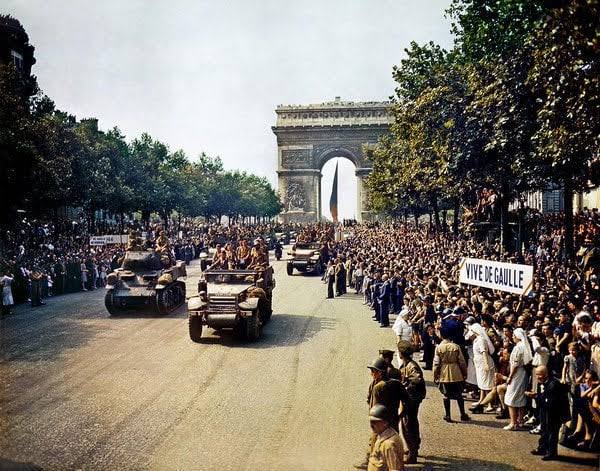
On June 14, 1940, German troops marched down the Champs-Élysées in Paris. Within days, the French government signed an armistice that split the country in two: the Occupied Zone in the north, under direct German military control, and the southern Free Zone, governed by the collaborationist Vichy regime. For the next four years, the French lived under a shadow of occupation that reached into every corner of public and private life from the ration books that dictated meals to the curfews that silenced streets after dark.
This is the story of how ordinary people navigated that shadow: the choices they made, the compromises they accepted, and the small acts of defiance that kept hope alive. It is a story of collaboration, resistance, and survival not as abstract categories, but as daily realities shaped by hunger, fear, and the stubborn will to endure.
The Liberation and Its Aftermath
The D-Day landings in June 1944 and the liberation of Paris in August brought hope, but the occupation did not end overnight. As the Allies pushed through France, the Vichy regime collapsed, and the collaborators were exposed.
In the aftermath, roughly 300,000 people were investigated for collaboration. About 100,000 were sentenced, and around 7,000 were executed. Some were punished for crimes, others for opportunism, and still others were simply in the wrong place at the wrong time. The process was imperfect, but it allowed France to confront the choices made during the occupation.
France emerged from the war with deep scars. Approximately 600,000 French people had died military, civilian, and Holocaust victims. The country had been divided, humiliated, and morally compromised. Yet it also had the legacy of the Resistance, a small but significant number of people who had chosen to fight back against the occupier and the collaborationist state.
Life in occupied France was a daily negotiation between survival and conscience. Some collaborated, some resisted, and most simply tried to get by. The choices were rarely clear-cut, and the lines between collaboration and resistance blurred in the gray zone of everyday life. But the stories of those who lived through it the denunciations and the hidden Jews, the black market and the Maquis remind us that even in the darkest times, people find ways to endure, to help others, and to reclaim their dignity.
Summary
- The occupation split France into the Occupied Zone and the Free Zone, with Vichy collaborating in the south.
- Rationing and shortages reduced caloric intake to nearly half of normal, fueling a black market.
- Collaboration ranged from state policy to everyday denunciations, with millions of letters sent.
- Resistance grew from small acts to organized networks, especially after the STO forced laborers into hiding.
- Liberation brought justice but also imperfect reckoning, with thousands executed for collaboration.
FAQ
Q: What was the difference between the Occupied Zone and the Free Zone?
A: The Occupied Zone, in the north and along the Atlantic coast, was directly controlled by German military authorities. The Free Zone, in the south, was governed by the Vichy regime under Marshal Pétain, who collaborated with Germany. In November 1942, Germany occupied the Free Zone as well, ending the division.
Q: How did ordinary French people survive the rationing?
A: They relied on ration books, but rations were far below normal caloric needs—around 1,500 calories a day. Many turned to the black market, which offered goods at high prices, while rural families often had better access to food. People also grew their own vegetables and bartered with neighbors.
Q: What was the Milice, and what did it do?
A: The Milice was Vichy’s paramilitary police force, created in January 1943. It actively hunted Resistance members and Jews, often using torture and summary executions. Its brutality was notorious, and it was feared more than the German Gestapo in some areas.
Q: How did the STO lead to the growth of the Maquis?
A: The STO (Service du Travail Obligatoire) required hundreds of thousands of young French men to work in German factories. Many refused and fled to rural areas, joining guerrilla bands known as the Maquis. These groups conducted sabotage and ambushes, and they became a significant part of the Resistance.
Q: What happened to collaborators after the liberation?
A: After liberation, roughly 300,000 people were investigated for collaboration. About 100,000 were sentenced, and around 7,000 were executed. The process was often chaotic and sometimes unjust, but it was an attempt to hold people accountable for their actions during the occupation.
Leave a Reply