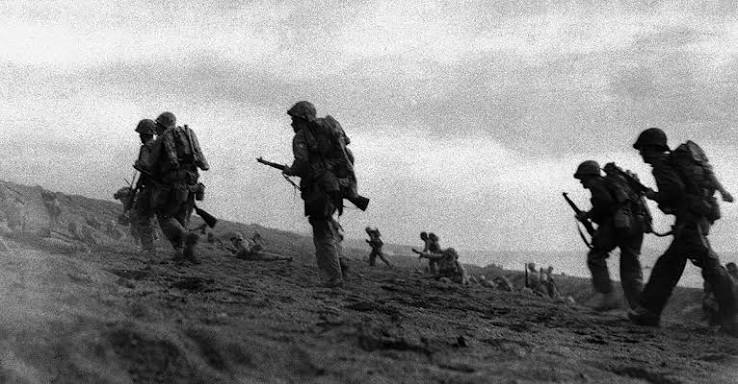
On February 19, 1945, the first wave of Marines hit the black sand beaches of Iwo Jima. They expected a quick fight—planners had given the island five days. Thirty-six days later, nearly 7,000 Americans were dead, and the island had cost more Marine lives than it would ever save in B-29 landings. The battle became a symbol of American grit, a Japanese masterpiece of defense, and a strategic decision that historians still argue about.
This is the story of how a tiny volcanic island, 750 miles from Tokyo, turned into one of the bloodiest encounters of the Pacific War—and why the debate over its necessity has never fully settled.
The Island That Shouldn’t Have Mattered
Iwo Jima is a lump of volcanic rock and sulfur, roughly eight square miles. In early 1945, it was a Japanese radar outpost and a base for fighters that harassed American B-29s flying from the Marianas to bomb Tokyo. The U.S. Joint Chiefs wanted it: an emergency landing field for damaged bombers, a home for P-51 Mustang escorts, and a staging ground for the invasion of Japan itself.
The plan, Operation Detachment, assumed five days to secure the island. The Japanese had other ideas.
Lieutenant General Tadamichi Kuribayashi had studied American tactics. He knew the beaches would be hammered by naval guns, so he abandoned the beach defense. Instead, his 21,000 troops dug into 11 miles of tunnels, built 800 pillboxes, and zeroed their artillery on the landing zones. He banned banzai charges, ordering his men to fight from cover and make the Americans pay for every yard.
The pre-invasion bombardment—three days, the heaviest of the Pacific War—did little. The shells churned the surface but missed the buried fortifications.
The First 36 Days
On February 19, the 4th and 5th Marine Divisions hit the southeastern beaches. The black volcanic ash was loose, like walking in sand, and provided no cover. Japanese guns from Mount Suribachi to the south and the northern highlands opened up. The first day ended with 550 dead and more than 1,800 wounded—the worst single day in Marine Corps history up to that point.
The fighting was relentless. The Marines advanced yard by yard, using flamethrowers, demolition charges, and grenades to clear bunkers. Kuribayashi’s men, well-supplied and hidden, inflicted casualties at a rate that stunned the Americans. By March 3, the airfield was in use, but the island was far from secure.
On February 23, a patrol reached the summit of Mount Suribachi. A small flag went up, photographed by Marine photographer Lou Lowery. Hours later, a larger flag replaced it. Associated Press photographer Joe Rosenthal captured that second raising—an image that would become the Marine Corps War Memorial. Of the six men in the photo, three—Harlon Block, Franklin Sousley, and Mike Strank—were killed later in the battle. It took 71 years to correct the identity of another man in the picture: Harold Schultz, not John Bradley, as misidentified for decades.
The Toll and the Aftermath
The battle dragged on. The 3rd Marine Division joined the fight. By March 16, the island was declared secure, but organized resistance continued until March 26, when the last Japanese defenders launched a final attack. At the end, 6,821 Americans were dead and 19,217 wounded. Japanese dead numbered about 20,000, with only 216 taken prisoner. This was the only major Pacific battle where U.S. casualties exceeded Japanese.
Twenty-seven Medals of Honor were awarded—more than in any other single battle in American history. The cost was staggering for an island that, in the end, did not prove decisive.
The Strategic Debate
Supporters point to the numbers: more than 2,200 B-29s made emergency landings on Iwo Jima, saving an estimated 24,000 airmen. The radar station was silenced, and the fighter base allowed P-51s to escort bombers.
Critics argue the numbers are misleading. Many of those landings were routine, not emergencies, and the P-51 escorts had limited impact. The cost—nearly 7,000 dead—was too high for what was gained. Some historians suggest the invasion was driven by interservice rivalry and momentum rather than strategic necessity.
Kuribayashi’s defense is studied today as a model of how to fight against overwhelming odds. In Japan, the battle is remembered as a symbol of sacrifice, though its meaning has been contested in nationalist narratives.
Thirty-six days on a volcanic rock changed the course of the Pacific War, but not in the way planners expected. The island was taken, but at a cost that still raises questions about whether it was worth it.
The battle of Iwo Jima remains a study in contrasts: a tactical victory, a strategic question mark, and a human tragedy. The flag raising on Suribachi became an icon of American resolve, but the island’s cost in lives demands a closer look at the decisions that led there. For the Marines who fought, the island was simply a job to do. For historians, it is a lesson in the brutal arithmetic of war—where the value of a piece of ground is measured in lives, not miles.
Summary
- The battle lasted 36 days, from February 19 to March 26, 1945, far beyond the 5 days planned.
- U.S. casualties: 6,821 killed, 19,217 wounded; Japanese: about 20,000 killed, only 216 captured.
- Kuribayashi’s tunnel defense and ban on banzai charges made the island a fortress.
- The iconic flag raising on Mount Suribachi had six men; three were killed later, and one was misidentified for decades.
- The strategic value of the island is debated: 2,200 B-29 landings vs. nearly 7,000 U.S. dead.
FAQ
Q: Why did the U.S. want Iwo Jima?
A: To provide an emergency landing field for B-29 bombers, a base for P-51 fighter escorts, and a staging area for the planned invasion of Japan.
Q: How did the Japanese defend the island?
A: Under Lieutenant General Tadamichi Kuribayashi, they built over 11 miles of tunnels, 800 pillboxes, and used artillery positioned to fire on the beaches. They avoided banzai charges and fought from prepared positions.
Q: How many Medals of Honor were awarded?
A: 27 Medals of Honor were awarded, more than any other single battle in U.S. history.
Q: What was the significance of the flag raising?
A: The second flag raising, photographed by Joe Rosenthal, became a symbol of the battle and inspired the Marine Corps War Memorial. Three of the six men in the photo were killed later in the battle.
Q: Was the invasion of Iwo Jima necessary?
A: The debate continues. Supporters cite over 2,200 B-29 landings and the elimination of the radar station. Critics argue the cost in lives outweighed the benefits, and the invasion may have been driven by momentum rather than necessity.
Leave a Reply