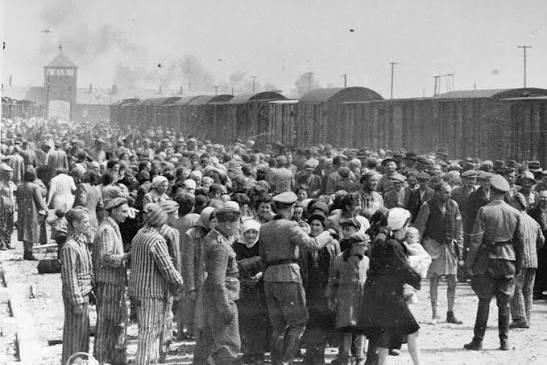
In the winter of 1942, a train pulled into the ramp at Auschwitz-Birkenau. The doors slid open to reveal hundreds of men, women, and children, bewildered and exhausted after days without food or water. Within hours, most would be dead, their bodies consumed by the chimneys of the crematoria. This scene repeated itself thousands of times across occupied Europe, part of a machinery of murder that claimed the lives of six million Jews.
The Holocaust, known in Hebrew as the Shoah, was not a spontaneous eruption of violence but a state-sponsored, meticulously organized campaign of annihilation. It unfolded over twelve years, from the Nazi seizure of power in 1933 to the final death marches in 1945, and it touched nearly every corner of the European continent. Understanding the Holocaust means confronting the darkest capabilities of human bureaucracy and ideology, and it demands a reckoning with how ordinary people became complicit in genocide.
From Discrimination to Destruction: The Legal Persecution (1933–1939)
The Nazi rise to power in January 1933 did not begin with mass murder. It began with a systematic legal assault on Jewish life. Within months, Jews were purged from the civil service, universities, and the arts. The Nuremberg Laws of 1935 stripped Jews of German citizenship and prohibited marriage or sexual relations between Jews and non-Jews. These laws, which defined Jewishness by blood rather than faith, were a crucial step in dehumanizing a whole population.
Emigration was initially encouraged, but as Germany expanded, the doors began to close. By 1939, hundreds of thousands of Jews had fled, but many remained, trapped in a country that had declared them enemies of the state. The violence escalated on Kristallnacht, November 9–10, 1938, when synagogues were burned, homes and businesses were ransacked, and at least 91 Jews were killed. Yet even this pogrom seemed a prelude to something worse not a departure from policy but a radicalization of it.
Ghettos and Einsatzgruppen: The War in the East (1939–1941)
World War II provided the cover for genocide. Following the invasion of Poland in September 1939, the Nazis forced Jews into overcrowded ghettos. In Warsaw alone, over 400,000 Jews were crammed into an area of just over one square mile, with an average of seven people per room. Disease and starvation killed thousands each month, but this was only a holding pattern.
The turning point came with Operation Barbarossa, the invasion of the Soviet Union in June 1941. Behind the advancing German army came the Einsatzgruppen mobile killing squads whose task was to eliminate Jews, Roma, and Soviet officials. They conducted mass shootings in open fields, ravines, and forests. At Babi Yar, near Kyiv, 33,771 Jews were murdered in two days in September 1941. Across the Baltic states and Ukraine, an estimated 1.5 million Jews were killed by these units and their local collaborators. The shooting was inefficient, psychologically taxing for the killers, and increasingly public. The Nazis sought a more industrialized method.
The Final Solution: Industrialized Murder (1941–1945)
On January 20, 1942, senior Nazi officials gathered at a villa in Wannsee, a Berlin suburb, to coordinate the deportation of Jews from across Europe to the East. The Wannsee Conference did not decide on the Holocaust that decision had evolved through a series of incremental steps but it formalized the logistics. The “Final Solution to the Jewish Question” was a euphemism for genocide.
The Nazis constructed dedicated extermination camps in occupied Poland: Chelmno, Belzec, Sobibor, Treblinka, and Auschwitz-Birkenau. At Treblinka, between 800,000 and 900,000 people were killed in under a year, mostly by carbon monoxide gas in stationary chambers. At Auschwitz-Birkenau, the largest of the camps, over 1.1 million people perished, about 90% of them Jews, many killed with the pesticide Zyklon B.
The process was chillingly efficient. Victims were selected on arrival those deemed unfit for labor, usually the elderly, the sick, and children, were sent directly to the gas chambers. Their belongings were sorted and shipped to Germany. Gold teeth were extracted from corpses. The camps were designed to maximize death while minimizing cost and psychological strain on the perpetrators.
Perpetrators and Collaborators: A Continent-Wide Effort
The Holocaust was not solely a German project. Across occupied Europe, local regimes and police forces participated in roundups and deportations. Vichy France, the Netherlands, Hungary, and Romania all collaborated to varying degrees. Romania’s wartime regime, acting independently of direct German orders, murdered an estimated 280,000 to 380,000 Jews in territories it controlled. In many cases, local antisemitism was stoked and exploited by the Nazis to ensure cooperation.
The perpetrators were not just fanatical Nazis. They included ordinary soldiers, policemen, and bureaucrats who followed orders or seized opportunities for career advancement. The Holocaust was a bureaucratic crime, facilitated by railway timetables, punch-card machines, and the administrative routines of modern states. This is one of its most troubling legacies: genocide was not the act of deranged monsters, but of a society’s institutions and individuals who chose to participate.
Resistance and Rescue: Light in the Darkness
Even in the face of annihilation, there was resistance. The Warsaw Ghetto Uprising of April–May 1943 saw a few hundred lightly armed Jewish fighters hold out for nearly a month against the German army. At Sobibor and Treblinka, prisoners staged revolts that briefly shut down the death camps. These acts did not stop the Holocaust, but they affirmed the humanity of the victims.
Rescuers also emerged, often at great personal risk. The Righteous Among the Nations, a designation given by Yad Vashem, honors over 28,000 individuals who saved Jews. Among them are Oskar Schindler, who protected over a thousand Jewish workers in his factory, and Raoul Wallenberg, the Swedish diplomat who issued protective passports to tens of thousands of Hungarian Jews. The villagers of Le Chambon-sur-Lignon in France sheltered thousands of Jewish refugees, an act of collective courage that shows how ordinary people could defy the machinery of death.
The End and Its Legacy
The Holocaust ended only with the military defeat of Nazi Germany in 1945. In the final months, as Soviet forces advanced, the Nazis forced concentration camp prisoners on death marches in freezing conditions, killing tens of thousands. When the camps were liberated, soldiers found emaciated survivors, piles of corpses, and evidence of an unimaginable crime.
The number — six million — is a statistical abstraction. Among them were 1.5 million children, the vast majority of Jewish children in occupied Europe. The Holocaust destroyed vibrant communities that had existed for centuries, leaving a void that still resonates.
Historians continue to debate whether the Holocaust was a pre-planned master plan or an incremental process that radicalized over time. Most now accept that ideology set the goal — the destruction of the Jewish people — but the methods evolved through bureaucratic competition, wartime pressures, and local initiatives. What is indisputable is the centrality of the Holocaust to Nazi aims. It was not a side effect of war; it was a war aim, pursued even when it diverted resources from the military effort.
The Holocaust forces us to ask uncomfortable questions about the nature of evil, the role of bureaucracy, and the fragility of civilization. It is a warning of what happens when prejudice is enshrined in law, when state power is used to dehumanize a group, and when ordinary people look away. Remembering six million dead is an act of defiance against those who sought to erase them.
The Holocaust was not a remote event confined to the past; it is a rupture in human history that continues to shape our understanding of morality, law, and the limits of human cruelty. To study it is to engage with the darkest recesses of the human soul and the societal structures that enable mass murder. Yet the stories of resistance, rescue, and survival remind us that even in the abyss, there were sparks of humanity. The legacy of the six million is not just a number — it is a call to vigilance against hatred, a demand for remembrance, and a pledge that “never again” must be more than a slogan.
Summary
- The Holocaust was the state-sponsored, systematic persecution and annihilation of European Jewry by Nazi Germany and its collaborators between 1933 and 1945.
- Approximately six million Jews, including 1.5 million children, were murdered, roughly two-thirds of the pre-war European Jewish population.
- The genocide evolved from legal persecution (Nuremberg Laws) to ghettoization and mass shootings (Einsatzgruppen) to industrialized murder in extermination camps like Auschwitz-Birkenau and Treblinka.
- The Wannsee Conference in January 1942 coordinated the deportations, marking the formal implementation of the “Final Solution.”
- Resistance and rescue occurred, as seen in the Warsaw Ghetto Uprising and the actions of the Righteous Among the Nations, but they could not prevent the scale of the catastrophe.
FAQ
Q: What is the difference between the Holocaust and the Shoah?
A: The Holocaust is the term commonly used in English, derived from the Greek for “burnt whole,” while Shoah, a Hebrew word meaning “catastrophe,” is preferred by many scholars and survivors because it avoids religious connotations of sacrifice.
Q: How many Jews were killed in the Holocaust?
A: Approximately six million Jews were murdered, a figure widely accepted by historians based on Nazi records, postwar investigations, and demographic studies. This included about 1.5 million children.
Q: Were there other victims besides Jews?
A: Yes, the Nazis also murdered millions of others, including Roma, Soviet prisoners of war, disabled people, Polish elites, and political opponents. However, the Holocaust specifically refers to the genocide of the Jews, which was unique in its totality and industrial scale.
Q: What were the main methods of murder used?
A: The Nazis used poison gas (Zyklon B and carbon monoxide), mass shootings, starvation, disease, and death marches. Extermination camps like Auschwitz-Birkenau employed gas chambers, while Einsatzgruppen carried out open-air executions.
Q: Did anyone resist the Nazis?
A: Yes, there was armed resistance, such as the Warsaw Ghetto Uprising and revolts at Sobibor and Treblinka. Many individuals also rescued Jews, with over 28,000 recognized as Righteous Among the Nations by Yad Vashem.
Leave a Reply