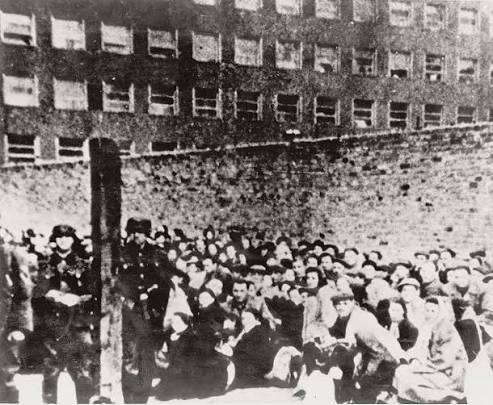
On the eve of Hitler’s birthday, April 19, 1943, the streets of Warsaw’s Jewish ghetto erupted in gunfire. For nearly a month, a few hundred poorly armed Jewish fighters held off thousands of German troops, turning a symbol of Nazi oppression into a beacon of resistance. This is the story of life in the ghetto and the desperate, heroic stand that followed.
The Ghetto: A City Within a City
In October 1940, the German occupiers sealed off a 3.3-square-kilometer area of Warsaw, confining over 400,000 Jews behind brick walls and barbed wire. At its peak, the ghetto held about 460,000 people roughly 30% of the city’s population in just 2.4% of its area. Families crowded into rooms with seven to nine people, sometimes thirteen. The official food ration provided a mere 184 calories per day, a death sentence in slow motion.
Daily Survival: Smuggling, Soup Kitchens, and the Black Market
To survive, the ghetto developed a clandestine economy. Smuggling was not a crime but a necessity. Children, small and nimble, crawled through sewers or slipped over walls to bring in food. The black market thrived, with the wealthy eating well while the poor starved in the streets. Soup kitchens run by charitable organizations offered meager meals, but they could not stem the tide of hunger. By mid-1942, over 83,000 Jews had died from starvation, typhus, and exposure.
Culture and Resistance: The Spirit Endures
Despite the misery, life persisted. Underground theaters staged plays, orchestras performed in secret, and schools operated in basements. Religious services continued, and political parties met covertly. Historian Emanuel Ringelblum organized the Oneg Shabbat archive, burying documents in milk cans to ensure the truth would survive even if they did not. This cultural defiance was a precursor to armed rebellion.
The Great Action: Deportations to Treblinka
From July to September 1942, the Germans conducted the “Great Action,” deporting approximately 265,000 Jews to the Treblinka extermination camp. The Judenrat, led by Adam Czerniaków, faced an impossible choice. When ordered to sign deportation orders for children, Czerniaków committed suicide. The deportations shattered the illusion that labor would save them. Those who remained about 50,000 to 70,000 knew the end was near.
The Birth of the Resistance
In October 1942, a coalition of Jewish youth movements and political factions formed the Jewish Combat Organization (ŻOB), with Mordechai Anielewicz as commander. A separate right-wing group, the Jewish Military Union (ŻZW), led by Pavel Frenkel, also prepared for battle. They acquired a handful of pistols, grenades, and Molotov cocktails, and built a network of bunkers and tunnels. When the Germans returned for another round of deportations in January 1943, ŻOB fighters ambushed them, forcing a four-day retreat. It was a small but crucial victory.
The Uprising: April 19 – May 16, 1943
On April 19, 1943, German forces entered the ghetto to liquidate it, expecting little resistance. They were met with gunfire and homemade bombs. The fighters, numbering about 750 to 1,000, used hit-and-run tactics, disappearing into bunkers and rooftops. The Germans, initially 2,000 strong, brought in tanks, artillery, and flame throwers. The fighting was brutal and unequal. The Germans systematically burned buildings, forcing fighters into the open. By May 8, the ŻOB command bunker at 18 Miła Street fell; Anielewicz and many of his comrades died there. The uprising was finally suppressed on May 16, when SS General Jürgen Stroop declared, “The Warsaw Ghetto is no more.”
Aftermath and Legacy
Over 13,000 Jews were killed during the uprising, and about 7,000 were deported to Treblinka. The remaining survivors, some 42,000, were captured and sent to labor and death camps. German casualties were light around 300 to 400. But the uprising had profound significance. It was the largest single act of Jewish resistance during the Holocaust, proving that even in the face of annihilation, defiance was possible. The fighters chose how to die, and in doing so, they inspired future revolts in other ghettos and camps.
Conclusion
The Warsaw Ghetto Uprising was not a military victory, but a moral one. It demonstrated that the human spirit could resist even the most systematic dehumanization. The courage of the fighters, and the resilience of the ghetto’s inhabitants, remains a testament to the will to live and the refusal to surrender. Their story is a reminder that even in the darkest times, hope and resistance can emerge.
Summary
- The Warsaw Ghetto confined over 460,000 Jews in 3.3 square kilometers, with deadly overcrowding and starvation.
- Daily life involved smuggling, black markets, and a vibrant clandestine culture, including the Oneg Shabbat archive.
- The “Great Action” of 1942 deported 265,000 to Treblinka, leading to the formation of the ŻOB and ŻZW resistance groups.
- The uprising began April 19, 1943, and lasted nearly a month, with 750–1,000 fighters against 2,000–4,000 German troops.
- Though suppressed, the uprising became a symbol of Jewish resistance, inspiring future revolts.
FAQ
Q: What was the Warsaw Ghetto?
A: A sealed district in Warsaw where over 400,000 Jews were forced to live in overcrowded, unsanitary conditions, with minimal food and constant threat of deportation.
Q: How did Jews resist before the uprising?
A: Through smuggling, cultural activities, underground schools, and the secret Oneg Shabbat archive, which documented life and preserved evidence for posterity.
Q: Who led the uprising?
A: The Jewish Combat Organization (ŻOB), commanded by Mordechai Anielewicz, and the Jewish Military Union (ŻZW), led by Pavel Frenkel.
Q: Why did the uprising happen?
A: After mass deportations to Treblinka, it became clear that the Germans intended to exterminate all Jews. The remaining residents chose to fight rather than go passively to their deaths.
Q: What was the outcome?
A: The uprising was crushed, with most fighters killed or deported, but it became a powerful symbol of resistance and a moral victory against Nazi tyranny.
Leave a Reply