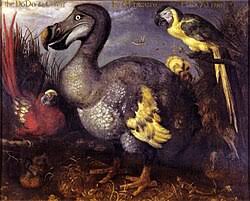
In 1598, Dutch sailors stumbled upon an island in the Indian Ocean and found a bird so unafraid that they could walk right up and grab it. The bird stood a meter tall, weighed as much as a large turkey, and had wings too small to fly. Within six decades, it was gone. The dodo’s extinction is often blamed on hungry sailors, but the real story is more complex—and its lessons echo into modern conservation efforts.
A Giant Pigeon on a Predator-Free Island
The dodo (Raphus cucullatus) was not a clumsy, overweight oddity as often depicted. It was a giant pigeon, a member of the Columbidae family, that evolved on Mauritius, an island formed by volcanic activity about 8 million years ago. Critically, Mauritius had no native land mammals. With no predators, the dodo lost its need to fly, evolving vestigial wings and a stout body. It nested on the ground, laid perhaps one egg per clutch, and showed no fear of the newcomers.
The island’s isolation also meant that the dodo’s ecosystem was delicate. When humans arrived, they brought more than just themselves: rats hidden in ships, pigs, goats, monkeys, cats, and dogs. These invaders feasted on dodo eggs and chicks, while settlers cleared forests for agriculture. The dodo’s slow reproduction and limited range sealed its fate.
The Real Causes: More Than Just Hunting
Popular accounts often claim sailors ate dodos into extinction. But contemporary reports suggest dodo meat was tough and not particularly tasty. The primary drivers were likely the introduced predators and habitat destruction. Rats and pigs devoured ground nests; monkeys and cats attacked adults. Deforestation removed the dodo’s food sources and nesting areas.
A timeline reveals the speed of the collapse: the first recorded sighting was in 1598, and the last credible sighting occurred in 1662, when shipwrecked sailor Volkert Evertsz saw one on a nearby islet. By the 1680s, the dodo was likely extinct, just 60 to 90 years after contact.
The Dodo in Culture and Science
The dodo entered popular culture long after its demise. In 1865, Lewis Carroll featured a Dodo in Alice’s Adventures in Wonderland, a character often read as a satirical self-portrait (Carroll had a stutter and pronounced his name “Do-Do”) or as a commentary on absurdity. The phrase “as dead as a dodo” soon followed.
Scientifically, the dodo became a case study in island biogeography. Its extinction demonstrated how isolated ecosystems are uniquely vulnerable to invasive species. It is often cited as the first documented human-caused extinction, predating the modern conservation movement.
Modern Rediscovery and Conservation Lessons
For centuries, scientists had only fragments of dodo skeletons. In the 19th century, the Oxford specimen—a head and foot—was the most complete. It wasn’t until 2005 that excavations at the Mare aux Songes swamp in Mauritius yielded thousands of bones, allowing detailed study of dodo biology. These findings challenged earlier assumptions: the dodo was likely leaner and faster than the bloated bird of lore.
The dodo’s story is a cautionary tale for conservation. It highlights the dangers of introducing non-native species and the irreversible loss of biodiversity. Today, Mauritius still faces challenges with invasive species, but the dodo serves as a powerful emblem for extinction awareness, appearing in environmental campaigns and even sparking speculative discussions about de-extinction using its closest living relative, the Nicobar pigeon.
The dodo’s fall was not inevitable. It was a consequence of human action and ecological naivety. As we confront a global biodiversity crisis, the dodo reminds us that extinction is forever—and that prevention is far better than resurrection.
The dodo’s extinction is not just a historical footnote but a stark warning. It shows how quickly a species can vanish when its environment is altered by human activity. The lessons from Mauritius—about invasive species, habitat loss, and the fragility of island ecosystems—apply to conservation efforts worldwide. In remembering the dodo, we are reminded of our responsibility to protect the species that still share our planet.
Summary
- The dodo was a giant flightless pigeon endemic to Mauritius, evolving without natural predators.
- It went extinct ~60-90 years after human contact, primarily due to introduced predators (rats, pigs, monkeys) and habitat loss, not just hunting.
- Its ground nesting and slow reproduction made it highly vulnerable.
- The dodo became a cultural symbol of extinction, popularized by Lewis Carroll’s ‘Alice in Wonderland’ and the phrase ‘as dead as a dodo’.
- Modern excavations (2005-present) have revealed new insights, and the dodo remains a cautionary case for conservation.
FAQ
Q: What did the dodo actually look like?
A: The dodo stood about 1 meter tall and weighed roughly 10-18 kg. It had a large hooked beak, small vestigial wings, a stout body, and a tuft of curly feathers on its rear. Its plumage was likely grey-brown, though no confirmed living color images exist.
Q: Why did the dodo become extinct?
A: The primary causes were predation by introduced species (rats, pigs, monkeys, cats, dogs) on eggs and chicks, and habitat destruction by settlers. Hunting by humans was a contributing factor but not the main cause.
Q: When did the dodo go extinct?
A: The last credible sighting was in 1662, though some reports suggest possible sightings into the 1680s. The estimated extinction date is between 1662 and 1690.
Q: Is there any chance of bringing the dodo back?
A: Some scientists have discussed de-extinction using the Nicobar pigeon as a surrogate, but this remains highly speculative and controversial. No concrete plans are in place.
Q: What lessons does the dodo teach us today?
A: The dodo illustrates the vulnerability of island ecosystems to invasive species and the irreversible nature of human-caused extinction. It underscores the importance of proactive conservation measures.
Leave a Reply