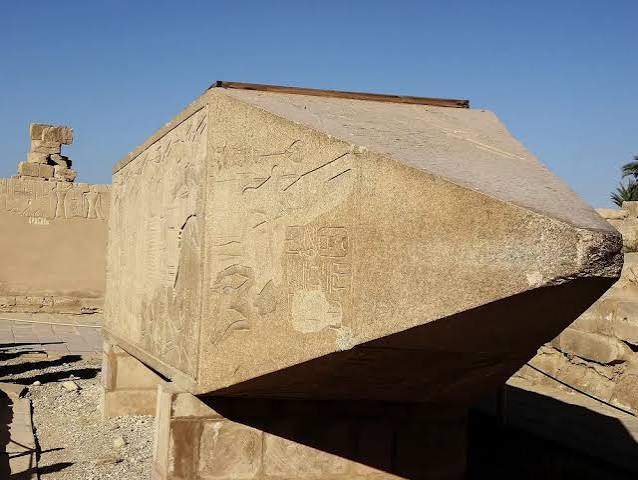
In the heart of the Karnak temple complex, a single red granite spire rises nearly 100 feet into the sky. It is the largest surviving obelisk from ancient Egypt, and its inscriptions tell a story that someone once tried very hard to erase. This is the story of Hatshepsut, the woman who ruled Egypt as a king, and the monument that survived the damnation of her memory.
For centuries, her name was missing from king lists. But the obelisk at Karnak never forgot her. Carved into its surface is a bold claim to divine legitimacy, made by a ruler who dared to wear the double crown of Upper and Lower Egypt when tradition demanded a male pharaoh. The obelisk is not just a piece of stone; it is a political manifesto, a theological argument, and a testament to how one woman bent the rules of cosmic order without breaking them.
Today, archaeologists and historians have pieced together a remarkable picture of Hatshepsut’s reign and her deliberate erasure. The obelisk survived because someone tried to hide it—and that irony preserves a legacy that the erasers meant to destroy.
A Woman Who Took the Throne
Hatshepsut was born into the royal family of Egypt’s 18th Dynasty, around 1507 BCE. Her father, Thutmose I, was pharaoh; her mother, Ahmose, was his Great Royal Wife. When her father died, she married her half-brother Thutmose II, as was customary. But Thutmose II’s reign was short, and when he died around 1479 BCE, his heir—Thutmose III—was still a child. Hatshepsut, as the queen and regent, began ruling in his name.
At first, she was a conventional regent, the kind of woman who had held power before. But within a few years, she did something unprecedented: she crowned herself pharaoh, taking the full fivefold titulary that only kings could claim. She adopted the throne name Maatkare, meaning “The Maat of Ra is the Ka of Hatshepsut.” She began to be depicted in the traditional regalia of a king—the false beard, the kilt, the crowns. In some reliefs, she still appears as a woman, the daughter of the god Amun. In others, she is unequivocally a man. This was not confusion; it was a pragmatic code-switching that let her claim divine birth and legitimate kingship simultaneously.
The Obelisk as Divine Propaganda
The obelisk at Karnak was her most audacious statement. It stands about 29 meters (97 feet) tall and weighs an estimated 320–350 tons, making it the largest obelisk ever successfully erected in Egypt. Quarried from red granite at Aswan, it was transported roughly 200 kilometers down the Nile on a barge, then raised in the precinct of Amun-Ra, the god she claimed as her father.
Obelisks were not just decorative monuments. They were “petrified rays of the sun,” linking the pharaoh directly to Ra and Amun-Ra. By erecting one, a king asserted his divine favor and his right to rule. Hatshepsut’s obelisk went further: its inscriptions describe her divine birth, claiming that Amun himself had disguised as Thutmose I and impregnated her mother. In one famous passage, she declares, “I have done this with a loving heart for my father Amun… I have not forgotten what he commanded.” This was theology deployed for political ends—an argument that her rule was not a usurpation but a divine appointment.
The Erasure Campaign
After Hatshepsut died around 1458 BCE, Thutmose III—now ruling in his own right—ordered a systematic campaign to chisel her name, images, and cartouches from monuments across Egypt. Her statues were smashed and buried in pits near her mortuary temple at Deir el-Bahri. Her obelisks were walled up or defaced.
For centuries, this was seen as the revenge of a stepson who resented his stepmother’s power grab. But modern scholarship suggests a more nuanced motive. Egyptologist Suzanne Onstine and others argue that the erasure was less about personal anger and more about dynastic politics. Thutmose III needed to legitimize his own son’s succession by reasserting the male line. If he erased Hatshepsut from the record, it would appear that he had ruled directly after his father, Thutmose II, with no female king in between. The erasure was targeted, bureaucratic, and incomplete—many inscriptions survived, suggesting it was not a furious rampage but a calculated project, possibly carried out late in Thutmose III’s reign or even under his son Amenhotep II.
The standing obelisk at Karnak survived because it was partially hidden. Later builders walled around its base, and the upper inscriptions were protected by the enclosure. Ironically, the attempt to hide it preserved it for future generations.
Rediscovery and the Mummy
Hatshepsut truly became “forgotten” for millennia, her name missing from king lists. But in 1822, Jean-François Champollion—fresh from deciphering hieroglyphs—noticed the erased cartouches at Karnak. In 1903, Howard Carter, later famous for Tutankhamun, excavated her tomb (KV20). Yet it wasn’t until 2007 that the Egyptian Mummy Project made a dramatic identification: a mummy from a small tomb (KV60A) was confirmed as Hatshepsut via a tooth found in a box bearing her name. The tooth matched perfectly. The female king had been found.
What the Obelisk Reveals
The obelisk is more than a record of Hatshepsut’s reign; it is a window into how she navigated a system that was not designed for her. By blending genders in her iconography and claiming divine parentage, she created a space for herself in a role that was ideologically male. She did not try to change the system; she found a way to fit into it, making herself into a king who happened to be a woman.
The erasure campaign, meanwhile, reveals the fragility of power and memory. Even a pharaoh could be written out of history. But the obelisk stood, hidden in plain sight, and its inscriptions outlasted the chisels of her successors. It remains a monument not only to her reign but to the very idea that history can be manipulated—and that sometimes, the truth endures.
Hatshepsut’s obelisk at Karnak is a survivor. It survived the quarrying, the transport, the erection, and the deliberate erasure that followed her death. It survived because someone tried to wall it up, and in doing so, they protected it from the chisels that defaced so many other monuments. Today, it stands as a reminder that history is not a fixed record but a battlefield. And in that battle, Hatshepsut—the female king who was nearly forgotten—may have won after all.
Summary
- Hatshepsut ruled Egypt as pharaoh in the 18th Dynasty (c. 1479–1458 BCE), taking the full titulary of a king, a step unprecedented for a woman.
- Her largest surviving obelisk at Karnak stands 29 meters (97 feet) tall, weighs 320–350 tons, and bears inscriptions claiming divine birth and legitimacy.
- After her death, Thutmose III ordered a campaign to erase her name and images, but the erasure was incomplete and possibly politically motivated rather than personal.
- The obelisk survived because it was partially walled up, which protected its inscriptions from defacement.
- Rediscovered in modern times, Hatshepsut was finally identified in 2007 when a tooth matched a mummy in KV60A.
FAQ
Q: Why did Hatshepsut have to present herself as a man in some depictions?nA: Egyptian kingship was ideologically male—the pharaoh was the living Horus, son of Ra. To be accepted as pharaoh, Hatshepsut often had to adopt male regalia and pronouns, while in other contexts she remained clearly female, especially in religious narratives that called her the daughter of Amun.nnQ: Was Thutmose III’s erasure of Hatshepsut motivated by hatred?nA: Modern scholarship suggests it was more about dynastic legitimacy than personal revenge. By erasing Hatshepsut, Thutmose III could present his own rule as a direct succession from his father, Thutmose II, without a female king in between. The erasure was targeted and incomplete, not a furious campaign.nnQ: How did the obelisk survive the erasure?nA: The base of the obelisk was walled up by later builders, and the upper inscriptions were protected by the enclosure. This partial hiding preserved it from the chisels that defaced other monuments.nnQ: How was Hatshepsut’s mummy identified?nA: In 2007, the Egyptian Mummy Project matched a tooth found in a box bearing Hatshepsut’s name to a mummy from tomb KV60A. The tooth fit exactly, confirming the identity.nnQ: What does the obelisk inscription say about her rule?nA: The inscriptions describe her divine birth, claiming that Amun disguised as Thutmose I fathered her, and emphasize her loving devotion to Amun. They were a theological justification for her kingship, arguing that the gods had chosen her to rule.
Leave a Reply