Tag: Nazi Germany

  • The Invasion of Poland: The 36 Days That Began World War II

    The Invasion of Poland: The 36 Days That Began World War II

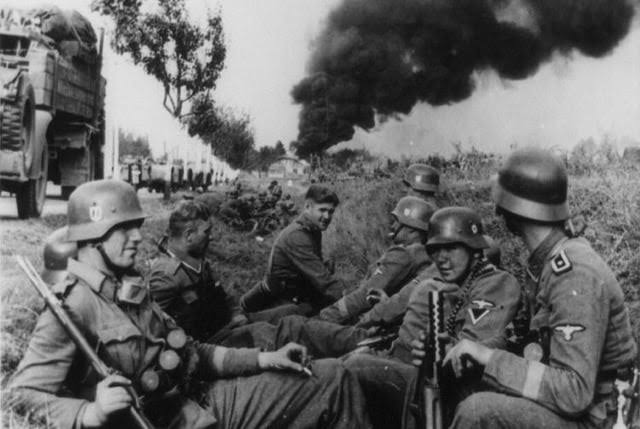
    At 4:45 AM on September 1, 1939, the German battleship Schleswig-Holstein opened fire on a Polish military transit depot at Westerplatte, near Danzig. Within minutes, German dive-bombers screamed over Polish cities, and armored columns crashed across the border from three directions. The invasion of Poland had begun not as a border skirmish, but as the opening act of the deadliest conflict in human history.

    Poland’s army, nearly a million strong, was the fifth-largest in Europe. It had tanks, aircraft, and a plan. But the plan relied on something that never came: a Western offensive against Germany. By October 6, organized Polish resistance was over. The country was partitioned between Hitler’s Reich and Stalin’s USSR. The war that followed would claim over 50 million lives.

    The False Dawn: Poland Between the Wars

    Poland had been erased from maps for 123 years, partitioned by Russia, Prussia, and Austria. Its rebirth in 1918 was a miracle of Versailles and the Polish-Soviet War of 1919–21. But the reconstituted state was fragile. The Polish Corridor, a strip of land giving Poland access to the Baltic Sea, sliced East Prussia off from the rest of Germany. Danzig (now Gdańsk) was declared a Free City under League of Nations oversight, its population overwhelmingly German. To Hitler, this was an intolerable wound. To many Germans, it was a genuine grievance — but Hitler had no interest in negotiation. He wanted war.

    Nazi propaganda called Poland a “seasonal state” (Saisonstaat), a temporary aberration created by the Treaty of Versailles. Poles were portrayed as Untermenschen — subhumans. Hitler’s real goal was Lebensraum, living space for the German people in the East. Poland was the first target, not the last.

    The Pact That Shocked the World

    On August 23, 1939, the world witnessed one of the most cynical diplomatic reversals in history. Nazi Germany and the Soviet Union, ideological enemies, signed the Molotov-Ribbentrop Pact. Publicly, it was a non-aggression treaty. Secretly, it divided Eastern Europe into spheres of influence. Poland would be split roughly along the Bug River — the same line Stalin had demanded in 1920.

    Stalin’s motives were cold and strategic. He distrusted Hitler but needed time to rebuild the Red Army, decimated by his own purges. The pact gave him a buffer zone and the chance to reclaim territories lost after World War I. It also ensured that if Germany attacked, the USSR would not be the first target. For Poland, the pact was a death sentence, signed behind its back.

    Blitzkrieg: The German Onslaught

    September 1, 1939. Germany hurled 1.5 million troops, 2,700 tanks, and 2,300 aircraft at Poland. The strategy was Blitzkrieg — lightning war. It wasn’t just about speed; it was about coordination. Panzer divisions punched through weak points, encircling entire Polish armies. Stuka dive-bombers acted as flying artillery, shattering communications and morale. The Polish air force, with roughly 400 outdated planes, was largely destroyed on the ground in the first days.

    Poland had mobilized about a million men, but not all units reached their positions. Its 880 tanks were mostly obsolete, its cavalry — despite romantic myths — was used for reconnaissance, not charges against armor. The Polish plan was defensive: hold the frontier, fall back to the Vistula River, and wait for France and Britain to attack Germany from the west. That attack never came.

    The Western Allies: Words Without Action

    On September 3, Britain and France declared war on Germany. But the declaration was followed by silence. In the west, the French army sat behind the Maginot Line while Germany’s western frontier was defended by only about 30 second-rate divisions. The main German forces were in Poland. A determined Allied offensive might have broken through. It didn’t happen. This period became known as the “Phoney War” — a strange, eerie calm in the West while Poland burned.

    Historians still debate whether an Allied attack could have changed the course of the war. What is certain is that Poland was let down. Its government had signed a military alliance with France in 1921 and received British guarantees in 1939. Those promises proved hollow. The Polish campaign lasted 36 days — not because Poland was weak, but because it fought alone against two overwhelming enemies.

    The Soviet Invasion: The Stab in the Back

    On September 17, 1939, the Red Army crossed Poland’s eastern border. Officially, Moscow claimed it was “liberating” ethnic Ukrainians and Belarusians from Polish oppression. In reality, it was executing the secret protocol of the Molotov-Ribbentrop Pact. Soviet forces numbered up to 800,000 troops, with thousands of tanks and aircraft. Polish resistance in the east was light — the country was already collapsing under the German onslaught.

    The timing was deliberate. The Polish government and military command had just fled to Romania, hoping to continue the fight from exile. The Soviet invasion sealed Poland’s fate. There was no possibility of a prolonged defense. The last major engagement, the Battle of Kock, ended on October 6. Poland was partitioned once again — the fourth partition in its history.

    The Human Cost: Numbers That Stun

    Poland’s military lost an estimated 66,000–70,000 dead and 130,000–200,000 wounded. Around 700,000 soldiers were captured by Germany and the USSR. Civilians fared no better. Between 150,000 and 200,000 Polish civilians were killed during the campaign itself, many in bombing raids, executions, and atrocities. The Luftwaffe bombed open cities, hospitals, and refugee columns — a foretaste of total war.

    German casualties were light by comparison: roughly 16,000–17,000 dead and 30,000 wounded. Soviet losses were even smaller, around 1,000–3,000 killed. But the true horror came later. In 1940, the NKVD executed approximately 15,000–20,000 Polish officers and intelligentsia in the Katyn Forest and other sites. The Nazis would go on to kill millions of Polish citizens, including nearly all of Poland’s 3 million Jews. The invasion was not just a military campaign; it was the beginning of a racial war of annihilation.

    Acts of Defiance: Westerplatte, Bzura, and Warsaw

    Even in defeat, there were moments of extraordinary courage. The Battle of Westerplatte lasted seven days. Outnumbered and outgunned, a garrison of 182 Polish soldiers held out against naval bombardment and ground assaults before surrendering. The Battle of the Bzura was the largest Polish counterattack of the campaign. For a week, Polish forces managed to temporarily halt a German advance, inflicting significant casualties. The defense of Warsaw held until September 27–28, when relentless bombing and shelling forced the city to capitulate.

    These actions did not change the outcome, but they defined Poland’s narrative of resistance. The campaign may have been a military disaster, but it was not a moral one. The Polish government-in-exile continued the fight in France and Britain, and the Polish Underground State would become one of the largest resistance movements in occupied Europe.

    The Legacy: A War Begun in Deceit

    The invasion of Poland is often cited as the clearest case of aggressive war under international law. It was the central charge at the Nuremberg trials. The Molotov-Ribbentrop Pact remains a symbol of how great powers can sacrifice smaller nations for their own ends. For Poland, the war lasted five and a half years, but the occupation was genocidal. An estimated 6 million Polish citizens died — about 17% of the country’s population.

    The invasion also shattered the illusion that appeasement could contain Hitler. It forced a reluctant Britain and France into war. And it set the stage for the Holocaust, the Eastern Front, and the division of Europe that would last until 1989. The 36 days of the Polish campaign were not just a prelude; they were the explosion that set the world ablaze.

    The invasion of Poland was a collision of brutal ideology, diplomatic betrayal, and military innovation. It ended with a country erased from maps again, but it also ignited a war that would ultimately consume its aggressors. The courage of Polish soldiers and civilians, fighting against overwhelming odds without allied help, remains a stark reminder of what happens when states choose appeasement over resistance. The war that began on September 1, 1939, did not end until 1945, but its first chapter was written in Polish blood.

    Summary

    • Germany invaded Poland on September 1, 1939, using Blitzkrieg tactics. Poland was outnumbered and outgunned, with obsolete equipment and a defensive strategy.
    • The Soviet Union invaded from the east on September 17, 1939, as per the secret Molotov-Ribbentrop Pact. Poland was partitioned between Germany and the USSR.
    • Britain and France declared war on Germany but did not launch a major offensive, leaving Poland to fight alone.
    • Polish military and civilian casualties were heavy: 66,000–70,000 military dead, 150,000–200,000 civilian dead, and 700,000 captured.
    • The invasion was the opening act of World War II and led to a brutal occupation that killed an estimated 6 million Polish citizens, including 3 million Jews.

    FAQ

    Q: Why did Germany invade Poland?
    A: Hitler wanted to regain Danzig and the Polish Corridor, but his larger goal was Lebensraum — living space for Germans in the East. Nazi ideology viewed Poles as subhumans, and the invasion was the first step in a racial war of annihilation.

    Q: Why did the Soviet Union invade Poland?
    A: The USSR invaded on September 17, 1939, executing the secret protocol of the Molotov-Ribbentrop Pact. Stalin wanted to reclaim territories lost after World War I, create a buffer zone against Germany, and buy time to rebuild the Red Army.

    Q: What was the Molotov-Ribbentrop Pact?
    A: Signed on August 23, 1939, it was a non-aggression treaty between Nazi Germany and the Soviet Union. A secret protocol divided Eastern Europe into spheres of influence, leading to the partition of Poland.

    Q: Why didn’t France and Britain help Poland?
    A: They declared war on Germany on September 3, 1939, but did not launch a major offensive. This period became known as the Phoney War. Historians debate whether an Allied attack could have succeeded, but Poland was left to fight alone.

    Q: How did Poland fall so quickly?
    A: Poland was outnumbered and outgunned, with obsolete tanks and aircraft. Its defense relied on allied help that never came. The Soviet invasion on September 17 sealed Poland’s fate. The last organized resistance ended on October 6, 1939.
  • The Battle of Stalingrad: The Turning Point of World War II

    The Battle of Stalingrad: The Turning Point of World War II

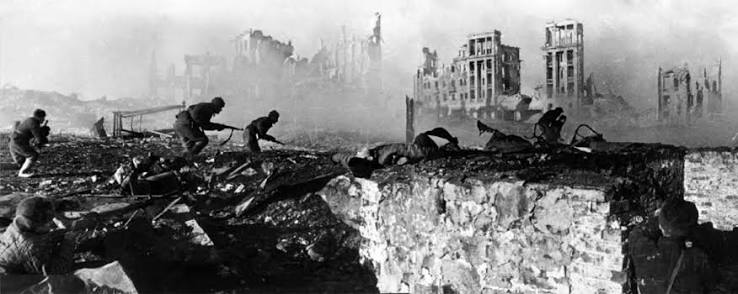
    On August 23, 1942, the German Sixth Army reached the Volga River and began the assault on Stalingrad. What followed was one of the most brutal and consequential battles in human history. Over the next five months, the city became a maelstrom of urban combat, where soldiers fought for every block, floor, and room. By the time the last German forces surrendered on February 2, 1943, over a million soldiers and tens of thousands of civilians had perished. The Battle of Stalingrad was not just a military engagement; it was the turning point of World War II in Europe, the moment when the Nazi war machine irrevocably lost its momentum and the Red Army began its relentless march toward Berlin.

    The battle’s significance extends beyond its staggering casualties. It shattered the myth of German invincibility, marked the first time a German field marshal was captured, and demonstrated the resilience of the Soviet people under unimaginable hardship. In the rubble of Stalingrad, the fate of the Eastern Front—and ultimately the entire war—was decided.

    The Road to Stalingrad

    In the summer of 1942, Hitler launched Operation Blue, a massive offensive aimed at the southern Soviet Union. The objectives were clear: capture the oil fields of the Caucasus and secure the Volga River, a vital supply artery. Stalingrad, a major industrial city and Stalin’s namesake, lay directly in the path. The German Sixth Army, the largest in the Wehrmacht with over 330,000 men, was tasked with taking the city.

    The advance was rapid. By late August, the Germans had reached the outskirts and began a devastating aerial bombardment that reduced much of the city to rubble. The Luftwaffe’s bombing raids were so intense that the city’s defenders, the Soviet 62nd Army under General Vasily Chuikov, were forced to fight amidst the ruins. The Volga River became a lifeline, with reinforcements and supplies ferried across under constant fire.

    The Rat War

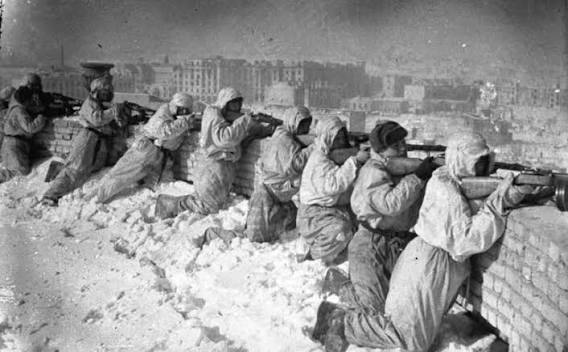
    The fighting in Stalingrad degenerated into what soldiers called “rat war” (Rattenkrieg). It was close-quarters combat at its most brutal—block by block, floor by floor, room by room. Chuikov adopted a radical tactic: “hugging the enemy.” By keeping Soviet lines uncomfortably close to German positions, he prevented the Luftwaffe and German artillery from striking without risking their own troops. This nullified the Germans’ advantage in firepower and turned the battle into a brutal grind of attrition.

    Snipers became iconic figures. Vasily Zaytsev, a Soviet sniper credited with over 200 kills, became a symbol of the Red Army’s determination. The city’s industrial plants—the tractor factory, the Red October steel plant, and the Barrikady arms factory—became fortified strongpoints, fought over with desperate intensity.

    The Soviet Counteroffensive: Operation Uranus

    While the world’s attention was fixed on the city’s defenders, Soviet commanders Georgy Zhukov and Aleksandr Vasilevsky were planning a massive counteroffensive. They identified a critical weakness: the German flanks were held by weaker Romanian, Italian, and Hungarian units. Operation Uranus, a double envelopment, was launched on November 19, 1942. The Red Army broke through the Romanian lines and within four days encircled the entire German Sixth Army, along with parts of the Fourth Panzer Army—about 300,000 men trapped in a pocket 30 miles wide.

    Hitler refused to authorize a breakout, ordering the Sixth Army to hold as “Fortress Stalingrad” and await relief. Field Marshal Erich von Manstein’s Operation Winter Storm, launched on December 12, came within about 30 miles of the pocket but failed to break through. The Luftwaffe’s promise to supply the trapped army by air proved catastrophic—they could deliver at most 100 to 120 tons per day, far short of the 700 tons required. Starvation and cold began to decimate the encircled forces.

    The End and the Surrender

    The Red Army tightened the noose, splitting the pocket and forcing the Germans into ever-shrinking areas of control. On January 30, 1943, Hitler promoted General Friedrich Paulus to Field Marshal—an implicit order to commit suicide, as no German field marshal had ever been captured. Paulus disobeyed and surrendered the next day. The last German units in the northern pocket capitulated on February 2, 1943.

    The scale of the catastrophe was staggering. The Axis suffered an estimated 800,000 to 850,000 casualties, including over 100,000 prisoners taken at surrender, of whom fewer than 6,000 ever returned home. Soviet losses were even higher, with over a million killed, wounded, or missing. The city itself was a wasteland, with tens of thousands of civilians dead.

    A Turning Point

    Stalingrad marked the definitive turning point in the European theater. After February 1943, the Wehrmacht never regained the strategic initiative on the Eastern Front. The Red Army began a continuous westward advance that would end in Berlin. The battle also had profound psychological and political effects. It shattered the aura of German invincibility and demonstrated to the world that the Nazi war machine could be defeated. In the words of one German soldier, “Stalingrad is the turning point of the war. We are lost.”

    The Battle of Stalingrad was a crucible of suffering and sacrifice, a confrontation that decided the fate of nations. The Red Army’s victory was not just a military triumph but a testament to human endurance in the face of unimaginable adversity. It remains a stark reminder of the cost of war and the resilience of those who fight for survival.

    Summary

    • The Battle of Stalingrad lasted from August 23, 1942, to February 2, 1943, and resulted in a decisive Soviet victory.
    • The German Sixth Army was encircled by Operation Uranus and destroyed, marking the first time a German field marshal was captured.
    • The battle caused over 1.5 million total casualties, making it one of the deadliest in history.
    • Stalingrad was the turning point of World War II in Europe; the Wehrmacht never regained the strategic initiative.
    • The Soviet tactic of “hugging the enemy” nullified German firepower in brutal urban combat.

    FAQ

    Q: Why was Stalingrad strategically important?
    A: Stalingrad was a major industrial center and a symbolic city named after Stalin. Controlling it would secure the Volga River supply route and protect the flank of German forces advancing toward the Caucasus oil fields.

    Q: How did the Soviet Union manage to turn the tide?
    A: The Soviets launched Operation Uranus, a massive counteroffensive targeting the weaker Romanian units on the German flanks, leading to the encirclement of the German Sixth Army.

    Q: What was the “rat war”?
    A: “Rat war” (Rattenkrieg) was the term soldiers used for the brutal close-quarters combat in Stalingrad, where fighting occurred block by block, floor by floor, and room by room.

    Q: How many casualties were there?
    A: Axis casualties were about 800,000 to 850,000, while Soviet casualties were over 1.1 million, including military and civilian deaths.

    Q: What happened to Field Marshal Paulus?
    A: Paulus was promoted to Field Marshal by Hitler on January 30, 1943, an implicit order to commit suicide. He instead surrendered, becoming the first German field marshal to be captured by the enemy.

  • The Last 2.5 Million: Inside the Brutal Final Act of the Battle of Berlin

    The Last 2.5 Million: Inside the Brutal Final Act of the Battle of Berlin

    On April 16, 1945, the roar of over 41,000 Soviet artillery pieces shattered the pre-dawn silence along the Oder River. Marshal Georgy Zhukov had ordered the largest artillery barrage in history, using 143 searchlights to blind the German defenders. But the first assault on the Seelow Heights stalled, costing thousands of lives in hours. This was the beginning of a battle that would consume Berlin block by block, end with Hitler’s suicide, and seal the fate of Nazi Germany.

    The Strategic Trap: Why Berlin Became Inevitable

    By early 1945, the Red Army stood 60 kilometers from Berlin, having swept across Poland in the Vistula-Oder Offensive. The Western Allies had crossed the Rhine in March, and a race for the German capital seemed possible. But General Dwight Eisenhower made a controversial decision: he halted the Western advance at the Elbe River, prioritizing the encirclement of the Ruhr and a push south. This was driven by military pragmatism—avoiding a costly urban fight—and the Yalta Agreement, which had already divided post-war Germany into occupation zones. Churchill protested, seeing Berlin as a political prize, but Stalin, suspicious of Western intentions, accelerated his offensive. The city was to be taken by the Soviets, and Stalin wanted it before the West could change the calculus.

    The Seelow Heights: A Bloody Gateway

    The first major obstacle was the Seelow Heights, a plateau about 70 kilometers east of Berlin. Zhukov’s 1st Belorussian Front attacked head-on, expecting a quick breakthrough. Instead, the Germans, under General Gotthard Heinrici, had anticipated the assault and pulled back from the first line. The Soviet advance was met with concentrated fire, and the initial attack faltered. For three days, the battle raged. Soviet artillery and numbers eventually overwhelmed the defenders, but the cost was staggering: roughly 30,000 to 33,000 Soviet soldiers died in this single engagement. The breakthrough came on April 19, opening the road to Berlin.

    While Zhukov battered the Seelow Heights, Marshal Ivan Konev’s 1st Ukrainian Front attacked from the south, crossing the Neisse River and pushing toward Berlin. The two fronts converged in a giant pincer, encircling the city by April 25. The same day, American and Soviet troops met at Torgau on the Elbe, symbolically linking the two fronts. Berlin was now cut off, but the defenders had no intention of surrendering.

    The Führerbunker: A Fantasy of Resistance

    Inside Berlin, Hitler had retreated to the Führerbunker, a concrete complex beneath the Reich Chancellery. He refused to consider surrender, ordering impossible counterattacks. One such order sent General Walther Wenck’s 12th Army, which was actually fighting on the Western Front, to relieve Berlin. Wenck’s army never reached the city. Hitler declared that Berlin would be defended to the last man, and the defenders were a desperate mix: regular Wehrmacht soldiers, SS units, police, Volkssturm (old men and boys), and Hitler Youth. They numbered roughly 766,000 to 1 million, but they were short on fuel, ammunition, and morale. Many were fighting with captured weapons or Panzerfausts, while Soviet tanks prowled the streets.

    The city itself was a fortress of rubble. The Soviets, having learned from Stalingrad, used small assault groups—infantry supported by tanks, heavy guns, and flamethrowers—to clear buildings block by block. The fighting was vicious and intimate. Civilians huddled in cellars, and the constant bombardment made the city a hellscape.

    The Fall of the Reichstag and Hitler’s End

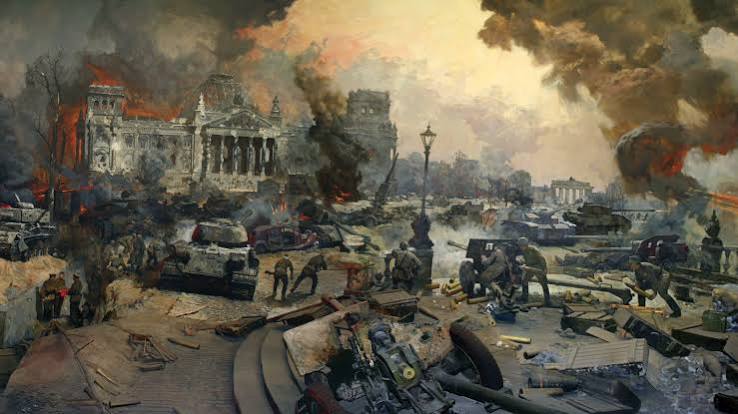
    On April 30, Soviet troops stormed the Reichstag, the symbolic heart of Nazi power. After hours of close-quarters combat, they raised the Red Flag over the building—a moment captured in an iconic photograph taken on May 2, though the first flag was raised on April 30. That same day, Hitler married Eva Braun in the bunker and then committed suicide. His body was burned in the courtyard. Joseph Goebbels, the propaganda minister, and his wife killed their children and then themselves on May 1. With the leadership dead and the city in ruins, General Helmuth Weidling, the commander of the Berlin Defense Area, surrendered the city on May 2.

    The battle was over, but the cost was immense. Soviet official records list 81,116 killed or missing and 280,251 wounded, though some historians estimate higher. German military casualties were around 92,000 to 100,000 killed, with 220,000 wounded and 480,000 captured. Civilian deaths in Berlin remain uncertain, with estimates ranging from 22,000 to over 100,000, including those who died in the fighting, from starvation, or in the wave of suicides that swept the city—an estimated 3,000 to 4,000 people took their own lives as the Red Army approached.

    The Aftermath: A City Divided, A War Ended

    The Battle of Berlin was not just a military victory; it was the final unraveling of the Nazi regime. The formal German surrender followed on May 8/9, ending the war in Europe. But the human cost lingered. For the Soviets, the victory was a just retribution for the atrocities of the Eastern Front, celebrated annually on May 9. For Germans, it was a catastrophe of their own making, marked by civilian suffering and the trauma of mass rape by Soviet troops—a dark chapter that remained largely unspoken for decades. For the West, it was a strategic decision that shaped the Cold War, with Berlin becoming a divided city and a flashpoint for the next half-century.

    The story of the Battle of Berlin is a study in extremes: the immense scale of the Soviet war machine, the desperation of a collapsing regime, and the human cost of fanaticism. It was a battle where history’s largest artillery barrage met a city reduced to rubble, and where a dictator’s refusal to surrender sealed the fate of millions.

    The Battle of Berlin ended with the Red Army’s victory and Hitler’s suicide, but its legacy is complex. It was a brutal finale to a war that had consumed Europe, a moment of triumph for the Soviets, and a tragedy for the civilians caught in the crossfire. The decisions made in those weeks—Eisenhower’s halt, Stalin’s rush, Hitler’s defiance—reverberated long after the guns fell silent, shaping the post-war world and the Cold War divisions that followed.

    Summary

    • The Battle of Berlin (April 16 – May 2, 1945) was the final major offensive of World War II in Europe, involving approximately 2.5 million Soviet troops against a German force of roughly 766,000–1 million.
    • The Soviet plan was a massive double envelopment, with Zhukov attacking from the east and Konev from the south, encircling the city by April 25.
    • The battle was characterized by brutal urban warfare, with heavy casualties on both sides and catastrophic civilian suffering, including an estimated 3,000–4,000 suicides in Berlin.
    • Hitler committed suicide on April 30, and the city surrendered on May 2, leading to the formal German surrender on May 8/9.
    • The battle’s outcome was shaped by Eisenhower’s decision to halt at the Elbe, leaving Berlin to the Soviets, a choice with lasting Cold War implications.

    FAQ

    Q: Why did the Western Allies not take Berlin?
    A: General Eisenhower halted the Western advance at the Elbe River, citing military pragmatism (avoiding a costly urban battle) and the Yalta Agreement’s division of post-war Germany into occupation zones, which placed Berlin within the Soviet zone.

    Q: How many Soviet soldiers died in the Battle of Berlin?
    A: Official Soviet records list 81,116 killed or missing, with some estimates higher. The battle for the Seelow Heights alone cost roughly 30,000–33,000 Soviet lives.

    Q: What was the role of the Volkssturm in the defense of Berlin?
    A: The Volkssturm was a militia of old men and boys, often poorly armed and trained, conscripted in the final months of the war. They were part of the improvised defense force, alongside Hitler Youth and police units.

    Q: When was the Red Flag raised over the Reichstag?
    A: The first flag was raised on April 30, 1945, though the famous photograph was taken on May 2. The Reichstag was captured after heavy fighting.

    Q: How did the Battle of Berlin affect German civilians?
    A: Civilians suffered greatly: an estimated 22,000 to over 100,000 died, including from fighting, starvation, and suicides. Many also endured the trauma of mass rape by Soviet troops, a painful legacy that was largely unspoken for decades.

  • Erwin Rommel: The Making and Unmaking of the Desert Fox Myth

    Erwin Rommel: The Making and Unmaking of the Desert Fox Myth

    Erwin Rommel is the most famous German general of World War II. His name evokes images of desert warfare, tactical brilliance, and a kind of chivalrous conduct that seemed out of place in the Nazi regime. But the ‘Desert Fox’ was as much a product of propaganda as of actual military achievement. Over the past few decades, historians have chipped away at the legend, revealing a more complex—and less heroic—figure.

    This article separates the man from the myth. We’ll trace Rommel’s rise from a WWI hero to Hitler’s favorite general, examine his campaigns in France and North Africa, and finally confront the uncomfortable truths about his relationship with Nazism and his role in the July 20 plot. The story that emerges is not about a clean soldier in a dirty war, but about a man whose reputation was carefully constructed—and is now being dismantled.

    The Making of a Legend: WWI and the Interwar Years

    Rommel was born in 1891 in Heidenheim, Germany, into a middle-class family. His father was a schoolteacher, and the young Rommel initially considered engineering. But he joined the infantry as an officer cadet in 1910, and the military became his life.

    In WWI, Rommel fought on the Western and Eastern fronts, then in Italy. At the Battle of Caporetto in 1917, he led a series of infiltration attacks that captured key mountain positions, using tactics that would later define his style. For this, he won the Pour le Mérite, Germany’s highest military honor at the time. After the war, he stayed in the army and wrote a manual, Infantry Attacks (1937), based on his experiences. The book caught the attention of Hitler, who was always looking for officers who thought offensively. It also became a bestseller abroad—George Patton read it, and it influenced his own aggressive armored warfare.

    The Ghost Division: Rommel in 1940

    When WWII broke out, Rommel was given command of the 7th Panzer Division. In the invasion of France in May 1940, he ignored orders and pushed his tanks at breakneck speed, often leaving the infantry far behind. His division moved so fast that it became known as the “Ghost Division”—it seemed to be everywhere at once. In one engagement, he used captured British tanks to confuse the enemy. His success was undeniable, but it also sowed seeds for his later arrogance: he believed he could outrun logistics and outsmart any opponent.

    The Desert Fox: North Africa, 1941–1943

    In February 1941, Rommel was sent to North Africa to rescue the struggling Italian army. He arrived with just two divisions, but within weeks he had pushed the British back across the desert. The British, desperate to explain their defeats, began to mythologize Rommel. They called him the “Desert Fox”—a clever, chivalrous enemy who outfoxed them with daring maneuvers. This propaganda suited the British: it made their defeat seem noble and their eventual victory more glorious.

    Rommel’s early successes were real. He recaptured Cyrenaica, besieged the port of Tobruk for months, and by June 1942 he had taken Tobruk and pushed his forces deep into Egypt. For that, Hitler promoted him to Field Marshal. But his advance stalled at El Alamein, just 100 miles from Alexandria. The supply lines stretched, the tanks wore out, and the British under Montgomery had the advantage of shorter logistics. Rommel’s gamble failed. After the Second Battle of El Alamein in October–November 1942, he was forced into a long retreat across Libya and Tunisia, finally leaving Africa in March 1943 due to illness—just before the Axis surrender in Tunisia.

    The Myth and the Reality: Rommel’s Strategic Flaws

    The legend says Rommel was a tactical genius, but historians have pointed out his strategic weaknesses. He often overextended his supply lines, underestimated logistics, and made decisions based on intuition rather than careful planning. His obsession with offensive action could be reckless. In North Africa, he ignored the advice of his quartermasters and pushed too far, which contributed to his eventual defeat. The “military genius” reputation was also inflated by British propaganda—they needed a superhuman enemy to justify their own setbacks.

    A Nazi General? Rommel’s Relationship with the Regime

    For decades, Rommel was seen as an apolitical soldier who served his country, not the Nazi Party. This view was promoted by his widow, his former subordinates, and even the Western Allies after the war, who found him a useful symbol of a “clean” German military. But recent scholarship has painted a different picture.

    Rommel was not a member of the Nazi Party, but he was not opposed to Hitler either. He benefited from Hitler’s favor, receiving rapid promotions and decorations that were often outside the normal chain of command. He also tolerated, and at times supported, war crimes. In North Africa, he ordered “energetic action” against Jewish refugees in Tunisia, and he did not object to the murder of captured commandos. His attitude toward the Holocaust was at best indifferent, at worst complicit.

    The July 20 Plot and Forced Suicide

    By 1944, Rommel was in command of Army Group B in Normandy, tasked with defending the Atlantic Wall against an expected Allied invasion. He argued that the panzer divisions should be stationed near the coast, but Hitler overruled him. On D-Day, June 6, 1944, Rommel was in Germany for his wife’s birthday—a fact that has been used to explain the chaotic German response. He returned to Normandy and was wounded on July 17 when an Allied fighter strafed his car.

    Three days later, on July 20, a bomb exploded in Hitler’s headquarters. The conspirators’ plot failed, but under torture, some named Rommel as a potential supporter. Hitler gave Rommel a choice: face a public trial for treason, which would mean the execution of his family, or take a cyanide pill and be given a state funeral with honors. Rommel chose suicide. On October 14, 1944, he was driven to a quiet spot, swallowed the poison, and died. His death was officially reported as resulting from his wounds—a lie that held for years.

    The End of the Legend

    Rommel’s role in the July 20 plot was passive at best. He had been approached by conspirators, but he was more concerned about the war’s inevitable defeat than about overthrowing Hitler. He did not actively participate, and his motives were not moral but pragmatic. The myth of Rommel as a principled resistance fighter is just that—a myth.

    Today, historians like Ralf Georg Reuth and Peter Lieb have argued that Rommel was a committed Nazi who used Hitler’s favor for his career and was complicit in crimes. His legend was built on selective memory and propaganda, both by the British to explain their defeats and by postwar Germans to distance themselves from the Nazi regime. The real Rommel was a brilliant tactical commander, yes, but also a man who served a criminal regime and looked away from its horrors.

    Erwin Rommel was a complex figure: a brave soldier, a talented tactician, and a man who rose to fame under a murderous dictatorship. His myth as the “clean” general served many purposes after the war, but it does not survive scrutiny. Understanding the real Rommel—with his flaws, his complicity, and his tragic end—is more valuable than preserving a legend. It reminds us that heroism is never simple, and that even the most celebrated figures can be built on sand.

    Summary

    • Rommel’s early successes in WWI and his manual Infantry Attacks made him a favorite of Hitler and a respected military mind.
    • In WWII, he led the “Ghost Division” in France and the Afrika Korps in North Africa, earning the nickname “Desert Fox” from the British.
    • His strategic flaws, especially overextending supply lines, contributed to his defeat at El Alamein.
    • The “clean Wehrmacht” myth is false: Rommel was a beneficiary of Nazism, tolerated war crimes, and was not a principled opponent of Hitler.
    • He was forced to commit suicide in 1944 after being implicated in the July 20 plot, but his involvement was passive and pragmatic.

    FAQ

    Q: Was Rommel a member of the Nazi Party?
    A: No, he was not a formal member, but he supported the regime and benefited from Hitler’s favor. He was not a principled opponent of Nazism.

    Q: What was Rommel’s role in the July 20 plot?
    A: His involvement was minimal. He was approached by conspirators, but he did not actively participate. His concerns were more about the war’s outcome than about overthrowing Hitler.

    Q: Why did the British call him the “Desert Fox”?
    A: They used the nickname to explain their defeats in North Africa, creating an image of a clever and chivalrous enemy. It was part of propaganda that later contributed to the Rommel myth.

    Q: Did Rommel commit war crimes?
    A: He tolerated and sometimes ordered actions that were war crimes, such as the murder of captured commandos and “energetic action” against Jewish refugees in Tunisia.

    Q: How did Rommel die?
    A: He was forced to commit suicide in 1944 after being implicated in the July 20 plot. Hitler gave him the choice of suicide with family protection or a public trial with family persecution. He chose suicide.

  • The Coordinated Life: How the Nazis Seized Control of Everyday Germany

    The Coordinated Life: How the Nazis Seized Control of Everyday Germany

    On the morning of February 28, 1933, the Reichstag building in Berlin smoldered. Within hours, President Hindenburg signed the Reichstag Fire Decree, suspending civil liberties across Germany. It was the first of many legal instruments that would dismantle the Weimar Republic and reshape daily life under Nazi rule. The decree allowed the regime to arrest political opponents without trial, search homes without warrants, and confiscate property all in the name of protecting the state from a Communist threat.

    But the Nazis’ control went far beyond legal repression. They aimed to orchestrate every aspect of existence: what people read, listened to, learned, and even how they spent their leisure time. Through a process they called Gleichschaltung coordination all institutions were aligned under Nazi ideology, creating a society where private life and public duty merged. This article explores how the regime penetrated the everyday, using a mix of terror, propaganda, and material incentives to bind ordinary Germans to the state.

    The Intensification of Control During War

    When World War II began in September 1939, control tightened further. Rationing of food, clothing, and consumer goods was introduced, and the regime planned the economy through the Four Year Plan, which prioritized rearmament and autarky. The war also brought new forms of mobilization: women were conscripted into factories, children were evacuated to the countryside, and forced laborers from occupied territories were brought in to work in German industry.

    Dissent was met with increasing brutality. The Gestapo and SD became more aggressive, and concentration camps expanded. The regime also executed thousands of Germans for “defeatist” remarks or resistance, including the members of the White Rose movement in 1943. Everyday life under war became a balancing act: survival, loyalty, and the need to avoid suspicion.

    The Nazis’ control of everyday life was neither purely coercive nor purely voluntary. It was a combination of terror, propaganda, and tangible benefits that created a society where many Germans were complicit in the regime’s crimes. The block warden, the denouncer, and the enthusiastic Hitler Youth member were as much a part of the system as the Gestapo officer. Understanding this coordination how a modern state can infiltrate the most intimate aspects of life remains a sobering lesson about the fragility of democracy and the dangers of totalitarian ambition.

    Summary

    • The Nazi regime used legal decrees like the Reichstag Fire Decree and the Enabling Act to dismantle democracy and establish a dictatorship.
    • Propaganda, led by Goebbels, controlled all media and culture, shaping public opinion through radio, film, and press.
    • Mass organizations like the Hitler Youth and Strength Through Joy provided benefits and indoctrination, fostering loyalty among the “racially valuable” population.
    • Everyday surveillance relied on block wardens and voluntary denunciations, making the Gestapo effective despite its small size.
    • Control intensified during WWII, with rationing, total mobilization, and brutal repression of dissent.

    FAQ

    Q: What was Gleichschaltung?
    A: Gleichschaltung, or “coordination,” was the Nazi process of aligning all political, social, and cultural institutions under Nazi control. It involved banning other political parties, replacing trade unions with the German Labor Front, and bringing media, education, and religion in line with Nazi ideology.

    Q: How did the Gestapo operate if it was so small?
    A: The Gestapo relied heavily on voluntary denunciations from ordinary Germans. Citizens reported neighbors, coworkers, and even family members for political crimes. This system of surveillance was so effective that the Gestapo could focus on the most serious cases, while the threat of denunciation kept the population in line.

    Q: Were there any benefits for ordinary Germans under Nazi rule?
    A: Yes, many Germans received material benefits, such as employment through rearmament and public works programs, leisure activities through the Strength Through Joy program, and welfare from the NSV, but only if they were considered “racially worthy.” These benefits helped secure loyalty and a sense of belonging.

    Q: How did Nazi control of everyday life change during World War II?
    A: During the war, control intensified. Rationing was introduced, women were mobilized for factory work, children were evacuated, and dissent was brutally suppressed. The regime also used forced labor from occupied territories, and the threat of execution for even minor criticism increased.

    Q: What was the role of block wardens?
    A: Block wardens were Nazi party officials assigned to apartment blocks. They monitored households for political loyalty, flag displays, and compliance with regulations, and reported any suspicious behavior to the party or police. They were a key part of the everyday surveillance system.

  • The Red Orchestra: The Spy Network That Danced in the Dark Heart of Nazi Germany

    The Red Orchestra: The Spy Network That Danced in the Dark Heart of Nazi Germany

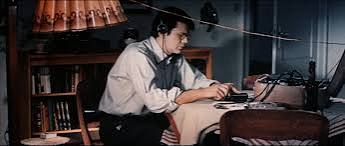
    The Red Orchestra - JIFF

    In the summer of 1941, as German troops massed on the Soviet border, a small group of Berliners began transmitting secrets from the capital of the Reich. They were not professional spies in the usual sense a Luftwaffe officer, an economist, a film publicist, an American woman but they formed the nucleus of what the Gestapo would later call the Rote Kapelle, the Red Orchestra. The name came from the Gestapo’s own slang: ‘Kapelle’ meant a radio operator, whose keying sounded like music, and ‘Rot’ meant red, for communism. The orchestra played a deadly tune, and when the Nazis finally found the source, the music stopped in a prison courtyard, but the echo of its notes would reach across the Cold War and into the present day.

    This is the story of two intertwined networks one in Berlin, one in Western Europe that fed intelligence to Moscow from the heart of the Nazi war machine. It is a story of courage, betrayal, and a warning that was tragically ignored. It is also a story that challenges easy categories: these were not heroes in the usual sense, nor traitors, but people caught between ideologies and loyalties, who made choices that cost many of them their lives.

    The Birth of the Orchestra

    The Red Orchestra did not emerge from a vacuum. It grew out of the wreckage of the Great Purge, which had decimated Soviet intelligence in the late 1930s. Desperate for reliable agents in Germany, the GRU Soviet military intelligence, not the NKVD turned to existing anti-fascist networks. One such network centered on Harro Schulze-Boysen, a Luftwaffe intelligence officer with a deep hatred of Nazism, and Arvid Harnack, an economist at the Reich Ministry of Economics. They were joined by their wives, Libertas and Mildred, and a circle of friends, artists, and civil servants who shared a loathing for Hitler.

    This was not a monolithic communist cell. The Berlin group was a loose and diverse circle: some were communists, but others were conservatives, nationalists, or simply humanists. They were united by opposition to the regime, not by ideology. This diversity gave them access to a wide range of information Harro could see Luftwaffe plans, Arvid had contact with economic data but it also created security lapses. The Gestapo, which initially underestimated communist networks, would later exploit these weaknesses.

    Meanwhile, in Brussels, a separate network was being built by Leopold Trepper, a Polish-Jewish communist and a veteran of Soviet intelligence. His network was more professional, composed of experienced agents and organized into cells. They focused on military and economic intelligence, and they would become the principal Soviet source in Western Europe.

    The Pact and the Silence

    The Nazi-Soviet Pact of 1939 created a moral and operational crisis for the Berlin group. Many of its members were anti-Nazi but not pro-Soviet; the pact forced them to choose between opposing Hitler and supporting Stalin. Some paused their operations, unwilling to help Moscow while it was allied with Berlin. Others continued to gather intelligence but withheld it from Moscow, waiting for the day when the two dictators would turn on each other.

    That day came on June 22, 1941, when German forces invaded the Soviet Union. The Red Orchestra’s warning of the invasion date—delivered via the Swiss ‘Lucy’ network, run by Rudolf Roessler—was dismissed by Stalin as British disinformation. It was a tragic intelligence failure that would cost millions of lives. After the invasion, the Berlin group’s work became urgent. They began transmitting information on German military production, Luftwaffe aircraft specifications, troop movements, and even the planned invasion itself—though the warning arrived too late.

    The Music of the Airwaves

    The Trepper network sent thousands of messages from Brussels and Paris. They reported on German logistics, economic data, and, crucially, the development of V-1 and V-2 rockets at Peenemünde. The Berlin group, despite its amateurish nature, provided valuable intelligence on the Luftwaffe and on German war production. The Swiss ‘Red Three’ network, a related but distinct operation run by Alexander Foote and Rachel Dübendorfer, transmitted over 3,000 messages to Moscow, including the Barbarossa warning.

    The Gestapo, however, was listening. The Funkabwehr, the German radio counterintelligence unit, used direction-finding to locate the transmitters. The discovery of the networks was not a single stroke but a slow process of triangulation, helped by a Belgian informant who betrayed the Trepper network in late 1941. The noose began to tighten.

    The Fall of the Orchestra

    In the summer of 1942, the Gestapo struck. Over 50 members of the Berlin group were arrested in a wave of raids. The arrests were followed by torture and interrogations, which led to further arrests. The trials were swift and brutal. Most of the accused were sentenced to death for ‘preparing to commit high treason’ and ‘aiding the enemy.’

    The executions took place at Plötzensee Prison in Berlin—by hanging or firing squad. Harro Schulze-Boysen was executed on December 22, 1942. His wife Libertas was killed the same day. Arvid Harnack was executed, and Mildred Harnack, who was American, was initially sentenced to six years in prison, but Hitler personally ordered a new trial, and she was executed on February 16, 1943. In all, more than 50 members of the Berlin group lost their lives.

    Trepper was arrested in 1942 but managed to escape in 1943 and survived the war. Anatoli Gurevich, codename ‘Kent,’ was captured and later returned to the USSR, where he was imprisoned—a fate that awaited many Soviet agents who had fallen into enemy hands. The network that had once been the Red Orchestra was no more.

    Aftermath and Memory

    The Red Orchestra’s place in history is contested. In West Germany, they were often branded as traitors, excluded from the honored narrative of the German resistance, which centered on the conservative plotters of the July 20, 1944, assassination attempt on Hitler. The communist association made them suspect. Only in recent decades have they been rehabilitated, with exhibitions at the German Resistance Memorial Center in Berlin.

    From the Soviet perspective, the network was a source of pride and a source of suspicion. Moscow treated the survivors with suspicion, imprisoning some, like Gurevich, despite their service. The Cold War froze the Red Orchestra into a propaganda tool, and the complex human stories behind the espionage were often lost.

    Today, the Red Orchestra is remembered as a rare instance of resistance from within the heart of the Nazi state, but it is also a cautionary tale about the limits of intelligence and the cost of political idealism. The warning they sent about Barbarossa was ignored, but the intelligence they gathered was not entirely without effect. The story of the Red Orchestra is not a simple victory or defeat; it is a story of moral ambiguity, sacrifice, and the terrible choices that war forces on people.

    The Trepper Network and the ‘Red Three’

    The Trepper network, separate from the Berlin group, was more professional but faced similar risks. Its members included Anatoli Gurevich, who operated in France and Switzerland, and a network of communist cells across Belgium and the Netherlands. The ‘Red Three’ in Switzerland, run by Alexander Foote and Rachel Dübendorfer, was crucial in transmitting the Barbarossa warning, but it also had its own internal tensions and was eventually compromised by a double agent.

    The information they provided was vast: reports on German logistics, economic data, and the V-2 rocket program. But the impact of this intelligence on the war’s outcome is debated. Some historians argue that it helped the Soviet Union prepare for the German onslaught, while others point to Stalin’s distrust and the failure to act on the warnings. The Red Orchestra’s legacy is thus ambiguous—neither a triumph nor a total failure, but a testament to the courage of individuals who risked everything to fight a monstrous regime from within.

    The Red Orchestra played its final notes in a Berlin prison, but its music has not faded. The story of these spies—the Luftwaffe officer, the economist, the American woman, the Polish communist—reminds us that resistance can take many forms, and that the line between hero and traitor is often drawn by history’s victors. Their warning was ignored, but their sacrifice was not in vain; it stands as a haunting reminder of the cost of ignoring the truth, and of the enduring power of human conviction in the face of tyranny.

    Summary

    • The Red Orchestra was a Soviet spy network in Nazi Germany, named by the Gestapo, with two main groups: the Berlin circle and the Trepper network in Western Europe.
    • Active from 1938 to 1942, it transmitted military and economic intelligence to Moscow, including the warning of Operation Barbarossa, which Stalin dismissed.
    • The Berlin group was a diverse anti-Nazi circle, not purely communist, while the Trepper network was more professional and communist-based.
    • The networks were broken by German radio counterintelligence and betrayal, leading to over 50 arrests and executions, including Harro Schulze-Boysen and Arvid Harnack.
    • Post-war, they were often excluded from the German resistance narrative, but have been rehabilitated in recent decades.

    FAQ

    Q: What was the Red Orchestra?
    A: The Red Orchestra was a Soviet spy network operating in Nazi Germany and Western Europe during World War II. It consisted of two main groups: the Berlin group led by Harro Schulze-Boysen and Arvid Harnack, and the Trepper network based in Brussels and Paris, led by Leopold Trepper.

    Q: Why was it called the Red Orchestra?
    A: The Gestapo coined the name ‘Rote Kapelle’ (Red Orchestra) because ‘Kapelle’ was their slang for a radio operator, whose transmissions sounded like music, and ‘Rot’ referred to communism. So the name literally meant ‘Red Band’ or ‘Red Orchestra.’

    Q: What information did the Red Orchestra send to Moscow?
    A: The Berlin group sent information on German military production, Luftwaffe aircraft specifications, and troop movements. The Trepper network reported on German logistics, economic data, and V-1/V-2 rocket development. The Swiss ‘Red Three’ network transmitted over 3,000 messages, including the warning of Operation Barbarossa.

    Q: How was the Red Orchestra discovered?
    A: The networks were broken by the German Funkabwehr (radio counterintelligence) using radio direction-finding to locate transmitters, and by a Belgian informant who betrayed the Trepper network in late 1941.

    Q: What happened to the members of the Red Orchestra?
    A: Over 50 members of the Berlin group were arrested in 1942 and most were executed by hanging or firing squad at Plötzensee Prison. Leopold Trepper was arrested but escaped in 1943 and survived the war. Anatoli Gurevich was captured and later imprisoned in the USSR.

  • The Fount of Life: Inside the Nazis’ Program to Breed an Aryan Race

    The Fount of Life: Inside the Nazis’ Program to Breed an Aryan Race

    In the winter of 1936, a secluded mansion in Steinhöring, Bavaria, opened its doors to a new kind of patient: unmarried pregnant women who had passed a rigorous racial examination. The home, run by the SS, offered these women luxurious care, anonymity, and a promise their children would be raised as the future elite of the Third Reich. This was Lebensborn, the ‘Fount of Life,’ a program conceived by Heinrich Himmler to reverse Germany’s declining birth rate by breeding a ‘racially pure’ Aryan generation.

    Lebensborn was the positive face of Nazi eugenics, a counterpart to the forced sterilizations and Nuremberg Laws that sought to eliminate ‘undesirable’ genes. While the numbers of children born in these homes remained small perhaps 20,000 across all of Europe the program’s chilling ambition revealed the depths of Nazi ideology: a bureaucratic machinery designed to treat human reproduction as a state-controlled enterprise. This is the story of that machinery, the women who entered it, and the children who bore its legacy long after the war ended.

    The Architecture of a Racial Utopia

    Heinrich Himmler, the Reichsführer-SS, was obsessed with demography. He believed that Germany’s finest blood the Nordic stock that he saw as the backbone of the nation was being wasted. Unmarried mothers faced social stigma, often resorting to abortion or giving up their children, while the birth rate among the ‘racially valuable’ was declining. Lebensborn, founded on December 12, 1935, was his answer: a state-sponsored network of maternity homes where ‘genetically healthy’ women could give birth in secret, supported by the SS.

    The program was meticulously designed. Women, married or not, had to prove their racial purity through genealogical records dating back to 1800. They underwent medical and psychological examinations, and their physical features were assessed for ‘Nordic’ traits. The father, too, had to be approved by the SS. Once accepted, the mothers were housed in comfortable facilities well-nourished, medically supervised, and shielded from the shame that society heaped on unwed mothers. For many vulnerable women, the offer was a lifeline; for the SS, it was a way to harvest ‘valuable’ children.

    Inside the Homes

    The first home opened in Steinhöring, and by the late 1930s, more followed across Germany. The atmosphere inside was a curious blend of clinical efficiency and maternal care. Nurses monitored the mothers’ health rigorously, and the children, once born, were registered with the SS and often placed for adoption into ‘worthy’ families typically SS officers’ households. The program’s business manager, Max Sollmann, and medical director, Gregor Ebner, ensured that every detail aligned with Nazi racial doctrine. Even the naming of children was a bureaucratic process: each birth was logged in special registers, with the mother’s racial score recorded alongside the child’s physical measurements.

    But Lebensborn was not confined to Germany. As the war expanded, so did the program. Norway, with its large contingent of German soldiers, became a key site: nine or ten homes operated there, exploiting the relationships between occupiers and local women. Similar facilities were established in Poland, France, Belgium, Luxembourg, Denmark, and the Netherlands. The scale remained modest—the war’s chaos and the SS’s obsession with secrecy limited expansion—but the intent was clear: to populate Europe with Aryan progeny, one birth at a time.

    The Darkest Extension: Kidnapping

    The program’s most sinister facet emerged in occupied Eastern Europe. In Poland and other territories, SS units conducted ‘racial assessments’ of children, particularly those in orphanages or foster care. Those judged ‘racially valuable’—blond hair, blue eyes, ‘Nordic’ skull measurements—were forcibly taken from their families, given German names, and placed in Lebensborn homes or with German families. The numbers are staggering: estimates range from tens of thousands to over 100,000 abducted children, though the exact figure remains unknown. Many were never returned after the war, and the trauma of these abductions continues to haunt Polish families to this day.

    This was the logical endpoint of Himmler’s ideology: human beings treated as genetic material, selected and relocated like livestock. The bureaucracy was chilling—forms, medical exams, racial scoring—all applied to children torn from their mothers’ arms.

    The Norwegian Aftermath

    In Norway, the legacy of Lebensborn was particularly bitter. Norwegian women who had relationships with German soldiers were ostracized after the war; many were arrested, interned, or lost their jobs. Their children, known as ‘tyskerbarn’ (German children), faced discrimination and abuse. Some were placed in psychiatric institutions, where they were mistreated, and many were denied education and social advancement. It wasn’t until 2018 that Norway’s prime minister formally apologized for this treatment, acknowledging the state’s role in perpetuating the stigma.

    For the women who entered Lebensborn homes, the experience was ambiguous. Some were grateful for the care and anonymity; others felt coerced, used by a regime that valued them only for their wombs. The children, now in their eighties, have spoken out in recent years, sharing stories of identity crises, silent shame, and, in some cases, the discovery of their origins only in adulthood. Their voices are a crucial counterpoint to the clinical records that survive.

    The End and the Unfinished Reckoning

    When Allied forces overran Germany in 1945, they found the Lebensborn homes abandoned, their records partially destroyed by the SS. The organization was formally dissolved in the 1950s, but the legal and moral questions it raised have never fully resolved. In Germany, the children were largely ignored for decades, with no official recognition of their suffering. In Norway, a 2004 report documented abuses, but compensation was initially denied and only partially granted. In Poland, the abducted children remain a painful wound—many never learned their true identities, and the search for families continues even today.

    The numbers are small compared to the millions who died in the Holocaust, but the significance of Lebensborn lies in its ambition. It was a state attempting to control human reproduction with the same precision as a breeding program for animals. The program’s failure to produce a ‘master race’ was inevitable, but its legacy of human suffering is a reminder of what happens when ideology overrides basic humanity.

    Lebensborn was not a footnote in Nazi history; it was a core expression of the regime’s racial ideology. The program’s homes, births, and abductions were all part of a larger plan to reshape humanity, and its consequences echo in the lives of the children and mothers who survived. As the last survivors age, their stories serve as a testament to the resilience of the human spirit against the coldest bureaucracies of the state.

    Summary

    • Founded by Heinrich Himmler on December 12, 1935, as an SS program to increase births of ‘racially pure’ Aryan children.
    • Provided maternity homes and financial support to women who met strict racial criteria, with around 20,000 children born across Germany and occupied territories.
    • Expanded into kidnapping ‘racially valuable’ children in Eastern Europe, with estimates of abducted children ranging from tens of thousands to over 100,000.
    • Norway was the most significant site outside Germany, with 9–10 homes; postwar children faced severe discrimination, leading to a formal apology in 2018.
    • The program was shut down in 1945, but legal and reparations issues remain unresolved, especially for Polish abductees.

    FAQ

    Q: What does ‘Lebensborn’ mean?
    A: It translates to ‘Fount of Life’ or ‘Spring of Life,’ reflecting the program’s goal to increase the birth rate of ‘racially pure’ Aryan children.

    Q: How many children were born in Lebensborn homes?
    A: Estimates suggest around 8,000–10,000 in Germany and 8,000–12,000 in Norway, totaling perhaps 20,000 or fewer across all territories.

    Q: Were all Lebensborn children born to unmarried mothers?
    A: No. While the program aimed to help unmarried mothers avoid social stigma, married women were also eligible if they and their husbands met the racial criteria.

    Q: Did the program operate outside Germany?
    A: Yes, it expanded into occupied territories, especially Norway, but also Poland, France, Belgium, Luxembourg, Denmark, and the Netherlands.

    Q: What happened to the children after the war?
    A: Many faced discrimination and stigma, particularly in Norway, where they were called ‘tyskerbarn.’ Some were placed in psychiatric institutions and abused. In Germany, they were largely ignored for decades. The abducted Polish children often never learned their true identities.

  • The Holocaust: The Systematic Extermination of Six Million Jews

    The Holocaust: The Systematic Extermination of Six Million Jews

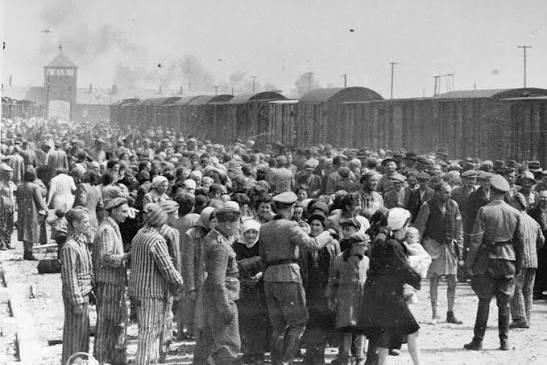
    In the winter of 1942, a train pulled into the ramp at Auschwitz-Birkenau. The doors slid open to reveal hundreds of men, women, and children, bewildered and exhausted after days without food or water. Within hours, most would be dead, their bodies consumed by the chimneys of the crematoria. This scene repeated itself thousands of times across occupied Europe, part of a machinery of murder that claimed the lives of six million Jews.

    The Holocaust, known in Hebrew as the Shoah, was not a spontaneous eruption of violence but a state-sponsored, meticulously organized campaign of annihilation. It unfolded over twelve years, from the Nazi seizure of power in 1933 to the final death marches in 1945, and it touched nearly every corner of the European continent. Understanding the Holocaust means confronting the darkest capabilities of human bureaucracy and ideology, and it demands a reckoning with how ordinary people became complicit in genocide.

    From Discrimination to Destruction: The Legal Persecution (1933–1939)

    The Nazi rise to power in January 1933 did not begin with mass murder. It began with a systematic legal assault on Jewish life. Within months, Jews were purged from the civil service, universities, and the arts. The Nuremberg Laws of 1935 stripped Jews of German citizenship and prohibited marriage or sexual relations between Jews and non-Jews. These laws, which defined Jewishness by blood rather than faith, were a crucial step in dehumanizing a whole population.

    Emigration was initially encouraged, but as Germany expanded, the doors began to close. By 1939, hundreds of thousands of Jews had fled, but many remained, trapped in a country that had declared them enemies of the state. The violence escalated on Kristallnacht, November 9–10, 1938, when synagogues were burned, homes and businesses were ransacked, and at least 91 Jews were killed. Yet even this pogrom seemed a prelude to something worse not a departure from policy but a radicalization of it.

    Ghettos and Einsatzgruppen: The War in the East (1939–1941)

    World War II provided the cover for genocide. Following the invasion of Poland in September 1939, the Nazis forced Jews into overcrowded ghettos. In Warsaw alone, over 400,000 Jews were crammed into an area of just over one square mile, with an average of seven people per room. Disease and starvation killed thousands each month, but this was only a holding pattern.

    The turning point came with Operation Barbarossa, the invasion of the Soviet Union in June 1941. Behind the advancing German army came the Einsatzgruppen mobile killing squads whose task was to eliminate Jews, Roma, and Soviet officials. They conducted mass shootings in open fields, ravines, and forests. At Babi Yar, near Kyiv, 33,771 Jews were murdered in two days in September 1941. Across the Baltic states and Ukraine, an estimated 1.5 million Jews were killed by these units and their local collaborators. The shooting was inefficient, psychologically taxing for the killers, and increasingly public. The Nazis sought a more industrialized method.

    The Final Solution: Industrialized Murder (1941–1945)

    On January 20, 1942, senior Nazi officials gathered at a villa in Wannsee, a Berlin suburb, to coordinate the deportation of Jews from across Europe to the East. The Wannsee Conference did not decide on the Holocaust that decision had evolved through a series of incremental steps but it formalized the logistics. The “Final Solution to the Jewish Question” was a euphemism for genocide.

    The Nazis constructed dedicated extermination camps in occupied Poland: Chelmno, Belzec, Sobibor, Treblinka, and Auschwitz-Birkenau. At Treblinka, between 800,000 and 900,000 people were killed in under a year, mostly by carbon monoxide gas in stationary chambers. At Auschwitz-Birkenau, the largest of the camps, over 1.1 million people perished, about 90% of them Jews, many killed with the pesticide Zyklon B.

    The process was chillingly efficient. Victims were selected on arrival those deemed unfit for labor, usually the elderly, the sick, and children, were sent directly to the gas chambers. Their belongings were sorted and shipped to Germany. Gold teeth were extracted from corpses. The camps were designed to maximize death while minimizing cost and psychological strain on the perpetrators.

    Perpetrators and Collaborators: A Continent-Wide Effort

    The Holocaust was not solely a German project. Across occupied Europe, local regimes and police forces participated in roundups and deportations. Vichy France, the Netherlands, Hungary, and Romania all collaborated to varying degrees. Romania’s wartime regime, acting independently of direct German orders, murdered an estimated 280,000 to 380,000 Jews in territories it controlled. In many cases, local antisemitism was stoked and exploited by the Nazis to ensure cooperation.

    The perpetrators were not just fanatical Nazis. They included ordinary soldiers, policemen, and bureaucrats who followed orders or seized opportunities for career advancement. The Holocaust was a bureaucratic crime, facilitated by railway timetables, punch-card machines, and the administrative routines of modern states. This is one of its most troubling legacies: genocide was not the act of deranged monsters, but of a society’s institutions and individuals who chose to participate.

    Resistance and Rescue: Light in the Darkness

    Even in the face of annihilation, there was resistance. The Warsaw Ghetto Uprising of April–May 1943 saw a few hundred lightly armed Jewish fighters hold out for nearly a month against the German army. At Sobibor and Treblinka, prisoners staged revolts that briefly shut down the death camps. These acts did not stop the Holocaust, but they affirmed the humanity of the victims.

    Rescuers also emerged, often at great personal risk. The Righteous Among the Nations, a designation given by Yad Vashem, honors over 28,000 individuals who saved Jews. Among them are Oskar Schindler, who protected over a thousand Jewish workers in his factory, and Raoul Wallenberg, the Swedish diplomat who issued protective passports to tens of thousands of Hungarian Jews. The villagers of Le Chambon-sur-Lignon in France sheltered thousands of Jewish refugees, an act of collective courage that shows how ordinary people could defy the machinery of death.

    The End and Its Legacy

    The Holocaust ended only with the military defeat of Nazi Germany in 1945. In the final months, as Soviet forces advanced, the Nazis forced concentration camp prisoners on death marches in freezing conditions, killing tens of thousands. When the camps were liberated, soldiers found emaciated survivors, piles of corpses, and evidence of an unimaginable crime.

    The number — six million — is a statistical abstraction. Among them were 1.5 million children, the vast majority of Jewish children in occupied Europe. The Holocaust destroyed vibrant communities that had existed for centuries, leaving a void that still resonates.

    Historians continue to debate whether the Holocaust was a pre-planned master plan or an incremental process that radicalized over time. Most now accept that ideology set the goal — the destruction of the Jewish people — but the methods evolved through bureaucratic competition, wartime pressures, and local initiatives. What is indisputable is the centrality of the Holocaust to Nazi aims. It was not a side effect of war; it was a war aim, pursued even when it diverted resources from the military effort.

    The Holocaust forces us to ask uncomfortable questions about the nature of evil, the role of bureaucracy, and the fragility of civilization. It is a warning of what happens when prejudice is enshrined in law, when state power is used to dehumanize a group, and when ordinary people look away. Remembering six million dead is an act of defiance against those who sought to erase them.

    The Holocaust was not a remote event confined to the past; it is a rupture in human history that continues to shape our understanding of morality, law, and the limits of human cruelty. To study it is to engage with the darkest recesses of the human soul and the societal structures that enable mass murder. Yet the stories of resistance, rescue, and survival remind us that even in the abyss, there were sparks of humanity. The legacy of the six million is not just a number — it is a call to vigilance against hatred, a demand for remembrance, and a pledge that “never again” must be more than a slogan.

    Summary

    • The Holocaust was the state-sponsored, systematic persecution and annihilation of European Jewry by Nazi Germany and its collaborators between 1933 and 1945.
    • Approximately six million Jews, including 1.5 million children, were murdered, roughly two-thirds of the pre-war European Jewish population.
    • The genocide evolved from legal persecution (Nuremberg Laws) to ghettoization and mass shootings (Einsatzgruppen) to industrialized murder in extermination camps like Auschwitz-Birkenau and Treblinka.
    • The Wannsee Conference in January 1942 coordinated the deportations, marking the formal implementation of the “Final Solution.”
    • Resistance and rescue occurred, as seen in the Warsaw Ghetto Uprising and the actions of the Righteous Among the Nations, but they could not prevent the scale of the catastrophe.

    FAQ

    Q: What is the difference between the Holocaust and the Shoah?
    A: The Holocaust is the term commonly used in English, derived from the Greek for “burnt whole,” while Shoah, a Hebrew word meaning “catastrophe,” is preferred by many scholars and survivors because it avoids religious connotations of sacrifice.

    Q: How many Jews were killed in the Holocaust?
    A: Approximately six million Jews were murdered, a figure widely accepted by historians based on Nazi records, postwar investigations, and demographic studies. This included about 1.5 million children.

    Q: Were there other victims besides Jews?
    A: Yes, the Nazis also murdered millions of others, including Roma, Soviet prisoners of war, disabled people, Polish elites, and political opponents. However, the Holocaust specifically refers to the genocide of the Jews, which was unique in its totality and industrial scale.

    Q: What were the main methods of murder used?
    A: The Nazis used poison gas (Zyklon B and carbon monoxide), mass shootings, starvation, disease, and death marches. Extermination camps like Auschwitz-Birkenau employed gas chambers, while Einsatzgruppen carried out open-air executions.

    Q: Did anyone resist the Nazis?
    A: Yes, there was armed resistance, such as the Warsaw Ghetto Uprising and revolts at Sobibor and Treblinka. Many individuals also rescued Jews, with over 28,000 recognized as Righteous Among the Nations by Yad Vashem.

  • The Battle of Stalingrad: 163 Days That Turned the Tide of World War II

    The Battle of Stalingrad: 163 Days That Turned the Tide of World War II

    On August 23, 1942, the Luftwaffe unleashed a hell of fire and steel on the city of Stalingrad. In a single day, waves of bombers dropped thousands of tons of explosives, turning the industrial metropolis on the Volga River into a moonscape of craters and burning rubble. Tens of thousands of civilians perished in the inferno, their bodies buried under collapsed buildings. That morning, the German 6th Army had reached the city’s outskirts; by nightfall, Stalingrad was a funeral pyre.

    What followed was not a conventional battle but a brutal, 163-day ordeal that would consume over two million lives. The Battle of Stalingrad, fought from August 23, 1942, to February 2, 1943, remains the bloodiest single engagement in human history. It was a clash of titans Nazi Germany and the Soviet Union locked in a struggle that would decide the fate of Europe. This is the story of how a city that bore Stalin’s name became the graveyard of the German Wehrmacht and the turning point of World War II.

    The City That Had to Be Taken

    Stalingrad was not just a city; it was a symbol. It bore the name of the Soviet dictator, and its factories churned out tanks, artillery, and small arms that fueled the Red Army. Strategically, it sat astride the Volga River, a vital artery for transporting oil from the Caucasus and supplies from the north. If Hitler could seize Stalingrad, he would cut the Soviet Union in half and secure the flanks of his drive toward the oil fields.

    For Hitler, the capture of Stalingrad was personal. He saw it as a propaganda coup that would demoralize the Soviets and cement his own myth of invincibility. For Stalin, losing the city would be a catastrophic blow to his prestige. In July 1942, he issued Order No. 227: “Not a step back!” The order forbade retreat under penalty of death, establishing penal battalions and blocking detachments that would shoot any soldier who fled. Both leaders had staked their reputations on a city that would become a meat grinder.

    The German summer offensive, codenamed Case Blue, had been launched in June 1942. Army Group South split into two prongs: one aimed for the Caucasus oil fields, the other, the 6th Army under General Friedrich Paulus, drove toward Stalingrad. By late August, Paulus’s forces, numbering over 300,000 men, were poised to take the city.

    The Bombing and the Rat War

    The Luftwaffe’s bombing on August 23 was designed to break the city’s will. It succeeded in killing thousands and leveling buildings, but it also created ideal defensive terrain. The rubble became a labyrinth of bunkers, sniper nests, and ambush points. The Soviet 62nd Army, commanded by General Vasily Chuikov, adopted a strategy that defied conventional military logic: hug the enemy.

    Chuikov’s doctrine was simple: keep Soviet lines so close to German lines that the Luftwaffe and artillery could not bomb without hitting their own troops. This turned the battle into a close-quarters brawl, fought with grenades, knives, and submachine guns. Soldiers engaged in what became known as the “rat war” fighting in sewers, basements, and the skeletons of buildings. Sniper duels became legendary; Vasily Zaytsev, a Soviet sniper, reportedly killed over 200 Germans, his exploits immortalized in the film Enemy at the Gates.

    By November, the Germans controlled about 90% of the city, but they could not dislodge the Soviet defenders from a narrow strip along the Volga’s western bank. Reinforcements and supplies crossed the river under constant fire, often at night. The eastern bank was held at all costs, becoming a lifeline that kept the defense alive.

    The Encirclement: Operation Uranus

    While the world’s attention was fixed on the street fighting, the Soviet high command was planning a massive counteroffensive. Generals Georgy Zhukov and Aleksandr Vasilevsky conceived Operation Uranus, a bold double envelopment designed to trap the German 6th Army. They amassed over a million troops, hidden through a masterful deception campaign (maskirovka) that fooled German intelligence about Soviet reserves.

    On November 19, 1942, the Red Army struck north and south of Stalingrad, smashing through the Romanian and Italian armies that protected the German flanks. Within four days, the pincers met at Kalach, encircling nearly 300,000 Axis troops in a pocket that stretched across the Volga steppe. The German high command was stunned. Hitler, in his bunker in East Prussia, refused to authorize a breakout, declaring that the 6th Army would hold the city and be resupplied by air.

    That promise proved hollow. The Luftwaffe’s transport fleet, already strained, could not deliver the required 700 tons of supplies per day. At its peak, it delivered only about 100–120 tons daily, a fraction of what was needed. The encircled army began to starve and freeze. Soldiers suffered frostbite, dysentery, and the gnawing agony of hunger. Horses were eaten, then pets, then rats.

    The Relief Attempt and the Siege’s End

    In December, Field Marshal Erich von Manstein launched Operation Winter Storm, a desperate attempt to break through to the trapped 6th Army. German tanks advanced to within 30 miles of the pocket before being halted by Soviet counterattacks. Hitler again forbade Paulus from attempting an exit, believing that holding Stalingrad was a matter of honor. It was a death sentence.

    By January 1943, the pocket had shrunk to a few square miles. The sick, wounded, and frostbitten huddled in cellars, surviving on scraps of bread and melted snow. The Red Army tightened the noose, capturing airfields and overwhelming the starving defenders. On January 31, Paulus was promoted to Field Marshal by Hitler—a clear signal that he should commit suicide rather than surrender. No German field marshal had ever been captured. Paulus chose life over honor.

    The northern pocket surrendered on February 2, 1943. Of the ~300,000 Axis troops encircled, about 91,000 were taken prisoner, including 24 generals. They were marched into captivity in the Soviet Union, a journey that most would not survive. Only about 5,000–6,000 ever returned to Germany.

    The Human Cost

    The numbers are staggering: combined military and civilian casualties ranged from 1.8 to 2.5 million. The Axis lost about 800,000–850,000 killed, wounded, or captured, while the Soviets suffered approximately 1.1–1.2 million casualties. Civilians bore the brunt of the initial bombing and the subsequent starvation; estimates of civilian deaths range from 40,000 to over 100,000. In the end, the city was a wasteland, its population decimated, its buildings reduced to hollow shells.

    The Battle of Stalingrad was not just a military defeat for Germany; it was a psychological and moral catastrophe. The myth of German invincibility was shattered. For the first time, the Wehrmacht had lost an entire army, and the tide of World War II in Europe had turned irrevocably. The Red Army would never lose the strategic initiative again, driving westward all the way to Berlin.

    For the soldiers who fought, Stalingrad was a descent into the abyss. Diaries and letters from both sides speak of the relentless horror: the stench of death, the constant shelling, the faces of comrades who vanished in a flash of fire. A German officer, Kurt Reuber, drew a charcoal sketch of a mother and child surrounded by darkness, titled the “Stalingrad Madonna,” a symbol of hope in the midst of despair.

    The Legacy

    Today, Volgograd—renamed in 1961 during de-Stalinization—stands as a monument to the battle. The Mamayev Kurgan hill, the site of some of the fiercest fighting, is crowned by a colossal statue, “The Motherland Calls.” It rises 85 meters above the city, a testament to the sacrifice of millions.

    Stalingrad remains a lesson in the dangers of overreach, the folly of hubris, and the terrible cost of war. It was a battle where the theories of generals collided with the grim reality of urban combat, where the will of a people proved stronger than the tanks of an invader. The blood of Stalingrad soaked into the Volga steppe, and from that blood rose a new world order.

    The battle’s outcome shaped the rest of the 20th century. It marked the beginning of the end for Nazi Germany and set the stage for the Cold War. For those who endured it, it was an experience that defied description. As one Soviet veteran wrote: “We who survived Stalingrad will never be the same. We have seen the face of war, and it is a face of utter ruin.”

    The Battle of Stalingrad was more than a military engagement; it was a crucible of fire and blood that forged the fate of nations. It demonstrated that even the most powerful army could be broken, and that the human spirit, when pushed to the brink, could endure unimaginable suffering. The names of Paulus, Chuikov, and Zaytsev are etched in history, but the countless anonymous soldiers and civilians who perished in the rubble are the true heroes of that epic struggle. As the world remembers the 80th anniversary of this cataclysm, we do well to reflect on the cost of hubris and the fragile value of peace.

    Summary

    • The Battle of Stalingrad (August 23, 1942 – February 2, 1943) was the bloodiest battle in history, with 1.8–2.5 million total casualties.
    • The German 6th Army was encircled by Soviet forces in Operation Uranus, leading to the surrender of ~91,000 soldiers, only a few thousand of whom survived captivity.
    • The battle marked a strategic turning point in World War II, ending the German advance into the Soviet Union.
    • Key tactics included Soviet “rat war” in the ruins and Chuikov’s “hug the enemy” strategy to neutralize German air superiority.
    • The Luftwaffe’s failed air supply operation doomed the encircled 6th Army, which suffered starvation and frostbite before surrendering.

    FAQ

    Q: Why is Stalingrad considered a turning point in World War II?
    A: Stalingrad was the first major defeat of the German Wehrmacht, resulting in the loss of an entire army. It shattered the myth of German invincibility and gave the Soviet Union the strategic initiative, which it never lost until Berlin fell in 1945.

    Q: How many people died in the Battle of Stalingrad?
    A: Estimates vary, but combined military and civilian casualties range from 1.8 to 2.5 million. The Axis suffered about 800,000–850,000 casualties, while the Soviet Union lost approximately 1.1–1.2 million soldiers and tens of thousands of civilians.

    Q: What was the “rat war”?
    A: The “rat war” referred to the brutal, close-quarters fighting in the ruins of Stalingrad, where soldiers battled in basements, sewers, and collapsed buildings. It was characterized by sniper duels, grenade attacks, and hand-to-hand combat, often at point-blank range.

    Q: Why did Hitler forbid the 6th Army from breaking out?
    A: Hitler believed that holding Stalingrad was essential for both strategic and propaganda reasons. He was confident the Luftwaffe could supply the army by air, but that proved impossible. He also promoted Paulus to Field Marshal, expecting him to commit suicide rather than surrender.

    Q: What was the fate of German prisoners of war from Stalingrad?
    A: Of the ~91,000 German soldiers taken prisoner, only about 5,000–6,000 survived Soviet captivity. Many died from disease, starvation, and the harsh conditions of labor camps during and after the war.

  • The White Rose: Six Leaflets That Defied Hitler

    The White Rose: Six Leaflets That Defied Hitler

    In the winter of 1943, as the Sixth Army froze and starved at Stalingrad, a small group of students in Munich began to print leaflets. They called themselves the White Rose. Their weapons were not guns or explosives, but words typed, mimeographed, and slipped into mailboxes and phone booths across the city.

    Their first leaflet opened with a blunt accusation: ‘The German people slumber on in a dull, stupid sleep and encourage the fascist criminals.’ That sentence was a death warrant for its authors. Within months, the core members would be executed by guillotine, but their words would outlive them, dropped by Allied planes over a Germany they had tried to awaken.

    The Students Who Saw Too Much

    Hans Scholl was 24 when he helped found the White Rose. He had served as a medic on the Eastern Front, where he witnessed the brutal treatment of Jews and prisoners of war. The experience shattered whatever illusions he had about the Nazi regime. His sister Sophie, 21, joined later, initially out of loyalty to her brother, but she quickly became as committed as he was. Christoph Probst, a 23-year-old medical student, completed the inner circle.

    They were not professional revolutionaries. They were students at the University of Munich, raised in a middle-class family, and deeply influenced by Christian morality and German idealism. Their professor, Kurt Huber, taught philosophy and provided intellectual grounding, drawing on Aristotle and Augustine to argue that tyranny must be resisted on moral grounds.

    The group’s name, White Rose, may have come from a novel by B. Traven, but it also evoked purity and resistance. They chose a symbol, not a battle cry.

    Six Leaflets, One Message

    Between June 1942 and February 1943, the White Rose produced six leaflets. Each was a call to passive resistance, sabotage of the war effort, and moral awakening. They were not asking for a coup or an assassination. They were asking Germans to think for themselves.

    The first four leaflets, distributed in Munich and other cities, were followed by a fifth, titled “Appeal to the Germans,” in January 1943. The sixth and final leaflet was printed in a run of approximately 6,000 to 9,000 copies. It was smuggled abroad through Helmuth von Moltke’s contacts and later dropped by Allied planes over Germany in 1943—a testament to the reach of their words, if not their immediate impact.

    The leaflets were not sophisticated political tracts. They were moral arguments, rooted in the belief that every individual had a duty to resist evil. They condemned the mass murder of Jews, the suppression of free speech, and the blind obedience that allowed the regime to continue.

    The Moment of Capture

    On February 18, 1943, Hans and Sophie Scholl carried a suitcase full of the sixth leaflet to the University of Munich. They left stacks in the hallways and on windowsills. A janitor saw them and reported them to the Gestapo.

    They were arrested within hours. In interrogation, Sophie was defiant. She reportedly told her interrogators that what she did, she did for Germany. The trial was swift. On February 22, 1943, Hans Scholl, Sophie Scholl, and Christoph Probst were found guilty of high treason and sentenced to death. They were executed by guillotine the same day at Stadelheim Prison.

    Their deaths did not end the movement. A second wave of arrests followed, leading to the execution of Willi Graf, Alexander Schmorell, and Kurt Huber later in 1943. Dozens more were imprisoned or sent to concentration camps.

    The Symbolic Impact

    The White Rose did not shorten the war by a single day. They did not save a single life directly. Their audience was limited to educated Germans who could access and understand the leaflets. Some historians argue they were ineffective as a resistance movement, lacking any plan for overthrowing the regime.

    But their impact was not operational. It was symbolic. They showed that “another Germany” existed—a Germany of conscience, not just complicity. The sixth leaflet, dropped by Allied planes, became a piece of propaganda that proved to the world that not all Germans supported Hitler.

    Sophie Scholl’s role is particularly significant. In a narrative dominated by men, she stands out as a young woman who defied the regime with equal courage. Her defiance during interrogation challenged the stereotype of women as passive bystanders in Nazi Germany.

    The Moral Legacy

    What remains today is not the strategy, but the moral clarity. The White Rose leaflet’s message—that ordinary people must resist evil, even at the cost of their lives—continues to resonate. Their Christian faith, both Protestant and Catholic, framed Nazism as a false religion demanding absolute loyalty. Kurt Huber’s final words before execution were: “In a few minutes you will stand before a higher judge.”

    The White Rose was a small group, but their words were big. They did not win, but they refused to be silent. That refusal, captured in six leaflets, remains a powerful example of conscience in the face of tyranny.

    The White Rose movement ended with the thud of a guillotine blade on February 22, 1943. But their leaflets, scattered across Munich and later dropped from Allied planes, carried a message that outlived the Third Reich. They were ordinary students who decided that silence was complicity. Their story is not a military victory but a moral one—a reminder that even the smallest voices can speak truth to power.

    Summary

    • The White Rose was a non-violent resistance group at the University of Munich, led by Hans and Sophie Scholl, Christoph Probst, and supported by Professor Kurt Huber.
    • They produced six leaflets between June 1942 and February 1943, calling for passive resistance and moral awakening.
    • The core members were caught distributing the sixth leaflet on February 18, 1943, and executed by guillotine on February 22, 1943.
    • The leaflets were later dropped by Allied planes, symbolizing that “another Germany” existed.
    • Their impact was symbolic rather than operational, but their moral clarity endures.

    FAQ

    Q: Who were the core members of the White Rose?
    A: The inner circle consisted of Hans Scholl (24), Sophie Scholl (21), and Christoph Probst (23). Key associates included Professor Kurt Huber, Alexander Schmorell, Willi Graf, and Jürgen Wittenstein.

    Q: What did the White Rose leaflets call for?
    A: They called for passive resistance, sabotage of the war effort, and a moral awakening of the German people. They were not a call for violent overthrow, but a plea for conscience.

    Q: How were the leaflets distributed?
    A: They were mailed to addresses across Germany and Austria, left in phone booths, trains, and public spaces, and placed in the University of Munich hallways.

    Q: What happened to the group after the Scholls were caught?
    A: A second wave of arrests led to the execution of Willi Graf, Alexander Schmorell, and Kurt Huber in 1943. Dozens more were imprisoned or sent to concentration camps.

    Q: Was the White Rose effective?
    A: They did not directly hasten the end of the war, but their leaflets were dropped by Allied planes as proof that “another Germany” existed, and their moral example has inspired generations.

  • The Quiet Heroes and the Loud Betrayers: Why Some Germans Hid Jews While Others Turned Them In

    The Quiet Heroes and the Loud Betrayers: Why Some Germans Hid Jews While Others Turned Them In

    In the heart of Nazi Germany, a place where terror was the law, a small number of Germans chose to defy the regime by hiding Jews. Their actions stand in stark contrast to the many who denounced their Jewish neighbors to the Gestapo. This article explores the motivations behind both the rescuers and the informers, drawing on historical records and survivor testimonies.

    The Rarity of Rescue

    Between 1933 and 1945, an estimated 6 million Jews were murdered in the Holocaust. In Germany itself, of the roughly 500,000 Jews living there in 1933, only about 15,000 to 16,000 survived in hiding. Of those, roughly half—about 7,500 to 8,000—were helped by non-Jewish Germans. This means that the number of active rescuers was minuscule: historians estimate between 5,000 and 25,000 Germans (including Austrians) actively hid or assisted Jews, well under 1% of the population. Yet their acts were not just rare; they were extraordinarily dangerous.

    The Mechanics of Hiding

    To hide a Jew was to risk everything. Rescuers had to secure food ration cards, which were strictly controlled, and find a safe location that could withstand the constant threat of house searches. A single slip—a neighbor noticing extra laundry, a child mentioning a visitor—could be fatal. The Gestapo, though understaffed with only 15,000 to 30,000 officers for all of Germany, relied heavily on civilian denunciations. The regime criminalized aid to Jews under vague charges like “preparing high treason” or “defeatism,” with punishments ranging from imprisonment to execution. The threat extended to the rescuer’s entire family, who could be sent to concentration camps.

    Why Did They Help?

    The motivations of rescuers were as varied as the individuals themselves. Some were driven by deep moral or religious conviction. Devout Christians, both Protestant and Catholic, cited biblical imperatives to love thy neighbor. Others were motivated by secular humanism or political opposition to Nazism—socialists, communists, and conservatives who rejected the regime’s ideology.

    But perhaps the most common thread was personal connection. Many rescuers acted not out of abstract morality but because they knew the Jew personally—as a friend, neighbor, colleague, or former employer. This concrete loyalty often outweighed the abstract fear of the regime.

    Psychologist Eva Fogelman’s studies of rescuers suggest they shared certain personality traits: a strong sense of independence, empathy, and a family background that valued tolerance. They were people who, when faced with a choice, could not look away.

    The Denouncers: A Culture of Betrayal

    In stark contrast, the denouncers—those who turned Jews in—were driven by a mix of ideology, greed, and petty grievances. Some were genuine Nazis who believed they were serving the state. Others saw material gain: denouncing a Jew could lead to the confiscation of the Jew’s property, which was sometimes rewarded to the informer. The regime actively encouraged this by making denunciation easy and anonymous, turning neighbor against neighbor.

    Personal grudges played a huge role. A business rivalry, a romantic jealousy, a long-standing dispute over a fence—these could all be settled with a single phone call to the Gestapo. The regime’s system of terror created a climate where fear and self-interest dominated, and denouncing a Jew was a way to prove loyalty, especially if the informer themselves were under suspicion.

    The Gray Zone of Bystanders

    Most Germans, however, fell into a middle category. They did not actively denounce, but they also did not help. They “knew and did not know”—a psychological state of willful ignorance that allowed them to survive without confronting the horror. Some provided indirect, passive help by not reporting what they saw, but this was a limited form of resistance. The propaganda machine that dehumanized Jews made it easier for many to look away.

    The Legacy of the Righteous

    Despite the overwhelming dangers, some Germans chose to act. Israel’s Holocaust memorial, Yad Vashem, has recognized over 27,000 “Righteous Among the Nations” worldwide, of whom about 600 to 650 are German—a figure that continues to grow as cases are verified. These individuals remind us that even in the darkest times, ordinary people can choose courage over complicity.

    Conclusion

    The story of why some Germans hid Jews while others turned them in is ultimately a story of human choice under extreme pressure. Rescuers were motivated by a complex mix of morality, personal loyalty, and opposition to the regime. Informers were driven by ideology, greed, and fear. The vast majority, the bystanders, chose to look away. But the rescuers’ actions, however few, shattered the myth that resistance was impossible. They proved that even in the heart of the Nazi state, humanity could prevail.

    The question of why some Germans hid Jews while others turned them in is not just a historical puzzle; it is a mirror held up to human nature. It forces us to confront the uncomfortable truth that under the right conditions, ordinary people can commit extraordinary acts of both cruelty and kindness. The rescuers, though few, remain a beacon of hope—a testament to the power of individual conscience against the tyranny of the state.

    Summary

    • Only a small minority of Germans (estimated 5,000–25,000) actively helped Jews survive, while the majority were bystanders or informers.n- Rescuers were motivated by moral conviction, personal relationships, political opposition, and personality traits like empathy and independence.n- Informers were driven by ideological belief, material gain (confiscated property), personal grudges, and fear of punishment.n- The Gestapo relied heavily on civilian denunciations, which were easy and anonymous, fostering a culture of betrayal.n- Of the roughly 500,000 Jews in Germany in 1933, only 15,000–16,000 survived in hiding, with about half helped by non-Jewish Germans.

    FAQ

    Q: How many Germans actively helped Jews during the Holocaust?nA: Historians estimate between 5,000 and 25,000 Germans (including Austrians) actively hid or assisted Jews, representing well under 1% of the population.nnQ: What were the risks for those who hid Jews?nA: Rescuers faced imprisonment, execution, and collective punishment, including sending their families to concentration camps. They also had to secure food ration cards and maintain absolute secrecy.nnQ: Why did some Germans denounce Jews?nA: Denouncers were motivated by ideological conviction, material gain (such as confiscated property), personal grudges, and fear of punishment for not reporting.nnQ: How did the Gestapo find hidden Jews?nA: The Gestapo was understaffed and relied heavily on civilian denunciations. A large proportion of arrests of hidden Jews resulted from tips from ordinary citizens.nnQ: What is the legacy of German rescuers?nA: Yad Vashem has recognized about 600–650 Germans as “Righteous Among the Nations,” a number that continues to grow as cases are verified.