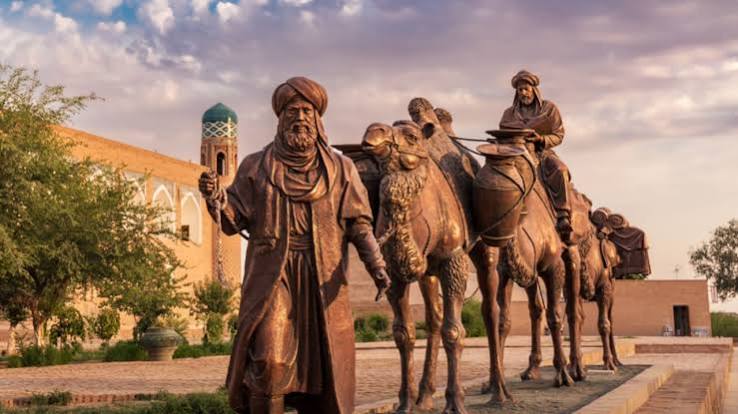
Two thousand years ago, a merchant in Samarkand loaded his caravan with bolts of silk, jars of rhubarb, and a stack of written contracts. He was a Sogdian, and his people controlled the arteries of commerce between China and the Mediterranean. They spoke a language that became the lingua franca of Central Asia, built self-governing colonies from Mongolia to Korea, and translated Buddhist scriptures for the Chinese. Yet today, their name barely registers outside academic circles.
For six centuries, the Sogdians were the indispensable intermediaries of the Silk Road. They didn’t build an empire or field a great army. Instead, they built something more durable: a network. When the Arabs arrived in the 8th century and the Tang dynasty retreated, that network collapsed. The Sogdians didn’t vanish—they assimilated, converted, and dissolved into the Persianate world. Their story is a masterclass in how trade can shape history, and how geopolitics can erase a people.
Who Were the Sogdians?
Imagine a land of fertile river valleys ringed by desert and steppe. That was Sogdiana, centered on the Zeravshan River in what is now Uzbekistan and Tajikistan. The Sogdians were an Eastern Iranian people, with roots stretching back to the Achaemenid Empire of the 6th century BCE. By the 4th century BCE, Alexander the Great had stormed through their territory, folding them into the Hellenistic world. But they were never a unified state—they were a collection of oasis city-states: Samarkand, Bukhara, Panjakent.
Their language, Sogdian, was written in a script borrowed from Aramaic and adapted over time. It doesn’t sound like much, but that language became the diplomatic and commercial language of the Silk Road for centuries. If you were doing business in Central Asia in the 6th century, you did it in Sogdian.
The Silk Road’s Commercial Geniuses
The Sogdians didn’t invent the Silk Road, but they perfected the art of moving goods across it. They were the middlemen who connected China’s silk and paper with Persia’s silver and glass, India’s spices, and the steppe’s horses. They didn’t just carry things—they engineered the entire logistics.
Take the Sogdian Ancient Letters, a cache of correspondence from the early 4th century CE, found near Dunhuang. These letters reveal a sophisticated commercial network. Merchants wrote to each other about credit, debts, and market conditions. They used written contracts and agency relationships, where one merchant would represent another’s interests in a distant city. In modern terms, they invented supply chain management and international brokerage.
They also spread their diaspora communities along the routes. In Tang China’s capital, Chang’an, a whole quarter was Sogdian. They had their own self-governing colonies in Dunhuang, Turfan, and even Mongolia and Korea. These weren’t just trading posts—they were cultural bubbles where Sogdian customs, religions, and art flourished.
What did they trade? Silk, of course, but also jade, musk, rhubarb (a prized medicine), and horses from the steppes. They dealt in glassware and silverware from the west, and they traded slaves. They were experts in arbitrage—buying low in one empire and selling high in another, while navigating the patchwork of imperial taxes and tariffs.
Cultural Middlemen: More Than Merchants
The Sogdians’ role wasn’t just commercial. They were cultural conduits. As they moved goods, they moved ideas. They practiced Zoroastrianism, but they were remarkably tolerant. They adopted Buddhism, Manichaeism, and Nestorian Christianity and spread them along the Silk Road.
Their most impressive cultural feat was translation. When Buddhism traveled from India to China, the Sogdians acted as intermediaries. They translated Buddhist scriptures into Chinese, not directly from Sanskrit but via Sogdian. They shaped how East Asia received a world religion.
Their art reflects this synthesis. The wall paintings of Panjakent and Afrasiab show a visual blend of Persian motifs, Indian postures, Greek drapery, and Chinese brushwork. The Sogdians didn’t just carry objects—they carried aesthetics and styles, fusing them into something new.
Their language left a lasting mark, too. The Sogdian script influenced the Uyghur script, which later gave rise to the Mongolian and Manchu scripts. So the next time you see Mongolian writing, you’re looking at a distant descendant of Sogdian.
Empires and Alliances: The Geopolitical Tightrope
The Sogdians survived for centuries by being useful to larger powers. They served as administrators under the Achaemenids, as diplomats under the Göktürk Khaganate, and as officials in Tang China. They weren’t a threat, so empires tolerated them. They were an asset.
Their partnership with the Göktürks in the 6th and 7th centuries was particularly fruitful. The Sogdians provided the commercial expertise, and the Göktürks provided military protection on the northern Silk Road. This nomadic-sedentary alliance was a model of cooperation that kept trade flowing.
In Tang China, Sogdians reached the highest levels. They served as generals, ministers, and even influenced court politics. But this dependence on empires was their Achilles’ heel. When those empires clashed, the Sogdians were caught in the middle.
The Fall: Squeezed Between Caliph and Emperor
The Arab conquest of Transoxiana began in the early 8th century. By 722 CE, the Arabs had taken Samarkand and Bukhara. The Sogdians resisted, but they were not a unified state, and their city-states fell one by one.
The decisive blow came at the Battle of Talas in 751 CE. The Abbasid Caliphate faced Tang China on the banks of the Talas River in modern Kyrgyzstan. Sogdians fought on both sides. The Arabs won, and the battle shifted the balance of power in Central Asia. The Tang withdrew their influence, and the Arabs tightened their grip.
For the Sogdians, this was a catastrophe. They were squeezed between two expanding powers. With the Arabs in control and the Chinese retreating, their comfortable position as intermediaries vanished. The trade routes shifted, and the Sogdian network began to unravel.
Assimilation and Legacy
The Sogdians didn’t die out—they were absorbed. Over the next two centuries, they converted to Islam and adopted Persian culture. The Sogdian language faded, replaced by Persian and Tajik. By the 10th or 11th century, it was effectively dead.
But their legacy persisted. The Sogdian diaspora in China—families with names like Shi and An—continued for generations, even as they assimilated into Chinese society. Their descendants included famous generals and officials. The artistic styles they helped spread lived on in later Central Asian cultures.
Their greatest legacy might be the model of trade itself. The Sogdians showed that you don’t need an army to shape the world—you need a network, a language, and the ability to adapt. Their rise was built on innovation and tolerance. Their fall came when geopolitics left no room for middlemen.
The Sogdians are a reminder that history often forgets the mediators. Empires write chronicles; merchants leave ledgers. But those ledgers shaped civilization. The Sogdians connected worlds, carried ideas, and paid the price when the worlds collided. Their story isn’t just a chapter in Central Asian history—it’s a lesson in how commerce and culture intertwine, and how fragile that web can be.
Summary
- The Sogdians were an Eastern Iranian people from Sogdiana (modern Uzbekistan/Tajikistan), who dominated Silk Road trade from the 4th to 8th centuries CE.
- They operated a vast commercial network with diaspora colonies from China to Korea, using language, contracts, and logistics to control trade.
- They were cultural brokers, spreading Buddhism, Christianity, and Manichaeism, and translating scriptures into Chinese.
- Their power came from alliances with empires like the Göktürks and Tang China, but they were squeezed between the Arab Caliphate and Tang, leading to their decline after the Battle of Talas (751 CE).
- They assimilated into Islamic Persianate culture, with their language dying out by the 10th century, but their influence on scripts and trade practices endured.
FAQ
Q: What was the Sogdians’ main contribution to the Silk Road?
A: The Sogdians were the dominant middlemen, connecting China with Persia and the Mediterranean. They pioneered logistics, credit instruments, and multilingual brokerage, moving goods and ideas across Central Asia.
Q: Why did the Sogdians disappear?
A: They didn’t disappear suddenly. After the Arab conquest and the Battle of Talas, they lost their privileged position. They gradually converted to Islam and adopted Persian culture, and their language died out by the 10th century.
Q: Where can we see Sogdian influence today?
A: Their script influenced Mongolian and Manchu scripts. Their art and culture left traces in Central Asian heritage, and their descendants in China kept family names like Shi and An.
Q: Were the Sogdians a unified empire?
A: No, they were a network of independent city-states like Samarkand and Bukhara. Their power relied on commercial cooperation, not political unity.
Q: What did the Sogdians trade?
A: They traded silk, jade, horses, glass, silverware, rhubarb, and slaves, among other goods. They were skilled at arbitrage across different imperial tax systems.
Leave a Reply