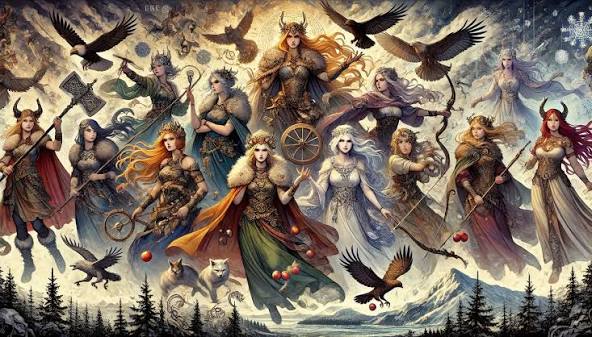
When most people picture Norse mythology, they see Odin, Thor, and a pantheon of warrior gods. But the Viking cosmos was not a boys’ club. Three goddesses Freyja, Frigg, and Skaði held power that rivaled the gods, and their myths reveal a society where women could own land, initiate divorce, and even choose their own husbands. Their stories were not just entertainment; they were blueprints for Viking social structures, legal practices, and cultural values.
Yet these goddesses are often overlooked in popular retellings, buried under the thunder of Thor’s hammer. This article brings them into the light, showing how Freyja’s magic, Frigg’s foresight, and Skaði’s fierce independence shaped everything from marriage customs to legal compensation. In a world where women’s rights were surprisingly advanced for the era, these deities were both mirrors and models.
The Problem with the Sources
Before we meet the goddesses, a warning: our knowledge of Norse myth comes almost entirely from medieval Icelandic manuscripts written after Christianization. The Poetic Edda and the Prose Edda, compiled in the 13th century, were set down by Christian scribes like Snorri Sturluson, a politician and historian. These texts are priceless, but they reflect the biases of their time. Snorri may have shaped stories to fit Christian ideas about gender and authority.
Still, the myths preserve older oral traditions, and they align remarkably well with other evidence. Roman historian Tacitus, writing in 98 CE, described Germanic women as influential and respected. Archaeological finds—such as the ‘Freyja’ pendant from Aska, Sweden, and weaving implements in graves—support the idea that women held significant status. The legal codes of Viking-age Iceland, like the Grágás, gave women property rights, the right to divorce, and inheritance rights. So, when we see goddesses with power, we are likely seeing a reflection of real-world female agency.
Freyja: The Goddess Who Got Half the Fallen
Freyja was a powerhouse. A Vanir goddess, she ruled over love, fertility, war, and magic. She owned the necklace Brísingamen, rode in a chariot pulled by cats, and had a boar named Hildisvíni. But her most striking role was in the afterlife: she received half of all warriors slain in battle into her hall Fólkvangr. Odin got the other half for Valhalla. This was no small honor—it meant Freyja was as important as Odin in the eyes of warriors.
She was also the patroness of seiðr, a form of shamanic magic. This was considered a woman’s art; for a man to practice it was seen as unmanly. Freyja’s command of seiðr gave her a power that even Odin coveted—he learned it from her. In one myth, she wept tears of gold when her husband was away, and she bargained with dwarves for her necklace, showing her agency and desire.
Her cult was practical: people invoked her for love, childbirth, and fertility. Her wagon traveled the countryside for fertility rites, similar to how her brother Freyr’s statue was paraded. This connection to the land and its prosperity made her central to everyday life, not just myth.
Frigg: The Queen Who Held the Fate of the Gods
Frigg, Odin’s wife, was the goddess of marriage, motherhood, and domestic order. But her power was subtle. She had the gift of prophecy—she knew the future—but she rarely spoke it. This silence was a form of control. In the myth of Baldr’s death, she extracted oaths from all things not to harm her son, but she overlooked mistletoe. When Loki used mistletoe to kill Baldr, Frigg’s attempt to change fate failed. Yet her grief was so profound that she tried to bargain with Hel for his return, showing her determination.
Frigg’s domain was the household, but in Viking society, the household was the center of power. Women ran farms while men were away at sea, and they managed textile production—a major export. Frigg was invoked for marriage, childbirth, and household prosperity. Her hall, Fensalir, meaning ‘hall of the marshes,’ suggests a connection to the earth and water.
The name of the day Friday might come from her or Freyja, showing her lasting cultural footprint. Frigg’s role as queen was not passive; she was a political actor in the divine realm, just as Viking queens and noblewomen could influence decisions.
Skaði: The Giantess Who Demanded Justice
Skaði is perhaps the most surprising of the three. She was a giantess, but she was counted among the gods. Her name may be linked to Skáney, an old name for Scandinavia, and skaði, meaning ‘harm.’ She was the goddess of winter, hunting, and skiing, but also of justice.
Her story begins with vengeance. When the gods killed her father, the giant Þjazi, she armed herself and marched to Asgard to demand compensation. The gods offered her a choice: she could pick a husband from among them, but she could only see their feet. She chose the most beautiful feet, thinking they belonged to Baldr, but they were Njörðr’s. The gods also had to make her laugh, which Loki did, and they gave her a gift: the tears of the gods. But Skaði was not satisfied until she placed a venomous serpent over Loki’s face, binding him in punishment for his role in Baldr’s death.
Her marriage to Njörðr failed because she wanted to live in her father’s mountain home, Þrymheimr, while he preferred the sea shore. They compromised by spending nine days in each, but neither was happy. This story illustrates the tension between different ways of life, but it also shows Skaði’s independence—she chose a husband and later left him.
Skaði’s status as a giantess among gods is unusual. It reflects the fluid boundaries between gods and giants in Norse myth, but it also highlights the respect for female assertiveness. She was a huntress and a ski runner, skills that would have been practical in Scandinavia’s snowy landscapes.
Goddesses and the Real Status of Women
The prominence of these goddesses corresponds with the relatively high status of women in Viking society. Women could own property, initiate divorce, and inherit land if there were no male heirs. The Grágás law code records these rights. They could also serve as priestesses (gyðja) or seers (völva). The völva held considerable power, as her prophecies were sought after by communities.
But there were limits. Women could not participate in the þing, the public assembly, and marriage was often arranged for alliances. The gods themselves had arranged marriages—Njörðr and Skaði’s union was a settlement. Yet, the myths also celebrate female choice: Freyja is often sought after by giants, but she refuses. She is not a passive prize.
In a world where men could be labeled unmanly for practicing seiðr, women’s association with magic gave them a unique kind of power. The norns, who wove the fates of all beings, even the gods, were female. This cosmic authority placed women at the very heart of destiny.
Why These Goddesses Matter Today
Popular culture, from Marvel movies to video games, has focused on Thor and Odin, leaving Freyja, Frigg, and Skaði in the shadows. But to understand Viking society, we must look at its goddesses. They show that gender roles were not as rigid as we might assume. Women could be warriors, but they were also farmers, weavers, and sorceresses. The goddesses embodied all these aspects.
Freyja’s dual nature as a fertility goddess and a war goddess mirrors the reality that women were both life-givers and, in some cases, fighters. Frigg’s foresight and silence reflect the strategic wisdom of queens. Skaði’s independence and demand for justice resonate with the legal rights Viking women actually had.
These goddesses are not ‘forgotten’ because they were unimportant; they were forgotten because later retellings favored male heroes. But their stories have survived in the Eddas, waiting to be rediscovered. They remind us that the Viking world was complex, and so was its view of women.
Freyja, Frigg, and Skaði were not minor figures. They were central to Norse cosmology and to the daily lives of Viking people. Their myths encoded the values of a society that, while patriarchal, offered women unprecedented freedoms compared to their European contemporaries. By remembering these goddesses, we correct the record and gain a fuller picture of Viking society—one that honored female power in all its forms.
Summary
- Freyja, a Vanir goddess, received half of all warriors slain in battle into her hall Fólkvangr, making her equal to Odin in the afterlife.
- Frigg, Odin’s wife, had the power of prophecy but rarely spoke, using silence as a form of control in the divine realm.
- Skaði, a giantess counted among the gods, demanded compensation after her father’s death, showing the legal rights women had in Viking society.
- Women in Viking Scandinavia could own property, initiate divorce, and serve as priestesses or seers, aligning with the goddesses’ power.
- The myths of these goddesses reflect and reinforced women’s status, challenging the misconception that Norse mythology was solely male-dominated.
FAQ
Q: Was Freyja more important than Odin?
A: In some ways, yes. She received half of all warriors slain in battle, making her a major deity of war and death. Her association with seiðr gave her a unique power that even Odin sought to learn.
Q: How did Viking women actually use the rights these goddesses represent?
A: Historical records, such as the Grágás law code, show that Viking women could own property, initiate divorce, and inherit land, especially if they had no male heirs. Some also held religious roles as priestesses or seers.
Q: Why are these goddesses often overlooked?
A: Popular culture and later Christian scribes, who wrote down the myths, often focused on male gods. The stories of goddesses were preserved but not emphasized, leading to their underrepresentation in modern retellings.
Q: Did Skaði choose her own husband?
A: Yes, Skaði was allowed to choose her husband from the gods, but she could only see their feet. She picked the most beautiful feet, thinking they were Baldr’s, but they belonged to Njörðr.
Q: What is seiðr and why was it associated with women?
A: Seiðr was a form of Norse shamanic magic used for prophecy and shaping the future. It was considered a woman’s art, and for a man to practice it was seen as unmanly, so it became a source of female power in Viking culture.
Leave a Reply