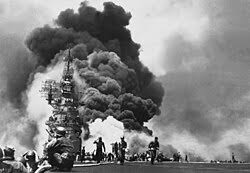
At 7:48 a.m. on December 7, 1941, the first wave of Japanese aircraft descended on Pearl Harbor. Within two hours, 2,403 Americans were dead, eight battleships were sunk or damaged, and the United States was irrevocably at war. But the attack on Hawaii was only one stroke in a coordinated sweep across the Pacific—Japanese troops were simultaneously landing in Malaya, the Philippines, and Hong Kong. The war that followed would last nearly four years, consume millions of lives, and redraw the map of Asia and the Pacific.
This is not a story of clean battle lines or simple heroes. It is a story of island hopping through coral and jungle, of firebombed cities and atomic flashes, of empires crumbling and new nations rising. To understand the Pacific War is to understand how the modern world took shape—through the roar of carrier aircraft, the silence of a surrendered fleet in Tokyo Bay, and the long shadows cast by decisions made in smoke-filled rooms on both sides of the ocean.
The Road to War: An Empire’s Gamble
Japan’s path to Pearl Harbor was paved with decades of ambition and desperation. After the Meiji Restoration of 1868, Japan industrialized at a breathtaking pace, but it lacked the raw materials to sustain its growth. The Great Depression of the 1930s only sharpened the crisis, pushing Tokyo toward expansion as a solution. In 1931, Japan occupied Manchuria, establishing the puppet state of Manchukuo. Six years later, it launched a full-scale invasion of China, plunging the region into a brutal conflict that would last until 1945.
The Western powers watched with growing alarm. The United States, Britain, and the Netherlands—the colonial rulers of Southeast Asia—controlled the oil, rubber, and tin that Japan so desperately needed. When Japan joined Germany and Italy in the Tripartite Pact in 1940, the Western response was swift: embargoes on oil, steel, and scrap metal. Japan’s oil reserves were estimated at only two years’ worth. Facing economic strangulation, Tokyo chose war.
The strategic logic was simple: strike the U.S. Pacific Fleet at Pearl Harbor to buy time, then seize the Southern Resource Area—the oil fields of the Dutch East Indies, the rubber of Malaya, the rice of Burma—and fortify a defensive perimeter across the Pacific. The plan was a gamble, but Japanese leaders saw it as a necessity. As Admiral Isoroku Yamamoto, who opposed the war, reportedly said, “I shall run wild considerably for the first six months or a year, but I have utterly no confidence for the second and third years.”
The First Six Months: The Japanese Blitzkrieg
Yamamoto’s prediction proved accurate. In the months after Pearl Harbor, Japanese forces swept through Southeast Asia and the Pacific with shocking speed. Hong Kong fell on Christmas Day 1941. Singapore, the supposedly impregnable British fortress, surrendered on February 15, 1942, with 80,000 troops captured. The Philippines—where American and Filipino forces under General Douglas MacArthur fought a desperate delaying action—fell by May. The Dutch East Indies, with its vital oil, was overrun in March. By the summer of 1942, Japan controlled a vast empire stretching from the Aleutians to the Solomon Islands.
The brutality of the occupation was immediate. In the Philippines, the Bataan Death March in April 1942 forced 75,000 prisoners on a 65-mile trek; thousands died from starvation, disease, and execution. In Burma, Allied POWs and Asian laborers were conscripted to build the Death Railway, where an estimated 12,000 POWs and 90,000 laborers perished. The Japanese military, guided by the Bushido code that forbade surrender, treated its captives with a contempt that shocked the Western world.
The Tide Turns: Midway and Guadalcanal
Japan’s expansion had to stop somewhere. It stopped at Midway.
In June 1942, the Japanese fleet—four heavy aircraft carriers, dozens of support ships—steamed toward Midway Atoll, intending to lure the U.S. Navy into a decisive battle. But American codebreakers had cracked Japanese naval codes. Admiral Chester Nimitz knew the plan in advance. On June 4, dive bombers from USS Enterprise and USS Yorktown caught the Japanese carriers rearming and refueling their aircraft. Within five minutes, three of the four carriers were burning wrecks. The fourth was sunk later that day. Japan lost 3,000 men and the core of its naval aviation. The battle halted Japanese expansion in the Pacific—permanently.
But Midway was not the end. The Allies needed to go on the offensive, and their first target was Guadalcanal, a jungle-covered island in the Solomon Islands where the Japanese were building an airfield. In August 1942, U.S. Marines landed, beginning a six-month campaign of attrition that would define the war in the Pacific. The battles around Guadalcanal—on land, at sea, and in the air—were brutal and costly. The Japanese called it “Starvation Island” as supply lines were cut and troops withered. The Americans held, and by February 1943, the Japanese had evacuated. The first major Allied land offensive had succeeded, but at a terrible price: over 7,000 Allied dead, and over 19,000 Japanese dead, most from starvation and disease.
Island Hopping: The Road to Tokyo
After Guadalcanal, the Allies adopted a strategy of “island hopping”: bypass heavily fortified Japanese positions, seize lightly defended islands to build airfields and naval bases, and let the isolated garrisons “wither on the vine.” Admiral Nimitz advanced across the central Pacific, while General MacArthur pushed up from the southwest. The pace was relentless: Tarawa in November 1943, where 1,000 Marines died in 76 hours; the Marshalls in early 1944; then the Marianas—Saipan, Tinian, Guam—in June and July 1944.
Saipan was a turning point. Its capture brought Japan’s home islands within range of American B-29 bombers. The Japanese knew it, and they defended the island with desperation. When defeat was inevitable, hundreds of civilians threw themselves from the cliffs at Marpi Point rather than surrender. The battle for Saipan cost over 3,000 U.S. dead and over 29,000 Japanese dead.
The largest naval battle in history occurred on October 23–26, 1944, in Leyte Gulf, in the Philippines. The Imperial Japanese Navy deployed nearly its entire remaining fleet in a desperate bid to destroy the U.S. invasion force. The result was a disaster for Japan: three battleships, four carriers, and ten cruisers were sunk, effectively destroying the Japanese fleet as a fighting force. It was also at Leyte Gulf that the Japanese first used kamikaze attacks—suicide pilots who crashed their planes into American ships. They would become a chilling symbol of Japan’s defiance in the face of inevitable defeat.
The Bloody Islands: Iwo Jima and Okinawa
By early 1945, the war had moved to Japan’s doorstep. The first target was Iwo Jima, a volcanic island 750 miles from Tokyo, needed as an emergency landing strip for B-29s. The Japanese had fortified the island with 21,000 troops in an elaborate network of tunnels and bunkers. The U.S. Marine assault, starting on February 19, 1945, was supposed to last five days. It took over a month. The iconic photograph of Marines raising the flag on Mount Suribachi became a symbol of American valor, but the cost was staggering: 6,821 U.S. dead and over 18,000 wounded. Of the 21,000 Japanese defenders, only 216 were taken prisoner.
Okinawa, in April 1945, was even worse. The island was the last defensive ring before the Japanese home islands. The Japanese garrison of over 100,000 troops fought with a fury that stunned the Americans. The battle dragged on for 82 days, the longest and bloodiest in the Pacific theater. The U.S. lost over 12,000 dead; the Japanese lost about 100,000 military dead. But the most tragic casualties were Okinawan civilians—about 150,000, roughly one-third of the island’s population, were killed in the crossfire, forced to commit suicide, or used as human shields.
Fire from the Sky: The Bombing of Japan
Even before Iwo Jima and Okinawa, the U.S. had begun a strategic bombing campaign against Japan’s cities. From late 1944, B-29s flew from bases in the Marianas, striking factories, railways, and urban areas. In March 1945, Major General Curtis LeMay ordered a change in tactics: low-altitude night raids using incendiary bombs. The first such raid on Tokyo on March 9–10, 1945, killed an estimated 100,000 people and destroyed 16 square miles of the city. Over the next five months, similar firebombing raids devastated 67 Japanese cities. The raids were horrifically effective, but Japan showed no sign of surrender.
The firebombing raids were a prelude to something even more terrible. On August 6, 1945, a B-29 named Enola Gay dropped an atomic bomb on Hiroshima, instantly killing an estimated 70,000 people. Three days later, a second bomb was dropped on Nagasaki, killing another 40,000. The long-term effects of radiation would raise the death toll to 200,000 by the end of 1945. On August 8, the Soviet Union declared war on Japan and invaded Manchuria, shattering any hope of a negotiated peace. On August 15, Emperor Hirohito—in a radio broadcast that was the first time most Japanese had heard his voice—announced Japan’s surrender. The formal ceremony took place on September 2, 1945, aboard the battleship USS Missouri in Tokyo Bay.
The Wider War: China, Southeast Asia, and the Colonial Collapse
While the U.S. and Japan fought across the Pacific, the war in China raged on. For the Chinese, the war had begun in 1937, not 1941. The conflict between Nationalists under Chiang Kai-shek and Communists under Mao Zedong had been interrupted by a fragile united front against the Japanese, but the two factions also fought each other. China suffered catastrophic losses: an estimated 10 to 20 million military and civilian deaths. The Rape of Nanjing in December 1937, where Japanese troops massacred hundreds of thousands of civilians and committed widespread sexual violence, remains one of the most horrific events of the war.
In Southeast Asia, the Japanese occupation had a dual legacy. It brutally exploited the region’s resources and peoples: forced labor on the Burma Railway, forced farming of crops for the Japanese war effort, and systematic starvation in the Dutch East Indies, where an estimated 4 million civilians died. But it also shattered the myth of white colonial invincibility. The Japanese defeated British, Dutch, and American colonial powers with stunning ease, and their propaganda of “Asia for the Asiatics” resonated with many who had long resented European rule. When the Japanese surrendered, they left a power vacuum. Independence movements in Indonesia, Vietnam, and the Philippines surged forward, leading to the end of Western colonialism in Asia within a decade.
The Pacific Islands themselves bore the brunt of the fighting. Tens of thousands of islanders were killed, displaced, or conscripted as laborers by both sides. The war’s end did not bring peace to the islands: the U.S. military continued to occupy and test nuclear weapons in the Marshall Islands, beginning with the Bikini Atoll tests in 1946, a continuation of militarization that would have lasting health and environmental consequences.
Legacy: The Shape of the Modern World
The Pacific War remade the world in ways that are still visible today. It ended the Japanese Empire and led to the transformation of Japan into a pacifist democracy under the American occupation. It raised the United States to superpower status, with a network of military bases across the Pacific. It accelerated the collapse of European colonialism and the emergence of new nations. It also left deep scars: the occupation of the Korean peninsula by the U.S. and Soviet Union set the stage for the Korean War; the division of Vietnam led to the Vietnam War; and the unresolved grievances of the war continue to shape relations between Japan, China, and Korea today.
The war also raised profound moral questions. The atomic bombings of Hiroshima and Nagasaki, the firebombing of Tokyo, the internment of 120,000 Japanese-Americans, the use of kamikaze attacks, and the systematic sexual slavery of “comfort women” all remain subjects of intense debate. Were the atomic bombs necessary? Did the firebombing of cities cross a moral line? These questions have no easy answers, but they are essential to understanding the war’s true cost.
In the end, the Pacific War was a war of extremes—of islands that were little more than specks on a map, of battles that turned on a few minutes of carrier aircraft, of civilian suffering on a scale that defies imagination. It was a war that began with a surprise attack on a quiet Sunday morning and ended with the flash of an atomic bomb over a city. Its legacy is written in the skyline of modern Tokyo, the independence of former colonies, and the memorials that dot the Pacific—from the USS Arizona in Pearl Harbor to the Peace Memorial in Hiroshima. To walk these sites is to remember that the modern world was forged in fire and ash.
The Pacific War ended on September 2, 1945, but its consequences have not ended. The war’s battles are re-fought in the history books, its wounds are re-opened in diplomatic disputes, and its lessons are re-examined in every new crisis. The war’s veterans are nearly gone, but the memory of what they did—and what was done in their name—remains. To understand the Pacific War is to understand the price of empire, the fragility of peace, and the enduring power of human resilience. It is a story that deserves to be told, not as a distant relic, but as a living part of our shared history.
Summary
- The Pacific War began on December 7/8, 1941, with the attack on Pearl Harbor and simultaneous invasions across Southeast Asia, and ended on September 2, 1945, with the formal surrender ceremony aboard USS Missouri.
- Key turning points included the Battle of Midway (June 1942), which halted Japanese expansion; Guadalcanal (1942–43), the first major Allied offensive; and Leyte Gulf (October 1944), the largest naval battle in history, which effectively destroyed the Japanese fleet.
- The war was fought with extreme brutality, including kamikaze attacks, firebombing of Japanese cities, the Bataan Death March, the Burma Railway, and the atomic bombings of Hiroshima and Nagasaki.
- The war had a devastating human cost: an estimated 2.1–2.5 million Japanese military dead, ~104,000 U.S. military dead, 10–20 million Chinese deaths, and millions of civilian deaths across Southeast Asia, including ~150,000 Okinawan civilians.
- The war’s end accelerated the collapse of European colonialism in Asia, leading to independence movements in Indonesia, Vietnam, and the Philippines, and set the stage for the Cold War in the Pacific.
FAQ
Q: Why did Japan attack Pearl Harbor?
A: Japan’s attack was a preventive strike to neutralize the U.S. Pacific Fleet, which threatened Japan’s ability to seize oil-rich territories in Southeast Asia. The U.S. had imposed embargoes on oil and steel, and Japan’s reserves were dwindling. The attack was designed to buy time for Japan to fortify its defensive perimeter.
Q: What was the “island hopping” strategy?
A: Island hopping was the Allied strategy of bypassing heavily fortified Japanese islands and instead seizing lightly defended islands to build airfields and naval bases. This allowed the Allies to advance toward Japan more quickly, while isolating and starving out Japanese garrisons that were cut off from supply lines.
Q: How many people died in the atomic bombings of Hiroshima and Nagasaki?
A: The immediate death toll was an estimated 70,000 in Hiroshima (August 6, 1945) and 40,000 in Nagasaki (August 9, 1945). By the end of 1945, the toll had risen to about 200,000 due to injuries and radiation sickness.
Q: What role did China play in the Pacific War?
A: China was a major battleground long before Pearl Harbor. The Second Sino-Japanese War began in 1937, and China suffered 10–20 million deaths, making it one of the largest contributors to the Allied cause. China’s resistance tied down millions of Japanese troops, preventing them from being deployed elsewhere.
Q: What were the “comfort women”?
A: “Comfort women” were an estimated 50,000 to 200,000 women, mostly Korean, who were forced into sexual slavery by the Japanese military during the war. The issue remains a major point of friction between Japan and its neighbors, as Japan has not fully acknowledged responsibility.
Leave a Reply