Tag: Pacific War

  • The 82-Day Siege: How Okinawa Became the Pacific War’s Bloodiest Battle

    The 82-Day Siege: How Okinawa Became the Pacific War’s Bloodiest Battle

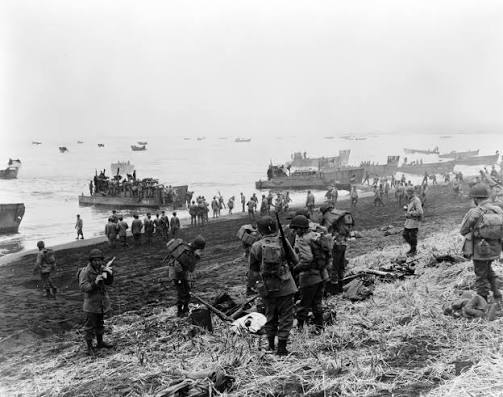
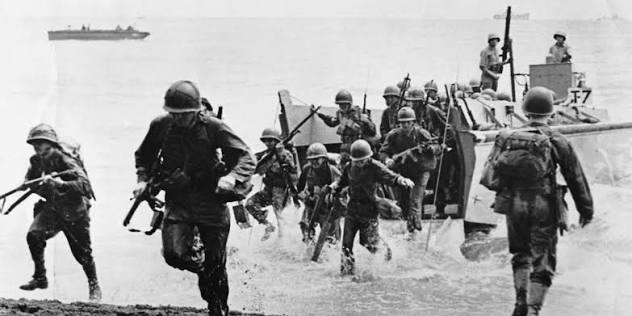
    On April 1, 1945, Easter Sunday, the largest amphibious assault of the Pacific War hit the beaches of Okinawa. The first waves of Marines and soldiers scrambled ashore expecting a slaughter. Instead, they found silence—no artillery, no machine-gun fire, no Japanese. The beaches were empty.

    That silence was the opening move in a deliberate Japanese strategy. Lt. Gen. Mitsuru Ushijima had ordered his 32nd Army to abandon the shoreline and dig into the island’s southern hills, turning Okinawa into a fortress designed not to repel the invasion, but to bleed it dry. What followed was an 82-day ordeal that would kill more than 12,000 Americans, over 77,000 Japanese soldiers, and—by most estimates—more than 100,000 Okinawan civilians. It was the last and bloodiest battle of World War II, and it changed the calculus for invading Japan itself.

    The Silent Beaches

    The U.S. Tenth Army, commanded by Lt. Gen. Simon Bolivar Buckner Jr., put 183,000 troops ashore in the first wave—more than the Normandy landings. The fleet offshore numbered over 1,300 ships, including the British Pacific Fleet’s Task Force 57, which covered the southern flank. Yet the Hagushi beaches on the island’s west coast were eerily quiet. The Japanese had not fired a shot.

    Ushijima, a seasoned commander, had rejected the old doctrine of annihilating invaders at the water’s edge. He knew the U.S. Navy’s overwhelming firepower would chew up any beach defense. Instead, he pulled his forces south, into a network of caves, tunnels, and pillboxes carved into the ridges around Shuri Castle. His operations officer, Col. Hiromichi Yahara, had argued for a pure war of attrition—no counterattacks, just relentless defense. Ushijima agreed, and the island’s fate was sealed.

    The Southern Fortress

    For the first three weeks, the battle seemed almost routine. The 1st and 6th Marine Divisions swept north, clearing the Motobu Peninsula by mid-April with light resistance. The army’s 7th and 96th Infantry Divisions moved south and hit the outer edges of the Shuri Line. That’s where the war turned ugly.

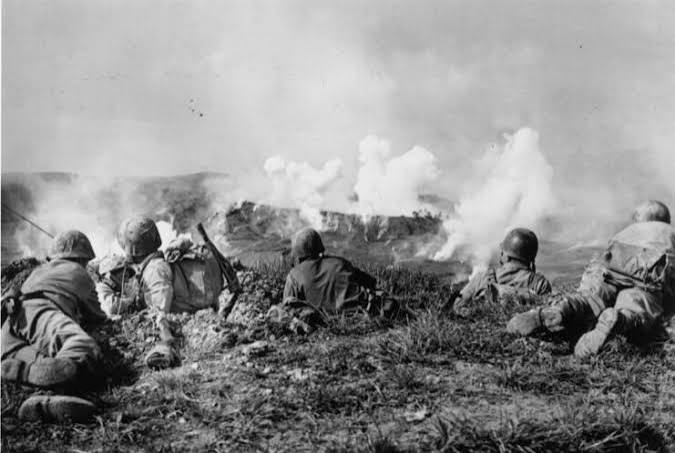
    Kakazu Ridge, Sugar Loaf Hill, Conical Hill, and the Maeda Escarpment—nicknamed Hacksaw Ridge—became names written in blood. The Japanese had fortified every approach, with interlocking fields of fire that turned each hill into a meat grinder. Progress was measured in yards, not miles. The 96th Division alone took 1,500 casualties taking Hacksaw Ridge, a 400-foot escarpment defended by a single Japanese battalion.

    Then the rain came. The spring typhoons turned the battlefield into a quagmire. Tanks sank to their hulls in mud. Supply trucks bogged down. Wounded men drowned in shell craters. One Marine officer wrote, “The mud is our worst enemy. It’s like fighting in a swamp that’s been churned by a million hooves.”

    The Shuri Line was a masterpiece of defensive engineering. Ushijima had spent months building it, with tunnels that linked the ridges so troops could move underground without exposure. The Japanese defenders—roughly 100,000 strong, including 20,000 Okinawan conscripts—were ordered not to surrender. They fought until they were killed, or killed themselves.

    The Kamikaze Storm

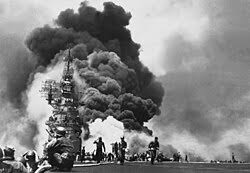
    While the ground troops bled for every ridge, the U.S. Navy faced its own nightmare. The Japanese launched the largest kamikaze campaign of the war—over 1,400 sorties against the invasion fleet. The destroyer USS Laffey survived six kamikaze hits and four bomb strikes on April 16, earning the nickname “The Ship That Would Not Die.” But many ships weren’t so lucky. Over 36 U.S. ships were sunk and 368 damaged, including 14 destroyers lost to kamikazes.

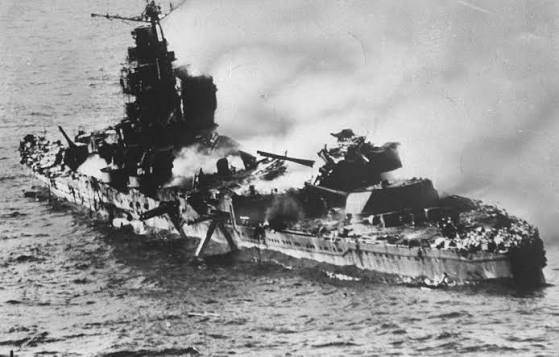
    The most dramatic moment came on April 7, when the super-battleship Yamato sortied on a one-way mission. She was the largest battleship ever built, but without air cover she was a floating target. U.S. carrier aircraft swarmed her, and she went down with more than 3,700 crew. It was the end of the Imperial Japanese Navy as a fighting force.

    The Counteroffensive That Failed

    By early May, Ushijima faced a dilemma. His defenses were holding, but the constant shelling and bombing were grinding down his troops. His staff officers, led by chief of staff Lt. Gen. Isamu Chō, demanded a counterattack. Yahara argued against it, warning that it would waste irreplaceable men. Ushijima sided with Chō.

    On May 4, the Japanese launched a mass assault. It was a disaster. The Americans had anticipated it, and their artillery and naval guns tore the attackers apart. The counteroffensive cost Ushijima thousands of men and, critically, his artillery ammunition. When it failed, the Shuri Line was doomed.

    The Collapse of the Shuri Line

    Throughout May, the U.S. Tenth Army ground forward. The 1st Marine Division took Sugar Loaf Hill after days of brutal fighting—the hill changed hands so many times that the ground was literally carpeted with bodies. The 7th Infantry Division finally broke through at Conical Hill, outflanking the Shuri Line from the east. By the end of May, Ushijima’s position was untenable. He ordered a withdrawal south, to the last defensive position at the Kiyan Peninsula.

    The retreat was a bloody affair. The Japanese abandoned thousands of wounded who couldn’t move—many of them killed themselves rather than be captured. The Americans pursued, and the fighting degenerated into a series of desperate, suicidal stands in caves and ravines.

    The Last Days and the Civilian Catastrophe

    By mid-June, the end was near. Ushijima’s remaining forces were cornered in the south. On June 18, Lt. Gen. Buckner was killed by a piece of coral shrapnel while observing the final assault—the highest-ranking U.S. general killed in the Pacific. His death was a bitter irony: the man who had ordered the invasion died just days before it ended.

    On June 22, Ushijima and Chō performed ritual suicide in a cave near Mabuni Hill. With them died the last organized resistance. The U.S. declared victory that day, though mopping-up operations continued for weeks.

    The true horror of Okinawa was the civilian toll. The Japanese military had conscripted Okinawans as laborers and, in many cases, as human shields. They also distributed grenades to civilians, encouraging them to commit suicide rather than surrender. As the battle collapsed into the southern tip of the island, tens of thousands of civilians were caught in the crossfire, killed by artillery, bombing, starvation, or their own hands. Estimates range from 40,000 to 150,000 dead—roughly a quarter to a third of the pre-war population. The exact number will never be known.

    The Legacy: A Warning of What Was to Come

    Okinawa was the bloodiest battle of the Pacific War. The U.S. lost over 12,500 killed and 38,000 wounded—more than at Iwo Jima and Guadalcanal combined. The Japanese lost nearly all of their 100,000-man garrison, with only a few thousand surrendering, most of them Okinawan conscripts.

    The cost was so staggering that it directly influenced the decision to use the atomic bomb. The planned invasion of Japan, Operation Downfall, was expected to cost millions of casualties on both sides. Okinawa proved that the Japanese would fight to the last man, and that civilians would die in massive numbers. When President Harry Truman authorized the atomic bombings of Hiroshima and Nagasaki in August 1945, his decision was shaped in part by the horrific preview that Okinawa had provided.

    The Battle of Okinawa was not just a military victory—it was a revelation. It showed the world the brutal lengths the Japanese would go to defend their homeland, and the terrible price the Allies would pay to take it. The island’s capture gave the U.S. a staging base for the invasion of Japan, but the battles’ casualties made that invasion almost unthinkable. In the end, Okinawa’s 82 days of hell may have saved millions of lives by making the atomic bomb seem like the lesser evil. It remains a sobering reminder of the true cost of war.

    Summary

    • The Battle of Okinawa lasted 82 days, from April 1 to June 22, 1945, and was the largest amphibious assault of the Pacific War.
    • The Japanese deliberately ceded the beaches and fought from fortified positions in the south, inflicting massive casualties on U.S. forces.
    • Over 12,500 Americans were killed and 38,000 wounded; Japanese military deaths exceeded 77,000, with most refusing to surrender.
    • An estimated 100,000–150,000 Okinawan civilians died, many from forced suicides and crossfire.
    • The battle’s horrific toll influenced the decision to use atomic bombs on Hiroshima and Nagasaki in August 1945.

    FAQ

    Q: How long did the Battle of Okinawa last?
    A: The ground combat lasted 82 days, from April 1 to June 22, 1945. Naval operations and kamikaze attacks continued into late July.

    Q: Why was the Battle of Okinawa so bloody?
    A: The Japanese abandoned beach defense and built a deep, fortified line in the south, fighting from caves and tunnels. They also launched mass kamikaze attacks against the U.S. fleet. The combination of fanatical resistance, difficult terrain, and heavy civilian presence led to catastrophic casualties.

    Q: How many people died at Okinawa?
    A: U.S. deaths were about 12,500, with 38,000 wounded. Japanese military deaths were between 77,000 and 110,000. Civilian deaths are estimated at 40,000–150,000, with the most common figure around 100,000–150,000.

    Q: What was the Shuri Line?
    A: The Shuri Line was a series of heavily fortified Japanese defensive positions in southern Okinawa, centered around Shuri Castle. It included tunnels, caves, and pillboxes, and was the main battleground of the battle.

    Q: How did the battle affect the decision to drop the atomic bomb?
    A: The massive casualties at Okinawa convinced U.S. leaders that an invasion of Japan would be prohibitively costly. This influenced the decision to use atomic bombs to force Japan’s surrender without an invasion.
  • 36 Days on a Volcanic Rock: The Brutal Calculus of Iwo Jima

    36 Days on a Volcanic Rock: The Brutal Calculus of Iwo Jima

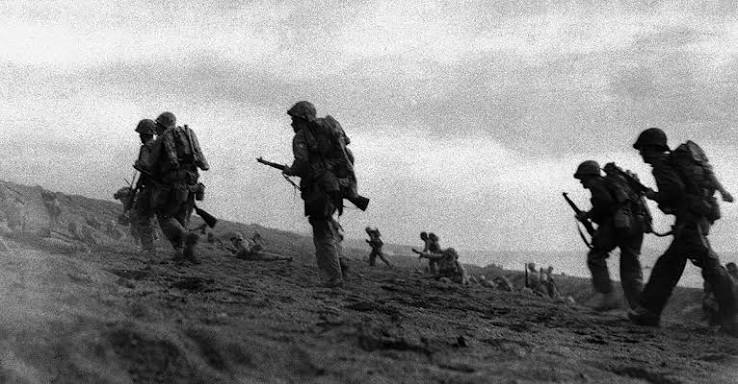
    On February 19, 1945, the first wave of Marines hit the black sand beaches of Iwo Jima. They expected a quick fight—planners had given the island five days. Thirty-six days later, nearly 7,000 Americans were dead, and the island had cost more Marine lives than it would ever save in B-29 landings. The battle became a symbol of American grit, a Japanese masterpiece of defense, and a strategic decision that historians still argue about.

    This is the story of how a tiny volcanic island, 750 miles from Tokyo, turned into one of the bloodiest encounters of the Pacific War—and why the debate over its necessity has never fully settled.

    The Island That Shouldn’t Have Mattered

    Iwo Jima is a lump of volcanic rock and sulfur, roughly eight square miles. In early 1945, it was a Japanese radar outpost and a base for fighters that harassed American B-29s flying from the Marianas to bomb Tokyo. The U.S. Joint Chiefs wanted it: an emergency landing field for damaged bombers, a home for P-51 Mustang escorts, and a staging ground for the invasion of Japan itself.

    The plan, Operation Detachment, assumed five days to secure the island. The Japanese had other ideas.

    Lieutenant General Tadamichi Kuribayashi had studied American tactics. He knew the beaches would be hammered by naval guns, so he abandoned the beach defense. Instead, his 21,000 troops dug into 11 miles of tunnels, built 800 pillboxes, and zeroed their artillery on the landing zones. He banned banzai charges, ordering his men to fight from cover and make the Americans pay for every yard.

    The pre-invasion bombardment—three days, the heaviest of the Pacific War—did little. The shells churned the surface but missed the buried fortifications.

    The First 36 Days

    On February 19, the 4th and 5th Marine Divisions hit the southeastern beaches. The black volcanic ash was loose, like walking in sand, and provided no cover. Japanese guns from Mount Suribachi to the south and the northern highlands opened up. The first day ended with 550 dead and more than 1,800 wounded—the worst single day in Marine Corps history up to that point.

    The fighting was relentless. The Marines advanced yard by yard, using flamethrowers, demolition charges, and grenades to clear bunkers. Kuribayashi’s men, well-supplied and hidden, inflicted casualties at a rate that stunned the Americans. By March 3, the airfield was in use, but the island was far from secure.

    On February 23, a patrol reached the summit of Mount Suribachi. A small flag went up, photographed by Marine photographer Lou Lowery. Hours later, a larger flag replaced it. Associated Press photographer Joe Rosenthal captured that second raising—an image that would become the Marine Corps War Memorial. Of the six men in the photo, three—Harlon Block, Franklin Sousley, and Mike Strank—were killed later in the battle. It took 71 years to correct the identity of another man in the picture: Harold Schultz, not John Bradley, as misidentified for decades.

    The Toll and the Aftermath

    The battle dragged on. The 3rd Marine Division joined the fight. By March 16, the island was declared secure, but organized resistance continued until March 26, when the last Japanese defenders launched a final attack. At the end, 6,821 Americans were dead and 19,217 wounded. Japanese dead numbered about 20,000, with only 216 taken prisoner. This was the only major Pacific battle where U.S. casualties exceeded Japanese.

    Twenty-seven Medals of Honor were awarded—more than in any other single battle in American history. The cost was staggering for an island that, in the end, did not prove decisive.

    The Strategic Debate

    Supporters point to the numbers: more than 2,200 B-29s made emergency landings on Iwo Jima, saving an estimated 24,000 airmen. The radar station was silenced, and the fighter base allowed P-51s to escort bombers.

    Critics argue the numbers are misleading. Many of those landings were routine, not emergencies, and the P-51 escorts had limited impact. The cost—nearly 7,000 dead—was too high for what was gained. Some historians suggest the invasion was driven by interservice rivalry and momentum rather than strategic necessity.

    Kuribayashi’s defense is studied today as a model of how to fight against overwhelming odds. In Japan, the battle is remembered as a symbol of sacrifice, though its meaning has been contested in nationalist narratives.

    Thirty-six days on a volcanic rock changed the course of the Pacific War, but not in the way planners expected. The island was taken, but at a cost that still raises questions about whether it was worth it.

    The battle of Iwo Jima remains a study in contrasts: a tactical victory, a strategic question mark, and a human tragedy. The flag raising on Suribachi became an icon of American resolve, but the island’s cost in lives demands a closer look at the decisions that led there. For the Marines who fought, the island was simply a job to do. For historians, it is a lesson in the brutal arithmetic of war—where the value of a piece of ground is measured in lives, not miles.

    Summary

    • The battle lasted 36 days, from February 19 to March 26, 1945, far beyond the 5 days planned.
    • U.S. casualties: 6,821 killed, 19,217 wounded; Japanese: about 20,000 killed, only 216 captured.
    • Kuribayashi’s tunnel defense and ban on banzai charges made the island a fortress.
    • The iconic flag raising on Mount Suribachi had six men; three were killed later, and one was misidentified for decades.
    • The strategic value of the island is debated: 2,200 B-29 landings vs. nearly 7,000 U.S. dead.

    FAQ

    Q: Why did the U.S. want Iwo Jima?
    A: To provide an emergency landing field for B-29 bombers, a base for P-51 fighter escorts, and a staging area for the planned invasion of Japan.

    Q: How did the Japanese defend the island?
    A: Under Lieutenant General Tadamichi Kuribayashi, they built over 11 miles of tunnels, 800 pillboxes, and used artillery positioned to fire on the beaches. They avoided banzai charges and fought from prepared positions.

    Q: How many Medals of Honor were awarded?
    A: 27 Medals of Honor were awarded, more than any other single battle in U.S. history.

    Q: What was the significance of the flag raising?
    A: The second flag raising, photographed by Joe Rosenthal, became a symbol of the battle and inspired the Marine Corps War Memorial. Three of the six men in the photo were killed later in the battle.

    Q: Was the invasion of Iwo Jima necessary?
    A: The debate continues. Supporters cite over 2,200 B-29 landings and the elimination of the radar station. Critics argue the cost in lives outweighed the benefits, and the invasion may have been driven by momentum rather than necessity.

  • The Six-Month Struggle for Guadalcanal: How the Allies Seized the Initiative in the Pacific

    The Six-Month Struggle for Guadalcanal: How the Allies Seized the Initiative in the Pacific

    On August 7, 1942, a force of nearly 19,000 U.S. Marines stormed the beaches of Guadalcanal, a small, jungle-covered island in the Solomon Islands. They expected a quick seizure of a half-built airfield. Instead, they ignited a six-month furnace of jungle warfare, naval clashes, and aerial duels that would become the turning point of the Pacific War.

    This was not a single battle but a relentless campaign of attrition, fought across land, sea, and air. By the time the Japanese evacuated in February 1943, the Allies had inflicted the first major defeat on the Empire of Japan, shifting the momentum of the war. The fight for Guadalcanal proved that the Allies could not only hold their own but also push back against an enemy that had seemed unstoppable since Pearl Harbor.

    The Strategic Gamble: Why Guadalcanal Mattered

    In mid-1942, Japan’s empire stretched from the Indian Ocean to the central Pacific. After the stunning loss of four fleet carriers at Midway in June, Japan still held the initiative in the South Pacific. Their plan was to build an airfield on Guadalcanal, extending their defensive perimeter and threatening the vital supply lines between the United States and Australia. From this base, they could launch further offensives toward Fiji, Samoa, and New Caledonia.

    American intelligence, aided by Australian coastwatchers hidden behind Japanese lines, detected the airfield’s construction. The Allies decided to strike first, launching Operation Watchtower with remarkable speed. The 1st Marine Division, many of whom had never seen combat, landed on August 7, 1942. They caught the Japanese construction crews and their guards off guard, capturing the nearly complete airfield within two days. They renamed it Henderson Field, in honor of a Marine aviator killed at Midway.

    The Jungle War: Land Battles and the Fight for Henderson Field

    The Marines dug in, but the Japanese were not about to surrender the island quietly. Over the next months, they launched repeated attempts to retake the airfield. One of the most desperate came in September 1942, when Japanese forces attacked along a grassy ridge south of the airfield. The Marines, outnumbered and low on ammunition, held their line through the night, repelling wave after wave of charges. The ridge became known as Edson’s Ridge, after the Marine colonel who led the defense. The Japanese lost over 1,000 men in that single assault.

    Supply was a constant problem. The Marines had landed with only a fraction of their equipment, and Japanese naval forces controlled the waters around the island at night. They survived on captured Japanese rice and whatever could be brought in by ship or air. Despite these hardships, they held the airfield, which became the linchpin of the entire campaign.

    The Ironbottom Sound: Naval Battles and the Tokyo Express

    The sea around Guadalcanal became a graveyard of ships, earning the name Ironbottom Sound. The first major naval engagement, the Battle of Savo Island in August 1942, was a disaster for the Allies. A Japanese cruiser force surprised and sank four Allied cruisers in a matter of minutes. The Japanese suffered minimal losses, and the Allies were forced to withdraw their carriers and transports, leaving the Marines on the island isolated.

    The Japanese, however, could not sustain their naval dominance. They resorted to nightly destroyer runs, dubbed the “Tokyo Express,” to deliver troops and supplies. But these ships could not carry heavy equipment or enough food, and the Japanese soldiers on the island began to starve. The Allies, meanwhile, used radar and codebreaking to gain an edge in night battles. The Naval Battle of Guadalcanal in November 1942 was a turning point, as the U.S. Navy turned back a Japanese bombardment force and sank two battleships, securing control of the sea.

    The Cactus Air Force: Command of the Skies

    From Henderson Field, a motley collection of Marine, Navy, and Army aircraft, known as the Cactus Air Force, flew daily sorties against Japanese bombers and supply convoys. They were often outnumbered and flying worn-out planes, but they inflicted heavy losses on the Japanese. In one notable action, they sank a Japanese transport carrying troops and supplies, forcing the Japanese to resort to even more desperate measures.

    Air superiority was crucial. It allowed the Allies to reinforce and resupply their troops, while denying the Japanese the same. By late 1942, the Japanese had lost so many aircraft and pilots that they could no longer challenge the Allies in the air.

    Attrition and Starvation: The Japanese Collapse

    The Japanese command made a fatal decision: instead of evacuating Guadalcanal when it became clear that they could not win, they continued to pour in reinforcements. This only increased the death toll. Japanese soldiers, cut off from supplies, died by the thousands from starvation and disease. Many resorted to desperate banzai charges, but they could not break the Allied lines.

    In January 1943, the Allies launched a final offensive, pushing the remaining Japanese forces to the northern coast. The Japanese, realizing the futility of further resistance, began a secret evacuation under the cover of darkness, Operation KE. Over several nights in early February, they managed to withdraw about 12,000 troops, leaving the island for good.

    The Turning Point: What Guadalcanal Meant

    The victory at Guadalcanal was not just a military achievement; it was a psychological breakthrough. For the first time, the Allies had decisively defeated the Japanese on land, sea, and air. The Japanese had been stopped, and the long road to Tokyo had begun.

    Casualties were heavy on both sides. The Allies lost over 7,000 dead and nearly 8,000 wounded, along with 24 ships. The Japanese lost over 19,000 dead on the island alone, with thousands more in the surrounding waters, and 38 ships. But the strategic gain was incalculable. The Allies had secured the sea lanes to Australia and established a forward base for future operations.

    Guadalcanal also proved that the U.S. military could adapt and overcome. The lessons learned in night fighting, amphibious assault, and logistics would be applied in the subsequent island-hopping campaign across the Pacific. For the Japanese, it was a bitter lesson in the cost of overreach.

    Conclusion

    The Battle of Guadalcanal was a brutal, grinding struggle that tested the endurance of both sides. It was won not by a single brilliant maneuver, but by the stubborn determination of Marines, sailors, and airmen who refused to lose. The island’s jungles and waters bore witness to the deadliest fighting of the Pacific War, but they also marked the moment when the tide turned. From Guadalcanal onward, the Allies would not look back.

    The Battle of Guadalcanal was a brutal, grinding struggle that tested the endurance of both sides. It was won not by a single brilliant maneuver, but by the stubborn determination of Marines, sailors, and airmen who refused to lose. The island’s jungles and waters bore witness to the deadliest fighting of the Pacific War, but they also marked the moment when the tide turned. From Guadalcanal onward, the Allies would not look back.

    Summary

    • First Major Allied Offensive: The campaign, from August 7, 1942, to February 9, 1943, was the first major Allied counteroffensive against Japan in the Pacific.
    • Strategic Importance: The fight centered on Henderson Field, which the Allies captured and held, securing supply lines to Australia and halting Japanese expansion.
    • Brutal Attrition: The campaign involved intense land battles (Edson’s Ridge, Matanikau), naval clashes (Savo Island, Naval Battle of Guadalcanal), and daily aerial duels, with heavy casualties on both sides.
    • Japanese Defeat: Japan lost over 19,000 troops on the island, many to starvation and disease, and was forced to evacuate in February 1943, marking their first major retreat of the war.
    • Turning Point: The Allied victory shifted the strategic momentum in the Pacific, paving the way for the island-hopping campaign that led to Japan’s eventual defeat.

    FAQ

    Q: Why was Guadalcanal so important?
    A: Guadalcanal was vital because it housed a Japanese airfield that threatened Allied supply lines to Australia. Capturing it allowed the Allies to protect those lines and launch their own offensive operations in the Pacific.

    Q: What was the Tokyo Express?
    A: The Tokyo Express was the nickname for Japanese naval forces, primarily destroyers, that made nightly runs to deliver troops and supplies to Guadalcanal. They were effective but could not carry heavy equipment or enough food, leading to severe shortages for Japanese troops.

    Q: What were the casualties at Guadalcanal?
    A: Allied forces suffered approximately 7,100 dead and 7,900 wounded, along with 24 ships sunk. Japanese losses were much higher, with around 19,200 dead on the island and about 31,000 total including naval and air losses, and 38 ships sunk.

    Q: Who were the key leaders on each side?
    A: On the Allied side, key figures included Admiral Chester Nimitz, General Alexander Vandegrift (1st Marine Division), and Admiral William Halsey. On the Japanese side, Admiral Isoroku Yamamoto, General Harukichi Hyakutake, and Vice Admiral Nobutake Kondo led their forces.

    Q: What was the outcome of the Guadalcanal Campaign?
    A: The Allies won a decisive strategic victory. Japan evacuated the island in February 1943, marking their first major retreat of the war. The campaign demonstrated that Japan could be defeated and set the stage for the Allied island-hopping strategy.

  • Five Minutes Over Midway: How Codebreakers and Courage Turned the Tide in the Pacific

    Five Minutes Over Midway: How Codebreakers and Courage Turned the Tide in the Pacific

    How Codebreakers Helped Secure U.S. Victory in the Battle of Midway | HISTORYAt 10:22 on the morning of June 4, 1942, the fate of the Pacific War hung on a sliver of sky above a pair of coral islands. Below, four Japanese aircraft carriers the vanguard of an empire that had swept across Asia and the Pacific in six monthswere turning into the wind to launch a second strike against Midway Atoll. Their decks were crammed with fueled planes, armed bombs, and torpedoes. Then, from 20,000 feet, three squadrons of American dive bombers plunged out of the sun. In five minutes, they turned the tide of World War II.

    This was no accident of luck. It was the product of a secret intelligence coup, a commander’s calculated gamble, and the desperate sacrifice of young pilots who flew straight into death to buy those five minutes. The Battle of Midway, fought June 4–7, 1942, was the moment Japan’s offensive momentum broke—when the U.S. Navy, outnumbered and battle-worn, struck a blow from which the Imperial Japanese Navy never recovered.

    The Road to the Reef

    Midway Atoll sits at the northwestern edge of the Hawaiian chain, 1,300 miles from Oahu. It is a speck of sand and reef, but by 1942 it was an unsinkable American aircraft carrier—a forward base for bombers and submarines that could threaten Japanese operations. For Admiral Isoroku Yamamoto, commander of Japan’s Combined Fleet, Midway was a lure. He planned to seize the island and, in the process, draw out the U.S. carriers he had failed to sink at Pearl Harbor on December 7, 1941.

    Yamamoto’s plan was grandiose and complicated. He would send a diversionary force to attack the Aleutians in the north, a main carrier strike force under Vice Admiral Chuichi Nagumo to soften Midway, an invasion force to land troops, and a massive battleship fleet lurking hundreds of miles behind—ready to crush the American carriers once they surfaced. It was a plan built on the assumption that the U.S. carriers would react predictably, steaming from Pearl Harbor only after Midway was attacked. It was a fatal assumption.

    The Codebreakers’ Secret

    While Yamamoto planned, a cramped basement at Pearl Harbor—Station HYPO—was quietly unraveling his strategy. Commander Joseph Rochefort and his team of cryptanalysts had been working on the Japanese JN-25 naval code for months. By May 1942, they had pieced together that a major operation was aimed at a target designated “AF.” But what was AF?

    Rochefort had a hunch it was Midway. To prove it, he devised a simple ruse. He ordered Midway to send an uncoded radio message stating that its freshwater distillation plant had broken down. Two days later, Japanese intelligence intercepted a message reporting that “AF” was short of fresh water. The trap was sprung. Nimitz knew exactly where the enemy was going.

    This intelligence gave the U.S. Pacific Fleet a priceless advantage. Nimitz could position his three carriers—Enterprise, Hornet, and the hastily repaired Yorktown—northeast of Midway, out of Japanese reconnaissance range, ready to spring an ambush. The Yorktown, which had been severely damaged at the Battle of the Coral Sea a month earlier, was patched in just 72 hours at Pearl Harbor. Shipyard workers, working around the clock, made her seaworthy enough to fight. She would sail into history.

    The Morning of June 4

    Nagumo’s four carriers—Akagi, Kaga, Soryu, and Hiryu—launched their first strike on Midway at dawn on June 4. The attack was successful but not decisive; Midway’s airfield remained operational, and its bombers were already in the air, searching for the Japanese fleet. Meanwhile, Nagumo’s scout planes were searching for the U.S. carriers. They found nothing.

    At 7:10 AM, Midway-based aircraft began attacking the Japanese carriers. Torpedo bombers, dive bombers, and B-17s came in waves, but they were slow, vulnerable, and poorly coordinated. Japanese Zero fighters and anti-aircraft fire cut them down. Not a single bomb hit a Japanese ship. But the attacks had a profound effect: they convinced Nagumo that Midway posed a greater threat than expected, and they delayed his decision on whether to strike again.

    At 8:20 AM, a scout plane from the cruiser Tone finally reported the presence of a U.S. carrier force. Nagumo was caught in a dilemma. His planes were armed with bombs for a second strike on Midway. To attack the carriers, they needed torpedoes. The process of rearming would take time—precious time. He ordered the rearming to begin, and then, at 8:37, he changed his mind and ordered the planes to be rearmed again. The decks of his carriers became a chaotic jumble of bombs, torpedoes, and fueled aircraft.

    The Sacrifice of the Torpedo Squadrons

    While Nagumo dithered, U.S. carrier aircraft were closing in. The first to arrive were the torpedo bombers—slow, low-flying TBD Devastators. They came in at wave height, without fighter cover, their torpedoes outdated and often malfunctioning. They flew straight into the teeth of the Japanese defenses.

    Torpedo Squadron 8 from the Hornet, led by Lieutenant Commander John Waldron, was the first to attack. All fifteen of its aircraft were shot down. Only one pilot, Ensign George Gay, survived—he floated in the water, watching the battle unfold, as his comrades died around him. Torpedo Squadrons from Enterprise and Yorktown followed, and they too were massacred. Of the 41 torpedo bombers that attacked, only six returned. They scored no hits. But they did something more important: they drew the Japanese Zero fighters down to sea level, leaving the sky above clear.

    The Five Minutes That Changed the War

    At 10:22 AM, the Japanese carriers were at their most vulnerable. Their decks were full of aircraft being rearmed, with bombs and torpedoes stacked carelessly, fuel lines snaking across the flight deck. Zeroes that had been scrambled to shoot down the torpedo bombers were low on fuel and ammunition, circling at low altitude. No one was looking up.

    Then, from 20,000 feet, the dive bombers arrived. They were from Enterprise and Yorktown—two squadrons of SBD Dauntlesses, about 50 aircraft total. They had arrived late, having missed the initial contact, but their timing was perfect. Led by Lieutenant Commander Wade McClusky, who had made a critical navigation decision to continue searching rather than turn back, they found the Japanese fleet by following a single destroyer’s wake.

    They pushed over into their dives. In the next five minutes, bombs struck Akagi, Kaga, and Soryu. The explosions ignited the fuel and ordnance on their decks. Fires raged out of control. The three carriers were doomed. Only Hiryu, further north, escaped the initial attack.

    The Final Act

    Hiryu launched a counterstrike that afternoon. Her bombers found Yorktown and hit her with three bombs and two torpedoes. The Yorktown was crippled, and she was later sunk by a Japanese submarine, along with the destroyer Hammann, which was alongside her during salvage efforts. But Hiryu’s victory was short-lived. U.S. scout planes located her, and a strike from Enterprise and Hornet found her in the late afternoon. Four bombs hit Hiryu’s flight deck, turning her into an inferno. She sank the next morning.

    By June 7, the battle was over. The U.S. had lost the Yorktown and the Hammann, but all four of Japan’s fleet carriers—the core of its naval air power—lay at the bottom of the Pacific. More than 250 carrier aircraft and their experienced pilots had gone down with them, a blow from which Japan’s air arm would never recover. The U.S. lost about 150 aircraft, but most of its aircrew survived to fight again.

    The Aftermath

    Midway was a turning point. Japan lost not only ships and men but the strategic initiative. Admiral Yamamoto’s dream of a decisive battle had ended in disaster. The U.S. went on the offensive, landing at Guadalcanal in August 1942, the first step in a long island-hopping campaign that would end at Tokyo Bay. The battle also vindicated the U.S. intelligence community and the carrier-centric naval doctrine that would dominate the rest of the war.

    For the men who fought there, the memory was stark. Ensign George Gay, floating in the Pacific, watched his squadron die and then watched the Japanese carriers burn. He was rescued the next day, his body burned and his spirit forever marked. A generation of American pilots had been sacrificed to buy those five minutes, but the sacrifice bought victory.

    Midway was not a battle that was won by a single genius or a single lucky break. It was won by intelligence, by risk-taking, and by the raw courage of men who flew into the face of death. The codebreakers who cracked JN-25, the commanders who gambled on a flanking position, and the torpedo pilots who gave their lives to set up the dive bombers—all of them were necessary. The Battle of Midway remains a testament to the fact that, in war, information and sacrifice can overcome superior numbers and brute force. It was the moment the Pacific War truly turned, and it has never been forgotten.

    Summary

    • The U.S. Navy’s codebreakers confirmed Midway as the Japanese target by faking a water shortage, enabling Admiral Nimitz to set an ambush.
    • The Japanese plan was overcomplicated and dispersed, violating the principle of concentration of force.
    • The sacrifice of U.S. torpedo squadrons, which suffered near-total losses, drew Japanese fighters down and left the sky clear for dive bombers.
    • At 10:22 AM on June 4, 1942, U.S. dive bombers struck three Japanese carriers in five minutes, turning the tide of the battle.
    • All four Japanese fleet carriers were sunk; Japan lost ~3,000 men and the initiative in the Pacific, while the U.S. lost one carrier and ~360 men.

    FAQ

    Q: Why did the Japanese attack Midway?
    A: Admiral Yamamoto wanted to draw out and destroy the U.S. carrier fleet in a decisive battle, and also to seize Midway as a forward airbase to threaten Hawaii and force a favorable peace.

    Q: How did the U.S. know the Japanese were coming?
    A: U.S. Navy cryptanalysts, led by Commander Joseph Rochefort, had partially broken the Japanese JN-25 code. They confirmed Midway as the target by having Midway send a false message about a broken water distillation plant, and then intercepting a Japanese report that ‘AF’ was short of water.

    Q: What was the ‘five minutes’ that changed the war?
    A: On June 4, 1942, at 10:22 AM, U.S. dive bombers from Enterprise and Yorktown attacked the Japanese carriers Akagi, Kaga, and Soryu while their decks were full of fueled and armed aircraft. In five minutes, they hit all three, causing catastrophic fires that doomed the carriers.

    Q: How many ships were lost on each side?
    A: Japan lost all four fleet carriers (Akagi, Kaga, Soryu, Hiryu) and a heavy cruiser. The U.S. lost the carrier Yorktown and the destroyer Hammann.

    Q: Why was the Battle of Midway a turning point?
    A: It was Japan’s first decisive defeat in 350 years. The loss of four fleet carriers and their irreplaceable aircrews ended Japan’s offensive capability, and the U.S. went on the strategic offensive, starting with the Guadalcanal campaign in August 1942.

  • The Pacific War: A Chronicle of Fire, Ash, and the Shape of the Modern World

    The Pacific War: A Chronicle of Fire, Ash, and the Shape of the Modern World

    At 7:48 a.m. on December 7, 1941, the first wave of Japanese aircraft descended on Pearl Harbor. Within two hours, 2,403 Americans were dead, eight battleships were sunk or damaged, and the United States was irrevocably at war. But the attack on Hawaii was only one stroke in a coordinated sweep across the Pacific—Japanese troops were simultaneously landing in Malaya, the Philippines, and Hong Kong. The war that followed would last nearly four years, consume millions of lives, and redraw the map of Asia and the Pacific.

    This is not a story of clean battle lines or simple heroes. It is a story of island hopping through coral and jungle, of firebombed cities and atomic flashes, of empires crumbling and new nations rising. To understand the Pacific War is to understand how the modern world took shape—through the roar of carrier aircraft, the silence of a surrendered fleet in Tokyo Bay, and the long shadows cast by decisions made in smoke-filled rooms on both sides of the ocean.

    The Road to War: An Empire’s Gamble

    Japan’s path to Pearl Harbor was paved with decades of ambition and desperation. After the Meiji Restoration of 1868, Japan industrialized at a breathtaking pace, but it lacked the raw materials to sustain its growth. The Great Depression of the 1930s only sharpened the crisis, pushing Tokyo toward expansion as a solution. In 1931, Japan occupied Manchuria, establishing the puppet state of Manchukuo. Six years later, it launched a full-scale invasion of China, plunging the region into a brutal conflict that would last until 1945.

    The Western powers watched with growing alarm. The United States, Britain, and the Netherlands—the colonial rulers of Southeast Asia—controlled the oil, rubber, and tin that Japan so desperately needed. When Japan joined Germany and Italy in the Tripartite Pact in 1940, the Western response was swift: embargoes on oil, steel, and scrap metal. Japan’s oil reserves were estimated at only two years’ worth. Facing economic strangulation, Tokyo chose war.

    The strategic logic was simple: strike the U.S. Pacific Fleet at Pearl Harbor to buy time, then seize the Southern Resource Area—the oil fields of the Dutch East Indies, the rubber of Malaya, the rice of Burma—and fortify a defensive perimeter across the Pacific. The plan was a gamble, but Japanese leaders saw it as a necessity. As Admiral Isoroku Yamamoto, who opposed the war, reportedly said, “I shall run wild considerably for the first six months or a year, but I have utterly no confidence for the second and third years.”

    The First Six Months: The Japanese Blitzkrieg

    Yamamoto’s prediction proved accurate. In the months after Pearl Harbor, Japanese forces swept through Southeast Asia and the Pacific with shocking speed. Hong Kong fell on Christmas Day 1941. Singapore, the supposedly impregnable British fortress, surrendered on February 15, 1942, with 80,000 troops captured. The Philippines—where American and Filipino forces under General Douglas MacArthur fought a desperate delaying action—fell by May. The Dutch East Indies, with its vital oil, was overrun in March. By the summer of 1942, Japan controlled a vast empire stretching from the Aleutians to the Solomon Islands.

    The brutality of the occupation was immediate. In the Philippines, the Bataan Death March in April 1942 forced 75,000 prisoners on a 65-mile trek; thousands died from starvation, disease, and execution. In Burma, Allied POWs and Asian laborers were conscripted to build the Death Railway, where an estimated 12,000 POWs and 90,000 laborers perished. The Japanese military, guided by the Bushido code that forbade surrender, treated its captives with a contempt that shocked the Western world.

    The Tide Turns: Midway and Guadalcanal

    Japan’s expansion had to stop somewhere. It stopped at Midway.

    In June 1942, the Japanese fleet—four heavy aircraft carriers, dozens of support ships—steamed toward Midway Atoll, intending to lure the U.S. Navy into a decisive battle. But American codebreakers had cracked Japanese naval codes. Admiral Chester Nimitz knew the plan in advance. On June 4, dive bombers from USS Enterprise and USS Yorktown caught the Japanese carriers rearming and refueling their aircraft. Within five minutes, three of the four carriers were burning wrecks. The fourth was sunk later that day. Japan lost 3,000 men and the core of its naval aviation. The battle halted Japanese expansion in the Pacific—permanently.

    But Midway was not the end. The Allies needed to go on the offensive, and their first target was Guadalcanal, a jungle-covered island in the Solomon Islands where the Japanese were building an airfield. In August 1942, U.S. Marines landed, beginning a six-month campaign of attrition that would define the war in the Pacific. The battles around Guadalcanal—on land, at sea, and in the air—were brutal and costly. The Japanese called it “Starvation Island” as supply lines were cut and troops withered. The Americans held, and by February 1943, the Japanese had evacuated. The first major Allied land offensive had succeeded, but at a terrible price: over 7,000 Allied dead, and over 19,000 Japanese dead, most from starvation and disease.

    Island Hopping: The Road to Tokyo

    After Guadalcanal, the Allies adopted a strategy of “island hopping”: bypass heavily fortified Japanese positions, seize lightly defended islands to build airfields and naval bases, and let the isolated garrisons “wither on the vine.” Admiral Nimitz advanced across the central Pacific, while General MacArthur pushed up from the southwest. The pace was relentless: Tarawa in November 1943, where 1,000 Marines died in 76 hours; the Marshalls in early 1944; then the Marianas—Saipan, Tinian, Guam—in June and July 1944.

    Saipan was a turning point. Its capture brought Japan’s home islands within range of American B-29 bombers. The Japanese knew it, and they defended the island with desperation. When defeat was inevitable, hundreds of civilians threw themselves from the cliffs at Marpi Point rather than surrender. The battle for Saipan cost over 3,000 U.S. dead and over 29,000 Japanese dead.

    The largest naval battle in history occurred on October 23–26, 1944, in Leyte Gulf, in the Philippines. The Imperial Japanese Navy deployed nearly its entire remaining fleet in a desperate bid to destroy the U.S. invasion force. The result was a disaster for Japan: three battleships, four carriers, and ten cruisers were sunk, effectively destroying the Japanese fleet as a fighting force. It was also at Leyte Gulf that the Japanese first used kamikaze attacks—suicide pilots who crashed their planes into American ships. They would become a chilling symbol of Japan’s defiance in the face of inevitable defeat.

    The Bloody Islands: Iwo Jima and Okinawa

    By early 1945, the war had moved to Japan’s doorstep. The first target was Iwo Jima, a volcanic island 750 miles from Tokyo, needed as an emergency landing strip for B-29s. The Japanese had fortified the island with 21,000 troops in an elaborate network of tunnels and bunkers. The U.S. Marine assault, starting on February 19, 1945, was supposed to last five days. It took over a month. The iconic photograph of Marines raising the flag on Mount Suribachi became a symbol of American valor, but the cost was staggering: 6,821 U.S. dead and over 18,000 wounded. Of the 21,000 Japanese defenders, only 216 were taken prisoner.

    Okinawa, in April 1945, was even worse. The island was the last defensive ring before the Japanese home islands. The Japanese garrison of over 100,000 troops fought with a fury that stunned the Americans. The battle dragged on for 82 days, the longest and bloodiest in the Pacific theater. The U.S. lost over 12,000 dead; the Japanese lost about 100,000 military dead. But the most tragic casualties were Okinawan civilians—about 150,000, roughly one-third of the island’s population, were killed in the crossfire, forced to commit suicide, or used as human shields.

    Fire from the Sky: The Bombing of Japan

    Even before Iwo Jima and Okinawa, the U.S. had begun a strategic bombing campaign against Japan’s cities. From late 1944, B-29s flew from bases in the Marianas, striking factories, railways, and urban areas. In March 1945, Major General Curtis LeMay ordered a change in tactics: low-altitude night raids using incendiary bombs. The first such raid on Tokyo on March 9–10, 1945, killed an estimated 100,000 people and destroyed 16 square miles of the city. Over the next five months, similar firebombing raids devastated 67 Japanese cities. The raids were horrifically effective, but Japan showed no sign of surrender.

    The firebombing raids were a prelude to something even more terrible. On August 6, 1945, a B-29 named Enola Gay dropped an atomic bomb on Hiroshima, instantly killing an estimated 70,000 people. Three days later, a second bomb was dropped on Nagasaki, killing another 40,000. The long-term effects of radiation would raise the death toll to 200,000 by the end of 1945. On August 8, the Soviet Union declared war on Japan and invaded Manchuria, shattering any hope of a negotiated peace. On August 15, Emperor Hirohito—in a radio broadcast that was the first time most Japanese had heard his voice—announced Japan’s surrender. The formal ceremony took place on September 2, 1945, aboard the battleship USS Missouri in Tokyo Bay.

    The Wider War: China, Southeast Asia, and the Colonial Collapse

    While the U.S. and Japan fought across the Pacific, the war in China raged on. For the Chinese, the war had begun in 1937, not 1941. The conflict between Nationalists under Chiang Kai-shek and Communists under Mao Zedong had been interrupted by a fragile united front against the Japanese, but the two factions also fought each other. China suffered catastrophic losses: an estimated 10 to 20 million military and civilian deaths. The Rape of Nanjing in December 1937, where Japanese troops massacred hundreds of thousands of civilians and committed widespread sexual violence, remains one of the most horrific events of the war.

    In Southeast Asia, the Japanese occupation had a dual legacy. It brutally exploited the region’s resources and peoples: forced labor on the Burma Railway, forced farming of crops for the Japanese war effort, and systematic starvation in the Dutch East Indies, where an estimated 4 million civilians died. But it also shattered the myth of white colonial invincibility. The Japanese defeated British, Dutch, and American colonial powers with stunning ease, and their propaganda of “Asia for the Asiatics” resonated with many who had long resented European rule. When the Japanese surrendered, they left a power vacuum. Independence movements in Indonesia, Vietnam, and the Philippines surged forward, leading to the end of Western colonialism in Asia within a decade.

    The Pacific Islands themselves bore the brunt of the fighting. Tens of thousands of islanders were killed, displaced, or conscripted as laborers by both sides. The war’s end did not bring peace to the islands: the U.S. military continued to occupy and test nuclear weapons in the Marshall Islands, beginning with the Bikini Atoll tests in 1946, a continuation of militarization that would have lasting health and environmental consequences.

    Legacy: The Shape of the Modern World

    The Pacific War remade the world in ways that are still visible today. It ended the Japanese Empire and led to the transformation of Japan into a pacifist democracy under the American occupation. It raised the United States to superpower status, with a network of military bases across the Pacific. It accelerated the collapse of European colonialism and the emergence of new nations. It also left deep scars: the occupation of the Korean peninsula by the U.S. and Soviet Union set the stage for the Korean War; the division of Vietnam led to the Vietnam War; and the unresolved grievances of the war continue to shape relations between Japan, China, and Korea today.

    The war also raised profound moral questions. The atomic bombings of Hiroshima and Nagasaki, the firebombing of Tokyo, the internment of 120,000 Japanese-Americans, the use of kamikaze attacks, and the systematic sexual slavery of “comfort women” all remain subjects of intense debate. Were the atomic bombs necessary? Did the firebombing of cities cross a moral line? These questions have no easy answers, but they are essential to understanding the war’s true cost.

    In the end, the Pacific War was a war of extremes—of islands that were little more than specks on a map, of battles that turned on a few minutes of carrier aircraft, of civilian suffering on a scale that defies imagination. It was a war that began with a surprise attack on a quiet Sunday morning and ended with the flash of an atomic bomb over a city. Its legacy is written in the skyline of modern Tokyo, the independence of former colonies, and the memorials that dot the Pacific—from the USS Arizona in Pearl Harbor to the Peace Memorial in Hiroshima. To walk these sites is to remember that the modern world was forged in fire and ash.

    The Pacific War ended on September 2, 1945, but its consequences have not ended. The war’s battles are re-fought in the history books, its wounds are re-opened in diplomatic disputes, and its lessons are re-examined in every new crisis. The war’s veterans are nearly gone, but the memory of what they did—and what was done in their name—remains. To understand the Pacific War is to understand the price of empire, the fragility of peace, and the enduring power of human resilience. It is a story that deserves to be told, not as a distant relic, but as a living part of our shared history.

    Summary

    • The Pacific War began on December 7/8, 1941, with the attack on Pearl Harbor and simultaneous invasions across Southeast Asia, and ended on September 2, 1945, with the formal surrender ceremony aboard USS Missouri.
    • Key turning points included the Battle of Midway (June 1942), which halted Japanese expansion; Guadalcanal (1942–43), the first major Allied offensive; and Leyte Gulf (October 1944), the largest naval battle in history, which effectively destroyed the Japanese fleet.
    • The war was fought with extreme brutality, including kamikaze attacks, firebombing of Japanese cities, the Bataan Death March, the Burma Railway, and the atomic bombings of Hiroshima and Nagasaki.
    • The war had a devastating human cost: an estimated 2.1–2.5 million Japanese military dead, ~104,000 U.S. military dead, 10–20 million Chinese deaths, and millions of civilian deaths across Southeast Asia, including ~150,000 Okinawan civilians.
    • The war’s end accelerated the collapse of European colonialism in Asia, leading to independence movements in Indonesia, Vietnam, and the Philippines, and set the stage for the Cold War in the Pacific.

    FAQ

    Q: Why did Japan attack Pearl Harbor?
    A: Japan’s attack was a preventive strike to neutralize the U.S. Pacific Fleet, which threatened Japan’s ability to seize oil-rich territories in Southeast Asia. The U.S. had imposed embargoes on oil and steel, and Japan’s reserves were dwindling. The attack was designed to buy time for Japan to fortify its defensive perimeter.

    Q: What was the “island hopping” strategy?
    A: Island hopping was the Allied strategy of bypassing heavily fortified Japanese islands and instead seizing lightly defended islands to build airfields and naval bases. This allowed the Allies to advance toward Japan more quickly, while isolating and starving out Japanese garrisons that were cut off from supply lines.

    Q: How many people died in the atomic bombings of Hiroshima and Nagasaki?
    A: The immediate death toll was an estimated 70,000 in Hiroshima (August 6, 1945) and 40,000 in Nagasaki (August 9, 1945). By the end of 1945, the toll had risen to about 200,000 due to injuries and radiation sickness.

    Q: What role did China play in the Pacific War?
    A: China was a major battleground long before Pearl Harbor. The Second Sino-Japanese War began in 1937, and China suffered 10–20 million deaths, making it one of the largest contributors to the Allied cause. China’s resistance tied down millions of Japanese troops, preventing them from being deployed elsewhere.

    Q: What were the “comfort women”?
    A: “Comfort women” were an estimated 50,000 to 200,000 women, mostly Korean, who were forced into sexual slavery by the Japanese military during the war. The issue remains a major point of friction between Japan and its neighbors, as Japan has not fully acknowledged responsibility.

  • The Battle of the Coral Sea: When the World’s Navies Fought Without Seeing Each Other

    The Battle of the Coral Sea: When the World’s Navies Fought Without Seeing Each Other

    On May 8, 1942, in the waters northeast of Australia, two naval forces fought a battle unlike any before. They never saw each other. No ship fired a shot at an enemy vessel. Instead, aircraft from four carriers two American, two Japanese located and struck their targets from over a hundred miles away. By the end of the day, one American carrier lay sinking, and a Japanese carrier was crippled. The Battle of the Coral Sea was the world’s first carrier-versus-carrier battle, and it changed naval warfare forever.

    The fight was not a clear-cut victory for either side. The Americans lost the fleet carrier USS Lexington, while the Japanese lost the light carrier Shōhō and saw Shōkaku heavily damaged. Yet strategically, the outcome favored the United States: Japan’s invasion of Port Moresby was called off, marking the first time a Japanese amphibious operation was turned back. More importantly, the battle blunted Japanese airpower at a critical moment, setting the stage for the decisive Battle of Midway one month later.

    The Strategic Chessboard

    In the spring of 1942, Japan’s expansion across the Pacific seemed unstoppable. After Pearl Harbor, they had swept through the Philippines, Malaya, and the Dutch East Indies. Their next target was Port Moresby on the southern coast of Papua New Guinea, a stepping stone for threatening Australia. Operation MO, as it was called, aimed to seize Port Moresby and establish a seaplane base at Tulagi in the Solomon Islands.

    But the United States had a secret weapon: codebreakers. They had cracked parts of the Japanese naval code, JN-25, and learned of the operation. This allowed Admiral Chester Nimitz to send carriers to intercept, even though his forces were still recovering from the devastating raid on Pearl Harbor.

    The Forces Converge

    The American side was built around two fleet carriers: USS Yorktown and USS Lexington. Rear Admiral Frank Jack Fletcher commanded the combined Task Force 17. The Japanese side, under Vice Admiral Takeo Takagi, had the fleet carriers Shōkaku and Zuikaku, plus the light carrier Shōhō, which was assigned to support the invasion force.

    Both sides had strengths and weaknesses. The Japanese pilots were battle-hardened from victories across the Pacific. The Americans were less experienced but had the advantage of better intelligence and a more concentrated force. The Japanese plan, by contrast, was complex and dispersed, splitting their carriers into separate groups with different missions.

    The First Strikes

    The battle began on May 3 when Japanese forces occupied Tulagi. The next day, American aircraft from Yorktown launched strikes on the invasion force, sinking a few small ships but failing to find the main carriers. For the next two days, both sides searched for each other, their scouts crisscrossing the Coral Sea.

    On May 7, the search paid off in a chaotic series of strikes. American aircraft spotted what they thought was the main Japanese carrier force—it turned out to be the light carrier Shōhō. They attacked with devastating effect, sinking her in minutes. Lieutenant Commander Robert Dixon radioed the famous message: “Scratch one flat-top!” It was the first Japanese carrier sunk in the war.

    Meanwhile, Japanese aircraft also found targets—but they were the wrong ones. They bombed and sank the destroyer USS Sims and the oiler USS Neosho, mistaking the latter for a carrier. It was a costly error for both sides: the Americans lost valuable ships, and the Japanese wasted bombs on a tanker.

    The Main Event

    On May 8, both carrier forces finally located each other almost simultaneously. Each launched full strikes. The American aircraft found Shōkaku and hit her with three bombs, putting her flight deck out of action. But Zuikaku, hidden in a rain squall, escaped undamaged. The Japanese strike found both American carriers. Yorktown took a bomb hit but remained operational. Lexington, however, was struck by two torpedoes and two bombs. At first, she seemed to be in stable condition, and her crew began damage control.

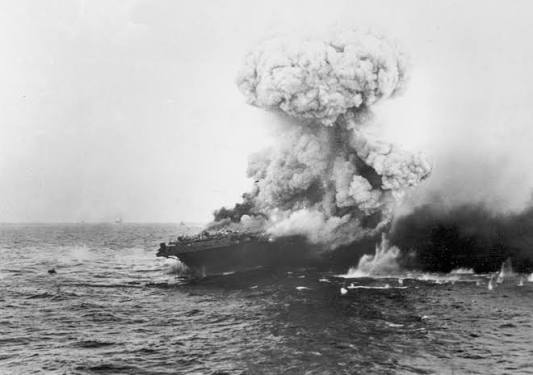
    Then, hours later, a massive explosion rocked Lexington. Fuel vapors had ignited, setting off a chain of internal blasts. The fires quickly became uncontrollable. By evening, the order was given to abandon ship. American destroyers scuttled her with torpedoes, sending the great carrier to the bottom.

    Aftermath and Consequences

    The battle ended with both sides withdrawing. The Japanese had lost Shōhō, and Shōkaku was so damaged she had to return to Japan for repairs. Zuikaku still had her flight deck, but she had lost so many aircraft and pilots that she was effectively out of action. The invasion of Port Moresby was postponed and then canceled.

    For the United States, the loss of Lexington was a bitter blow. But the battle had achieved its strategic goal: the Japanese advance on Australia was halted. More importantly, the battle severely weakened Japanese carrier airpower. The experienced pilots lost at Coral Sea were irreplaceable—Japan had no training program to quickly produce new ones. This proved decisive at Midway, where the Japanese would face the Americans with fewer veteran airmen and only three operational fleet carriers.

    The Battle of the Coral Sea also validated the new doctrine of carrier-centric warfare. It showed that ships could fight each other without ever coming into visual range, and that airpower was now the dominant factor at sea. For the first time in naval history, the surface fleet had taken a back seat to the aircraft carrier.

    The lessons learned were costly. The loss of Lexington highlighted the dangers of fuel vapor and the need for better damage control. The confusion of the searches showed the importance of effective scouting and coordination. These lessons would be applied just weeks later at Midway, where the United States would turn the tide of the Pacific War.

    The Battle of the Coral Sea was a turning point, even though neither side could claim a clear tactical victory. It stopped Japan’s expansion and set the stage for Midway. It also marked the beginning of a new era in naval warfare, where the carrier reigned supreme and the battleship became obsolete. In the annals of history, it stands as the first battle where the enemy was only a distant speck on a radar screen, a harbinger of how wars would be fought in the future.

    Summary

    • The Battle of the Coral Sea (May 4–8, 1942) was the first naval battle where opposing ships never sighted each other.
    • The U.S. lost the carrier Lexington, but stopped the Japanese invasion of Port Moresby, achieving a strategic victory.
    • The Japanese lost the light carrier Shōhō and suffered heavy aircraft and pilot losses, weakening their carrier force for the Battle of Midway.
    • The battle demonstrated the dominance of carrier aviation and the importance of intelligence and scouting.

    FAQ

    Q: Why is the Battle of the Coral Sea considered a turning point?
    A: It was the first time Japan’s expansion was halted, and the first carrier-versus-carrier battle, showing that airpower would decide future naval engagements.

    Q: What was the strategic significance of the battle?
    A: The U.S. prevented Japan from capturing Port Moresby, which would have threatened Australia, and the attrition of Japanese aircrews contributed to their defeat at Midway.

    Q: How did the loss of Lexington affect the U.S. Navy?
    A: It was a heavy blow, but it led to improvements in damage control and validated the carrier as the primary offensive weapon.

    Q: Did the Japanese achieve their objective?
    A: No, they failed to take Port Moresby and had to call off the invasion, marking their first strategic setback in the Pacific.

    Q: What happened to the Japanese carriers after the battle?
    A: Shōkaku was damaged and out of action for months, while Zuikaku lost so many aircraft and pilots that she could not participate in the Battle of Midway.

  • The Kokoda Track: The Jungle War That Stopped Japan at Australia’s Doorstep

    The Kokoda Track: The Jungle War That Stopped Japan at Australia’s Doorstep

    In July 1942, a Japanese army landed on the northern coast of Papua New Guinea, aiming to cross the Owen Stanley Range and capture Port Moresby. The only route was a 96-kilometer footpath that clawed over razorback ridges and through fetid jungle. For four months, Australian soldiers many of them teenage conscripts fought a desperate delaying action along that track, and in the end, they did what no other Allied force had yet done: they halted a Japanese land offensive and forced it into retreat.

    The Kokoda Track Campaign was a war of extremes: heat and cold, mud and blood, courage and exhaustion. It was fought by men with little food and less sleep, against an enemy that seemed unstoppable. But the battle was not won by Australians alone it depended on the labor of Papuan villagers who carried supplies forward and wounded men back. Their story, too, is part of the track’s brutal legacy.

    The Gate to Australia

    By early 1942, Japan had swept through Southeast Asia. Rabaul had fallen, and Lae and Salamaua were in enemy hands. Port Moresby, on the southern coast of Papua, was the last Allied base between Japan and Australia. It was a critical staging point for any counteroffensive and a perfect launch pad for an invasion of Australia itself.

    The Japanese first tried to take Port Moresby by sea. That plan was shattered at the Battle of the Coral Sea in May 1942, so they devised an overland approach. The South Seas Detachment, led by Major General Tomitaro Horii, would land on the north coast at Gona and Buna, cross the Owen Stanley Range, and strike Port Moresby from the rear.

    Their intelligence said the track was passable and resistance would be light. Both assumptions were wrong.

    A Track That Breaks Men

    The Kokoda Track is not a road; it is a footpath that climbs to 2,190 meters at Mount Bellamy. It twists through dense jungle, over steep ridges, and along razorback spurs. Rain falls almost daily, turning the ground into deep mud. In the lowlands, the heat is tropical; at altitude, the nights are near freezing. There are no vehicles everything, from ammunition to food to wounded men, moves by foot.

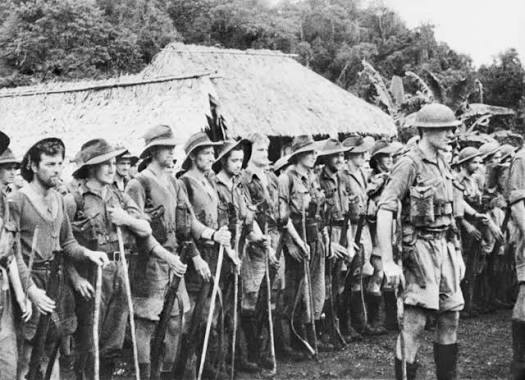
    The first Australians to fight on the track were members of the 39th Battalion, a militia unit made up mostly of teenage conscripts many were 18 or 19 years old. They were untrained, under-equipped, and outnumbered, but they had one job: delay the Japanese long enough for experienced AIF troops to return from the Middle East.

    They did their job. From the first contact at Awala on 23 July 1942, the 39th fought a series of rearguard actions, falling back from one ridge to the next. They destroyed bridges, set ambushes, and slowed the Japanese advance at every step.

    The Long Retreat to Ioribaiwa

    The Japanese pushed hard. By late August, they had driven the Australians back to Ioribaiwa Ridge, just 40 kilometers from Port Moresby. From that ridge, soldiers could see the lights of the city—and the Coral Sea beyond. It was the closest the Japanese ever came to their objective.

    But the advance had already stalled. The Japanese supply line stretched back over the mountains, and they were running out of food and ammunition. Meanwhile, the AIF’s 7th Division was arriving from the Middle East, fresh and well-equipped. The tide was about to turn.

    On 14 September, the Japanese received orders to withdraw. The Guadalcanal campaign was consuming resources, and the South Seas Detachment was overextended. The retreat became a nightmare: starving, diseased, and harassed by Australian patrols, thousands of Japanese soldiers died on the track.

    The Recapture of Kokoda

    The Australians went on the offensive. On 2 November 1942, they recaptured Kokoda village and its airstrip—the first significant victory of the campaign. But the fighting was far from over. The Japanese retreated to the coast, where they fortified the Buna–Gona beachhead. The battle there, from November 1942 to January 1943, was even more brutal than the mountain campaign—a slog through swamps and bunkers that cost thousands of lives.

    By the time the campaign ended, the Australians had lost about 625 killed and 1,055 wounded. More than 4,000 were evacuated sick, most with malaria and dysentery. The Japanese lost around 6,500 dead—many from starvation and disease during the retreat. Of the roughly 16,000 men they deployed, only a fraction survived.

    The Fuzzy Wuzzy Angels

    The campaign would have been impossible without the Papuan villagers who served as carriers and stretcher-bearers. They carried supplies forward, often under fire, and carried wounded Australians back to safety. The troops called them “Fuzzy Wuzzy Angels” for their hair and their kindness.

    Their contribution was extraordinary. But it also came at a cost. Many were conscripted or coerced into service, and they suffered casualties and displacement. After the war, they were largely forgotten, and their post-war neglect remains a point of contention in Australian–Papua New Guinean relations.

    A Defining National Story

    For Australians, Kokoda has become a national narrative—a story of endurance, mateship, and courage. It is often compared to Gallipoli, but with a crucial difference: Kokoda was a defensive victory on Australia’s doorstep. It stopped the Japanese advance and proved that the AIF could fight and win in the most brutal conditions imaginable.

    For Japan, the campaign is a lesser-known tragedy—a costly failure driven by overreach and underestimation. For Papua New Guinea, it is a story of resilience and sacrifice, but also of exploitation and broken promises.

    The track itself remains. It is now a pilgrimage site for trekkers, who walk the same ridges and mud, often in awe of what the soldiers endured. The Kokoda Track is a monument to the men who fought there, the villagers who helped them, and the terrible cost of war in the jungle.

    The Kokoda Track Campaign was a turning point in the Pacific War. It proved that the Japanese army could be stopped on land, and it secured Port Moresby as a base for the Allied counteroffensive. But its true legacy lies in the men who fought and the Papuans who carried them—ordinary people pushed to extraordinary limits in a place that seemed designed to break them.

    Summary

    • The Kokoda Track Campaign (July–November 1942) was a series of engagements along a 96-kilometer footpath in Papua New Guinea.
    • Australian forces, including the 39th Battalion militia, halted a Japanese overland advance on Port Moresby and forced a retreat.
    • The campaign was fought in extreme conditions: dense jungle, steep mountains, mud, and constant rain.
    • Australian casualties: ~625 killed, ~1,055 wounded, ~4,000+ sick. Japanese: ~6,500 dead, many from starvation and disease.
    • Papuan villagers, known as “Fuzzy Wuzzy Angels,” served as carriers and stretcher-bearers, playing a vital role.

    FAQ

    Q: How long is the Kokoda Track?
    A: The Kokoda Track is approximately 96 kilometers (60 miles) long.

    Q: Who fought in the Kokoda Track Campaign?
    A: The campaign was fought between Australian forces (including AIF and militia units) and the Imperial Japanese Army, primarily the South Seas Detachment.

    Q: What was the outcome of the Kokoda Track Campaign?
    A: The Allies achieved a strategic victory. The Japanese advance on Port Moresby was halted and reversed, marking a turning point in the Pacific War.

    Q: What were the main causes of casualties?
    A: In addition to combat, disease—especially malaria and dysentery—was a major killer. Many Japanese died from starvation and disease during the retreat.

    Q: What role did Papuan villagers play?
    A: Papuan villagers served as carriers, stretcher-bearers, and guides, transporting supplies and wounded soldiers. They were essential to the campaign, though many were conscripted or coerced into service.

  • The Aleutian Islands Campaign: The Forgotten Battle on American Soil

    The Aleutian Islands Campaign: The Forgotten Battle on American Soil

    In the cold, fog-shrouded Aleutian Islands, a battle raged that most Americans have never heard of. It was the only World War II battle fought on North American soil, a campaign of brutal weather and fierce combat that lasted 14 months and claimed thousands of lives. Yet, it remains overshadowed by the simultaneous Battle of Midway, a name that echoes in history while the Aleutians are forgotten.

    This is the story of a forgotten war, where the enemy was as much the weather as the Japanese, where the fog could hide an entire evacuation, and where American soldiers fought and died on their own continent. It is a tale of strategic feints, heroic sacrifices, and the harsh lessons learned in a place described as ‘a place where the wind never stops and the fog never lifts.’

    As we explore the Aleutian Islands Campaign, we uncover a critical chapter of WWII that shaped the Pacific War and taught the U.S. military costly lessons that would prove vital in the island-hopping campaigns to come. This is the battle on American soil that time forgot.

    The Aleutians: A Strategic Afterthought

    When the Japanese attacked Dutch Harbor on June 3, 1942, they struck a remote U.S. naval base in the Aleutian Islands, a volcanic archipelago stretching over 1,000 miles from mainland Alaska. The attack was not a desperate gamble but a calculated feint. Japan’s primary objective was Midway Island, where they hoped to lure the U.S. Pacific Fleet into a decisive battle. The Aleutian assault was designed to draw American carriers north, away from Midway, and to establish a defensive perimeter against potential U.S. bombing raids on Japan via Alaska.

    The Aleutians sit along the Great Circle Route, the shortest air path between North America and Asia, making them strategically valuable. The U.S. feared Japan would use the islands as a staging ground to attack the West Coast or interdict the Alaska-Siberia lend-lease air route. So, when Japanese troops landed unopposed on Kiska and Attu on June 6–7, 1942, the U.S. had no choice but to respond.

    But the attack on Dutch Harbor and the invasions of Attu and Kiska were a diversion. And the Americans, thanks to codebreakers, knew it. They did not divert forces from Midway, and Japan lost four carriers there. The Aleutian campaign, however, was just beginning, and it would become a long, arduous fight in one of the most inhospitable places on Earth.

    The Battle of Attu: Blood and Ice

    The first major confrontation came in May 1943, when U.S. forces landed on Attu. The 7th Infantry Division, trained for desert warfare, was ill-prepared for the Aleutian tundra. They expected a quick victory over a small Japanese garrison, but they faced entrenched defenders in the mountains, and the weather was a relentless adversary.

    From May 11 to May 30, the Battle of Attu raged. The Japanese, led by Colonel Yasuyo Yamasaki, fought from fortified positions. The U.S. troops suffered from frostbite, trench foot, and pneumonia, with more casualties from weather than from enemy fire. The fog prevented air support and naval bombardment, leaving the infantry to fight a brutal, close-quarters battle.

    On May 29, Yamasaki launched a final banzai charge, one of the largest of the war. It broke through U.S. lines before being annihilated. Nearly all of the 2,500 Japanese defenders died, with only 28 captured. The U.S. lost 549 killed and 1,148 wounded, with over 2,100 casualties from weather-related causes. The battle was a sobering preview of the bloody island campaigns to come in the Pacific.

    The Battle of Attu was the only land battle fought on American soil during WWII, and its cost was high. It taught the U.S. military valuable lessons about amphibious assaults, logistics, and the importance of adapting to extreme environments. But the Aleutians were not done with the Americans yet.

    The Ghost of Kiska: Evacuation and Friendly Fire

    Following Attu, the Allies turned their attention to Kiska, the larger Japanese base. For weeks, the U.S. subjected Kiska to relentless bombing, with over 1,200 sorties, making it the most heavily bombed island in the Pacific relative to its size. But the Japanese, under the cover of fog, had secretly evacuated on July 28, 1943, using cruisers and destroyers. The U.S. Navy never detected the evacuation.

    On August 15, 1943, a force of 34,000 U.S. and Canadian troops landed on Kiska, expecting a fierce battle. Instead, they found an empty island. The Japanese had vanished, leaving behind booby traps and abandoned equipment. In the confusion and fog, Allied forces fired on each other, triggering booby traps, and suffering accidents. In the end, 313 Allied casualties were incurred, all from friendly fire, booby traps, and accidents. The Japanese had evacuated without a single combat loss.

    The Kiska landing was a humiliating anti-climax, but it ended the Aleutian campaign. On August 24, 1943, Kiska was declared secure, and the only battle on North American soil was over.

    The Legacy: Lessons Learned and Forgotten

    The Aleutian Islands Campaign is often overshadowed by Midway, but its significance extends beyond its place in history. It was the first major amphibious assault by U.S. forces in the Pacific, providing critical lessons in amphibious warfare, logistics, and the challenges of fighting in extreme environments. The mistakes made at Attu, from inadequate clothing to poor coordination, were addressed in later campaigns.

    Strategically, the campaign secured the northern flank of the Pacific theater, preventing Japan from using the islands as a staging ground for attacks on the West Coast or disruptions of shipping lanes. It also demonstrated the vital role of intelligence, as the U.S. was able to anticipate Japanese moves.

    Yet, the campaign remains forgotten. The veterans of Attu and Kiska returned to a nation that didn’t know they had fought on American soil. The fog that hid the Japanese evacuation also hid the campaign’s memory. Today, the Aleutian Islands are a remote, windswept outpost, but they hold the graves of hundreds of Americans who died to defend their country. It is time to remember them.

    The Aleutian Islands Campaign is a reminder that war is not just about grand battles and famous names. It is about soldiers fighting in freezing fog, on islands few could locate on a map, for reasons that seemed distant and abstract. Yet, their sacrifice was real, and their victory secured the northern frontier of the United States. As we honor the veterans of WWII, let us not forget those who fought in the forgotten battle on American soil. The wind still blows across Attu and Kiska, but the memory of their courage should not be lost to the mist.

    Summary

    • The Aleutian Islands Campaign was the only WWII battle fought on North American soil, lasting from June 1942 to August 1943.
    • Japanese forces bombed Dutch Harbor and occupied Attu and Kiska as a diversion from the Battle of Midway.
    • The Battle of Attu in May 1943 resulted in nearly all 2,500 Japanese defenders killed, with 549 U.S. deaths and thousands of weather-related casualties.
    • The invasion of Kiska in August 1943 found the island abandoned, with 313 Allied casualties from friendly fire and booby traps.
    • The campaign provided crucial lessons in amphibious warfare and secured the northern Pacific flank.

    FAQ

    Q: Why is the Aleutian Islands Campaign often forgotten?
    A: It occurred simultaneously with the Battle of Midway, a turning point in the Pacific War, and the campaign’s remote location and harsh conditions made it difficult to report. Additionally, the Kiska landing’s anti-climactic end (finding the island empty) overshadowed the earlier fighting.

    Q: What was the strategic importance of the Aleutian Islands?
    A: The islands sat along the Great Circle Route, the shortest air path between North America and Asia. They were valuable for staging attacks and defending against potential Japanese strikes on the U.S. West Coast or disruption of shipping lanes.

    Q: How did the weather affect the campaign?
    A: The Aleutians are notorious for dense fog, storms, and freezing temperatures. More U.S. casualties on Attu came from weather-related injuries like frostbite and trench foot than from Japanese fire. Fog also hampered air support and naval bombardment and enabled the Japanese evacuation of Kiska.

    Q: What lessons were learned from the Aleutian campaign?
    A: The campaign was the first major U.S. amphibious assault in the Pacific. It highlighted the need for proper cold-weather gear, better coordination, and the importance of intelligence. These lessons were applied in later island-hopping campaigns.

    Q: Were there any civilians in the Aleutian Islands during the campaign?
    A: Yes, a small U.S. weather station on Attu was captured, and the Japanese took prisoners. Additionally, the U.S. evacuated the native Aleut population from the islands for their safety, but they were relocated to internment camps in Alaska, a tragic episode in itself.

  • The Unbreakable Code: How 29 Navajo Men Built a Language of War and Won the Pacific

    The Unbreakable Code: How 29 Navajo Men Built a Language of War and Won the Pacific

    In the spring of 1942, on a windswept parade ground at Camp Pendleton, California, a small group of Navajo men stood at attention. They were not carrying rifles or grenades—they carried something far more powerful: a language that had been banned in American schools, ridiculed by missionaries, and dismissed as primitive. Within months, that language would become the United States’ most closely guarded secret and the key to victory in the Pacific.

    These were the Original 29—the first Navajo Code Talkers. Their task was to build a code from their native tongue that the Japanese could never break. They succeeded beyond anyone’s imagination. By the end of World War II, more than 400 Navajo men had served as Code Talkers in every major Marine offensive, transmitting thousands of messages with a speed and accuracy that mechanical encryption machines could not match—and the Japanese never cracked it.

    A Language Built for Secrecy

    Navajo—or Diné bizaad—is an Athabaskan language with a grammar so complex, tonal qualities so subtle, and sounds so foreign (glottal stops, gutturals, and sounds that don’t exist in English) that it’s nearly impossible for an adult to learn fluently. At the time, it was unwritten, spoken by fewer than 30,000 people, almost all confined to the Navajo Nation in the American Southwest. To most outsiders, it was an impenetrable mystery. That obscurity made it perfect for a code.

    The idea came from Philip Johnston, a World War I veteran who grew up on the Navajo reservation as the son of a missionary. In early 1942, he walked into a Marine Corps office with a proposal: use Navajo as a secure communication method. The Marines were skeptical, but Johnston gave a demonstration. He set up a test with Navajo speakers, who transmitted a message in Navajo over a field telephone and translated it back in under a minute. The Marines were convinced.

    By May 1942, the first 29 recruits—many of them teenagers fresh from boarding schools where they had been punished for speaking their own language—began training at Camp Pendleton. Their assignment: invent a code from scratch.

    Building the Code: Two Layers of Genius

    The code they created was ingeniously simple and maddeningly complex at the same time. It had two layers. The first was a word-for-word substitution for military terms. A fighter plane became da-he-tih-hi—”hummingbird”—because of its speed and agility. A submarine was besh-lo—”iron fish”—for its metallic hull and silent movement. A grenade became ni-ma-si—”potato”—because it was round and thrown like a potato. These were not arbitrary; they were visual metaphors that any Navajo speaker could instantly grasp.

    The second layer was a letter-substitution system for spelling out words that had no direct equivalent. Each English letter got a Navajo word: A became wol-la-chee (ant), B became shush (bear), C became moasi (cat). To encode a word like “Pacific,” a Code Talker would say “pig, ant, cat, ice, fox, ice, cat”—but in Navajo, and often with multiple choices for each letter to confuse eavesdroppers.

    By the end of the war, the code had grown to about 500 distinct terms. It was not a simple cipher; it was a living language, adapted on the fly as new weapons and tactics emerged. And it was fast. A Code Talker could encode, transmit, and decode a three-line message in about 20 seconds. Mechanical encryption machines took 30 minutes for the same task. In combat, where seconds meant lives, that speed was decisive.

    The Crucible of the Pacific

    The Code Talkers served in all six Marine divisions, from the jungles of Guadalcanal to the coral reefs of Tarawa, from the blood-soaked sands of Peleliu to the volcanic ash of Iwo Jima. At each battle, they proved their worth.

    At Iwo Jima, the fighting was so intense that six Code Talker networks operated continuously. In the first 48 hours, they transmitted over 800 messages—everything from troop movements to artillery coordinates—with zero errors. Major Howard Connor, the signal officer at Iwo Jima, later declared, “Were it not for the Navajos, the Marines would never have taken Iwo Jima.”

    Throughout the war, the Japanese never broke the code. They intercepted the strange, guttural transmissions and tried desperately to decipher them, but the language was too alien, the code too layered, the messages too fast. Some Japanese soldiers even reported hearing “tortured animal sounds” coming from American radios. The code was, and remains, the only military code in modern history that was never cracked.

    The Irony of Service

    The Code Talkers’ story is steeped in irony. Many of these men had been sent to government boarding schools as children, where they were beaten for speaking Navajo. They were told their language was worthless—a relic of a savage past. Yet they used that same language to defeat a formidable enemy and save countless American lives.

    Their service occurred against a backdrop of systemic discrimination. Native Americans served in the U.S. military at a higher per-capita rate than any other ethnic group during WWII, yet they returned home to find their voting rights restricted in several states, their children still forced into English-only schools, and their contributions erased from history.

    The Code Talkers themselves were sworn to secrecy. They could not tell their wives, their children, or their parents what they had done. For decades, the code remained classified. Many carried the burden of that silence—some with pride, others with trauma. One Code Talker, Chester Nez, later recalled that he “felt like a traitor” to his own people for using a language that the U.S. government had tried to kill, even as he fought for that government.

    Decades of Silence, Then Honor

    It took nearly 60 years for the U.S. government to fully recognize the Code Talkers. In 1968, the code was finally declassified. In 1982, President Ronald Reagan declared August 14 as National Navajo Code Talkers Day. But it wasn’t until 2000 that President Bill Clinton signed the Navajo Code Talkers Congressional Gold Medal Act, awarding the Congressional Gold Medal to the Original 29 and silver medals to all other Code Talkers. The following year, the surviving members of the Original 29 received their medals in a ceremony on the Capitol steps.

    By then, many of the heroes were gone. Of the 29 original recruits, only a handful lived to see the recognition. Their story, once hidden, is now taught in schools, memorialized in museums, and celebrated by the Navajo Nation. But the recognition came late—a reflection, many argue, of a nation’s lingering discomfort with acknowledging the contributions of its indigenous peoples.

    The Code That Outlived Its Creators

    Today, the Navajo Code Talkers are remembered as symbols of ingenuity and sacrifice. Their code, once a weapon of war, is now a source of cultural pride. It proved that a language once suppressed could become a nation’s greatest asset. And it stands as a reminder that the people who are often marginalized are also the ones who can save us.

    As the last of the Code Talkers have passed away—including Chester Nez, who died in 2014—their legacy endures. The hummingbirds and iron fish and potato-grenades of their language still echo across the Pacific, a ghostly transmission of courage and cleverness that the enemy never understood and can never forget.

    The Navajo Code Talkers did not just win battles; they rewrote the rules of warfare. In a world of machines and ciphers, they proved that a human language—ancient, unwritten, and nearly extinct—could be the most unbreakable code of all. Their story is not just a chapter of military history; it is a testament to the power of language, the resilience of a people, and the unexpected ways that the oppressed can become heroes. As we remember them, we honor not only their service but also the beautiful, complex language they turned into a weapon of freedom.

    Summary

    • Approximately 400–450 Navajo men served as Code Talkers in the U.S. Marine Corps during WWII, with the first 29 recruits creating the code in 1942.
    • The code had two layers: word-for-word substitutions (e.g., “fighter plane” = “hummingbird”) and a letter-substitution system (A = “ant”).
    • Speed and accuracy were crucial: a Code Talker could transmit a three-line message in 20 seconds vs. 30 minutes for mechanical encryption.
    • The code was never broken by the Japanese, and at Iwo Jima, over 800 messages were sent in 48 hours with zero errors.
    • Recognition came late: declassified in 1968, National Navajo Code Talkers Day in 1982, and Congressional Gold Medals in 2000–2001.

    FAQ

    Q: How many Navajo Code Talkers were there?
    A: Approximately 400–450 Navajo men served as Code Talkers in the U.S. Marine Corps during World War II, starting with the 29 original recruits in 1942.

    Q: Why was the Navajo language chosen for the code?
    A: Navajo was an unwritten, tonal, and extremely complex language spoken by fewer than 30,000 people, almost all within the Navajo Nation. Its obscurity and difficulty made it nearly impossible for the Japanese to understand or decipher.

    Q: How fast could Code Talkers send messages?
    A: A Code Talker could encode, transmit, and decode a three-line message in about 20 seconds, compared to 30 minutes for mechanical encryption machines.

    Q: Was the Navajo code ever broken by the Japanese?
    A: No. The code was never broken by the Japanese during the entire war. It remains the only military code in modern history that was not cracked.

    Q: When were the Code Talkers officially recognized?
    A: The code was declassified in 1968, National Navajo Code Talkers Day was declared in 1982, and the Congressional Gold Medal Act was signed in 2000, with medals awarded in 2001.