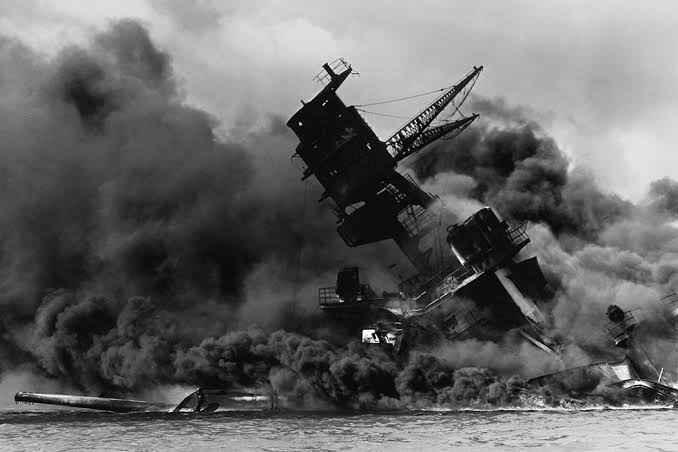
At 7:48 a.m. on a quiet Sunday, the sky above Oahu filled with the roar of 353 Japanese aircraft. The first bombs fell on Battleship Row, and within minutes, the U.S. Pacific Fleet lay in flames. The attack on Pearl Harbor lasted just 110 minutes, but it killed 2,403 Americans, sunk or damaged 21 ships, and permanently altered the course of World War II.
This was not a random act of aggression, but the culmination of a decade of rising tensions, economic sanctions, and a desperate gamble by an empire that saw no other way out. The story of Pearl Harbor is one of strategic miscalculation, human courage, and the moment that propelled the United States into a global conflict.
A Sunday Morning Turned to Ash
December 7, 1941, began as a typical Sunday at Pearl Harbor. Sailors were at breakfast, church services were underway, and the fleet lay at anchor in what was considered a safe haven. The first wave of 183 Japanese aircraft, led by Commander Mitsuo Fuchida, arrived at 7:48 a.m. They came in two waves, targeting battleships, airfields, and aircraft.
The attack was over by 9:45 a.m. When the smoke cleared, the U.S. had lost 188 aircraft and seen all eight of its Pacific Fleet battleships damaged, four of them sunk. The USS Arizona alone took 1,177 of her crew with her, and the USS Oklahoma capsized, trapping hundreds below deck.
Japan’s losses were comparatively light: 29 aircraft, 55 airmen, and five midget submarines. But the strategic victory was hollow. The attack missed the U.S. aircraft carriers (which were at sea), the oil storage tanks, and the submarine base—all of which would prove vital in the Pacific War.
Pearl Harbor was a day of infamy that galvanized a nation. The memory of that morning—the burning ships, the fallen sailors, the cries for vengeance—propelled the United States into a war that would end with Japan’s surrender in 1945. The attack failed to break American will; instead, it forged a resolve that would carry the Allies to victory.
Summary
- The attack on Pearl Harbor occurred on December 7, 1941, at 7:48 a.m., lasting 110 minutes.
- Japan launched 353 aircraft from six carriers, sinking or damaging 21 U.S. ships and destroying 188 aircraft.
- U.S. casualties: 2,403 dead, 1,178 wounded; Japan lost 29 aircraft and 55 airmen.
- The attack was a preemptive strike to neutralize the U.S. Pacific Fleet and secure Japan’s oil supply in Southeast Asia.
- The following day, the U.S. declared war on Japan, and on December 11, Germany and Italy declared war on the U.S., bringing America into World War II.
FAQ
Q: Why did Japan attack Pearl Harbor?
A: Japan sought to cripple the U.S. Pacific Fleet to buy time to seize oil-rich territories in Southeast Asia, which were essential for its war effort in China. The U.S. oil embargo and asset freeze threatened Japan’s strategic survival.
Q: How many waves of aircraft attacked?
A: Two waves. The first wave of 183 aircraft hit at 7:48 a.m.; the second wave of 170 arrived about an hour later. The attack was over by 9:45 a.m.
Q: What was the U.S. intelligence failure?
A: While the U.S. had broken Japan’s diplomatic code (Purple), it had not cracked the naval code (JN-25). Washington sent a ‘war warning’ on November 27 but did not anticipate an attack on Hawaii, focusing instead on the Philippines or Southeast Asia.
Q: Did any U.S. ships survive the attack?
A: All eight battleships were damaged, but four were repaired and returned to service. The USS Arizona and USS Oklahoma were permanently lost. The aircraft carriers, the primary targets, were not in port and were never hit.
Q: What was the immediate U.S. reaction?
A: On December 8, President Franklin D. Roosevelt delivered his ‘Day of Infamy’ speech, and Congress declared war on Japan with only one dissenting vote. Three days later, Germany and Italy declared war on the U.S., thrusting America into both the Pacific and European theaters.
Leave a Reply