Tag: World War I

  • The Battle of the Falklands: How a Forgotten Naval Clash in 1914 Secured the Seas and Shaped the War

    The Battle of the Falklands: How a Forgotten Naval Clash in 1914 Secured the Seas and Shaped the War

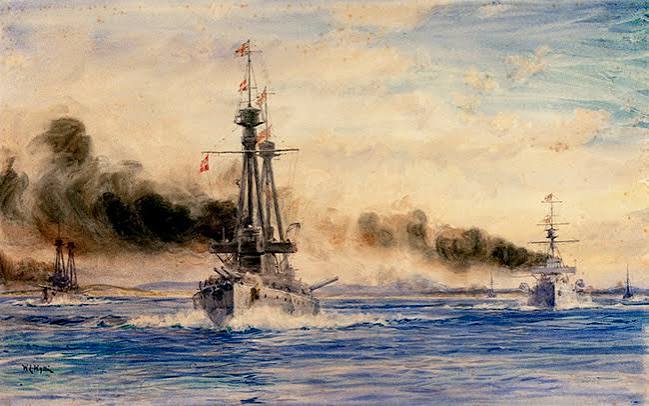
    On the morning of 8 December 1914, lookouts on the German cruiser SMS Gneisenau spotted masts rising above the harbor at Port Stanley in the Falkland Islands. They belonged to British warships. But the Germans did not know that two of those ships were battlecruisers—fast, heavily armed giants whose 12-inch guns could outrange and outrun anything in their squadron. Within hours, the German East Asia Squadron, victors of a stunning defeat against Britain just five weeks earlier, would be shattered, and the balance of the war at sea would shift irrevocably.

    This naval engagement, fought in the remote South Atlantic, is often overshadowed by the great battles of the Western Front. Yet it was a turning point. It eliminated Germany’s only significant surface threat outside the North Sea, secured the sea lanes for Allied troop convoys, and freed the Royal Navy to concentrate on the blockade that would slowly strangle Germany. The battle was not just a victory—it was a strategic necessity, and its consequences rippled through the rest of the war.

    A Stunning Defeat and a Crisis in Britain

    To understand the Falklands, you must first understand Coronel. On 1 November 1914, off the coast of Chile, a British squadron under Rear Admiral Sir Christopher Cradock intercepted the German East Asia Squadron, commanded by Vice Admiral Maximilian von Spee. The Germans had newer ships, longer-range guns, and a tactical advantage. The British cruisers HMS Good Hope and HMS Monmouth were sunk with all hands—about 1,600 sailors died. It was the Royal Navy’s first defeat in over a century.

    The news hit Britain like a thunderbolt. The public was stunned; the Admiralty was humiliated. First Lord of the Admiralty Winston Churchill faced intense criticism. The war was only three months old, and Britain’s naval supremacy—the bedrock of its empire—seemed suddenly fragile.

    Something had to be done. The Admiralty’s response was to detach two of its most powerful battlecruisers, HMS Invincible and HMS Inflexible, from the Home Fleet. These ships were vital for countering the German High Seas Fleet in the North Sea, but they were assigned to a new task: hunt down and destroy von Spee. Vice Admiral Sir Doveton Sturdee, who had been Chief of the War Staff, was given command. He sailed secretly, and the deployment was kept from public knowledge.

    The Germans’ Plan and a Race to the Falklands

    Von Spee, after his victory at Coronel, rounded Cape Horn and set a course for the Falkland Islands. His objective was to destroy the British coaling station at Port Stanley, seize its coal supplies, and disrupt British communications in the South Atlantic. He did not know that Sturdee’s battlecruisers had arrived there just the day before, coaling and repairing after their long voyage.

    On the morning of 8 December, German lookouts spotted the British masts. Initially, they believed the ships were cruisers, not battlecruisers. Von Spee hesitated, weighing the risk of attack against the chance to achieve his mission. But as the identity of the ships became clear, he ordered his squadron to flee. It was too late. Sturdee’s battlecruisers, capable of 25 knots, gave chase. Their 12-inch guns had a range of over 16,000 yards—far exceeding the Germans’ 8.2-inch guns.

    The battle unfolded over several hours. The British ships pursued relentlessly, closing the distance with superior speed. The German armored cruisers, Scharnhorst and Gneisenau, fought bravely but were outmatched. By late afternoon, both had been sunk. The light cruisers Nürnberg and Leipzig were also caught and destroyed. Only the Dresden escaped, but she was hunted down and scuttled in March 1915 off the coast of Chile.

    The human cost was staggering for the Germans. Approximately 1,871 men were killed, including Admiral von Spee and his two sons. Only about 215 survivors were rescued. In stark contrast, the British suffered virtually no casualties—no ships lost, and fewer than ten wounded. It was a decisive, almost bloodless victory.

    A Victory That Shaped the Rest of the War

    The Falklands was not just a revenge for Coronel; it changed the strategic picture. Before the battle, the German East Asia Squadron posed a constant threat to British shipping and tied down a significant portion of the Royal Navy. Afterward, that threat was gone. Germany’s remaining surface raiders were reduced to individual submarines and disguised merchant ships, which, while annoying, could not seriously disrupt the Allied war effort.

    More importantly, the victory freed British naval assets to concentrate on the North Sea blockade of Germany. The blockade, which cut off Germany from overseas food and raw materials, was a key element of the Allied strategy. It contributed to the shortages and civilian unrest that weakened Germany in the later years of the war.

    The battle also secured the sea lanes for the movement of troops from the dominions. The convoys carrying Australian and New Zealand soldiers (ANZAC) to Europe and the Middle East sailed safely after the Falklands. The threat of a German raider intercepting them was eliminated, ensuring that reinforcements reached the Western Front and the Gallipoli campaign.

    For Britain, the victory was a morale booster at a time when the war on land was bogged down in trenches and stalemate. It was a clear, unambiguous triumph that the public could celebrate. Churchill’s reputation was restored, and the Royal Navy’s prestige was reaffirmed.

    A Battle Remembered, or Forgotten?

    Despite its significance, the Battle of the Falklands is often overlooked in popular histories of World War I. The great land battles—the Somme, Verdun, Passchendaele—dominate the narrative. Yet the battle at sea was equally decisive. It was a classic example of naval power projection: a few hours of combat in a remote corner of the Atlantic changed the course of the war.

    As the historian Julian Corbett later wrote, the Falklands was “the decisive battle of the war for the command of the sea.” It ensured that the British Empire could continue to trade, communicate, and move troops without interference from German surface raiders. It also demonstrated the importance of speed and firepower in naval warfare, lessons that would shape future engagements.

    In the end, the battle remains a testament to the courage of the sailors on both sides and the strategic acumen of the commanders. For the Germans, it was a tragic end to a remarkable voyage across the Pacific. For the British, it was a necessary and resounding victory that helped to secure the eventual Allied triumph.

    The Battle of the Falklands on 8 December 1914 was a turning point in World War I, though it is often forgotten. By destroying the German East Asia Squadron, Britain secured control of the seas, protected its empire, and ensured that the blockade of Germany would remain effective. The victory came at a critical moment, lifting British morale and reinforcing the naval dominance that would prove essential to winning the war. It is a battle that deserves to be remembered not just as a naval engagement, but as a strategic pivot that shaped the conflict and its outcome.

    Summary

    • The Battle of the Falklands (8 December 1914) was a decisive British naval victory that destroyed the German East Asia Squadron.
    • The battle was a direct response to the British defeat at Coronel (1 November 1914), which had caused a political crisis in Britain.
    • The British sent two battlecruisers, HMS Invincible and HMS Inflexible, which outgunned and outran the German ships.
    • Nearly 1,900 German sailors were killed, including Admiral von Spee and his two sons; British casualties were minimal.
    • The victory secured sea lanes for Allied trade and troop movements, and freed the Royal Navy to enforce the blockade of Germany.

    FAQ

    Q: Why did the German East Asia Squadron head to the Falklands?
    A: Admiral von Spee intended to destroy the British coaling station at Port Stanley, seize coal supplies, and disrupt British communications in the South Atlantic, hoping to then return to Germany.

    Q: How did the British get battlecruisers to the Falklands without the Germans knowing?
    A: The Admiralty secretly detached HMS Invincible and HMS Inflexible from the Home Fleet, and Vice Admiral Sturdee sailed with them under a veil of secrecy. The deployment was kept from public knowledge, and even the German fleet in the North Sea was unaware of their absence.

    Q: What were the immediate consequences of the battle?
    A: The German East Asia Squadron was virtually annihilated. Only the light cruiser Dresden escaped, but she was hunted down and scuttled in March 1915. The victory ended Germany’s surface raiding threat outside the North Sea and boosted British morale.

    Q: How did the battle affect the wider war?
    A: It secured the sea lanes for Allied troop convoys, especially from Australia and New Zealand, and allowed the Royal Navy to concentrate on the blockade of Germany, which was a key factor in weakening Germany’s war effort.

    Q: Why is the battle considered ‘forgotten’ despite its importance?
    A: The battle is often overshadowed by the major land battles of World War I, such as the Somme and Verdun. However, its strategic impact on naval warfare and the overall Allied war effort was profound.
  • Benito Mussolini: The Man Who Invented Fascism

    Benito Mussolini: The Man Who Invented Fascism

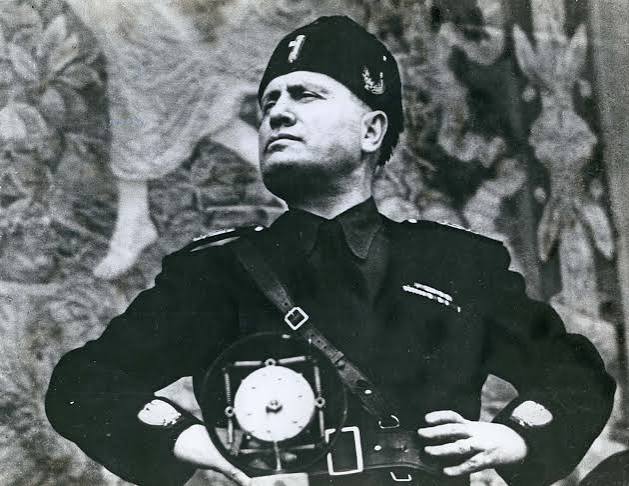
    On October 28, 1922, Benito Mussolini arrived in Rome by overnight train from Milan. He had not marched with his Blackshirts most were stuck in the rain outside the city but King Victor Emmanuel III, fearing civil war, refused to sign martial law and instead handed him the government. Mussolini was 39 years old, and within four years he would dismantle democracy and turn Italy into the world’s first fascist state.

    His rise was not a sudden coup but a slow, legal creep punctuated by violence. He called himself “Il Duce” the Leader and he gave the world a new word for a new kind of tyranny. Today, “fascism” is used loosely, but its inventor had a specific playbook: nationalism, anti-socialism, paramilitary terror, and a cult of personality built on radio and mass rallies.

    From Blacksmith’s Son to Revolutionary

    Mussolini was born in 1883 in Predappio, a small town in Italy’s Romagna region. His father Alessandro was a blacksmith and a revolutionary socialist; his mother Rosa was a schoolteacher. The household was poor but politically charged. Young Benito was named after Benito Juárez, the Mexican reformer, and Amilcare Cipriani, an Italian patriot names that signaled his parents’ radical hopes.

    He became a schoolteacher and journalist. In 1902, he fled to Switzerland to avoid military service, where he was arrested for vagrancy and spent time with exiled anarchists and socialists. Back in Italy, he rose quickly in the Socialist Party, editing its newspaper Avanti!. He was a gifted writer and a ferocious orator, but he was also impatient with party discipline.

    World War I broke his allegiance. The Socialists opposed the war; Mussolini, suddenly, demanded Italy join. Expelled from the party in 1914, he founded his own paper, Il Popolo d’Italia, funded partly by French and Italian industrialists who wanted intervention. He had found his new faith: nationalism.

    The Birth of the Fasci

    After the war, Italy was a tinderbox. Veterans returned to unemployment and inflation. The government had promised land and glory; it delivered a “mutilated victory” Italy got less than it wanted from the peace treaties. In the factories and fields, workers were striking, and many landowners and industrialists feared a Bolshevik-style revolution.

    In 1919, Mussolini gathered a small band of veterans and radicals in Milan’s Piazza San Sepolcro. They called themselves the Fasci Italiani di Combattimento the fasces being the ancient Roman symbol of bundled rods, meaning strength through unity. At first they were a fringe group, winning no seats in the 1919 election. But they had a weapon the Socialists didn’t: violence.

    The Blackshirts squadristi roamed the countryside, beating up socialists, breaking up strikes, and occupying town halls. Local authorities often looked the other way or even welcomed them. In 1921, Mussolini formalized the movement into the National Fascist Party. By 1922, the Fascists were strong enough to threaten power, and the March on Rome was launched.

    The Dictator Who Made Trains Run on Time (Sometimes)

    Once in power, Mussolini moved carefully. He formed a coalition government, but within months he demanded and got the power to rule by decree. The murder of socialist deputy Giacomo Matteotti in 1924, after he dared to denounce Fascist violence in parliament, marked the point of no return. Mussolini took responsibility, and by 1926, he had banned all other parties, censored the press, and created a secret police.

    He called his state “totalitarian” a word he embraced. “Everything within the state, nothing outside the state, nothing against the state,” he declared. He controlled schools, youth groups, sports, and even spare time. The Dopolavoro (After Work) organization ran clubs and holidays. The Opera Nazionale Balilla turned children into little soldiers, teaching them to march and to worship Il Duce.

    Was there a positive side? Yes, and it’s often exaggerated. The regime drained the Pontine Marshes and built autostrade (highways). The “Battle for Grain” increased wheat production, but it pushed Italy toward inefficient autarky. The famous “trains running on time” was a myth the trains ran on time for tourists, but the economy was increasingly rigid and corrupt. The corporate state, which claimed to mediate between workers and employers, actually just suppressed unions and set wages from above.

    The Lateran Treaty: An Unholy Alliance

    One of Mussolini’s biggest successes was with the Vatican. In 1929, he signed the Lateran Treaty, recognizing the Pope’s sovereignty over a tiny Vatican City state and paying the Church for its lost territories. In return, the Church recognized the Italian state. The agreement ended 60 years of tension and won Mussolini crucial Catholic support. For a dictator, it was a masterpiece of political theater pictures of him walking with the Pope’s emissary appeared in every newspaper.

    But the peace with the Church didn’t last. In 1938, Mussolini, now aligned with Hitler, passed antisemitic racial laws. Italian Jews were expelled from schools, professions, and public life. This was partly to please Germany, but also to create a “pure” Italian race—a concept that had no basis in history or science.

    The Road to Disaster: Ethiopia, Spain, and the Axis

    Mussolini wanted an empire. In 1935, he invaded Ethiopia, using poison gas and bombing cities. The League of Nations condemned him, but he didn’t care. He had his empire, and he called it “a place in the sun” for Italy’s surplus population.

    He then intervened in the Spanish Civil War, sending troops and planes to help General Franco. The war drained Italy’s resources, but it brought Mussolini closer to Hitler. In 1936, he announced the Rome–Berlin Axis—a pact that would eventually seal his fate.

    Hitler, at first, admired Mussolini and copied his style. But by 1940, the roles had reversed. Mussolini, watching Hitler’s blitzkrieg sweep across Europe, felt Italy must join the war to grab spoils. He declared war on France and Britain in June 1940, announcing from his balcony that Italy had “broken its chains.” It was a fatal miscalculation. The Italian army was poorly equipped, and its defeats in Greece and North Africa quickly exposed the regime’s weakness.

    Downfall and Death

    By July 1943, the Allies had landed in Sicily. The Grand Council of Fascism—the very body Mussolini had created—voted him out of power. The King had him arrested. But the Germans, still occupying Italy’s north, rescued him in a dramatic glider raid. They installed him as head of the Italian Social Republic, a puppet state in the north, based in the town of Salò. There, he returned to his early radicalism, “socializing” industry, but he was merely a figurehead. The real power was German.

    In April 1945, as the Allies advanced, Mussolini tried to flee to Switzerland disguised as a German soldier. He was caught by partisans near Lake Como, along with his mistress Clara Petacci. The next day, they were executed. Their bodies were taken to Milan and hung upside down in Piazzale Loreto—the same square where partisans had been executed by Fascists months earlier. The crowd spat and threw stones.

    The Legacy of the First Fascist

    Mussolini invented a political system that outlived him. His innovations—the cult of personality, the use of propaganda, the corporate state, the alliance of nationalism and anti-socialism—were copied by Hitler and Franco. But his regime also left Italy with a lasting scar. When the war ended, Italy had to rebuild not just its cities but its democracy, which had been so easily discarded.

    His legacy is still contested. Some Italians remember the public works and the order; others remember the fear and the millions of dead. In 2017, a far-right group called CasaPound even tried to build a memorial in his hometown, but it was blocked. History doesn’t repeat itself, but its warnings are clear.

    Benito Mussolini rose to power by exploiting fear and division, then held onto it by dismantling every institution that could check him. His rule ended in ruin, but his invention—fascism—remains a dangerous idea that has never fully disappeared. Understanding his story is not about excusing it; it’s about recognizing the patterns, so they can be resisted wherever they appear again.

    Summary

    • Mussolini was the inventor of fascism, coining the term from the Latin ‘fasces’ and building a totalitarian state in Italy from 1922 to 1943.
    • He rose to power through a combination of legal maneuvering, paramilitary violence (the Blackshirts), and the March on Rome in 1922.
    • His regime mixed public works and propaganda with severe repression, including the murder of opponents, press censorship, and, from 1938, antisemitic racial laws.
    • His foreign policy led to the invasion of Ethiopia, intervention in the Spanish Civil War, and an alliance with Hitler that drew Italy into World War II.
    • Mussolini was ousted in 1943, rescued by Germans, and finally captured and executed by Italian partisans in April 1945.

    FAQ

    Q: Was Mussolini responsible for the murder of Giacomo Matteotti?
    A: Yes. Matteotti, a socialist deputy, was kidnapped and killed in 1924 after giving a speech denouncing Fascist violence. Though the killers were hired thugs, Mussolini took responsibility in a speech, effectively acknowledging his role, and used the crisis to tighten his grip on power.

    Q: Did Mussolini really make the trains run on time?
    A: The claim is a myth. The Fascist regime did invest in railways, but the “on-time trains” were often propaganda, prioritizing high-profile routes. The broader economy suffered from inefficiency and corruption, and the “miracle” was largely a public relations invention.

    Q: What was the Lateran Treaty?
    A: The Lateran Treaty was signed in 1929 between Mussolini and the Vatican. It recognized the Pope’s sovereignty over Vatican City and made Catholicism the state religion, in exchange for the Church’s recognition of the Italian state and a financial settlement. It ended 60 years of conflict between Italy and the papacy.

    Q: Why did Mussolini pass antisemitic laws in 1938?
    A: Mussolini passed the racial laws to align Italy with Nazi Germany and to create a sense of a “pure” Italian race. The laws expelled Jews from schools, professions, and public life, and were a stark departure from Italy’s earlier record, where Jews were generally integrated.

    Q: How did Mussolini die?
    A: On April 28, 1945, Mussolini was captured by Italian partisans near Lake Como while trying to flee to Switzerland. He and his mistress Clara Petacci were executed the same day. Their bodies were then hung upside down in Milan’s Piazzale Loreto, where a crowd gathered to spit on them.

  • Haig vs. Foch: The Two Strategies That Broke the German Army

    Haig vs. Foch: The Two Strategies That Broke the German Army

    On the morning of August 8, 1918, a dense fog rolled over the fields of Amiens. Under its cover, hundreds of British tanks and infantry from Australia and Canada surged forward. By nightfall, they had torn a 15-mile gap in the German lines, capturing 12,000 prisoners. General Erich Ludendorff called it the “black day of the German army.” The Allies had finally broken the stalemate that had killed millions since 1914.

    But who deserved the credit for this victory and the war itself? Two commanders had shaped the Allied path to that moment: Douglas Haig, the British commander who had spent years grinding down the German army at a horrific cost, and Ferdinand Foch, the French general who became Supreme Allied Commander in 1918 and orchestrated the final, crushing blow. Their strategies were different, their personalities clashed, and their legacies remain contested. This is the story of how two very different approaches—attrition and coordination—together won the war, and why the question of who deserves the laurels is more complicated than it seems.

    The Two Commanders and Their Doctrines

    Douglas Haig took command of the British Expeditionary Force in December 1915. He was a cavalryman by training, but he became the architect of a brutal, industrial war of attrition. His idea was simple: keep attacking the German army relentlessly, even if it meant losing tens of thousands of men, because Germany would run out of soldiers before the British Empire did. The results were staggering. On the first day of the Somme in July 1916, the British suffered 57,000 casualties—the bloodiest day in British military history. By the end of Passchendaele in November 1917, the British had gained a few miles of mud at the cost of hundreds of thousands of lives. Critics called him the “Butcher of the Somme.”

    Ferdinand Foch, by contrast, was a French artilleryman and a fierce advocate of the offensive spirit. Before the war, he had preached the doctrine of “offensive à outrance”—attack with everything you have, and the strongest will to win will prevail. That doctrine had proven disastrous in 1914, when French offensives in Alsace and Lorraine were mowed down by German machine guns. But by 1918, Foch had evolved. As Supreme Allied Commander, he would become the master of coordination, not the champion of the frontal assault.

    The Crisis of 1918: When the Allies Almost Lost

    The spring of 1918 brought the war to a tipping point. With Russia out of the war, Germany transferred 50 divisions to the Western Front, hoping to knock out the Allies before American troops arrived in strength. On March 21, they launched Operation Michael, a massive offensive aimed at the British Fifth Army. The British lines buckled and nearly broke. The Allies faced the real prospect of being split apart and defeated.

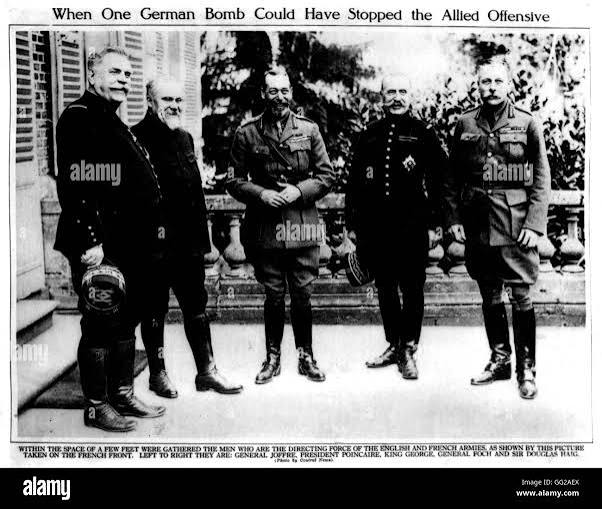
    At the Doullens Conference on March 26, the Allies made a historic decision: they appointed Foch as Supreme Allied Commander, giving him authority over all Allied forces on the Western Front. It was the first time in the war that a single commander had coordinated the efforts of the British, French, and later American armies. Haig, who had been reluctant to serve under anyone, accepted the arrangement, recognizing the emergency. It was a moment of unity that would prove decisive.

    Foch’s Strategy: Flexibility and Counter-Attack

    Foch’s approach in 1918 was radically different from his pre-war doctrine. Instead of rigid defense or reckless offense, he emphasized flexibility. His motto was “Tout le monde à la bataille”—everyone to the battle. He managed reserves like a chess master, refusing to commit them to static defensive lines. Instead, he waited for the right moment to counter-attack.

    That moment came on July 18, 1918. The German spring offensives had exhausted themselves, and Foch launched a counter-offensive at the Marne, throwing in French and American troops. The attack was a stunning success, pushing the Germans back and signaling that the initiative had shifted. Foch’s coordination of reserves had prevented a German breakthrough in the spring and set the stage for the final Allied advance.

    Haig’s War of Attrition: The Long Grind That Made Victory Possible

    While Foch’s 1918 coordination was brilliant, it rested on the foundation laid by Haig’s attrition strategy. From 1916 to 1917, Haig had kept relentless pressure on the German army, even when the gains were measured in yards. The Somme and Passchendaele were horrific, but they inflicted irreplaceable losses on the Germans. By 1918, German divisions were understrength, poorly fed, and demoralized. Ludendorff’s own memoirs admit that the German army was a shadow of its former self.

    Haig also oversaw the transformation of the British army into a modern, combined-arms fighting force. The BEF had grown from 6 divisions in 1914 to 60 divisions by 1918—the largest Allied army on the Western Front. Under his command, the British adopted new tactics: creeping barrages, tanks, aircraft coordination, and infiltration techniques. The Battle of Amiens was a textbook example of this new warfare. It was a British-planned and British-executed victory, with Australian and Canadian troops at the spearhead. Foch had actually pushed for a more ambitious offensive, but it was Haig’s forces that achieved the breakthrough.

    The Hundred Days: Two Strategies Merge

    In the autumn of 1918, Foch orchestrated the final offensive—a “sledgehammer” of simultaneous attacks along the entire front. The goal was to prevent the Germans from shifting reserves from one sector to another. Haig, initially reluctant to extend his offensive, eventually pushed for the breakthrough of the Hindenburg Line. On September 29, British, Australian, and American forces broke through the supposedly impregnable line. The German army was in full retreat, mutiny was spreading, and the Kaiser abdicated. On November 11, the Armistice was signed.

    The Hundred Days Offensive was a coordinated triumph, but it was built on the attrition of the previous years. Without Haig’s grinding warfare, the German army might have been strong enough to withstand the final blow. Without Foch’s coordination, the Allies might have squandered their advantage. The two strategies were complementary, not opposed.

    The Legacy and the Debate

    The question “Which general won the war?” is, in many ways, the wrong question. The war was won by the combined efforts of millions of soldiers and the strategies of both commanders. Haig’s attrition was necessary but costly; Foch’s coordination was brilliant but depended on the foundation Haig had built. Their legacies, however, are wildly different. Haig remains the “Butcher of the Somme” in popular memory, though revisionist historians argue he was a necessary evil. Foch is celebrated as the architect of victory, though his pre-war offensive doctrine had proven deadly. The truth is that both men adapted to the realities of industrial warfare—Haig by embracing attrition, Foch by embracing coordination—and together they broke the German army.

    The debate between Haig and Foch is not a simple choice. It is a story of two men with different philosophies who, in the crucible of 1918, found a way to work together. Haig’s attrition wore down the enemy; Foch’s coordination delivered the final blow. The war was won by both—and by the millions who fought and died under their command. Their strategies, though different, were two halves of a single whole, and the question of who deserves the credit is best answered by recognizing that neither could have won without the other.

    Summary

    • Douglas Haig commanded the British Expeditionary Force from 1915, implementing a strategy of attrition that inflicted heavy losses on the German army, despite massive British casualties.
    • Ferdinand Foch became Supreme Allied Commander in March 1918, coordinating Allied reserves and launching counter-offensives that turned the tide.
    • Foch’s flexibility and coordination were crucial in 1918, but they relied on the weakened German army that Haig’s attrition had created.
    • The Hundred Days Offensive was a coordinated effort, with Haig’s forces achieving key breakthroughs like Amiens and the Hindenburg Line.
    • The war was won by a combination of both strategies, not by one general alone.

    FAQ

    Q: Who was Douglas Haig?
    A: Douglas Haig was the Commander-in-Chief of the British Expeditionary Force from December 1915 to the end of World War I. He is known for his attrition strategy, which led to heavy casualties at battles like the Somme and Passchendaele, but also contributed to the eventual defeat of Germany.

    Q: Who was Ferdinand Foch?
    A: Ferdinand Foch was a French general who became the Supreme Allied Commander in March 1918. He coordinated the Allied response to the German Spring Offensive and planned the final Hundred Days Offensive that led to the Armistice.

    Q: What was the Hundred Days Offensive?
    A: The Hundred Days Offensive was the final Allied offensive of World War I, from August 8 to November 11, 1918. It consisted of a series of coordinated attacks along the Western Front that broke the German army’s will to fight.

    Q: Why is Haig called the ‘Butcher of the Somme’?
    A: Haig earned this nickname because of the massive casualties suffered under his command, particularly on the first day of the Battle of the Somme, which saw 57,000 British casualties. Critics argue he was reckless, while supporters say his attrition strategy was necessary.

    Q: Did Foch and Haig agree on strategy?
    A: Not always. They had different approaches—Haig favored attrition, while Foch favored coordination and counter-attack. However, they worked together in 1918, with Haig accepting Foch’s overall command and Foch relying on Haig’s forces for key breakthroughs.

  • Why the First World War Lasted So Long: The Anatomy of a Stalemate

    Why the First World War Lasted So Long: The Anatomy of a Stalemate

    On the morning of August 22, 1914, the French Army suffered 27,000 casualties—the deadliest single day in its history. The war was barely three weeks old, and already the quick, decisive victory every general staff had promised was unraveling. By September, the German advance on Paris had been halted at the Marne, and within months, a line of trenches stretched from the North Sea to Switzerland. The war would grind on for another four years, consuming millions of lives and toppling empires.

    Why did the First World War, expected to be over by Christmas, drag on for over 1,500 days of trench warfare? The answer lies not in a single blunder, but in a lethal combination of military technology, industrial mobilization, and political inflexibility that turned a continental conflict into a global war of attrition.

    The Quick-War Mirage

    In 1914, every major European power planned for a short war. The German Schlieffen Plan aimed to knock out France in six weeks, then turn east to face Russia. Austria-Hungary expected a swift punitive strike against Serbia. Russia’s mobilization plans were geared toward rapid offensives into East Prussia. These plans were built on speed, rail timetables, and the belief that modern economies could not sustain a long war.

    But the plans ignored a fundamental shift in warfare: the firepower revolution. The magazine rifle, the machine gun, quick-firing artillery, and barbed wire gave defenders an overwhelming advantage. A handful of men with machine guns could mow down advancing infantry by the thousands. The first months of the war proved this brutally. At the Battle of the Marne in September 1914, the French and British halted the German advance, but at a staggering cost. The “Race to the Sea” that followed extended the front line northward, but neither side could outflank the other. By Christmas, the Western Front was a continuous, fortified line.

    The Defense Dominates

    The technology of the era favored the defender. Artillery, which caused the majority of casualties, could be pre-sighted on no-man’s-land. Barbed wire slowed attackers, turning them into targets. Machine guns swept the battlefield. And when an offensive did achieve a breakthrough, the reserves—moved by rail—could seal the gap faster than the attackers could exploit it on foot or horseback. The tactical mobility of defenders outpaced the strategic mobility of attackers.

    Commanders tried to break the deadlock with sheer mass. At Verdun in 1916, German General Falkenhayn aimed not to take the city but to “bleed the French Army white”—to force them into a battle of attrition they could not win. The French held, but at a cost of over 700,000 casualties on both sides. The Somme, launched the same year, was meant to relieve pressure on Verdun. It produced over a million casualties for a maximum advance of about seven miles. Neither battle changed the strategic picture.

    The Industrial War of Attrition

    The war lasted because both sides could absorb enormous losses and keep fighting. Total war economies shifted to produce shells, guns, and equipment on an unprecedented scale. Factories churned out artillery shells by the millions. Conscription replaced the men who fell. The British blockade of Germany and the German U-boat campaign against Allied shipping turned the war into an economic contest as much as a military one. Each side’s industrial capacity allowed it to replace losses, so neither could achieve a decisive breakthrough.

    The learning curve was slow. Tanks appeared on the Somme in 1916, but were too few and mechanically unreliable. Stormtrooper tactics and creeping barrages matured only by 1917–18. Yet even the great German spring offensive of 1918, using these new tactics, failed to break the Allied lines before American reinforcements arrived in strength.

    The Global Reach

    The war was never just a European affair. The Ottoman Empire’s entry in 1914 opened fronts in Gallipoli, Mesopotamia, Palestine, and the Caucasus. Colonial empires mobilized troops from Africa, India, and the Pacific. The British naval blockade and German U-boat campaigns made this a global economic war. This global dimension stretched resources and ensured that no single defeat could end the conflict.

    The Political Lock

    War aims expanded as the war ground on. What began as a punitive action against Serbia grew into maximalist goals: annexations, reparations, regime change, the destruction of rival empires. Neither alliance could accept a compromise peace without risking domestic political collapse. Nationalist publics, war-bond investments, and the “spirit of 1914” made it politically impossible for leaders to seek a negotiated peace. Governments feared that admitting failure would trigger revolution—a fear realized in Russia in 1917, and nearly in Germany and France the same year.

    The Russian Revolution and the Treaty of Brest-Litovsk in March 1918 removed Russia from the war, giving Germany a temporary advantage. But the subsequent spring offensives failed to break the Allied lines before American troops arrived in force. The war ended not with a decisive battlefield victory, but with military exhaustion, the collapse of the Central Powers’ home fronts, and the Armistice of 11 November 1918.

    The Final Months

    By the summer of 1918, the Central Powers were cracking. The Allied blockade had caused widespread famine in Germany. Mutinies broke out in the German Navy, and revolutions toppled the Kaiser. Austria-Hungary dissolved into nationalist chaos. The war ended because the home fronts collapsed, not because the armies were defeated in a single battle. The First World War lasted so long because it became a war of attrition—a grinding, industrial slaughter that neither side could win quickly, but neither could abandon.

    The First World War lasted so long because it was a war of attrition fought with the technology of the industrial age. The quick-war plans of 1914 failed because the defense dominated, and total war economies allowed both sides to absorb staggering losses. Political leaders, trapped by their own maximalist war aims and nationalist publics, could not accept a compromise peace. The war ended only when the Central Powers’ home fronts collapsed under the strain of blockade and exhaustion. The Great War’s longevity was not an accident—it was the logical outcome of a world that had industrialized warfare but had not yet developed the means to end it quickly.

    Summary

    • The First World War lasted over 1,500 days because no decisive military breakthrough was possible given contemporary technology and tactics.
    • The defense dominated due to machine guns, barbed wire, and quick-firing artillery; railways allowed defenders to reinforce faster than attackers could exploit breakthroughs.
    • Total war economies enabled both sides to replace losses, turning the conflict into a war of attrition.
    • War aims expanded over time, making compromise politically impossible for leaders.
    • The war ended through exhaustion, blockade, and home-front collapse, not a single decisive battle.

    FAQ

    Q: What was the Schlieffen Plan and why did it fail?
    A: The Schlieffen Plan was Germany’s strategy to defeat France quickly by invading through Belgium, then turning east to face Russia. It failed at the Battle of the Marne in September 1914, when the French and British halted the German advance. The plan underestimated the speed of Russian mobilization and the resilience of the French army.

    Q: Why did trench warfare lead to a stalemate?
    A: Trench warfare created a static, fortified line where the defense had overwhelming advantages. Machine guns, barbed wire, and pre-sighted artillery made frontal assaults extremely costly. Even when breakthroughs occurred, defenders could use railways to rush reserves to seal the gap, while attackers on foot could not exploit the breach quickly enough.

    Q: How did the war become a global conflict?
    A: The Ottoman Empire’s entry in 1914 opened fronts in the Middle East and Caucasus. Colonial empires mobilized troops from Africa, India, and the Pacific. The British naval blockade and German U-boat campaigns turned the war into an economic struggle across the globe.

    Q: What role did the Russian Revolution play in prolonging the war?
    A: The Russian Revolution in 1917 led to Russia’s withdrawal from the war, allowing Germany to concentrate forces on the Western Front. However, the resulting spring offensives in 1918 failed to break the Allied lines before American troops arrived in strength, prolonging the war until autumn.

    Q: Why didn’t either side seek a negotiated peace?
    A: War aims expanded over time to include annexations, reparations, and regime change. Nationalist publics and political leaders feared that compromising would trigger domestic collapse. The fear of revolution, which became reality in Russia, made it politically impossible to accept a less-than-total victory.

  • The Anatomy of Defeat: Why Germany Lost the First World War

    The Anatomy of Defeat: Why Germany Lost the First World War

    In the autumn of 1918, the German Empire was not defeated on a single battlefield. It collapsed like a house of cards—militarily exhausted, economically starved, and politically fractured. The end came swiftly: the Hundred Days Offensive broke the Western Front, the British blockade had already crippled the home front, and Germany’s allies deserted one by one. Within weeks, the Kaiser fled, the military sued for peace, and a revolution erupted in Berlin. This article traces the multifaceted reasons behind Germany’s defeat, from strategic blunders to the devastating effects of total war.

    The Last Gamble: The Spring Offensives of 1918

    By early 1918, Germany’s situation was dire. The British blockade had been strangling the country for over three years, and the entry of the United States into the war in April 1917 threatened to tip the balance permanently against the Central Powers. General Erich Ludendorff, the de facto military dictator of Germany, knew that time was not on his side. He launched a series of five massive offensives—collectively known as the Kaiserschlacht—between March and July 1918, aiming to knock out the Allies before American troops arrived in overwhelming numbers.

    The first offensive, Operation Michael, began on March 21, 1918, with a devastating artillery bombardment. German stormtroopers, specially trained in infiltration tactics, broke through the British lines and advanced up to 60 kilometers in some places. It was the deepest penetration of Allied lines since the trench warfare began in 1914. For a few weeks, it seemed possible that Germany might win the war.

    But the offensive stalled. The German army had advanced too far from its supply lines, and its soldiers were exhausted and hungry. The Allies, under the unified command of Marshal Ferdinand Foch, held key defensive positions and counterattacked relentlessly. By July, the last German offensive, Friedensturm, had failed. The German army had suffered over 800,000 casualties in these spring offensives—losses that could not be replaced. In contrast, the Allies were reinforced by fresh American troops at a rate of over a million per month by mid-1918.

    The Black Day of the German Army

    August 8, 1918, marked the turning point. At Amiens, Allied forces—including British, French, Canadian, and Australian troops—launched a counteroffensive supported by over 400 tanks. They broke through the German lines with astonishing ease, capturing 15,000 prisoners and 400 guns in a single day. Ludendorff called it “the black day of the German army,” not because of the territorial losses, but because of the morale collapse: German soldiers surrendered in droves, and many units refused to fight.

    The Hundred Days Offensive that followed was a continuous series of Allied attacks that pushed the Germans back relentlessly. The Allies had learned to combine infantry, artillery, tanks, and aircraft in coordinated assaults—tactics that the Germans could not match with their dwindling resources. By September, the German army was in full retreat, but it was not a rout. It was a disciplined withdrawal, yet one marked by growing mutiny and desertion. The German high command knew the war was lost, but they continued to fight, hoping to secure a negotiated peace.

    The Hunger Blockade

    While the German army was being defeated in the field, the home front was collapsing. The British Royal Navy had imposed a naval blockade on Germany from the start of the war, cutting off imports of food, fuel, and raw materials. The blockade was not absolute—some goods trickled through via neutral countries—but it was devastating enough. By 1918, the German civilian population was suffering from severe malnutrition. The infamous “turnip winter” of 1916–17, when the potato crop failed and the population was forced to subsist on turnips, had already caused widespread suffering. Estimates suggest that between 500,000 and 800,000 German civilians died from starvation and disease caused by the blockade.

    The blockade also crippled Germany’s war economy. Without access to overseas resources, Germany had to rely on Ersatz (substitute) materials—synthetic rubber, ersatz coffee, and even bread made with sawdust. But these substitutes were inferior and never enough. By 1918, German factories were producing fewer shells, guns, and aircraft than the Allies. The German war machine was slowly starving to death.

    The Collapse of Germany’s Allies

    Germany’s strategic position was further weakened by the rapid collapse of its allies in the autumn of 1918. On September 29, Bulgaria signed an armistice with the Allies, opening the road to the Danube and threatening Germany from the south. On October 30, the Ottoman Empire capitulated, followed by Austria-Hungary on November 3. These defections left Germany isolated, fighting alone on multiple fronts. The German army had to divert troops to shore up its faltering allies, further weakening its already exhausted forces in the West.

    The collapse of Austria-Hungary was particularly significant. The Austro-Hungarian Empire, Germany’s primary ally, had been a liability for years. Its multi-ethnic armies were riddled with dissent and desertion. By October 1918, the empire was disintegrating into independent national states, and its army dissolved. Germany could no longer rely on any ally to tie down Allied forces.

    The Home Front Revolts

    The final blow came from within. In late October 1918, the German High Seas Fleet was ordered to sail out for a final, suicidal battle against the British Royal Navy. The sailors at Kiel mutinied, refusing to throw away their lives in a hopeless gesture. The mutiny quickly spread to other ports and then to industrial cities across Germany. Workers and soldiers formed councils, following the example of the Russian Revolution. By November 9, revolution had reached Berlin, and Kaiser Wilhelm II was forced to abdicate and flee to the Netherlands.

    The new government, led by the Social Democrat Friedrich Ebert, had no choice but to sue for peace. On November 11, 1918, the Armistice was signed in a railway carriage at Compiègne, France. The guns fell silent, but the German army was not decisively beaten in a single battle. It was exhausted, demoralized, and starved, but it was still on foreign soil—inside France and Belgium. This gave rise to the dangerous myth of the “stab in the back.”

    The Myth of the Stab in the Back

    Even before the war ended, Ludendorff and other right-wing figures began to spread the false claim that the German army was “undefeated in the field” and had been betrayed by civilians at home—socialists, democrats, and Jews. This “stab-in-the-back” myth was a deliberate attempt to shift blame away from the military leadership and to undermine the new democratic government. It was a lie, but it was a powerful one. It poisoned German politics for the next two decades and was later weaponized by the Nazis to justify their rise to power.

    The truth was that Germany lost the war because it was militarily, economically, and politically overwhelmed. The failure of the Schlieffen Plan in 1914 condemned Germany to a two-front war of attrition that it could not win. The British blockade strangled its economy. The entry of the United States tipped the numerical balance irrevocably against it. The failure of the 1918 offensives exhausted its army. And the collapse of its allies left it isolated. By November 1918, Germany was not stabbed in the back; it was simply beaten.

    Germany’s defeat in the First World War was not the result of a single catastrophic mistake, but a combination of strategic errors, economic strangulation, military exhaustion, and political collapse. The war ended not because the German army was routed, but because it was no longer able to fight. The armistice of November 11, 1918, was a military surrender, but the myth of the stab in the back would live on to haunt the peace and sow the seeds of an even greater conflict.

    Summary

    • Germany’s last military gamble, the Spring Offensives of 1918, failed to achieve a strategic breakthrough and exhausted irreplaceable reserves.
    • The Allied Hundred Days Offensive, starting with the ‘Black Day’ at Amiens on August 8, 1918, broke the German army’s morale and led to continuous retreat.
    • The British naval blockade starved Germany of food and resources, causing hundreds of thousands of civilian deaths and crippling war production.
    • The rapid collapse of Bulgaria, the Ottoman Empire, and Austria-Hungary in autumn 1918 left Germany isolated and fighting alone.
    • The Kiel Mutiny and subsequent revolution forced the Kaiser to abdicate and led to the armistice, while the ‘stab-in-the-back’ myth falsely blamed civilians for the defeat.

    FAQ

    Q: What was the immediate cause of Germany’s defeat?
    A: The immediate cause was the collapse of the German army during the Hundred Days Offensive, combined with the revolution at home that forced the Kaiser to abdicate and the new government to sign the Armistice on November 11, 1918.

    Q: How did the British blockade contribute to Germany’s defeat?
    A: The blockade cut off Germany’s access to overseas food and raw materials, causing widespread malnutrition and starvation that killed an estimated 500,000–800,000 civilians. It also severely hampered German war production, making it impossible to match Allied output.

    Q: Why did the Spring Offensives of 1918 fail?
    A: The offensives achieved initial territorial gains but outran their supply lines and were halted by Allied counterattacks. German casualties were irreplaceable, while Allied forces were continuously reinforced by fresh American troops.

    Q: What was the ‘stab-in-the-back’ myth?
    A: It was a false claim promoted by Ludendorff and other right-wing figures that the German army was undefeated in the field and had been betrayed by civilians—socialists, democrats, and Jews—who undermined the war effort and forced a surrender. This myth was later used by the Nazis to attack the Weimar Republic.

    Q: How did the collapse of Germany’s allies affect the outcome?
    A: The rapid defeats of Bulgaria, the Ottoman Empire, and Austria-Hungary in the autumn of 1918 isolated Germany, leaving it to fight alone on multiple fronts and reducing its ability to concentrate forces in the West.

  • The Weight of the War: How the Allies Broke Germany in 1918

    The Weight of the War: How the Allies Broke Germany in 1918

    In the spring of 1918, the German army launched its last gamble. Operation Michael, the first of a series of Spring Offensives, pushed the British Fifth Army back forty miles in a matter of days. It was the deepest advance on the Western Front in four years. Yet by August, the tide had turned so completely that Allied forces were advancing daily, and by November, the German high command was suing for peace. How did the Allies, who had suffered years of stalemate and slaughter, finally win?

    The answer is not a single stroke of genius but a grinding combination of material superiority, naval blockade, strategic coordination, and a slow learning curve that culminated in the Hundred Days Offensive. The Allies did not win because they were braver or cleverer; they won because they could afford to lose more and learn faster. The war was a test of endurance, and the Allies had the resources to outlast the Central Powers.

    The Arithmetic of War: Material Superiority

    World War I was a war of production. By 1918, the Allies were out-producing the Central Powers in almost every category that mattered. In steel, the Allies produced more than double Germany’s output. In coal, the British mines alone fed the war effort, while Germany’s access to overseas raw materials was cut off. The United States, entering the war in April 1917, tipped the balance decisively. American industry supplied not only its own troops but also billions of dollars in loans to Britain and France, keeping their war economies afloat.

    The numbers tell a stark story. When the U.S. entered the war, it had a standing army of about 200,000 men. By the Armistice, over 1.2 million American soldiers had arrived in France. This fresh manpower was crucial, not because the Americans were better fighters, but because they filled the ranks depleted by years of attrition. The French army had mutinied in 1917, and the British were scraping the bottom of their manpower barrel. The arrival of the Americans allowed the Allies to absorb German offensives and then counterattack.

    The Silent Siege: The British Blockade

    While the guns thundered on the Western Front, a quieter weapon was strangling Germany. The British Royal Navy’s blockade, initiated in 1914, cut off Germany from overseas food and raw materials. The impact was catastrophic. By 1916, Germany was experiencing the “turnip winter,” where the population survived on turnips because potatoes and grain were scarce. Malnutrition weakened the civilian population, leading to disease and a drop in morale. By 1918, strikes and protests were common in German cities, and the war effort was increasingly unpopular.

    The blockade also affected the military. German troops in 1918 were undersized and hungry, and their equipment was shoddy due to a lack of raw materials like rubber and copper. In contrast, the Allies had access to global resources, and their supply lines were never seriously threatened. The U-boat campaign was Germany’s attempt to counter-blockade Britain, but it failed to starve the island nation and instead provoked the United States into the war.

    Coordination: The Birth of a Unified Command

    For most of the war, the Allies fought as separate armies with separate strategies. This changed in March 1918, when the German Spring Offensives threatened to split the British and French armies. In response, the Allies appointed French General Ferdinand Foch as Supreme Allied Commander, giving him authority to coordinate operations across all fronts. This was a revolutionary step. For the first time, the British, French, and American armies could act as a single force, moving to plug gaps and launch joint offensives.

    Foch’s coordination was key to the Hundred Days Offensive, which began on August 8, 1918. The assault at Amiens used a combined-arms approach: infantry, tanks, artillery, and aircraft working together. The British tanks, first introduced at Cambrai in 1917, had improved significantly. The element of surprise was achieved by not shelling the German lines beforehand, a departure from standard practice. The attack broke through, and the Allies advanced, capturing prisoners and territory in a way that had been impossible in earlier years.

    Learning the Hard Way: Tactical Innovation

    The Allies’ victory was also a story of learning. The early years of the war had been marked by futile frontal assaults against entrenched positions. The Somme in 1916 and Verdun in 1916 taught bloody lessons. By 1918, the Allies had developed “bite and hold” tactics, where they would seize a limited objective, consolidate, and then move on. They used creeping barrages, where artillery fire moved forward just ahead of the infantry, providing cover and neutralizing German machine guns.

    The Hundred Days Offensive showed how much the Allies had evolved. The Battle of Amiens on August 8 was described by German General Erich Ludendorff as the “black day of the German army.” The Allies captured 15,000 prisoners and broke through the German lines. The offensive continued, with the Allies attacking on multiple fronts, forcing the Germans to retreat. The Hindenburg Line, the German defensive position, was breached in late September, and the German army was in full retreat.

    The Collapse of the Central Powers

    The Allied victory was not just won in France. The other Central Powers were crumbling. Bulgaria signed an armistice on September 29, 1918, after an Allied offensive in the Balkans. The Ottoman Empire followed in October, and Austria-Hungary signed an armistice on November 3, 1918. These collapses meant that Germany was fighting alone, with no allies and no hope of reinforcement. The German high command, led by Hindenburg and Ludendorff, realized that the war was lost. Ludendorff, who had been the architect of the Spring Offensives, urged the government to seek an armistice, fearing that the army would collapse and that revolution was imminent.

    The German people were starving and war-weary. The blockade had taken its toll, and news of the military defeats sapped morale. On November 9, the Kaiser abdicated, and on November 11, the Armistice was signed in a railway carriage at Compiègne. The Allies had won, but the cost was immense: over 5 million Allied soldiers dead, and Germany itself was on the brink of revolution.

    A War of Attrition, Won by Endurance

    In the end, the Allies won because they could endure longer. Their economies and populations were larger, their supply lines were open, and their strategy improved. The German Spring Offensives of 1918 were a final gamble that failed, leaving the German army exhausted and demoralized. The Allies had learned to fight a modern war, and they had the resources to do it. The victory was not a single moment but a slow, grinding process that reached its climax in 1918.

    The Allied victory in World War I was not a flash of brilliance but a grinding accumulation of advantages. The blockade starved Germany, the U.S. entry provided fresh resources, and tactical innovation broke the stalemate. By 1918, the Central Powers were exhausted, and the Allies were not. It was a war of endurance, and the Allies simply had more of it.

    Summary

    • The Allies’ industrial and economic superiority, especially after U.S. entry, gave them a decisive advantage in resources and manpower.
    • The British naval blockade caused severe shortages in Germany, weakening civilian morale and military effectiveness.
    • The appointment of Ferdinand Foch as Supreme Allied Commander in 1918 enabled effective coordination among Allied armies.
    • Tactical innovations like bite-and-hold and creeping barrages, plus improved tanks, broke the trench stalemate.
    • The collapse of Bulgaria, the Ottoman Empire, and Austria-Hungary isolated Germany and hastened its surrender.

    FAQ

    Q: Why did the U.S. entry into the war matter so much?
    A: The U.S. provided fresh troops, financial credit, and industrial output. Over 1.2 million American soldiers arrived by the Armistice, filling Allied ranks and tipping the balance.

    Q: How did the British blockade affect Germany?
    A: The blockade cut off food and raw materials, causing malnutrition and disease among civilians, leading to strikes and unrest, and weakening the German war effort.

    Q: What was the Hundred Days Offensive?
    A: A series of Allied offensives starting on August 8, 1918, that broke the German lines and led to the Armistice. It used combined-arms tactics and was the first successful sustained offensive by the Allies.

    Q: Did tanks win the war?
    A: No, tanks were not decisive alone, but they were part of the combined-arms tactics that helped break the stalemate. The Allies used them effectively in 1918, especially at Amiens.

    Q: Why did Germany surrender in 1918?
    A: Germany was exhausted: the Spring Offensives failed, the blockade caused shortages, and the collapse of its allies left it isolated. The high command recognized the war was lost and sought an armistice.

  • The Forgotten Front: Colonial Soldiers’ Untold Stories of the Great War

    The Forgotten Front: Colonial Soldiers’ Untold Stories of the Great War

    When the guns of August 1914 fell silent, the world’s empires called upon their most distant subjects. From the plains of Punjab to the villages of Senegal, millions of men marched to a war they had no part in starting, yet whose consequences would shape their lives forever. This is the story of those soldiers—the men history often overlooks.

    Between 2 and 3 million colonial soldiers served in World War I, yet their experiences remain shadowed by the dominant narratives of European trenches. They fought in the mud of Flanders, the heat of Mesopotamia, and the jungles of East Africa. They died in numbers that rivaled their European counterparts, yet their sacrifices were met with broken promises and colonial indifference.

    The First to Arrive: Indian Soldiers on the Western Front

    In October 1914, the Indian Army Corps—comprising the Lahore and Meerut Divisions—became the first colonial troops to reach the Western Front. They were thrown into the Battle of Ypres, where they faced a new kind of warfare: trenches, machine guns, and poison gas. The cold, the mud, and the unfamiliar landscape took a heavy toll. By the war’s end, over 1.4 million Indian soldiers had served, and around 74,000 never returned home.

    Their presence was a radical departure from pre-war doctrine. The Indian Army was designed for imperial policing on the North-West Frontier, not European battlefields. Yet, the British Empire’s need for manpower was desperate. Indian soldiers fought at Neuve Chapelle, the Somme, and Gallipoli, earning a reputation for bravery that was often met with paternalistic racism.

    The experience was profoundly alienating. Men accustomed to the heat of South Asia suffered frostbite in the trenches. Their traditional diets were unavailable, and their religious practices were often ignored. As the war dragged on, morale plummeted, and some soldiers began to question why they were dying for a distant king.

    The Force Noire: France’s African Soldiers

    France, facing a demographic crisis, turned to its colonies with a theory known as the force noire. General Charles Mangin’s 1910 book of the same name argued that African soldiers were natural warriors who could be used as shock troops. When the war broke out, France mobilized roughly 600,000 colonial soldiers, including about 180,000 from sub-Saharan Africa and 475,000 from North Africa.

    The Tirailleurs Sénégalais—a catch-all term for West African soldiers—bore the brunt of the fighting. Around 135,000 served, and nearly 30,000 were killed. They were often placed in the most dangerous frontal assaults, suffering disproportionate casualties. At Verdun, they held the line when French units faltered, but their sacrifices were rarely acknowledged.

    Recruitment was often coercive. Village chiefs were pressured to supply quotas, and many men were taken against their will. They were promised pay, land, and citizenship—promises that were largely broken after the war. Despite their sacrifices, they returned to a colonial system that treated them as subjects, not citizens.

    The Carrier Corps: Africa’s Invisible Army

    In East Africa, the war took a different form. The German commander Paul von Lettow-Vorbeck led a guerrilla campaign with about 14,000 Askaris (African soldiers) and thousands of carriers. To counter him, the British assembled the Carrier Corps, a force of over 25,000 African porters who carried supplies, ammunition, and food across some of the most unforgiving terrain on Earth.

    These men were not soldiers in the traditional sense, but their contribution was vital. They died in staggering numbers—mortality rates reached 20–25%, largely from disease and starvation. Malaria, dysentery, and influenza killed more men than combat. The Carrier Corps was a logistical lifeline, but their suffering was invisible to the outside world.

    The campaign in East Africa was a sideshow to the European war, yet it consumed resources and lives on an enormous scale. The Germans, too, relied on African carriers, and the civilian population bore the brunt of the conflict. When the war ended, the survivors returned to villages devastated by famine and disease.

    The British West Indies Regiment: Black Soldiers in a White Man’s War

    The British West Indies Regiment (BWIR) was formed in 1915, with over 15,000 men volunteering from the Caribbean. They were initially used as laborers, but eventually saw combat in the Middle East and on the Western Front. The regiment suffered 185 killed in action, but over 1,000 died of disease—a common fate for colonial troops.

    Despite their service, the BWIR faced systemic racism. They were paid less than their white counterparts, and promotion was nearly impossible. After the war, many veterans were denied pensions, and their service was quietly forgotten. The war had been a crucible of hope, but the imperial system remained unchanged.

    Forgotten in the Mud: The Aftermath

    When the armistice was signed in November 1918, colonial soldiers returned to a world that had not changed. In India, veterans expected recognition for their service, but instead found the same colonial administration, the same poverty, and the same lack of rights. Their experiences fueled the growing nationalist movement, as men who had fought for the empire began to question why they should not govern themselves.

    In France, colonial troops were used to occupy the Rhineland after the war. This sparked a racist campaign in Germany, known as the “Black Shame,” which portrayed African soldiers as barbaric occupiers. This propaganda was a precursor to the racial ideologies that would engulf Europe in the next war.

    Commemoration was almost exclusively white. Few memorials were built to honor colonial soldiers, and their names were omitted from official histories. It was not until the 21st century that countries began to acknowledge their sacrifices, with memorials in places like London and Paris.

    Legacy: A Complex Reckoning

    The story of colonial soldiers is not one of simple heroism or victimhood. They fought for empires that often despised them, yet they fought with courage and determination. They were pawns in imperial power games, yet their experiences shaped the course of decolonization.

    In Africa, veterans returned with new ideas about rights and citizenship. In the Caribbean, the BWIR’s treatment fueled labor unrest. In India, the war accelerated the demand for self-rule. The war may have been fought for empire, but it sowed the seeds of its demise.

    Today, historians are piecing together these untold stories, revealing a war that was truly global. The colonial soldiers were not bystanders to history; they were actors who shaped it, even if their voices were silenced for too long.

    The Great War was a global conflict, fought not just by Europeans but by millions of men from every continent. Their stories challenge the traditional narrative of the war as a European tragedy, reminding us that the cost of empire was paid in blood across the globe. As we remember the fallen, we must also remember those who were forgotten—the colonial soldiers whose sacrifices were too often erased from history.

    Summary

    • Approximately 2–3 million colonial soldiers served in World War I, with over 1.4 million from India alone.
    • Colonial troops fought in major battles on the Western Front, Gallipoli, and Africa, often suffering disproportionate casualties.
    • African carriers in East Africa faced mortality rates as high as 20–25%, mostly from disease and starvation.
    • Despite their sacrifices, colonial veterans returned to unchanged colonial rule, with many denied pensions and recognition.
    • The war fueled nationalist movements and challenged imperial authority, shaping the 20th century.

    FAQ

    Q: How many colonial soldiers served in World War I?
    A: Estimates range from 2 to 3 million, though exact numbers are contested. The British Empire contributed over 1.4 million from India, and France about 600,000 from its colonies.

    Q: What role did colonial soldiers play on the Western Front?
    A: Indian troops arrived in October 1914 and fought in major battles like Ypres and the Somme. French colonial units, such as the Tirailleurs Sénégalais, were often used as shock troops in frontal assaults, suffering heavy casualties.

    Q: Why are colonial soldiers often forgotten in World War I history?
    A: Historians have traditionally focused on European experiences. Additionally, colonial powers had little interest in commemorating soldiers from their colonies, and many veterans faced discrimination that silenced their stories.

    Q: What was the Carrier Corps?
    A: The Carrier Corps was a group of African porters who supplied British forces in East Africa. They were not soldiers but were essential to the campaign, and they suffered high death rates from disease and starvation.

    Q: How did colonial service affect post-war independence movements?
    A: Veterans returned with new expectations of rights and citizenship. Their disillusionment with colonial rule fueled nationalist movements in India, Africa, and the Caribbean, contributing to decolonization after World War II.

  • The Silent Siege: How Naval Blockades Strangled Nations and Reshaped History

    The Silent Siege: How Naval Blockades Strangled Nations and Reshaped History

    In the winter of 1918, a young German boy named Erich Kästner watched his mother cry over a bowl of turnip soup. The soup was all they had, and it was thin. Across the North Sea, British warships had been sitting in the gray waters for nearly four years, their steel hulls a constant reminder that no food, no medicine, and no hope could reach Germany’s ports. Kästner later wrote, ‘The blockade was a siege, and we were the besieged.’ He was not a soldier. He was a child, and he was starving.

    Naval blockades are the quiet engines of war. They do not explode or charge across fields. They simply wait. And in that waiting, they can kill more people than any battle. From Napoleon’s Continental System to the U.S. quarantine of Cuba, blockades have strangled economies, toppled governments, and pushed the world to the brink of annihilation—all without a single shot fired at the enemy’s main forces.

    The Weapon That Waits

    A naval blockade is a military act: the isolation of a port or coastline by enemy ships to cut off all maritime traffic. It is not an embargo, which is a political or economic tool. A blockade is enforced by cannon and steel, and it has a legal backbone. Under the 1856 Declaration of Paris and the 1909 Declaration of London, a blockade must be publicly declared, effectively enforced—not a mere “paper blockade”—and applied equally to all nations. But the law has rarely cushioned the suffering it causes.

    Blockades became strategically vital only when nations grew dependent on the sea for survival. In the 19th century, industrial warfare meant that a country’s ability to fight rested on imported food, coal, rubber, and oil. Cut those imports, and the war machine sputters. The concept of a “fleet in being” emerged: a fleet doesn’t have to win a battle; its mere presence deters enemy shipping, creating a psychological and economic stranglehold.

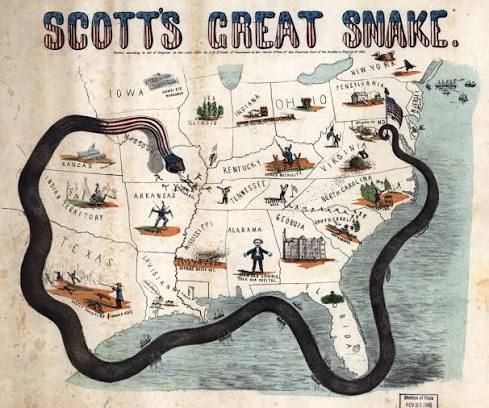
    The American Civil War’s Anaconda Plan is a textbook example. In 1861, the Union navy began a blockade of Confederate ports, stretching from Virginia to Texas. The plan was slow, but it worked. Southern cotton exports plummeted, and weapons imports dried up. By 1865, the Confederacy’s economy was in ruins, and its armies were short on rifles and gunpowder. The blockade didn’t win the war alone, but it squeezed the life out of the South’s ability to fight.

    The Hunger Blockade of World War I

    World War I elevated the blockade to an industrial-scale instrument of mass suffering. Britain, with its overwhelming naval superiority, blockaded Germany from the war’s first days. The British aimed to starve Germany into submission. They intercepted neutral ships, confiscated cargoes, and mined the North Sea. By 1918, Germany was importing almost nothing. The result was catastrophic: an estimated 400,000 to 800,000 German civilians died from starvation and disease—people who never wore a uniform.

    The German government exploited the blockade for propaganda, but the suffering was real. Children, the elderly, and the sick were the first to fall. Turnip soup became a symbol of desperation. The blockade didn’t break the German army, but it broke the home front. The German Revolution of 1918–1919, which toppled the Kaiser, was fueled in part by hunger. The blockade was not lifted until July 1919, months after the armistice, a decision that historians still debate as a deliberate act of cruelty.

    Germany’s response to the British blockade was to invert the concept. Since Germany couldn’t match British surface power, it turned to submarines. The U-boat campaign was a counter-blockade: Germany declared the waters around Britain a war zone and sank merchant ships, including those of neutral nations. The sinking of the Lusitania in 1915, which killed 1,198 civilians, showed how blockades could blur the line between combatant and civilian. The U-boats nearly brought Britain to its knees in 1917, but the introduction of convoys and the entry of the United States turned the tide. Both blockades caused immense suffering, but the Allied blockade was the more effective and the more deadly.

    The Battle of the Atlantic and the Axis Stranglehold

    World War II saw blockades on a global scale. Germany again tried to starve Britain, this time with U-boats in the Battle of the Atlantic. The goal was to sink enough merchant ships to cut Britain’s lifeline. In 1942, German submarines were sinking ships faster than the Allies could build them. The turning point came with improved radar, code-breaking, and air cover. By 1943, the Allies were winning the battle, and the blockade of Germany’s sea routes was nearly complete. The Allies also blockaded Japan, which was heavily dependent on imported oil, rice, and other essentials. The U.S. Navy’s submarine campaign sank Japanese merchant shipping, and by 1945, Japan’s industrial production had collapsed. The blockade contributed to widespread malnutrition and an estimated 1 million civilian deaths, though the atomic bombs and the Soviet invasion ultimately forced Japan’s surrender.

    The blockades of WWII were part of a broader strategy of total war, where the distinction between soldier and civilian dissolved. The Allied blockade of Europe, while designed to weaken the Axis, also caused suffering among occupied populations. The Dutch famine of 1944–1945, which killed tens of thousands, was exacerbated by the German blockade of the Netherlands, a reverse blockade. Blockades were not just between nations; they were also tools of occupation.

    The Brink of Nuclear War: The Cuban Quarantine

    The most dangerous blockade in history came in 1962, during the Cuban Missile Crisis. The United States discovered Soviet nuclear missiles in Cuba, just 90 miles from Florida. President John F. Kennedy chose a “quarantine”—a blockade—rather than an air strike or invasion. U.S. warships formed a ring around Cuba, and Kennedy announced that any Soviet ship carrying offensive weapons would be stopped. The world held its breath. For 13 days, American and Soviet forces teetered on the edge of nuclear conflict. The blockade worked as a tool of coercive diplomacy: Soviet ships turned back, and the crisis ended with a secret deal to remove missiles from both Cuba and Turkey.

    The Cuban quarantine was different from the hunger blockades of the world wars. It was brief, targeted, and did not aim to starve civilians. But it showed that the blockade was still a potent weapon in the nuclear age—a way to apply pressure without escalating to full-scale war. It also highlighted the legal and moral complexities of blockades. Was it legal to stop and search Soviet ships on the high seas? The United States argued it was a quarantine, not a blockade, to avoid the formal declaration required under international law. The crisis passed, but the precedent remains controversial.

    The Ethics of Starvation

    Blockades raise profound ethical questions. Is it legitimate to starve a civilian population to force a military surrender? The international community has tried to answer with law. The Geneva Conventions and modern international humanitarian law place limits on blockades, requiring that food and medicine be allowed through for civilian populations. But these rules are often ignored in practice. The debate over the WWI blockade—whether it was a legitimate military strategy or a war crime—has never been fully resolved. Historians remain divided. Some argue that the blockade was a lawful means of warfare, aimed at breaking Germany’s war-making capacity. Others see it as a deliberate policy of mass starvation, a war crime.

    Modern conflicts have seen blockades in Yemen, Gaza, and elsewhere, where humanitarian organizations decry the civilian toll. The same logic that drove the Anaconda Plan still operates: cut off supplies, and the enemy will eventually capitulate. But the cost in human life is staggering. Children are the most vulnerable. The blockade of Germany in WWI led to a generation of undernourished children, who grew up with lasting health problems. The blockade of Japan in WWII led to food shortages that killed civilians even before the atomic bombs fell.

    The political and psychological effects of a blockade are also profound. A siege mentality can unite a population against the enemy, as it did in Britain during the U-boat campaigns. But it can also breed despair and revolution, as it did in Germany in 1918. Blockades are slow, grinding instruments of war. They test national resolve, create political instability, and can reshape the balance of power long after the war ends.

    Conclusion

    Naval blockades are a paradox of war: they are invisible, silent, and slow, yet they can be more devastating than any battle. From the Continental System to the Cuban quarantine, they have changed the course of history by strangling economies, breaking morale, and killing millions. They are a testament to the brutal calculus of total war, where the line between soldier and civilian is erased. And they remain a haunting reminder that in war, the most powerful weapon is often not the one that explodes, but the one that waits.

    Blockades are a weapon of attrition, and their history is a grim ledger of human suffering. They have been used by empires, republics, and dictatorships alike, and they have always been justified by necessity. But the cost is always borne by the most vulnerable. As long as nations depend on the sea for survival, the blockade will remain a tool of war—and a moral challenge that we have yet to answer.

    Summary

    • A naval blockade is a military isolation of a coast, enforced by warships, distinct from a political embargo.
    • The WWI British blockade of Germany caused an estimated 400,000–800,000 civilian deaths from starvation and disease.
    • The WWII Allied blockade of Japan contributed to approximately 1 million civilian deaths and widespread malnutrition.
    • The Cuban Missile Crisis of 1962 saw a U.S. “quarantine” of Cuba that brought the world to the brink of nuclear war.
    • Modern international law tries to limit blockades by requiring food and medicine to reach civilians, but enforcement remains weak.

    FAQ

    Q: What is the difference between a blockade and an embargo?
    A: A blockade is a military measure enforced by naval forces, while an embargo is a political or economic measure that restricts trade. A blockade physically prevents ships from reaching a port.

    Q: How did the WWI British blockade affect Germany?
    A: The blockade cut off food and raw material imports, leading to an estimated 400,000–800,000 civilian deaths from starvation and disease, and contributed to the German Revolution of 1918–1919.

    Q: Was the Cuban Missile Crisis a blockade?
    A: The United States called it a “quarantine,” but it was a naval blockade of Cuba to prevent Soviet missiles from being delivered. It was a short, targeted action that avoided a direct invasion.

    Q: Are blockades legal under international law?
    A: Yes, but they must be declared, effective, and impartial. Modern humanitarian law also requires allowing food and medicine for civilians, but this is often violated in practice.

    Q: What is the “fleet in being” concept?
    A: It is the idea that a fleet can have strategic effect without fighting a battle, simply by its presence. In a blockade, the mere threat of interception deters enemy shipping, creating economic pressure.

  • The Unfinished Duty: How DNA and Archaeology Are Finding WWI’s Lost Soldiers

    The Unfinished Duty: How DNA and Archaeology Are Finding WWI’s Lost Soldiers

    The fields of the Western Front still give up their dead. A century after the guns fell silent, farmers in the Somme regularly turn up bones and rusted equipment. Construction crews in Flanders hit buried trenches with human remains. The numbers are staggering: of the 9.7 million military deaths in WWI, roughly 30% have no known grave. For the Commonwealth alone, that’s about 300,000 soldiers. In Germany, the Volksbund estimates 1.2 million are still missing on the Western Front.

    Finding these soldiers is a painstaking, often emotional work that blends history, archaeology, and cutting-edge science. It involves metal detectors sweeping former battlefields, ground-penetrating radar scanning for disturbed earth, and DNA matching against living relatives. It’s a race against time, as development and erosion threaten what remains. And it’s a duty that many believe is never truly finished.

    The Scale of the Loss

    The nature of WWI made death anonymous. Trench warfare meant soldiers died in no-man’s land, in collapsed dugouts, or were buried by shellfire. Artillery was the great killer, and it often obliterated bodies or left them under tons of earth. Field burials were hasty, with wooden crosses that rotted or were destroyed by later shelling. Post-war recovery teams, often German POWs, searched the battlefields between 1919 and 1939, but the task was overwhelming. By the time they stopped, hundreds of thousands of bodies remained undiscovered.

    France alone accounts for an estimated 700,000+ missing soldiers from all nations. Memorials like the Menin Gate in Ypres, with its 54,000 names, and the Thiepval Memorial on the Somme, with 72,000, stand as somber roll calls of the missing. But these names are not just historical records—they represent families who never knew what happened to their loved ones.

    How the Search Works Today

    The search for lost soldiers is a methodical process that combines old records with new technology. It starts with historical research. Maps from the war—trench maps, aerial photos, and post-war surveys—are overlaid onto modern satellite imagery. This helps pinpoint likely burial sites, such as old trench lines, shell holes, or documented field graves.

    Once a site is identified, teams use metal detectors to sweep the ground. The presence of military equipment—rifles, ammunition, personal gear—can indicate a body nearby. Ground-penetrating radar (GPR) and LiDAR can reveal disturbed soil or hidden cavities without digging. But the only way to be sure is to excavate.

    Excavations happen in two ways: planned archaeological digs and unplanned discoveries. Planned digs are often driven by research, like the 2009–2010 excavation at Pheasant Wood in Fromelles, where 250 Australian soldiers were recovered from a mass grave. Unplanned discoveries are more common: a farmer plowing a field, a construction crew laying a pipeline, or a riverbank eroding after heavy rain. In France, any human remains found are treated as war dead, and the government must be notified. Excavation then follows, often with archaeologists and military experts.

    The Science of Identification

    Once remains are recovered, the hard work of identification begins. Forensic anthropologists examine the bones to estimate age, height, and any signs of injury—such as a healed fracture or a bullet wound. Dental records, if available, can provide a match. Clothing and equipment, like buttons, insignia, or dog tags, offer direct clues. In 2024, a soldier from the 1916 Battle of the Somme was identified using a rare regimental badge and DNA matching.

    DNA analysis has been the game-changer. Since the 1990s, labs like the Armed Forces DNA Identification Laboratory (AFDIL) in the US have used mitochondrial DNA (maternal line) and Y-chromosome (paternal line) to match remains with living descendants. This requires collecting DNA samples from potential relatives, which can be a delicate process. But it has led to remarkable identifications, such as the 2018 discovery of US soldiers from the “Lost Battalion” in the Argonne Forest, who were identified through DNA.

    The process is not always successful. Some bodies are too fragmented, or the DNA is too degraded. In those cases, soldiers are buried as “unknown” under a headstone that reads “Known Unto God.” The CWGC maintains over 1.7 million graves and memorials across 150 countries, and many of those are for unknown soldiers.

    The Organizations and the Law

    The work is carried out by a mix of official bodies and volunteer groups. The Commonwealth War Graves Commission (CWGC) is the primary body for British Empire casualties. The German War Graves Commission (Volksbund) does the same for German soldiers. The American Battle Monuments Commission (ABMC) oversees US graves and memorials. The French Ministry of Defense manages French military graves and recovery.

    In addition, non-profits and volunteer groups like The Diggers in the UK and La Route des Châteaux in France conduct searches and advocate for recovery. They often work with local authorities and landowners.

    Legal frameworks govern this work. In France, excavation requires government authorization, and any remains found must be treated with respect. The 2005 Fromelles Agreement between the UK, Australia, and France set protocols for excavation and reburial after the mass grave at Pheasant Wood was discovered. Internationally, the 1919 Treaty of Versailles mandated the return of remains and the establishment of cemeteries. The 2006 “Human Remains in Archaeology” guidelines, while UK-based, have influenced practice worldwide.

    Why It Still Matters

    The centenary commemorations of 2014–2018 brought renewed public interest. But the search continues for a more personal reason: families still want answers. For many, a grave—even a known one—brings closure. For others, it’s about historical duty and respect for the dead.

    There are also practical reasons. Development and agriculture are constantly disturbing the ground. Every year, construction projects uncover mass graves, as happened in 2023 at Beaucourt-sur-l’Ancre on the Somme, where 30+ British and German soldiers were found. Erosion along riverbanks and coasts also exposes remains. The work is urgent.

    Each discovery is a story. In 2021, the remains of 13 Australian soldiers from Fromelles were identified and reburied with full military honors. Their families, some of whom had waited over a century, finally had a place to mourn. This is the heartbeat of the work: it turns a name on a memorial into a real person, honored and remembered.

    The search for WWI’s lost soldiers is a testament to human perseverance and compassion. It’s a task that may never be fully complete, but each identification brings a measure of peace to families and ensures that the sacrifice of those soldiers is not forgotten. As technology advances and new discoveries are made, the promise is kept: no soldier left behind, even a century later.

    Summary

    • Approximately 1 million WWI soldiers remain unidentified or missing, including 300,000 from the Commonwealth and 1.2 million Germans.
    • Soldiers are found through metal detection, ground-penetrating radar, historical map analysis, and unplanned discoveries during construction or farming.
    • Identification uses forensic anthropology, artifacts, and DNA matching with living descendants.
    • Key organizations include the CWGC, Volksbund, ABMC, and French Ministry of Defense, operating under legal frameworks like the Fromelles Agreement.
    • Recent discoveries, such as the 2023 mass grave at Beaucourt-sur-l’Ancre, highlight the ongoing need for recovery.

    FAQ

    Q: How many WWI soldiers are still missing?
    A: Approximately 1 million soldiers from all nations remain unidentified or missing, with about 300,000 from the Commonwealth and 1.2 million Germans.

    Q: How are soldiers’ remains discovered today?
    A: They are found through systematic metal detection surveys, excavation during construction or farming, and remote sensing like ground-penetrating radar and LiDAR.

    Q: What methods are used to identify remains?
    A: Identification combines forensic anthropology (age, height, injuries), dental records, artifacts and insignia, and DNA analysis matching with living descendants.

    Q: What happens when remains are found on private land?
    A: In France, any human remains are treated as war dead, and the government must be notified. Excavation follows with proper authorization and archaeological oversight.

    Q: Why are soldiers still being found so long after the war?
    A: Causes include agricultural plowing, construction and infrastructure projects, erosion, and deliberate searches driven by technology and centenary interest.

  • The Great War’s Long Shadow: How WWI Still Shapes Our World

    The Great War’s Long Shadow: How WWI Still Shapes Our World

    At 11 a.m. on November 11, 1918, the guns fell silent along the Western Front. In the preceding four years, over 30 nations had mobilized some 70 million troops. By the time the Armistice was signed, an estimated 9 to 11 million soldiers and 7 to 8 million civilians were dead. The scale of slaughter was unprecedented, and its effects did not end with the ceasefire.

    Today, the legacy of World War I is not merely a matter of history. The borders of the Middle East, the structure of international diplomacy, the very language we use to describe trauma—all trace directly to the decisions made between 1914 and 1918. To understand the present, we must first reckon with the war that reshaped the world.

    The Treaty That Built the Bomb

    When the Allies gathered at Versailles in 1919, they were determined to punish Germany. The resulting treaty assigned sole war guilt to Germany (Article 231), imposed heavy reparations, stripped territory, and limited the German army to 100,000 troops. The treaty’s architects hoped to ensure lasting peace; instead, they created the conditions for resentment that would explode again in 1939.

    Historians debate the precise degree of causation, but the connection is clear: the treaty’s harsh terms fueled German grievance. Adolf Hitler and the Nazi Party weaponized the “stab-in-the-back” myth—the false claim that civilians and socialists had betrayed the army—to undermine the Weimar Republic. The reparations wrecked the German economy, contributing to hyperinflation in 1923 and deepening the misery of the Great Depression. When Hitler rose to power in 1933, he promised to overturn Versailles. The world would pay the price.

    Carving Up the Middle East

    While the Treaty of Versailles mapped Europe, a separate set of agreements redrew the Middle East. In 1916, British and French diplomats signed the Sykes-Picot Agreement, planning to divide the Ottoman Empire’s territories after the war. The subsequent Mandate system created the modern states of Iraq, Syria, Lebanon, Jordan, and Palestine. These borders, drawn with little regard for local ethnic and religious divisions, have proved remarkably durable—and remarkably volatile.

    The sectarian tensions that simmer in Syria and Iraq today, the Israeli-Palestinian conflict, and the persistent instability of the region all have roots in the post-war settlements. The people of the region were promised self-determination but instead were placed under European rule. Resentment simmered, fueling anti-colonial movements. Egypt’s 1919 revolution and Gandhi’s post-war activism in India were direct consequences of the war’s broken promises.

    The New Face of War

    World War I was the first large-scale conflict to feature tanks, aircraft, submarines, and chemical weapons. Chlorine, phosgene, and mustard gas turned the trenches into a nightmare of poison and burning lungs. The machine gun, perfected in colonial wars, now mowed down entire generations. At Verdun and the Somme, millions of shells churned the earth into a lunar landscape. The casualty figures are almost incomprehensible: France alone counted over 2 million wounded.

    The war also changed how we think about the human cost of combat. The term “shell shock” entered the medical lexicon as soldiers returned with what we now call PTSD. The “Lost Generation”—a phrase popularized by Gertrude Stein and Ernest Hemingway—described the psychological and cultural devastation of the survivors. The war poets, Wilfred Owen and Siegfried Sassoon, captured the horror in verse, stripping away any romantic illusion about glory. Their anti-heroic tone has shaped how we perceive war ever since.

    The Fall of Empires

    By 1918, the war had toppled four empires: the German, Austro-Hungarian, Ottoman, and Russian. The Russian Revolution of 1917, born from war-related strain, created the Soviet Union—a state that would define global politics for the next seven decades. The collapse of the Habsburg and Ottoman empires redrew the map of Eastern Europe and the Middle East, creating new nations from the wreckage.

    The war also reshaped the balance of global power. European economies were devastated, while the United States emerged as a creditor nation and a rising military force. The US entry into the war in 1917 was framed as a crusade for democracy, and it marked the beginning of America’s ascent to global dominance. Yet, after the war, the US retreated into isolation, refusing to join the League of Nations—a decision that undermined the new world body from the start.

    The Unfinished Peace

    The League of Nations, conceived as the first global intergovernmental organization for peace, was a direct product of the war. It failed to prevent World War II, but it laid the groundwork for the United Nations. Its creation was a revolutionary idea: that nations could collectively manage conflict. Its failure was a lesson in the limits of idealism.

    On the home front, the war had unleashed social change. Women entered factories and munitions plants in unprecedented numbers, accelerating the push for suffrage. Britain granted partial suffrage in 1918, the US in 1920. But the gains were uneven; after the war, many women were pushed back into domesticity, and the true revolution in gender roles would come later.

    The Long Shadow

    Today, the war’s legacy is invoked in debates about nationalism, border conflicts, and the ethics of military intervention. The chemical weapons ban, enshrined in international law, owes its existence to the horrors of gas warfare. The Middle East’s ongoing instability, the rise of populist nationalism in Europe, and the very structure of the United Nations all bear the imprint of 1914–1918.

    The war was not “pointless” nor was it wholly “just.” It was a catastrophe caused by a complex web of alliances, militarism, nationalism, and miscalculation—a failure of leadership that cost millions of lives. The lessons of that failure remain urgent. As the last veterans have died, we are left with the monuments and the memory. The task is to remember not just the sacrifice, but the decisions that made it necessary.

    The guns of 1918 have long been silent, but their echo persists. The borders drawn in the sand, the institutions built to prevent another war, and the psychological scars of a generation all continue to shape our world. Understanding the legacy of WWI is not merely an exercise in nostalgia; it is a way of recognizing the fragility of peace and the cost of complacency. The past is never fully past—it lives on in the present, demanding we learn its lessons.

    Summary

    • World War I involved 30+ nations, mobilized ~70 million troops, and caused 9–11 million military deaths.
    • The Treaty of Versailles assigned sole war guilt to Germany, contributing to WWII.
    • Sykes-Picot and the Mandate system created modern Middle Eastern states with enduring conflicts.
    • The war introduced new technologies (tanks, chemical weapons, aircraft) and psychological trauma (PTSD).
    • It led to the collapse of four empires and the rise of the US as a global power.

    FAQ

    Q: How did WWI contribute to WWII?
    A: The Treaty of Versailles imposed harsh reparations and guilt on Germany, fueling resentment that Nazi propaganda exploited. The economic devastation and political instability created conditions for Hitler’s rise.

    Q: What was the Sykes-Picot Agreement?
    A: A 1916 secret agreement between Britain and France to divide Ottoman territories, which laid the foundation for modern Middle Eastern states and their ongoing conflicts.

    Q: How did WWI affect women’s rights?
    A: Women entered the workforce in large numbers during the war, which accelerated suffrage movements. Britain granted partial suffrage in 1918 and the US in 1920, though gains were uneven and contested.

    Q: What is the ‘stab-in-the-back’ myth?
    A: The false German belief that civilians and socialists betrayed the army, leading to defeat. It undermined the Weimar Republic and fueled far-right nationalism.

    Q: Why is the League of Nations important?
    A: It was the first global intergovernmental organization for peace, created after WWI. Though it failed to prevent WWII, it served as a blueprint for the United Nations.

  • The Silence After the Guns: How November 11th Became a Day of Remembrance

    The Silence After the Guns: How November 11th Became a Day of Remembrance

    At 10:59 AM on November 11, 1918, the guns along the Western Front were still firing. Soldiers who knew the Armistice had been signed hours earlier crouched in muddy trenches, waiting. At 11:00, the shelling stopped. In the sudden quiet, men who had spent four years under constant bombardment heard birdsong for the first time in years. Some wept. Others simply stood, stunned by the silence.

    That silence has echoed through the past century. Every November 11th, millions of people pause for two minutes to recreate it. But the day we now call Remembrance Day, Veterans Day, or Armistice Day is more than a historical anniversary. It marks a moment that ended 20 million deaths and began a century of uneasy peace. Understanding why that specific hour—the eleventh hour of the eleventh day of the eleventh month—still matters requires looking at both what happened in 1918 and what we’ve chosen to remember since.

    The Long Road to Compiègne

    The Armistice didn’t happen because the war simply ran out of steam. It happened because Germany’s military position collapsed with stunning speed in the autumn of 1918. After the failed Spring Offensive (March–July 1918), the Allies launched the Hundred Days Offensive in August, pushing German forces back relentlessly. By October, Germany’s allies were falling away one by one: Bulgaria signed an armistice on September 29, the Ottoman Empire on October 30, Austria-Hungary on November 3. Germany stood alone.

    On the home front, the British naval blockade was strangling the country. Food shortages caused widespread suffering, and when the German naval command ordered a final suicide mission against the British fleet in late October, sailors at Kiel mutinied. The revolt spread, forcing Kaiser Wilhelm II to abdicate on November 9. A new civilian government, led by moderate Social Democrats, immediately sought an armistice.

    The German delegation, headed by Matthias Erzberger, arrived at a railway siding in the Forest of Compiègne, France, on November 8. They were brought to a private dining car that belonged to Marshal Ferdinand Foch, the Supreme Allied Commander. Foch’s terms were harsh: Germany must withdraw from all occupied territories, including Alsace-Lorraine, within 14 days. It must surrender 5,000 artillery pieces, 25,000 machine guns, 1,700 aircraft, and 5,000 locomotives. All Allied prisoners of war were to be released immediately. The naval blockade would remain in place until a formal peace treaty was signed.

    The Germans were given 72 hours to accept. They protested that the terms were impossible to fulfill, but Foch was unmoved. At 5:00 AM on November 11, the Armistice was signed. It would take effect at 11:00 AM—six hours later.

    The Deadliest Morning

    Those six hours became one of the war’s most tragic footnotes. Word of the signing spread quickly among Allied commanders, but many units continued fighting until the exact minute of the ceasefire. Some officers, eager to secure strategic positions before the peace took hold, ordered attacks on the final morning. Others, unaware of the news, simply kept fighting.

    The result was an estimated 2,700 to 3,000 casualties on November 11 itself, including 863 British and Commonwealth troops. The last British soldier killed was Private George Edwin Ellison, shot at 9:30 AM near Mons, Belgium. The last Canadian casualty was Private George Lawrence Price, killed at 10:58 AM, just two minutes before the ceasefire. The last French soldier, Augustin Trébuchon, was killed at 10:45 AM, carrying a message to his comrades that soup would be served after the ceasefire.

    In the decades since, the deaths of that final morning have become a powerful symbol of war’s absurdity. They underscore that the Armistice was not a clean, neat ending but a messy, human one—a reminder that even the most decisive historical moments are experienced as chaos by those living through them.

    Not a Surrender

    The Armistice was a ceasefire, not a surrender. The German army was not formally defeated on the battlefield; it was exhausted and withdrawing, but still intact. The terms were deliberately designed to be reversible—the ceasefire was initially signed for 36 days and had to be renewed several times before the Treaty of Versailles was signed on June 28, 1919.

    This distinction would have enormous consequences. In Germany, the belief that the army had been “stabbed in the back” by civilian politicians—the so-called “November Criminals”—took root. The new democratic government, not the military, signed the Armistice, and many Germans refused to accept that their country had lost. This myth would be exploited by Adolf Hitler and the Nazis, contributing directly to the rise of World War II.

    The Armistice’s terms also sowed seeds of resentment. Germany was required to accept full responsibility for the war under Article 231 of the Versailles Treaty, and to pay massive reparations. The economic hardship that followed fueled political extremism. The “war to end all wars” had ended, but its aftermath created the conditions for an even deadlier conflict just 21 years later.

    The Birth of a Tradition

    In the immediate aftermath, November 11 was celebrated with joy and relief. In London, Paris, and New York, crowds poured into the streets. But as the scale of the loss became clear—an estimated 9 to 10 million military deaths and 8 to 10 million civilian deaths—the mood shifted from celebration to mourning.

    The first two-minute silence was held in Cape Town, South Africa, on November 11, 1918, at noon local time. The idea spread, and in 1919, King George V issued a proclamation formalizing the tradition in Britain. At 11:00 AM on November 11, 1919, the entire British Empire paused for two minutes—one minute for the dead, one for the living.

    That same year, the British government conceived the idea of burying an unknown soldier in Westminster Abbey. The Unknown Warrior was buried on November 11, 1920, in soil brought from the battlefields of France. The United States followed with the Tomb of the Unknown Soldier at Arlington National Cemetery, dedicated on November 11, 1921. These burials gave the abstract concept of “the fallen” a physical, sacred focus—a single grave representing millions of individual sacrifices.

    In the United States, November 11 was originally called Armistice Day, declared a federal holiday in 1938. After World War II and the Korean War, veterans’ organizations lobbied to expand the day’s meaning. In 1954, President Dwight D. Eisenhower signed legislation renaming it Veterans Day, to honor all American veterans, not just those who served in World War I. The UK, Canada, Australia, and other Commonwealth nations continue to call it Remembrance Day, while France and Belgium still use Armistice Day.

    The Silence That Speaks

    The two-minute silence has proven remarkably durable. It is observed at war memorials, schools, and workplaces across the Commonwealth and beyond. In the UK, the Royal British Legion distributes millions of red paper poppies each year, inspired by the poem “In Flanders Fields” by John McCrae. The poppy has become an international symbol of remembrance.

    Why does this particular ritual endure? Perhaps because the silence is the most honest way to honor those who died. It doesn’t glorify war or celebrate victory—it simply acknowledges loss. In that silence, the scale of what happened on November 11, 1918, becomes tangible. The guns fell silent, and in that silence, millions of people began the long process of counting their dead.

    That process is never truly complete. Every year, the silence is observed by people who never knew a World War I veteran. They observe it because the war’s impact is still present—in the borders of the Middle East, in the shape of European politics, in the laws of international conflict. The Armistice didn’t just end a war; it created a world.

    The Tragic Irony

    The phrase “the war to end all wars” was used with hope in 1918. It became a bitter joke by 1939. The Armistice’s failure to secure a lasting peace is not a reason to dismiss its significance—it’s a reason to study it more carefully. The day marks not just an ending but a promise that was broken. The silence we observe on November 11 is partly for the 20 million who died in World War I, and partly for the tens of millions who died in wars since, because that promise was not kept.

    Yet the day endures because it also represents something positive: the possibility of peace. The Armistice proved that even the most devastating conflict can be brought to a halt, that human beings can choose to stop killing each other. The fact that the choice was only temporary makes it no less important. Every November 11, we remember that the choice exists.

    The Armistice of November 11, 1918, was a moment of profound silence after four years of unprecedented noise. That silence has become a ritual, a way of remembering not just the dead but the fragile nature of peace. Whether we call it Remembrance Day, Veterans Day, or Armistice Day, the eleventh hour of the eleventh day of the eleventh month remains a day to pause, reflect, and honor those who served. It matters because the choices made in that railway carriage in Compiègne—and the choices made in the years that followed—still shape our world. And it matters because the silence reminds us that peace is not a given; it is something we must actively choose, every day.

    Summary

    • The Armistice that ended World War I was signed at 5:00 AM on November 11, 1918, and took effect at 11:00 AM, after six hours of continued fighting that caused thousands of needless casualties.
    • It was a ceasefire, not a surrender; the formal peace came with the Treaty of Versailles in June 1919.
    • November 11 is observed as Remembrance Day, Veterans Day, or Armistice Day worldwide, with traditions including the two-minute silence and the burial of unknown soldiers.
    • The Armistice’s terms and the “stab in the back” myth contributed to the rise of World War II, adding tragic irony to the “war to end all wars.”
    • The day endures as a symbol of both the horror of war and the possibility of peace.

    FAQ

    Q: Why does the Armistice take effect at the “eleventh hour of the eleventh day of the eleventh month”?
    A: The Armistice was signed at 5:00 AM on November 11, 1918, but the ceasefire was deliberately set for 11:00 AM to give commanders time to communicate the news to all units. The symbolic timing—11/11 at 11:00—has become central to how we remember the event.

    Q: Was the Armistice a surrender?
    A: No. It was a cessation of hostilities with terms designed to be reversible if Germany resumed fighting. The formal peace was established by the Treaty of Versailles, signed on June 28, 1919.

    Q: Why do some countries call it Remembrance Day and others Veterans Day?
    A: The day was originally called Armistice Day everywhere. In 1954, the United States renamed it Veterans Day to honor veterans of all wars, not just World War I. Commonwealth nations retained Remembrance Day, which has a broader focus on commemorating the war dead.

    Q: What is the significance of the two-minute silence?
    A: The tradition began in South Africa in 1918 and was formalized in the UK in 1919. It consists of one minute for the dead and one minute for the living, creating a shared moment of reflection and respect.

    Q: How many people died in World War I?
    A: An estimated 20 million people died, including roughly 9–10 million military personnel and 8–10 million civilians. Millions more were wounded or missing.

  • The Christmas Truce of 1914: When the Guns Fell Silent

    The Christmas Truce of 1914: When the Guns Fell Silent

    On Christmas Eve 1914, along a 500-mile stretch of mud-soaked trenches in Belgium and France, something extraordinary happened. Soldiers who had been trying to kill each other for months began singing carols, exchanging gifts, and even playing football. The Christmas Truce of 1914 remains one of the most remarkable moments of World War I—a spontaneous outbreak of humanity in the midst of industrial slaughter.

    This is the story of how that truce came about, what it meant to the men who took part, and why it has never been forgotten, even as the war ground on for four more brutal years.

    The Road to Christmas

    By December 1914, the war had already proven itself a catastrophe. The swift offensive that leaders on both sides had promised was long gone. After the First Battle of Ypres in October and November, where British and German forces each suffered tens of thousands of casualties, the opposing armies had dug in. The trenches stretched from the North Sea to Switzerland, and in many places, the front lines were only 30 to 100 meters apart.

    Life in those trenches was miserable. Soldiers endured freezing temperatures, relentless rain, and mud that could swallow a man. Rats scurried through dugouts, and frostbite was a constant threat. The constant fear of snipers and artillery took a psychological toll. Yet proximity also meant that soldiers on both sides could hear each other. They could hear the Christmas carols drifting across the wire.

    The First Signs

    On Christmas Eve, the weather began to clear, and the frost set in. Along parts of the British sector near Ypres, German soldiers began decorating their trenches with small Christmas trees, lit with candles. The glowing lights were a strange, beautiful sight in the desolate landscape. Then, the singing started.

    German voices carried ‘Stille Nacht’ (Silent Night) across the lines. British troops responded with ‘The First Noel’ and other carols. The singing was not coordinated, but it created a fragile bridge. Men who had been shooting at each other hours earlier were now harmonizing across the mud.

    Accounts from letters home describe the wonder of that night. One British soldier wrote that he heard the Germans singing and thought it was ‘the most beautiful thing I have ever heard.’ Another described the surreal experience of seeing his enemy emerge from the trenches, unarmed, under a white flag.

    The Truce Spreads

    The truce was not universal. It was strongest in the British sector, where roughly two-thirds of the line saw some form of ceasefire. French and Belgian units were far less likely to participate. For them, the Germans were occupiers of their homeland, and the resentment was too deep. But where it happened, it was powerful.

    In the days around Christmas, soldiers from both sides met in No Man’s Land. They shook hands, exchanged cigarettes, food, buttons, and souvenirs. They helped each other bury their dead. In some places, they even set up makeshift barbershops. The dead were the most pressing concern—bodies had been rotting in No Man’s Land for weeks, and the truce allowed for proper burials, with joint services and prayers.

    The most famous image of the truce is the football match. Contemporary letters and diaries mention kickabouts with improvised balls—bundles of straw, empty tins, or even a real football if one was available. No official match with a score was ever recorded. The accounts are fragmented and contradictory, but the spirit is clear: men desperate for a taste of normalcy, even for a few hours.

    The Commanders’ Response

    Senior officers on both sides were appalled. They saw fraternization as a direct threat to discipline and fighting spirit. They feared that if soldiers saw their enemies as human, they would refuse to fight at all. Orders were issued immediately after the truce, forbidding any further contact with the enemy. Units that had participated were rotated to different sectors to prevent familiarity from building.

    Some soldiers were punished, though the penalties were generally light—reprimands or extra duties rather than courts-martial. The high commands did not want to acknowledge that their men had engaged in such behavior, so they tried to suppress the stories. But the soldiers themselves wrote home, and the news spread.

    The Legacy

    The Christmas Truce of 1914 has taken on a mythic quality. For many, it represents a moment when shared humanity triumphed over the insanity of war. For others, it is a reminder of what was lost—the war continued for four more years, killing millions, and the truce was never repeated on the same scale.

    Historians debate its meaning. Some see it as a spontaneous, genuine expression of peace. Others point to more pragmatic motives: the need to bury the dead, the desire to repair trenches, the sheer exhaustion of both sides. And some argue that the truce was an exception that proves the rule—that the ‘live and let live’ system of tacit non-aggression in quiet sectors was common, but the Christmas truce was unique in its scale and visibility.

    What is not in dispute is the number: around 100,000 soldiers participated in some form of informal ceasefire. That is a staggering figure, and it speaks to a deep, shared desire for a pause in the killing.

    The truce also had a darker side. It raised hopes that the war might end soon, hopes that were cruelly dashed. When the fighting resumed, it was with renewed ferocity. The men who shook hands in No Man’s Land would go on to fight at the Somme, at Verdun, at Passchendaele. Many of them would die.

    A Final Scene

    One of the most poignant accounts from the truce comes from a Scottish soldier who, on Christmas Day, traded a plum pudding for a German helmet. The German soldier gave him his helmet and asked for a photograph. They posed together, arms around each other’s shoulders, grinning at the camera. The photograph was later published in a newspaper. The Scottish soldier was killed in action in 1916.

    The Christmas Truce of 1914 was a brief, fragile moment of peace in a war that would last four more years and claim over 15 million lives. It did not stop the war, nor did it change its outcome. But it proved that even in the darkest of times, the human spirit can find a way to connect. And that is why, more than a century later, we still remember it.

    The Christmas Truce of 1914 remains a powerful symbol of peace and humanity in the midst of war. It was not universal, it was not sanctioned, and it did not last. But for one brief moment, along a stretch of the Western Front, soldiers chose to stop fighting and celebrate Christmas together. Their story reminds us that even in the most brutal of circumstances, compassion can prevail—even if only for a day.

    Summary

    • The Christmas Truce of 1914 was an unofficial ceasefire along parts of the Western Front, involving about 100,000 soldiers.
    • It was strongest in the British sector, with French and Belgian units participating less due to German occupation of their territories.
    • Soldiers exchanged gifts, sang carols, buried their dead, and played informal football matches.
    • Senior commanders opposed the truce and issued orders preventing its recurrence.
    • The truce has been romanticized but was localized and did not stop the war, which continued for four more years.

    FAQ

    Q: Was the Christmas Truce universal?
    A: No. It occurred along roughly two-thirds of the British-held sector of the Western Front, but was much rarer in French and Belgian sectors, where fighting continued.

    Q: Did a football match really happen?
    A: Yes, but not as an organized match with a score. Soldiers played informal kickabouts with improvised balls, as mentioned in contemporary letters and diaries.

    Q: How did commanders react?
    A: They were opposed and issued orders forbidding fraternization. Some soldiers were punished, but lightly, and units were rotated to prevent familiarity.

    Q: Why did French and Belgian soldiers participate less?
    A: Because German troops occupied their countries, making the war a matter of invasion and occupation, which created deep resentment against fraternization.

    Q: Did the truce happen again in later years?
    A: Not on the same scale. Sporadic fraternization continued into early 1915, but high command orders and increased hostility prevented a repeat on Christmas 1915 and beyond.

  • The Mutilated Victory: How Italy’s Lost Spoils of War Fueled the Rise of Fascism

    The Mutilated Victory: How Italy’s Lost Spoils of War Fueled the Rise of Fascism

    On a cool September evening in 1919, a poet led a ragtag army of 2,500 nationalists into the disputed city of Fiume. Gabriele D’Annunzio, his face scarred by war and his rhetoric aflame, declared the city Italian by right of blood and sacrifice. The Italian government, exhausted by war and paralyzed by political crisis, did nothing to stop him. For 15 months, D’Annunzio’s self-styled ‘Regency of Carnaro’ held the city, defying the Allies and embarrassing Rome.

    This bold act was not a spontaneous outburst. It was the culmination of a deep-seated national anger—a fury born from the belief that Italy, though victorious in the Great War, had been robbed of its spoils. This ‘mutilated victory’ (vittoria mutilata) would become a rallying cry, a political weapon, and a path to power for a former socialist journalist named Benito Mussolini. The story of that discontent is not just a footnote to history; it is the crucial link between the trenches of World War I and the balconies of Fascist Italy.

    The Promise and the Price

    Italy entered World War I in May 1915, not out of loyalty to its allies, but out of calculated ambition. The secret Treaty of London, signed in April 1915, promised Italy substantial territorial gains in exchange for abandoning its neutrality: Trentino, South Tyrol, Istria, and parts of Dalmatia, along with colonial compensation. The deal was a gamble—a dangerous bet that victory would bring Italy its long-desired ‘unredeemed’ lands and elevate it to great power status.

    The cost of that gamble was staggering. By the armistice in November 1918, Italy had suffered approximately 650,000 military deaths, with another million wounded. Civilian deaths, from disease and famine, pushed the total to over a million. The economy was in shambles: war debts to Britain and the United States mounted, inflation soared, and unemployment gripped returning soldiers who found a nation that could not absorb them. The social fabric, already strained by regional divisions between the industrial North and agrarian South, began to tear.

    Yet, for many Italians, the sacrifice seemed justified—if the promises of the Treaty of London were kept. But at the Paris Peace Conference in 1919, those promises evaporated.

    The Humiliation of Paris

    At Versailles, Italy’s leaders—Prime Minister Vittorio Orlando and Foreign Minister Sidney Sonnino—found themselves outmaneuvered. President Woodrow Wilson’s principle of national self-determination clashed directly with the secret Treaty of London. The Allies, led by the triumvirate of Wilson, Lloyd George, and Clemenceau, had little interest in honoring a secret pact that now appeared imperialistic and outdated.

    The core dispute centered on two territories:

    • Fiume (now Rijeka): The Treaty of London had ambiguously promised the city to Croatia, but Italy demanded it based on its ethnic Italian majority.
    • Dalmatia: Italy expected large parts of this Adriatic coast, but the new Kingdom of Serbs, Croats, and Slovenes (Yugoslavia) fiercely opposed this, and Wilson supported them.

    Italy’s position was contradictory: it insisted on the full Treaty of London terms and additional claims like Fiume. This “Fiume or nothing” stance weakened its bargaining position. In a theatrical protest, Orlando walked out of the conference in April 1919. The Allies simply continued without Italy. Orlando returned, humiliated, and resigned in June 1919.

    The final treaties were a bitter pill. Italy received Trentino, South Tyrol, and Istria—but not Dalmatia, except for the small port of Zara and a few islands. Fiume was not awarded to Italy; instead, it was placed under international control. Colonial compensation in Africa and Anatolia was largely denied.

    For many Italians, this was not a peace—it was an insult. The poet Gabriele D’Annunzio, who had coined the term “mutilated victory” in a 1918 article for Mussolini’s newspaper Il Popolo d’Italia, gave voice to this fury. In a famous 1919 speech, he declared that Italy had been “tricked” and “betrayed” at the conference table.

    The Occupation of Fiume

    D’Annunzio’s seizure of Fiume on September 12, 1919, was a direct challenge to the Allied order. Leading about 2,500 nationalist irregulars—including veterans, arditi (elite assault troops), and futurists—he established the Italian Regency of Carnaro. The occupation was a grand spectacle: speeches from balconies, black-shirted legionnaires, and a constitution that blended anarchist, syndicalist, and nationalist ideas.

    For 15 months, D’Annunzio held the city, defying the Italian government and the Allies. His actions were not just a military adventure; they were a political statement that resonated deeply with a disillusioned public. The occupation became a symbol of resistance against the perceived injustices of Versailles.

    The Italian government, led by Prime Minister Francesco Saverio Nitti, was paralyzed. It could not support D’Annunzio without alienating the Allies, but it could not crush him without losing face at home. Eventually, with the Treaty of Rapallo in November 1920, Italy and Yugoslavia agreed to make Fiume a Free State. D’Annunzio refused to leave. In December 1920, the Italian army forcibly expelled him in the so-called “Bloody Christmas,” an operation that killed dozens of legionnaires.

    Though D’Annunzio’s adventure ended in failure, it left an indelible mark. It demonstrated the weakness of the liberal state, the power of nationalist rhetoric, and the willingness of paramilitary forces to challenge the established order. It also provided a template for Mussolini’s own march on Rome two years later.

    The Rise of Fascism

    The “mutilated victory” narrative did not die with D’Annunzio’s expulsion. It fed into a broader crisis of the Italian state. The “Two Red Years” (Biennio Rosso) from 1919 to 1920 saw massive labor unrest: factory occupations, strikes, and peasant uprisings. In 1921, the Italian Communist Party was founded, adding to the specter of revolution. Many middle-class Italians, frightened by socialism and humiliated by the peace settlement, looked for a strongman to restore order and national pride.

    Mussolini, a former socialist who had turned to nationalism during the war, skillfully exploited this discontent. His Fascist movement, founded in 1919 as the Fasci di Combattimento, initially struggled at the polls. But by 1921, it gained seats in parliament, and Mussolini began to cast himself as the defender of Italy’s honor and the enemy of Bolshevism.

    The “mutilated victory” was central to Fascist propaganda. Mussolini promised to rectify the injustice—to claim Italy’s rightful place in the world. The occupation of Fiume, which he had initially supported and later distanced himself from, served as a symbol of what nationalist resolve could achieve.

    In October 1922, the March on Rome brought Mussolini to power. King Victor Emmanuel III, fearing civil war, appointed him Prime Minister. Within two years, Mussolini had consolidated power and, in January 1924, he achieved what the liberals could not: the Treaty of Rome annexed Fiume to Italy. The “mutilated victory” was, in a sense, avenged—but at the cost of democracy and the rule of law.

    The Legacy

    The story of the “mutilated victory” is a cautionary tale about the dangers of nationalist resentment. Italy’s legitimate grievances at Versailles were real, but they were exploited by forces that had no interest in democratic solutions. The failure of the liberal state to address the economic and social crises of the postwar period, coupled with the humiliation of the peace settlement, created a vacuum that fascism filled.

    D’Annunzio’s occupation of Fiume was more than a theatrical stunt; it was a rehearsal for the authoritarianism that would engulf Europe in the following decades. The “mutilated victory” did not just shape Italy’s fate; it contributed to the broader instability that led to World War II.

    In the end, the victory that was mutilated was not just Italy’s territorial ambitions—it was the possibility of a peaceful, liberal, and unified nation. The wounds of 1919 were never healed; they were instead inflamed by demagogues who promised to restore Italy’s glory, but delivered only tragedy.

    The “mutilated victory” was a political myth that tapped into real pain and legitimate grievance, but it was also a tool of manipulation. The territorial losses Italy suffered at Versailles were real, but they did not justify the rise of a dictatorship. The story serves as a stark reminder of how unaddressed anger and national humiliation can be weaponized by those who promise simple solutions to complex problems. Italy’s journey from the trenches of the Isonzo to the balconies of Piazza Venezia is a lesson in the fragility of democratic institutions and the enduring appeal of strongman politics.

    Summary

    • Italy’s “mutilated victory” referred to the belief that the Allies cheated Italy out of territorial gains promised in the 1915 Treaty of London, fueling nationalist resentment.
    • Key grievances included the denial of Fiume, most of Dalmatia, and colonial compensation, despite Italy’s heavy human and economic costs in WWI.
    • Gabriele D’Annunzio’s 1919 occupation of Fiume epitomized the nationalist anger and exposed the weakness of the Italian liberal state.
    • The economic and social crises of the postwar period, including the Biennio Rosso, eroded faith in democracy and paved the way for Mussolini’s rise.
    • Mussolini exploited the “mutilated victory” narrative to gain power, ultimately annexing Fiume in 1924 and fulfilling Fascist promises at the cost of democracy.

    FAQ

    Q: What was the “mutilated victory”?
    A: A term coined by poet Gabriele D’Annunzio to describe Italy’s belief that, despite winning World War I, it was deprived of promised territories (like Fiume and Dalmatia) by the Treaty of Versailles and the Treaty of Rapallo.

    Q: Why did Italy feel cheated after WWI?
    A: Italy had been promised territorial gains in the secret Treaty of London (1915), but at the Paris Peace Conference, President Wilson’s principle of national self-determination and opposition from Yugoslavia led to a reduced settlement.

    Q: What was D’Annunzio’s role in Fiume?
    A: In September 1919, D’Annunzio led about 2,500 nationalist irregulars to seize the city of Fiume, establishing a short-lived state (the Italian Regency of Carnaro) that lasted 15 months before being expelled by the Italian army.

    Q: How did the “mutilated victory” contribute to the rise of fascism?
    A: The narrative of betrayal and national humiliation, combined with economic instability and fear of socialism, created a receptive audience for Mussolini’s promises to restore Italy’s honor. Fascism capitalized on this discontent to gain power in 1922.

    Q: Did Italy ever get Fiume?
    A: Yes, in 1924, after Mussolini came to power, the Treaty of Rome formally annexed Fiume to Italy, fulfilling a key demand of the “mutilated victory” movement.

  • The War That Forged a Nation: How WWI Reshaped Canada

    The War That Forged a Nation: How WWI Reshaped Canada

    On August 4, 1914, when Britain declared war on Germany, Canada a self-governing Dominion with no independent foreign policy was automatically at war. Within a month, over 30,000 Canadians had volunteered, and the country of roughly 8 million people would eventually send 620,000 to the front lines. The cost was staggering: 66,000 killed, over 172,000 wounded. But the war’s impact reached far beyond the trenches, transforming Canada’s economy, politics, and national identity in ways that still echo today.

    The Crucible of Vimy Ridge

    On Easter Monday, April 9, 1917, all four divisions of the Canadian Corps fought together for the first time, attacking the German-held Vimy Ridge in northern France. The victory was swift and decisive—the ridge fell in a matter of hours—but the significance was national. For the first time, Canadians had fought as Canadians, not as colonial adjuncts to the British Army. The triumph was costly: over 10,000 casualties, including nearly 3,600 dead. Yet it became a defining moment of Canadian nationhood, a symbol of sacrifice and achievement that would be invoked for generations.

    Vimy Ridge also had a political consequence. Prime Minister Robert Borden, who had witnessed the Canadian contribution first-hand, returned to London determined to secure a greater voice for the Dominions in imperial decision-making. This push culminated in Canada signing the Treaty of Versailles independently in 1919, a significant step toward the full autonomy later formalized by the Statute of Westminster in 1931.

    The Economics of Total War

    The war transformed Canada’s economy. The Shell Committee, later replaced by the Imperial Munitions Board, organized factories to produce shells and other war materiel. By 1917, Canada was producing more shells than any other Allied country. Wheat production on the Prairies surged to feed the Allies, fueling a “wheat boom” that enriched the region. The federal government’s role in the economy expanded dramatically, with the introduction of the Income War Tax Act of 1917—a “temporary” measure that became permanent.

    This industrial mobilization accelerated urbanization and industrialization, creating a larger working class and setting the stage for post-war labor unrest. But the economic boom also masked deep social tensions, especially over conscription.

    The Conscription Crisis: A Nation Divided

    By 1916, voluntary enlistment had declined sharply as the reality of trench warfare sank in. In 1917, Borden, a Conservative, introduced the Military Service Act, which mandated conscription. The move was deeply divisive. English-speaking Canadians largely supported it, seeing it as a duty to the Empire. French-speaking Canadians, particularly in Quebec, opposed it almost unanimously, viewing the war as a British imperial affair that was not Quebec’s fight.

    The election of 1917 saw Borden form a Union government—a coalition with pro-conscription Liberals, which split the Liberal Party. The conscription crisis reached its violent peak in 1918, when riots broke out in Quebec City over the enforcement of conscription, leaving four civilians dead. The crisis entrenched a lasting political divide: Quebec would become a Liberal stronghold for decades, and anti-conscription sentiment fueled the rise of Quebec nationalist movements.

    The Home Front: Women, Internment, and the War Measures Act

    The war also reshaped Canadian society. The federal government granted women the right to vote in 1918, partly to secure their support for conscription in the 1917 election. Most provinces followed shortly after. Women had entered the workforce in unprecedented numbers, working in factories, as nurses, and on farms, and their wartime contributions were often cited in the suffrage debate—though historians note the political calculations behind the timing.

    But the war also exposed Canada’s darker side. The War Measures Act of 1914 gave the federal government sweeping powers, including the internment of “enemy aliens.” Over 8,000 people, mostly Ukrainian and other Eastern European immigrants, were interned in camps. This suppression of civil liberties, along with the conscription crisis, complicates any simple narrative of national unity.

    The Return: Flu, Labor Unrest, and Veterans

    The war’s end did not bring peace at home. Returning soldiers carried the Spanish Flu, which killed roughly 50,000 Canadians—more than the war itself. Demobilization of about 250,000 soldiers led to unemployment and labor unrest, culminating in the Winnipeg General Strike of 1919, which was violently suppressed. The war also created new institutions, such as the Department of Soldiers’ Civil Re-establishment, to support veterans, but many faced a difficult transition.

    Indigenous soldiers, over 4,000 of whom served despite being exempt from conscription, returned to a country that denied them full citizenship—the vote was not granted to most Indigenous people until 1960.

    A Legacy of Contradictions

    The war’s legacy is one of contradictions. It is remembered as a coming of age, a baptism of fire that earned Canada international respect and a seat at the peace table. Yet it also exposed deep fractures—conscription, internment, and the suppression of dissent—that complicate the narrative of unified nationhood. The war accelerated social change, from women’s suffrage to labor organization, but it also entrenched divisions between French and English Canada that would persist for decades. In the end, WWI was not just a war fought overseas; it was a war that forged—and fractured—the nation at home.

    The effects of WWI on Canada were profound and lasting. The war cost tens of thousands of lives, transformed the economy, and reshaped politics and society. It gave Canada a new sense of nationhood, but also exposed deep divisions that would shape the country for generations. The war’s legacy is still visible today, in the politics of Quebec, the structure of the federal government, and the way Canadians remember their place in the world.

    Summary

    • Canada sent 620,000 soldiers to WWI; 66,000 were killed and over 172,000 wounded, out of a population of ~8 million.
    • Vimy Ridge (1917) was a major victory where all four Canadian divisions fought together, seen as a defining moment of nationhood.
    • The conscription crisis of 1917 deeply divided French and English Canada, leading to riots and lasting political consequences.
    • The federal government expanded its economic role, introducing income tax and becoming a major munitions producer.
    • Women gained the right to vote in 1918, partly a political move to support conscription.
    • The war led to internment of over 8,000 ‘enemy aliens’ and the Spanish Flu killed about 50,000 Canadians.
    • Canada signed the Treaty of Versailles independently, a step toward autonomy from Britain.

    FAQ

    Q: How many Canadians served in WWI?
    A: Approximately 620,000 Canadians enlisted, out of a population of about 8 million.

    Q: What was the conscription crisis?
    A: The Military Service Act of 1917 introduced conscription, which was deeply opposed in Quebec, leading to riots and a lasting political divide along French-English lines.

    Q: How did WWI affect women’s suffrage in Canada?
    A: The federal government granted women the right to vote in 1918, partly to secure support for conscription, and most provinces followed shortly after.

    Q: What was the War Measures Act?
    A: Enacted in 1914, it gave the federal government sweeping powers, including the internment of over 8,000 ‘enemy aliens,’ mostly Ukrainian and other Eastern European immigrants.

    Q: How did WWI contribute to Canadian independence?
    A: Canada signed the Treaty of Versailles independently, a step toward full autonomy from Britain, later formalized by the Statute of Westminster in 1931.

  • The Remaking of the Middle East: How Two World Wars Redrew a Region

    The Remaking of the Middle East: How Two World Wars Redrew a Region

    In 1916, two diplomats Sir Mark Sykes of Britain and François Georges-Picot of France sat over a map of the Ottoman Empire and drew a line. With a pencil, they divided the Arab provinces into zones of future control: the British would take what became Iraq and Jordan, the French would take Syria and Lebanon. The line was arbitrary, cutting through tribal lands and ethnic enclaves, but it would become the border of four modern states.

    That single stroke, and the wars that followed, transformed the Middle East from a multi-ethnic empire into a mosaic of nation-states. World War I destroyed the Ottoman Empire; World War II destroyed the European empires that replaced it. Each war left an indelible mark on the region’s borders, politics, and conflicts that still shape headlines today.

    The Fall of the Ottomans: A World Drawn by Pencils

    For 400 years, the Ottoman Empire ruled the Middle East from Istanbul. Its collapse in 1918 was not sudden—it had been crumbling for decades—but the war delivered the final blow. When the empire dissolved, the Allies, led by Britain and France, were left to decide the region’s fate.

    The Sykes-Picot Agreement of 1916 was the blueprint. It was a secret pact, revealed to the world only when the Bolsheviks published it after the Russian Revolution. The agreement divided the Ottoman Arab provinces into British and French zones, with a nod to Russian interests in the north. The borders it drew ignored the region’s ethnic and religious mosaic. Kurds found themselves split among Turkey, Iraq, Syria, and Iran. Shiite and Sunni Arab communities were merged into new states that had never existed before.

    The League of Nations formalized this division in 1920 with the mandate system, a euphemism for colonial rule. Britain took mandates for Iraq, Palestine, and Transjordan; France took Syria and Lebanon. The mandates were supposed to prepare these territories for self-governance, but in practice, they were colonies with a veneer of international oversight.

    One declaration from 1917 cast a long shadow: the Balfour Declaration, in which Britain expressed support for a “national home for the Jewish people” in Palestine. At the time, Palestine was 90 percent Arab and 10 percent Jewish. The declaration, which contradicted British promises to Arab leaders during the war, sowed the seeds of a conflict that would erupt decades later.

    The Birth of New States and the Rise of Turkey

    Out of the Ottoman wreckage, new states emerged, often with rulers chosen by the colonial powers. The Hashemite dynasty, which had led the Arab Revolt against the Ottomans, was rewarded with thrones in Iraq and Transjordan. The French, meanwhile, carved Syria and Lebanon out of the Levant, favoring the Maronite Christians in Lebanon and the Alawite minority in Syria—a policy of divide and rule that would have lasting consequences.

    The borders were artificial, and the populations were not consulted. As the British diplomat T.E. Lawrence famously said, the lines were “drawn by the pencil of a diplomat, not by the sword of a soldier.” The result was a legacy of instability: nations whose borders did not align with ethnic or tribal loyalties.

    Not all of the Middle East fell under mandate rule. The Turkish War of Independence (1919–1923), led by Mustafa Kemal Atatürk, expelled Greek and Allied forces from Anatolia and established the Republic of Turkey. Atatürk abolished the Caliphate in 1924, ending a 1,300-year institution that had symbolized Muslim unity. Turkey emerged as a secular, nationalist state—a model that would inspire other Middle Eastern leaders.

    World War II: The End of Empire

    World War II devastated Europe, leaving Britain and France financially exhausted and militarily weakened. The war also brought the Middle East into sharper focus as a strategic prize. Oil, discovered in the region in the early 20th century, had become essential for modern warfare. The Suez Canal, controlled by Britain, was the lifeline to India and the East.

    The war accelerated Jewish immigration to Palestine, driven by the Holocaust. Between 1939 and 1948, the Jewish population of Palestine doubled, intensifying Arab-Jewish tensions. In 1947, the United Nations proposed a partition plan, dividing Palestine into Arab and Jewish states. The Arab leadership rejected it; the Jewish leadership accepted it. On May 14, 1948, Israel declared independence, and the first Arab-Israeli War began the next day.

    The war was a catastrophe for Palestinian Arabs, who called it the Nakba, or “catastrophe.” Around 700,000 Palestinians were displaced or fled from their homes, becoming refugees in neighboring countries. The state of Israel survived, but the conflict became a defining issue of Middle Eastern politics for decades.

    The Cold War and the Rise of Nationalism

    As the European empires withdrew, the United States and the Soviet Union moved in, turning the Middle East into a Cold War battleground. Each superpower sought allies, offering military aid, economic support, and diplomatic protection in exchange for influence. The region’s oil reserves made it a prize worth competing for.

    Arab nationalism, already a potent force, surged in the decades after World War II. Leaders like Gamal Abdel Nasser of Egypt, who came to power in a 1952 coup, championed secular pan-Arabism—the idea that all Arabs should unite in a single state or bloc, free of colonial influence. Nasser’s rhetoric inspired millions, but his dreams of unity were thwarted by the very borders the Sykes-Picot Agreement had drawn.

    Oil became the lever for economic sovereignty. Iran nationalized its oil industry in 1951, taking control from the Anglo-Iranian Oil Company. The move was a direct challenge to British power, and it was met with Western retaliation—a CIA-backed coup in 1953 restored the Shah and reversed the nationalization. But the genie was out of the bottle: other oil-producing states began to demand a greater share of profits and control.

    The Suez Crisis of 1956 was the final nail in the coffin of Anglo-French dominance. When Nasser nationalized the Suez Canal, Britain, France, and Israel invaded Egypt. The United States and the Soviet Union, both opposed to the invasion, pressured the three powers to withdraw. The humiliating retreat marked the definitive end of Britain’s and France’s imperial era in the Middle East.

    A Region Redrawn: From Empires to Nation-States

    By the 1960s, the Middle East was unrecognizable from the Ottoman era. The multi-ethnic empires that had ruled the region for centuries were replaced by a system of sovereign nation-states with fixed borders. The colonial powers were gone, replaced by new actors: the United States, the Soviet Union, and a new generation of Arab leaders.

    The legacy of the two world wars is a double-edged sword. On one hand, the nation-states that emerged brought a new form of political identity—nationalism—that gave people a sense of belonging and self-determination. On the other hand, the borders drawn by colonial powers and the conflicts that followed have left a volatile legacy. The Israeli-Palestinian conflict, the Kurdish question, and the sectarian tensions in Iraq and Syria all trace their roots to the decisions made in the aftermath of the wars.

    The Middle East today is a product of the 20th century’s wars, but it is not a passive product. The people of the region have reshaped the structures imposed on them, sometimes violently, sometimes peacefully. The remaking of the Middle East is not a finished story; it continues to unfold in every border dispute, every movement for change, every negotiation over oil and identity.

    The two world wars dismantled the Ottoman Empire and then the European empires that succeeded it, leaving behind a new Middle East. The borders drawn by diplomats in the 1910s and 1920s still define the region, but they are not eternal. The forces of nationalism, religion, and geopolitics continue to strain against those boundaries, a reminder that the remaking of the Middle East is an ongoing process, shaped by the choices of its people.

    Summary

    • World War I dissolved the Ottoman Empire, leading to the Sykes-Picot Agreement and the mandate system, which created artificial borders.
    • The Balfour Declaration of 1917 set the stage for the Israeli-Palestinian conflict.
    • World War II weakened Britain and France, accelerating decolonization and the rise of independent states.
    • The establishment of Israel in 1948 and the Nakba displaced ~700,000 Palestinians, fueling regional conflict.
    • The Cold War made the Middle East a superpower battleground, while Arab nationalism and oil nationalization reshaped politics.

    FAQ

    Q: What was the Sykes-Picot Agreement?
    A: It was a 1916 secret treaty between Britain and France that divided the Ottoman Empire’s Arab provinces into zones of control, forming the basis for modern Middle Eastern borders.

    Q: Why are Middle Eastern borders considered artificial?
    A: Because they were drawn by European diplomats without regard for ethnic, tribal, or religious boundaries, often splitting communities across different states.

    Q: How did World War II affect the Middle East?
    A: It weakened Britain and France, leading to decolonization, intensified Jewish immigration to Palestine, and set the stage for the Cold War rivalry between the US and USSR.

    Q: What is the Nakba?
    A: The Nakba, meaning “catastrophe,” refers to the displacement of ~700,000 Palestinian Arabs during the 1948 Arab-Israeli War.

    Q: How did the Suez Crisis change the region?
    A: The 1956 crisis, in which Britain, France, and Israel invaded Egypt after the Suez Canal was nationalized, ended with a US-Soviet forced withdrawal, marking the end of European colonial dominance in the Middle East.