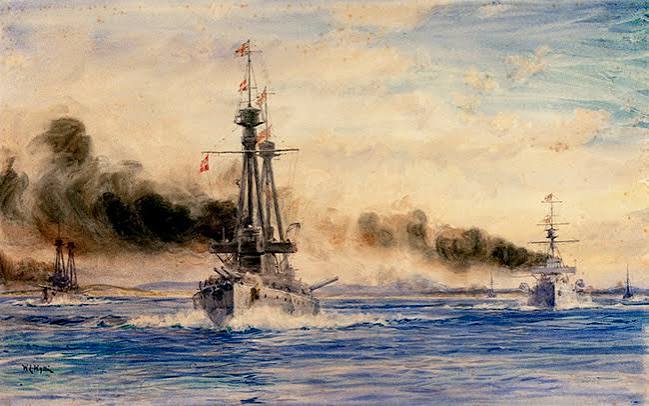
On the morning of 8 December 1914, lookouts on the German cruiser SMS Gneisenau spotted masts rising above the harbor at Port Stanley in the Falkland Islands. They belonged to British warships. But the Germans did not know that two of those ships were battlecruisers—fast, heavily armed giants whose 12-inch guns could outrange and outrun anything in their squadron. Within hours, the German East Asia Squadron, victors of a stunning defeat against Britain just five weeks earlier, would be shattered, and the balance of the war at sea would shift irrevocably.
This naval engagement, fought in the remote South Atlantic, is often overshadowed by the great battles of the Western Front. Yet it was a turning point. It eliminated Germany’s only significant surface threat outside the North Sea, secured the sea lanes for Allied troop convoys, and freed the Royal Navy to concentrate on the blockade that would slowly strangle Germany. The battle was not just a victory—it was a strategic necessity, and its consequences rippled through the rest of the war.
A Stunning Defeat and a Crisis in Britain
To understand the Falklands, you must first understand Coronel. On 1 November 1914, off the coast of Chile, a British squadron under Rear Admiral Sir Christopher Cradock intercepted the German East Asia Squadron, commanded by Vice Admiral Maximilian von Spee. The Germans had newer ships, longer-range guns, and a tactical advantage. The British cruisers HMS Good Hope and HMS Monmouth were sunk with all hands—about 1,600 sailors died. It was the Royal Navy’s first defeat in over a century.
The news hit Britain like a thunderbolt. The public was stunned; the Admiralty was humiliated. First Lord of the Admiralty Winston Churchill faced intense criticism. The war was only three months old, and Britain’s naval supremacy—the bedrock of its empire—seemed suddenly fragile.
Something had to be done. The Admiralty’s response was to detach two of its most powerful battlecruisers, HMS Invincible and HMS Inflexible, from the Home Fleet. These ships were vital for countering the German High Seas Fleet in the North Sea, but they were assigned to a new task: hunt down and destroy von Spee. Vice Admiral Sir Doveton Sturdee, who had been Chief of the War Staff, was given command. He sailed secretly, and the deployment was kept from public knowledge.
The Germans’ Plan and a Race to the Falklands
Von Spee, after his victory at Coronel, rounded Cape Horn and set a course for the Falkland Islands. His objective was to destroy the British coaling station at Port Stanley, seize its coal supplies, and disrupt British communications in the South Atlantic. He did not know that Sturdee’s battlecruisers had arrived there just the day before, coaling and repairing after their long voyage.
On the morning of 8 December, German lookouts spotted the British masts. Initially, they believed the ships were cruisers, not battlecruisers. Von Spee hesitated, weighing the risk of attack against the chance to achieve his mission. But as the identity of the ships became clear, he ordered his squadron to flee. It was too late. Sturdee’s battlecruisers, capable of 25 knots, gave chase. Their 12-inch guns had a range of over 16,000 yards—far exceeding the Germans’ 8.2-inch guns.
The battle unfolded over several hours. The British ships pursued relentlessly, closing the distance with superior speed. The German armored cruisers, Scharnhorst and Gneisenau, fought bravely but were outmatched. By late afternoon, both had been sunk. The light cruisers Nürnberg and Leipzig were also caught and destroyed. Only the Dresden escaped, but she was hunted down and scuttled in March 1915 off the coast of Chile.
The human cost was staggering for the Germans. Approximately 1,871 men were killed, including Admiral von Spee and his two sons. Only about 215 survivors were rescued. In stark contrast, the British suffered virtually no casualties—no ships lost, and fewer than ten wounded. It was a decisive, almost bloodless victory.
A Victory That Shaped the Rest of the War
The Falklands was not just a revenge for Coronel; it changed the strategic picture. Before the battle, the German East Asia Squadron posed a constant threat to British shipping and tied down a significant portion of the Royal Navy. Afterward, that threat was gone. Germany’s remaining surface raiders were reduced to individual submarines and disguised merchant ships, which, while annoying, could not seriously disrupt the Allied war effort.
More importantly, the victory freed British naval assets to concentrate on the North Sea blockade of Germany. The blockade, which cut off Germany from overseas food and raw materials, was a key element of the Allied strategy. It contributed to the shortages and civilian unrest that weakened Germany in the later years of the war.
The battle also secured the sea lanes for the movement of troops from the dominions. The convoys carrying Australian and New Zealand soldiers (ANZAC) to Europe and the Middle East sailed safely after the Falklands. The threat of a German raider intercepting them was eliminated, ensuring that reinforcements reached the Western Front and the Gallipoli campaign.
For Britain, the victory was a morale booster at a time when the war on land was bogged down in trenches and stalemate. It was a clear, unambiguous triumph that the public could celebrate. Churchill’s reputation was restored, and the Royal Navy’s prestige was reaffirmed.
A Battle Remembered, or Forgotten?
Despite its significance, the Battle of the Falklands is often overlooked in popular histories of World War I. The great land battles—the Somme, Verdun, Passchendaele—dominate the narrative. Yet the battle at sea was equally decisive. It was a classic example of naval power projection: a few hours of combat in a remote corner of the Atlantic changed the course of the war.
As the historian Julian Corbett later wrote, the Falklands was “the decisive battle of the war for the command of the sea.” It ensured that the British Empire could continue to trade, communicate, and move troops without interference from German surface raiders. It also demonstrated the importance of speed and firepower in naval warfare, lessons that would shape future engagements.
In the end, the battle remains a testament to the courage of the sailors on both sides and the strategic acumen of the commanders. For the Germans, it was a tragic end to a remarkable voyage across the Pacific. For the British, it was a necessary and resounding victory that helped to secure the eventual Allied triumph.
The Battle of the Falklands on 8 December 1914 was a turning point in World War I, though it is often forgotten. By destroying the German East Asia Squadron, Britain secured control of the seas, protected its empire, and ensured that the blockade of Germany would remain effective. The victory came at a critical moment, lifting British morale and reinforcing the naval dominance that would prove essential to winning the war. It is a battle that deserves to be remembered not just as a naval engagement, but as a strategic pivot that shaped the conflict and its outcome.
Summary
- The Battle of the Falklands (8 December 1914) was a decisive British naval victory that destroyed the German East Asia Squadron.
- The battle was a direct response to the British defeat at Coronel (1 November 1914), which had caused a political crisis in Britain.
- The British sent two battlecruisers, HMS Invincible and HMS Inflexible, which outgunned and outran the German ships.
- Nearly 1,900 German sailors were killed, including Admiral von Spee and his two sons; British casualties were minimal.
- The victory secured sea lanes for Allied trade and troop movements, and freed the Royal Navy to enforce the blockade of Germany.
FAQ
Q: Why did the German East Asia Squadron head to the Falklands?
A: Admiral von Spee intended to destroy the British coaling station at Port Stanley, seize coal supplies, and disrupt British communications in the South Atlantic, hoping to then return to Germany.
Q: How did the British get battlecruisers to the Falklands without the Germans knowing?
A: The Admiralty secretly detached HMS Invincible and HMS Inflexible from the Home Fleet, and Vice Admiral Sturdee sailed with them under a veil of secrecy. The deployment was kept from public knowledge, and even the German fleet in the North Sea was unaware of their absence.
Q: What were the immediate consequences of the battle?
A: The German East Asia Squadron was virtually annihilated. Only the light cruiser Dresden escaped, but she was hunted down and scuttled in March 1915. The victory ended Germany’s surface raiding threat outside the North Sea and boosted British morale.
Q: How did the battle affect the wider war?
A: It secured the sea lanes for Allied troop convoys, especially from Australia and New Zealand, and allowed the Royal Navy to concentrate on the blockade of Germany, which was a key factor in weakening Germany’s war effort.
Q: Why is the battle considered ‘forgotten’ despite its importance?
A: The battle is often overshadowed by the major land battles of World War I, such as the Somme and Verdun. However, its strategic impact on naval warfare and the overall Allied war effort was profound.
Leave a Reply