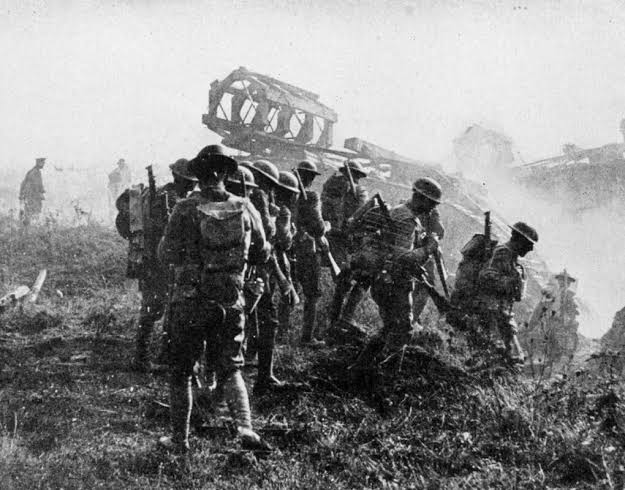
In the spring of 1918, the German army launched its last gamble. Operation Michael, the first of a series of Spring Offensives, pushed the British Fifth Army back forty miles in a matter of days. It was the deepest advance on the Western Front in four years. Yet by August, the tide had turned so completely that Allied forces were advancing daily, and by November, the German high command was suing for peace. How did the Allies, who had suffered years of stalemate and slaughter, finally win?
The answer is not a single stroke of genius but a grinding combination of material superiority, naval blockade, strategic coordination, and a slow learning curve that culminated in the Hundred Days Offensive. The Allies did not win because they were braver or cleverer; they won because they could afford to lose more and learn faster. The war was a test of endurance, and the Allies had the resources to outlast the Central Powers.
The Arithmetic of War: Material Superiority
World War I was a war of production. By 1918, the Allies were out-producing the Central Powers in almost every category that mattered. In steel, the Allies produced more than double Germany’s output. In coal, the British mines alone fed the war effort, while Germany’s access to overseas raw materials was cut off. The United States, entering the war in April 1917, tipped the balance decisively. American industry supplied not only its own troops but also billions of dollars in loans to Britain and France, keeping their war economies afloat.
The numbers tell a stark story. When the U.S. entered the war, it had a standing army of about 200,000 men. By the Armistice, over 1.2 million American soldiers had arrived in France. This fresh manpower was crucial, not because the Americans were better fighters, but because they filled the ranks depleted by years of attrition. The French army had mutinied in 1917, and the British were scraping the bottom of their manpower barrel. The arrival of the Americans allowed the Allies to absorb German offensives and then counterattack.
The Silent Siege: The British Blockade
While the guns thundered on the Western Front, a quieter weapon was strangling Germany. The British Royal Navy’s blockade, initiated in 1914, cut off Germany from overseas food and raw materials. The impact was catastrophic. By 1916, Germany was experiencing the “turnip winter,” where the population survived on turnips because potatoes and grain were scarce. Malnutrition weakened the civilian population, leading to disease and a drop in morale. By 1918, strikes and protests were common in German cities, and the war effort was increasingly unpopular.
The blockade also affected the military. German troops in 1918 were undersized and hungry, and their equipment was shoddy due to a lack of raw materials like rubber and copper. In contrast, the Allies had access to global resources, and their supply lines were never seriously threatened. The U-boat campaign was Germany’s attempt to counter-blockade Britain, but it failed to starve the island nation and instead provoked the United States into the war.
Coordination: The Birth of a Unified Command
For most of the war, the Allies fought as separate armies with separate strategies. This changed in March 1918, when the German Spring Offensives threatened to split the British and French armies. In response, the Allies appointed French General Ferdinand Foch as Supreme Allied Commander, giving him authority to coordinate operations across all fronts. This was a revolutionary step. For the first time, the British, French, and American armies could act as a single force, moving to plug gaps and launch joint offensives.
Foch’s coordination was key to the Hundred Days Offensive, which began on August 8, 1918. The assault at Amiens used a combined-arms approach: infantry, tanks, artillery, and aircraft working together. The British tanks, first introduced at Cambrai in 1917, had improved significantly. The element of surprise was achieved by not shelling the German lines beforehand, a departure from standard practice. The attack broke through, and the Allies advanced, capturing prisoners and territory in a way that had been impossible in earlier years.
Learning the Hard Way: Tactical Innovation
The Allies’ victory was also a story of learning. The early years of the war had been marked by futile frontal assaults against entrenched positions. The Somme in 1916 and Verdun in 1916 taught bloody lessons. By 1918, the Allies had developed “bite and hold” tactics, where they would seize a limited objective, consolidate, and then move on. They used creeping barrages, where artillery fire moved forward just ahead of the infantry, providing cover and neutralizing German machine guns.
The Hundred Days Offensive showed how much the Allies had evolved. The Battle of Amiens on August 8 was described by German General Erich Ludendorff as the “black day of the German army.” The Allies captured 15,000 prisoners and broke through the German lines. The offensive continued, with the Allies attacking on multiple fronts, forcing the Germans to retreat. The Hindenburg Line, the German defensive position, was breached in late September, and the German army was in full retreat.
The Collapse of the Central Powers
The Allied victory was not just won in France. The other Central Powers were crumbling. Bulgaria signed an armistice on September 29, 1918, after an Allied offensive in the Balkans. The Ottoman Empire followed in October, and Austria-Hungary signed an armistice on November 3, 1918. These collapses meant that Germany was fighting alone, with no allies and no hope of reinforcement. The German high command, led by Hindenburg and Ludendorff, realized that the war was lost. Ludendorff, who had been the architect of the Spring Offensives, urged the government to seek an armistice, fearing that the army would collapse and that revolution was imminent.
The German people were starving and war-weary. The blockade had taken its toll, and news of the military defeats sapped morale. On November 9, the Kaiser abdicated, and on November 11, the Armistice was signed in a railway carriage at Compiègne. The Allies had won, but the cost was immense: over 5 million Allied soldiers dead, and Germany itself was on the brink of revolution.
A War of Attrition, Won by Endurance
In the end, the Allies won because they could endure longer. Their economies and populations were larger, their supply lines were open, and their strategy improved. The German Spring Offensives of 1918 were a final gamble that failed, leaving the German army exhausted and demoralized. The Allies had learned to fight a modern war, and they had the resources to do it. The victory was not a single moment but a slow, grinding process that reached its climax in 1918.
The Allied victory in World War I was not a flash of brilliance but a grinding accumulation of advantages. The blockade starved Germany, the U.S. entry provided fresh resources, and tactical innovation broke the stalemate. By 1918, the Central Powers were exhausted, and the Allies were not. It was a war of endurance, and the Allies simply had more of it.
Summary
- The Allies’ industrial and economic superiority, especially after U.S. entry, gave them a decisive advantage in resources and manpower.
- The British naval blockade caused severe shortages in Germany, weakening civilian morale and military effectiveness.
- The appointment of Ferdinand Foch as Supreme Allied Commander in 1918 enabled effective coordination among Allied armies.
- Tactical innovations like bite-and-hold and creeping barrages, plus improved tanks, broke the trench stalemate.
- The collapse of Bulgaria, the Ottoman Empire, and Austria-Hungary isolated Germany and hastened its surrender.
FAQ
Q: Why did the U.S. entry into the war matter so much?
A: The U.S. provided fresh troops, financial credit, and industrial output. Over 1.2 million American soldiers arrived by the Armistice, filling Allied ranks and tipping the balance.
Q: How did the British blockade affect Germany?
A: The blockade cut off food and raw materials, causing malnutrition and disease among civilians, leading to strikes and unrest, and weakening the German war effort.
Q: What was the Hundred Days Offensive?
A: A series of Allied offensives starting on August 8, 1918, that broke the German lines and led to the Armistice. It used combined-arms tactics and was the first successful sustained offensive by the Allies.
Q: Did tanks win the war?
A: No, tanks were not decisive alone, but they were part of the combined-arms tactics that helped break the stalemate. The Allies used them effectively in 1918, especially at Amiens.
Q: Why did Germany surrender in 1918?
A: Germany was exhausted: the Spring Offensives failed, the blockade caused shortages, and the collapse of its allies left it isolated. The high command recognized the war was lost and sought an armistice.
Leave a Reply