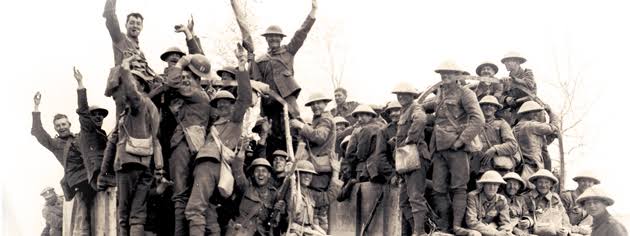
On August 4, 1914, when Britain declared war on Germany, Canada a self-governing Dominion with no independent foreign policy was automatically at war. Within a month, over 30,000 Canadians had volunteered, and the country of roughly 8 million people would eventually send 620,000 to the front lines. The cost was staggering: 66,000 killed, over 172,000 wounded. But the war’s impact reached far beyond the trenches, transforming Canada’s economy, politics, and national identity in ways that still echo today.
The Crucible of Vimy Ridge
On Easter Monday, April 9, 1917, all four divisions of the Canadian Corps fought together for the first time, attacking the German-held Vimy Ridge in northern France. The victory was swift and decisive—the ridge fell in a matter of hours—but the significance was national. For the first time, Canadians had fought as Canadians, not as colonial adjuncts to the British Army. The triumph was costly: over 10,000 casualties, including nearly 3,600 dead. Yet it became a defining moment of Canadian nationhood, a symbol of sacrifice and achievement that would be invoked for generations.
Vimy Ridge also had a political consequence. Prime Minister Robert Borden, who had witnessed the Canadian contribution first-hand, returned to London determined to secure a greater voice for the Dominions in imperial decision-making. This push culminated in Canada signing the Treaty of Versailles independently in 1919, a significant step toward the full autonomy later formalized by the Statute of Westminster in 1931.
The Economics of Total War
The war transformed Canada’s economy. The Shell Committee, later replaced by the Imperial Munitions Board, organized factories to produce shells and other war materiel. By 1917, Canada was producing more shells than any other Allied country. Wheat production on the Prairies surged to feed the Allies, fueling a “wheat boom” that enriched the region. The federal government’s role in the economy expanded dramatically, with the introduction of the Income War Tax Act of 1917—a “temporary” measure that became permanent.
This industrial mobilization accelerated urbanization and industrialization, creating a larger working class and setting the stage for post-war labor unrest. But the economic boom also masked deep social tensions, especially over conscription.
The Conscription Crisis: A Nation Divided
By 1916, voluntary enlistment had declined sharply as the reality of trench warfare sank in. In 1917, Borden, a Conservative, introduced the Military Service Act, which mandated conscription. The move was deeply divisive. English-speaking Canadians largely supported it, seeing it as a duty to the Empire. French-speaking Canadians, particularly in Quebec, opposed it almost unanimously, viewing the war as a British imperial affair that was not Quebec’s fight.
The election of 1917 saw Borden form a Union government—a coalition with pro-conscription Liberals, which split the Liberal Party. The conscription crisis reached its violent peak in 1918, when riots broke out in Quebec City over the enforcement of conscription, leaving four civilians dead. The crisis entrenched a lasting political divide: Quebec would become a Liberal stronghold for decades, and anti-conscription sentiment fueled the rise of Quebec nationalist movements.
The Home Front: Women, Internment, and the War Measures Act
The war also reshaped Canadian society. The federal government granted women the right to vote in 1918, partly to secure their support for conscription in the 1917 election. Most provinces followed shortly after. Women had entered the workforce in unprecedented numbers, working in factories, as nurses, and on farms, and their wartime contributions were often cited in the suffrage debate—though historians note the political calculations behind the timing.
But the war also exposed Canada’s darker side. The War Measures Act of 1914 gave the federal government sweeping powers, including the internment of “enemy aliens.” Over 8,000 people, mostly Ukrainian and other Eastern European immigrants, were interned in camps. This suppression of civil liberties, along with the conscription crisis, complicates any simple narrative of national unity.
The Return: Flu, Labor Unrest, and Veterans
The war’s end did not bring peace at home. Returning soldiers carried the Spanish Flu, which killed roughly 50,000 Canadians—more than the war itself. Demobilization of about 250,000 soldiers led to unemployment and labor unrest, culminating in the Winnipeg General Strike of 1919, which was violently suppressed. The war also created new institutions, such as the Department of Soldiers’ Civil Re-establishment, to support veterans, but many faced a difficult transition.
Indigenous soldiers, over 4,000 of whom served despite being exempt from conscription, returned to a country that denied them full citizenship—the vote was not granted to most Indigenous people until 1960.
A Legacy of Contradictions
The war’s legacy is one of contradictions. It is remembered as a coming of age, a baptism of fire that earned Canada international respect and a seat at the peace table. Yet it also exposed deep fractures—conscription, internment, and the suppression of dissent—that complicate the narrative of unified nationhood. The war accelerated social change, from women’s suffrage to labor organization, but it also entrenched divisions between French and English Canada that would persist for decades. In the end, WWI was not just a war fought overseas; it was a war that forged—and fractured—the nation at home.
The effects of WWI on Canada were profound and lasting. The war cost tens of thousands of lives, transformed the economy, and reshaped politics and society. It gave Canada a new sense of nationhood, but also exposed deep divisions that would shape the country for generations. The war’s legacy is still visible today, in the politics of Quebec, the structure of the federal government, and the way Canadians remember their place in the world.
Summary
- Canada sent 620,000 soldiers to WWI; 66,000 were killed and over 172,000 wounded, out of a population of ~8 million.
- Vimy Ridge (1917) was a major victory where all four Canadian divisions fought together, seen as a defining moment of nationhood.
- The conscription crisis of 1917 deeply divided French and English Canada, leading to riots and lasting political consequences.
- The federal government expanded its economic role, introducing income tax and becoming a major munitions producer.
- Women gained the right to vote in 1918, partly a political move to support conscription.
- The war led to internment of over 8,000 ‘enemy aliens’ and the Spanish Flu killed about 50,000 Canadians.
- Canada signed the Treaty of Versailles independently, a step toward autonomy from Britain.
FAQ
Q: How many Canadians served in WWI?
A: Approximately 620,000 Canadians enlisted, out of a population of about 8 million.
Q: What was the conscription crisis?
A: The Military Service Act of 1917 introduced conscription, which was deeply opposed in Quebec, leading to riots and a lasting political divide along French-English lines.
Q: How did WWI affect women’s suffrage in Canada?
A: The federal government granted women the right to vote in 1918, partly to secure support for conscription, and most provinces followed shortly after.
Q: What was the War Measures Act?
A: Enacted in 1914, it gave the federal government sweeping powers, including the internment of over 8,000 ‘enemy aliens,’ mostly Ukrainian and other Eastern European immigrants.
Q: How did WWI contribute to Canadian independence?
A: Canada signed the Treaty of Versailles independently, a step toward full autonomy from Britain, later formalized by the Statute of Westminster in 1931.
Leave a Reply