On the morning of August 8, 1918, a dense fog rolled over the fields of Amiens. Under its cover, hundreds of British tanks and infantry from Australia and Canada surged forward. By nightfall, they had torn a 15-mile gap in the German lines, capturing 12,000 prisoners. General Erich Ludendorff called it the “black day of the German army.” The Allies had finally broken the stalemate that had killed millions since 1914.
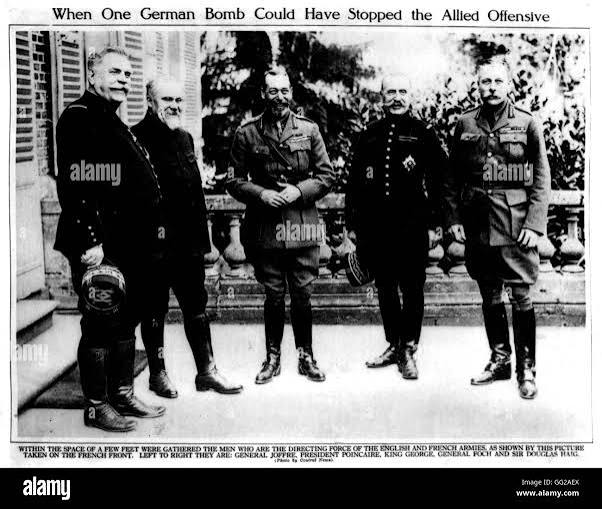
But who deserved the credit for this victory and the war itself? Two commanders had shaped the Allied path to that moment: Douglas Haig, the British commander who had spent years grinding down the German army at a horrific cost, and Ferdinand Foch, the French general who became Supreme Allied Commander in 1918 and orchestrated the final, crushing blow. Their strategies were different, their personalities clashed, and their legacies remain contested. This is the story of how two very different approaches—attrition and coordination—together won the war, and why the question of who deserves the laurels is more complicated than it seems.
The Two Commanders and Their Doctrines
Douglas Haig took command of the British Expeditionary Force in December 1915. He was a cavalryman by training, but he became the architect of a brutal, industrial war of attrition. His idea was simple: keep attacking the German army relentlessly, even if it meant losing tens of thousands of men, because Germany would run out of soldiers before the British Empire did. The results were staggering. On the first day of the Somme in July 1916, the British suffered 57,000 casualties—the bloodiest day in British military history. By the end of Passchendaele in November 1917, the British had gained a few miles of mud at the cost of hundreds of thousands of lives. Critics called him the “Butcher of the Somme.”
Ferdinand Foch, by contrast, was a French artilleryman and a fierce advocate of the offensive spirit. Before the war, he had preached the doctrine of “offensive à outrance”—attack with everything you have, and the strongest will to win will prevail. That doctrine had proven disastrous in 1914, when French offensives in Alsace and Lorraine were mowed down by German machine guns. But by 1918, Foch had evolved. As Supreme Allied Commander, he would become the master of coordination, not the champion of the frontal assault.
The Crisis of 1918: When the Allies Almost Lost
The spring of 1918 brought the war to a tipping point. With Russia out of the war, Germany transferred 50 divisions to the Western Front, hoping to knock out the Allies before American troops arrived in strength. On March 21, they launched Operation Michael, a massive offensive aimed at the British Fifth Army. The British lines buckled and nearly broke. The Allies faced the real prospect of being split apart and defeated.
At the Doullens Conference on March 26, the Allies made a historic decision: they appointed Foch as Supreme Allied Commander, giving him authority over all Allied forces on the Western Front. It was the first time in the war that a single commander had coordinated the efforts of the British, French, and later American armies. Haig, who had been reluctant to serve under anyone, accepted the arrangement, recognizing the emergency. It was a moment of unity that would prove decisive.
Foch’s Strategy: Flexibility and Counter-Attack
Foch’s approach in 1918 was radically different from his pre-war doctrine. Instead of rigid defense or reckless offense, he emphasized flexibility. His motto was “Tout le monde à la bataille”—everyone to the battle. He managed reserves like a chess master, refusing to commit them to static defensive lines. Instead, he waited for the right moment to counter-attack.
That moment came on July 18, 1918. The German spring offensives had exhausted themselves, and Foch launched a counter-offensive at the Marne, throwing in French and American troops. The attack was a stunning success, pushing the Germans back and signaling that the initiative had shifted. Foch’s coordination of reserves had prevented a German breakthrough in the spring and set the stage for the final Allied advance.
Haig’s War of Attrition: The Long Grind That Made Victory Possible
While Foch’s 1918 coordination was brilliant, it rested on the foundation laid by Haig’s attrition strategy. From 1916 to 1917, Haig had kept relentless pressure on the German army, even when the gains were measured in yards. The Somme and Passchendaele were horrific, but they inflicted irreplaceable losses on the Germans. By 1918, German divisions were understrength, poorly fed, and demoralized. Ludendorff’s own memoirs admit that the German army was a shadow of its former self.
Haig also oversaw the transformation of the British army into a modern, combined-arms fighting force. The BEF had grown from 6 divisions in 1914 to 60 divisions by 1918—the largest Allied army on the Western Front. Under his command, the British adopted new tactics: creeping barrages, tanks, aircraft coordination, and infiltration techniques. The Battle of Amiens was a textbook example of this new warfare. It was a British-planned and British-executed victory, with Australian and Canadian troops at the spearhead. Foch had actually pushed for a more ambitious offensive, but it was Haig’s forces that achieved the breakthrough.
The Hundred Days: Two Strategies Merge
In the autumn of 1918, Foch orchestrated the final offensive—a “sledgehammer” of simultaneous attacks along the entire front. The goal was to prevent the Germans from shifting reserves from one sector to another. Haig, initially reluctant to extend his offensive, eventually pushed for the breakthrough of the Hindenburg Line. On September 29, British, Australian, and American forces broke through the supposedly impregnable line. The German army was in full retreat, mutiny was spreading, and the Kaiser abdicated. On November 11, the Armistice was signed.
The Hundred Days Offensive was a coordinated triumph, but it was built on the attrition of the previous years. Without Haig’s grinding warfare, the German army might have been strong enough to withstand the final blow. Without Foch’s coordination, the Allies might have squandered their advantage. The two strategies were complementary, not opposed.
The Legacy and the Debate
The question “Which general won the war?” is, in many ways, the wrong question. The war was won by the combined efforts of millions of soldiers and the strategies of both commanders. Haig’s attrition was necessary but costly; Foch’s coordination was brilliant but depended on the foundation Haig had built. Their legacies, however, are wildly different. Haig remains the “Butcher of the Somme” in popular memory, though revisionist historians argue he was a necessary evil. Foch is celebrated as the architect of victory, though his pre-war offensive doctrine had proven deadly. The truth is that both men adapted to the realities of industrial warfare—Haig by embracing attrition, Foch by embracing coordination—and together they broke the German army.
The debate between Haig and Foch is not a simple choice. It is a story of two men with different philosophies who, in the crucible of 1918, found a way to work together. Haig’s attrition wore down the enemy; Foch’s coordination delivered the final blow. The war was won by both—and by the millions who fought and died under their command. Their strategies, though different, were two halves of a single whole, and the question of who deserves the credit is best answered by recognizing that neither could have won without the other.
Summary
- Douglas Haig commanded the British Expeditionary Force from 1915, implementing a strategy of attrition that inflicted heavy losses on the German army, despite massive British casualties.
- Ferdinand Foch became Supreme Allied Commander in March 1918, coordinating Allied reserves and launching counter-offensives that turned the tide.
- Foch’s flexibility and coordination were crucial in 1918, but they relied on the weakened German army that Haig’s attrition had created.
- The Hundred Days Offensive was a coordinated effort, with Haig’s forces achieving key breakthroughs like Amiens and the Hindenburg Line.
- The war was won by a combination of both strategies, not by one general alone.
FAQ
Q: Who was Douglas Haig?
A: Douglas Haig was the Commander-in-Chief of the British Expeditionary Force from December 1915 to the end of World War I. He is known for his attrition strategy, which led to heavy casualties at battles like the Somme and Passchendaele, but also contributed to the eventual defeat of Germany.
Q: Who was Ferdinand Foch?
A: Ferdinand Foch was a French general who became the Supreme Allied Commander in March 1918. He coordinated the Allied response to the German Spring Offensive and planned the final Hundred Days Offensive that led to the Armistice.
Q: What was the Hundred Days Offensive?
A: The Hundred Days Offensive was the final Allied offensive of World War I, from August 8 to November 11, 1918. It consisted of a series of coordinated attacks along the Western Front that broke the German army’s will to fight.
Q: Why is Haig called the ‘Butcher of the Somme’?
A: Haig earned this nickname because of the massive casualties suffered under his command, particularly on the first day of the Battle of the Somme, which saw 57,000 British casualties. Critics argue he was reckless, while supporters say his attrition strategy was necessary.
Q: Did Foch and Haig agree on strategy?
A: Not always. They had different approaches—Haig favored attrition, while Foch favored coordination and counter-attack. However, they worked together in 1918, with Haig accepting Foch’s overall command and Foch relying on Haig’s forces for key breakthroughs.
Leave a Reply