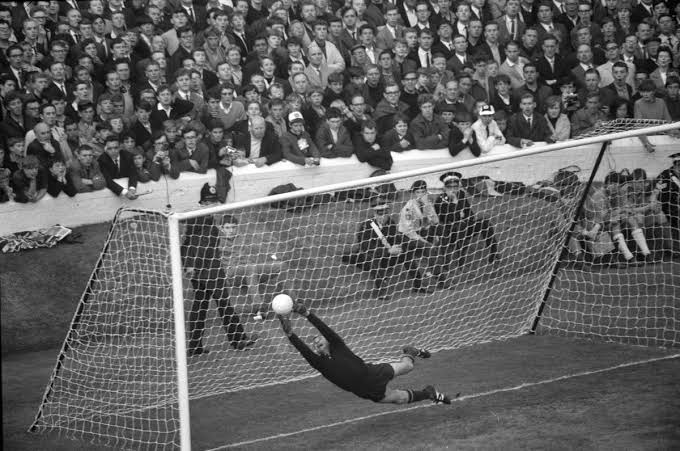
In 1963, a 34-year-old Soviet goalkeeper named Lev Yashin won the Ballon d’Or, the most prestigious individual award in football. No goalkeeper has won it since. To understand why Yashin was not just an exception but a revolutionary, you have to look beyond the trophy and into the penalty area he treated as his personal fiefdom.
Yashin’s career spanned two decades at Dynamo Moscow, where he made over 300 league appearances, and he became a national hero for the Soviet Union, winning Olympic gold in 1956 and the first European Championship in 1960. But his true legacy lies in how he redefined the goalkeeper’s role—from a static shot-stopper to an active, commanding presence who could change the course of a match with his decisions and his psychology.
The Black Spider’s Web: A New Kind of Goalkeeper
In the 1950s and 1960s, goalkeepers were expected to stay on their line. Their job was reactive: make saves, catch crosses, punt the ball upfield. The idea of a goalkeeper as a sweeper, a playmaker, or a psychological weapon was alien. Then came Lev Yashin, dressed head-to-toe in black, earning nicknames like “The Black Spider” and “The Octopus” for his uncanny reach and his habit of covering every inch of his goal.
But Yashin’s web extended far beyond the goal line. He was the first true sweeper-keeper, routinely charging out of his penalty area to clear through balls, punch crosses away, and act as an extra outfield player. In an era when the back-pass rule didn’t exist—goalkeepers could pick up any ball played back to them—Yashin’s willingness to leave his line was a radical departure. He didn’t just defend his goal; he patrolled the entire penalty area, organizing his defense, claiming crosses with authority, and starting counterattacks with accurate throws.
His style was so ahead of its time that it took decades for the rest of the world to catch up. Modern sweeper-keepers like Manuel Neuer, Alisson, and Ederson owe a direct debt to Yashin’s pioneering aggression. When Neuer races off his line to clear a through ball, he’s channeling the Black Spider’s spirit. And when a goalkeeper commands his box and shouts orders at his defenders, he’s following a template Yashin set half a century ago.
The Penalty Psychologist: 150 Saves and Counting
Yashin’s penalty-saving record is the stuff of legend. Estimates put his career total at over 150 penalties saved—a figure that, if accurate, is unmatched in the modern game. But what made him so good at stopping spot-kicks wasn’t just reflexes; it was psychology.
Yashin studied penalty takers meticulously. He watched their body language, their run-up, their preferred corners. He was known to delay facing penalties, staring down the taker to unsettle them. He used gamesmanship—shuffling on his line, spreading his arms wide to make himself look bigger, and sometimes even pointing to where he thought the ball would go. This wasn’t random guesswork; it was calculated psychological warfare.
In an era before video analysis and data-driven penalty metrics, Yashin relied on intuition and observation. Modern goalkeepers now have detailed databases on every taker’s tendencies, but Yashin did it all with his own eyes. He turned penalty shootouts into a duel of wits, and more often than not, he came out on top.
His approach echoes in today’s game. When a goalkeeper like Emiliano Martínez tries to distract a penalty taker with trash talk or antics, he’s tapping into the same psychological principles Yashin pioneered. The difference is that Yashin did it with a quiet intensity that earned him respect even from the players he denied.
The Only Ballon d’Or Goalkeeper: A Cold War Icon
The 1963 Ballon d’Or was a shock. Goalkeepers simply didn’t win the award, which was dominated by outfield players. But Yashin, then 34, finished ahead of Italian midfielder Gianni Rivera and English striker Jimmy Greaves. The award wasn’t just for his shot-stopping; it was for his entire influence on the position.
Yashin’s success carried political weight. He was a Soviet state hero, a symbol of communist athletic prowess. Yet he was also adored in the West, where his all-black kit and dramatic style made him a cult figure. In an era when Soviet athletes were often portrayed as robotic, Yashin’s flair and sportsmanship—he was known to comfort opponents who missed penalties against him—transcended the Iron Curtain.
His legacy in Russia is immense. There are statues of him, a stadium named in his honor, and the annual Yashin Award, which was given to the best goalkeeper at the World Cup from 1994 to 2018. But his influence goes beyond trophies and honors. He changed how the world viewed goalkeepers, and his innovations laid the groundwork for the modern game.
The Rules Caught Up: The Back-Pass Rule and Beyond
One of the most intriguing aspects of Yashin’s story is how his innovations eventually influenced rule changes. In 1992, FIFA introduced the back-pass rule, which prohibited goalkeepers from handling deliberate passes from teammates. The rule was partly a response to time-wasting tactics, but it also reflected a changing understanding of the goalkeeper’s role—a role Yashin had redefined decades earlier.
Ironically, Yashin’s sweeping style was made less necessary by the rule change, since goalkeepers could no longer pick up back-passes. But the rule also made sweeping more important in a different way: goalkeepers now had to be skilled with their feet, and the modern sweeper-keeper emerged as a direct consequence. Yashin’s willingness to play as an extra defender foreshadowed this evolution, even if the rules of his time didn’t require it.
Today, the best goalkeepers are expected to be comfortable with the ball at their feet, capable of playing out from the back and sweeping behind a high defensive line. That expectation would have felt familiar to Yashin, who was doing it in the 1960s with a heavy leather ball and no protective gloves.
The Octopus’s Legacy: What Modern Goalkeepers Can Learn
Yashin’s career offers timeless lessons for goalkeepers at every level. First, the mental game matters as much as physical ability. His penalty-saving record was built on study and psychology, not just reflexes. Second, the goalkeeper is not a passive last line of defense but an active participant in the team’s tactics. Yashin’s sweeping and organization were ahead of their time, and they’re now standard practice.
Third, style matters. Yashin’s all-black kit wasn’t just a fashion choice; it was a statement. It made him stand out, intimidated opponents, and became part of his legend. In a sport where confidence and presence are crucial, Yashin understood that perception is performance.
Finally, Yashin’s career shows that true innovation often comes from breaking the rules—or at least pushing against their boundaries. He didn’t wait for permission to leave his penalty area; he did it because he saw opportunities that others missed. That mindset is what separates a good goalkeeper from a game-changer.
As of 2025, no goalkeeper has won the Ballon d’Or since Yashin. The award remains the exclusive domain of outfield players, but Yashin’s place in history is secure. He didn’t just play the position; he reimagined it. And in doing so, he made the penalty area his kingdom—a kingdom that modern goalkeepers still inhabit, whether they know it or not.
Lev Yashin’s legacy is not measured in trophies alone, though he had plenty. It’s measured in the way goalkeepers play today. Every time a keeper charges off their line, commands their box, or studies a penalty taker’s run-up, they’re following the template Yashin created. He was the Black Spider who wove a web across the penalty area, and the football world is still caught in it.
Summary
- Lev Yashin is the only goalkeeper to win the Ballon d’Or (1963), and no goalkeeper has won it since.
- He pioneered the sweeper-keeper role, routinely leaving his penalty area to intercept passes and organize his defense, decades before modern keepers like Manuel Neuer.
- Yashin’s estimated 150+ penalty saves were a result of intense psychological study of takers, using body language and gamesmanship to gain an edge.
- His all-black kit and dramatic style made him a cult figure during the Cold War, transcending political divides.
- His innovations influenced the evolution of the goalkeeper position, including the eventual 1992 back-pass rule, and his legacy lives on in the modern game.
FAQ
Q: How many penalties did Lev Yashin save?
A: Unofficial counts estimate Yashin saved over 150 penalties during his career, a figure widely cited as unmatched in modern football.
Q: Why is Lev Yashin considered a pioneer of the sweeper-keeper role?
A: He routinely left his penalty area to clear through balls, punch crosses, and act as an extra defender, a style that was revolutionary in the 1950s and 1960s and is now standard for many top goalkeepers.
Q: What was the Yashin Award?
A: The Yashin Award was given to the best goalkeeper at each FIFA World Cup from 1994 to 2018, named in honor of Lev Yashin. It has since been replaced by the Best FIFA Goalkeeper award.
Q: Did Lev Yashin win any major international trophies?
A: Yes, he won Olympic gold in 1956 and the first European Championship in 1960 with the Soviet Union.
Q: How did Yashin’s style influence the back-pass rule?
A: While the 1992 back-pass rule was primarily introduced to stop time-wasting, it reflected a changing view of goalkeepers as active players. Yashin’s sweeping style foreshadowed the modern expectation that keepers be skilled with their feet.