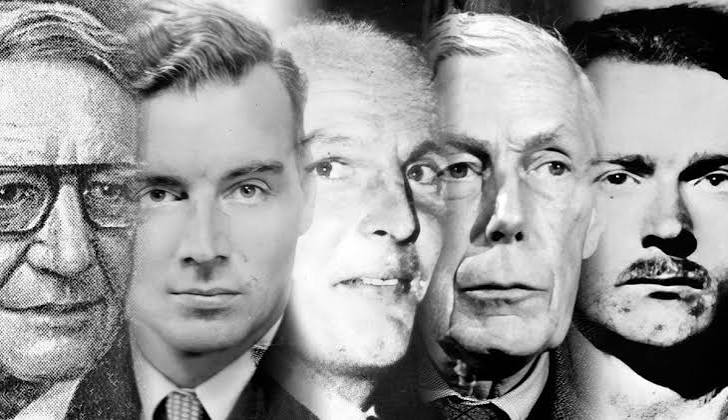
In the 1930s, as fascism swept across Europe, a group of brilliant young men at Cambridge University made a choice that would haunt British intelligence for decades. They were not recruited for money or blackmail, but for ideology. They believed the Soviet Union was the only true bulwark against Hitler.
Over the next thirty years, these five men Kim Philby, Donald Maclean, Guy Burgess, Anthony Blunt, and John Cairncross rose to the highest echelons of British power. They became diplomats, intelligence officers, and even the Queen’s art adviser. All the while, they fed the Kremlin the West’s most guarded secrets, from atomic weapons research to the identities of Western spies.
The Making of a Spy Ring
Cambridge University in the 1930s was a cauldron of radical ideas. The Great Depression had shattered economies, the Spanish Civil War was a rallying cry for anti-fascists, and Hitler’s rise in Germany made communism seem like the only credible opposition. For many students, Marxism wasn’t just a theory it was a moral imperative.
The Soviet NKVD, the predecessor to the KGB, saw an opportunity. They targeted elite universities, reasoning that upper-class recruits could infiltrate Britain’s corridors of power with ease. Their key recruiter was Arnold Deutsch, a Soviet agent who arrived in London in 1934.
Deutsch found fertile ground. Kim Philby, the son of a British diplomat, was already a committed communist. Donald Maclean, a tall, charismatic Scot, shared his zeal. Guy Burgess, flamboyant and brilliant, was a member of the Apostles, a secret intellectual society that also included Anthony Blunt. The ring grew organically, bound by shared ideology and friendship. John Cairncross, a scholarship boy, joined later, recruited by Blunt.
Their class background was their shield. Public school, Oxbridge, family connections these were the keys to Britain’s establishment, and the Five had them in spades. No one suspected that these gentlemen could be traitors.
The Cambridge Five remain a cautionary tale about the power of ideology, the dangers of complacency, and the blindness of privilege. Their story is not just a spy thriller, but a mirror held up to the British establishment a reflection of how easily the elite can be deceived when they cannot imagine betrayal from within.
Summary
- The Cambridge Five were five British spies who leaked secrets to the Soviet Union from the 1930s to the 1950s, including atomic intelligence and the identities of Western agents.
- They were recruited at Cambridge University by Soviet handler Arnold Deutsch, motivated by anti-fascism and Marxist ideology.
- Their privileged backgrounds made them above suspicion, allowing them to rise to senior positions in MI6, the Foreign Office, and even the royal household.
- The ring unraveled slowly, beginning with the Venona decrypts and the 1951 defection of Burgess and Maclean, followed by Philby in 1963, and the public unmasking of Blunt in 1979 and Cairncross in 1990.
- Their actions caused immense damage to Western intelligence and highlighted systemic failures in British intelligence’s old boy network.
FAQ
Q: Who were the Cambridge Five?
A: The Cambridge Five were a ring of British spies—Kim Philby, Donald Maclean, Guy Burgess, Anthony Blunt, and John Cairncross—who passed classified information to the Soviet Union from the 1930s through the 1950s.
Q: Why did they spy for the Soviet Union?
A: They were ideologically motivated communists who believed the USSR was the only real bulwark against fascism. They were not paid mercenaries but committed believers in Marxism.
Q: How were they eventually caught?
A: The Venona project, a US code-breaking effort, identified Soviet agents codenamed “Homer” (Maclean) and “Stanley” (Philby). The 1951 defection of Burgess and Maclean, the 1963 defection of Philby, and the 1964 confession of Blunt all contributed to the unraveling.
Q: What was the scale of the damage they caused?
A: They compromised Western intelligence operations, exposed agents inside Soviet intelligence, and leaked atomic secrets that accelerated the Soviet nuclear program. They also alerted Moscow to the Venona project, allowing the Soviets to change their codes.
Q: Why were they able to evade detection for so long?
A: Their class background and establishment connections made them above suspicion. The “old boy network” protected them, and senior figures found it hard to believe that Oxbridge elites could be traitors.
Leave a Reply