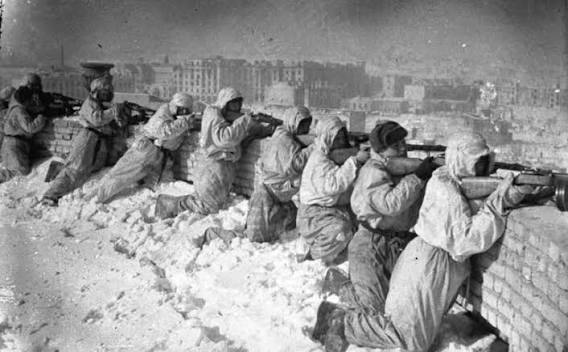
On August 23, 1942, the German Sixth Army reached the Volga River and began the assault on Stalingrad. What followed was one of the most brutal and consequential battles in human history. Over the next five months, the city became a maelstrom of urban combat, where soldiers fought for every block, floor, and room. By the time the last German forces surrendered on February 2, 1943, over a million soldiers and tens of thousands of civilians had perished. The Battle of Stalingrad was not just a military engagement; it was the turning point of World War II in Europe, the moment when the Nazi war machine irrevocably lost its momentum and the Red Army began its relentless march toward Berlin.
The battle’s significance extends beyond its staggering casualties. It shattered the myth of German invincibility, marked the first time a German field marshal was captured, and demonstrated the resilience of the Soviet people under unimaginable hardship. In the rubble of Stalingrad, the fate of the Eastern Front—and ultimately the entire war—was decided.
The Road to Stalingrad
In the summer of 1942, Hitler launched Operation Blue, a massive offensive aimed at the southern Soviet Union. The objectives were clear: capture the oil fields of the Caucasus and secure the Volga River, a vital supply artery. Stalingrad, a major industrial city and Stalin’s namesake, lay directly in the path. The German Sixth Army, the largest in the Wehrmacht with over 330,000 men, was tasked with taking the city.
The advance was rapid. By late August, the Germans had reached the outskirts and began a devastating aerial bombardment that reduced much of the city to rubble. The Luftwaffe’s bombing raids were so intense that the city’s defenders, the Soviet 62nd Army under General Vasily Chuikov, were forced to fight amidst the ruins. The Volga River became a lifeline, with reinforcements and supplies ferried across under constant fire.
The Rat War
The fighting in Stalingrad degenerated into what soldiers called “rat war” (Rattenkrieg). It was close-quarters combat at its most brutal—block by block, floor by floor, room by room. Chuikov adopted a radical tactic: “hugging the enemy.” By keeping Soviet lines uncomfortably close to German positions, he prevented the Luftwaffe and German artillery from striking without risking their own troops. This nullified the Germans’ advantage in firepower and turned the battle into a brutal grind of attrition.
Snipers became iconic figures. Vasily Zaytsev, a Soviet sniper credited with over 200 kills, became a symbol of the Red Army’s determination. The city’s industrial plants—the tractor factory, the Red October steel plant, and the Barrikady arms factory—became fortified strongpoints, fought over with desperate intensity.
The Soviet Counteroffensive: Operation Uranus
While the world’s attention was fixed on the city’s defenders, Soviet commanders Georgy Zhukov and Aleksandr Vasilevsky were planning a massive counteroffensive. They identified a critical weakness: the German flanks were held by weaker Romanian, Italian, and Hungarian units. Operation Uranus, a double envelopment, was launched on November 19, 1942. The Red Army broke through the Romanian lines and within four days encircled the entire German Sixth Army, along with parts of the Fourth Panzer Army—about 300,000 men trapped in a pocket 30 miles wide.
Hitler refused to authorize a breakout, ordering the Sixth Army to hold as “Fortress Stalingrad” and await relief. Field Marshal Erich von Manstein’s Operation Winter Storm, launched on December 12, came within about 30 miles of the pocket but failed to break through. The Luftwaffe’s promise to supply the trapped army by air proved catastrophic—they could deliver at most 100 to 120 tons per day, far short of the 700 tons required. Starvation and cold began to decimate the encircled forces.
The End and the Surrender
The Red Army tightened the noose, splitting the pocket and forcing the Germans into ever-shrinking areas of control. On January 30, 1943, Hitler promoted General Friedrich Paulus to Field Marshal—an implicit order to commit suicide, as no German field marshal had ever been captured. Paulus disobeyed and surrendered the next day. The last German units in the northern pocket capitulated on February 2, 1943.
The scale of the catastrophe was staggering. The Axis suffered an estimated 800,000 to 850,000 casualties, including over 100,000 prisoners taken at surrender, of whom fewer than 6,000 ever returned home. Soviet losses were even higher, with over a million killed, wounded, or missing. The city itself was a wasteland, with tens of thousands of civilians dead.
A Turning Point
Stalingrad marked the definitive turning point in the European theater. After February 1943, the Wehrmacht never regained the strategic initiative on the Eastern Front. The Red Army began a continuous westward advance that would end in Berlin. The battle also had profound psychological and political effects. It shattered the aura of German invincibility and demonstrated to the world that the Nazi war machine could be defeated. In the words of one German soldier, “Stalingrad is the turning point of the war. We are lost.”
The Battle of Stalingrad was a crucible of suffering and sacrifice, a confrontation that decided the fate of nations. The Red Army’s victory was not just a military triumph but a testament to human endurance in the face of unimaginable adversity. It remains a stark reminder of the cost of war and the resilience of those who fight for survival.
Summary
- The Battle of Stalingrad lasted from August 23, 1942, to February 2, 1943, and resulted in a decisive Soviet victory.
- The German Sixth Army was encircled by Operation Uranus and destroyed, marking the first time a German field marshal was captured.
- The battle caused over 1.5 million total casualties, making it one of the deadliest in history.
- Stalingrad was the turning point of World War II in Europe; the Wehrmacht never regained the strategic initiative.
- The Soviet tactic of “hugging the enemy” nullified German firepower in brutal urban combat.
FAQ
Q: Why was Stalingrad strategically important?
A: Stalingrad was a major industrial center and a symbolic city named after Stalin. Controlling it would secure the Volga River supply route and protect the flank of German forces advancing toward the Caucasus oil fields.
Q: How did the Soviet Union manage to turn the tide?
A: The Soviets launched Operation Uranus, a massive counteroffensive targeting the weaker Romanian units on the German flanks, leading to the encirclement of the German Sixth Army.
Q: What was the “rat war”?
A: “Rat war” (Rattenkrieg) was the term soldiers used for the brutal close-quarters combat in Stalingrad, where fighting occurred block by block, floor by floor, and room by room.
Q: How many casualties were there?
A: Axis casualties were about 800,000 to 850,000, while Soviet casualties were over 1.1 million, including military and civilian deaths.
Q: What happened to Field Marshal Paulus?
A: Paulus was promoted to Field Marshal by Hitler on January 30, 1943, an implicit order to commit suicide. He instead surrendered, becoming the first German field marshal to be captured by the enemy.
Leave a Reply