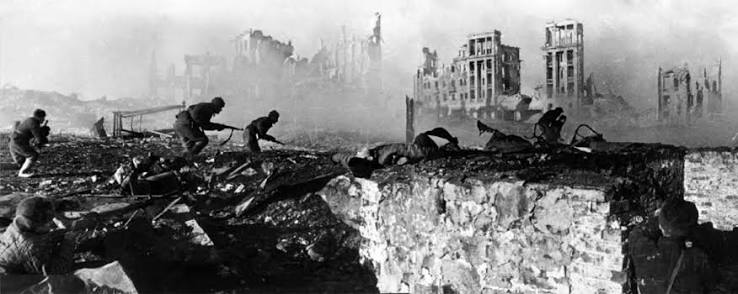
On August 23, 1942, the Luftwaffe unleashed a hell of fire and steel on the city of Stalingrad. In a single day, waves of bombers dropped thousands of tons of explosives, turning the industrial metropolis on the Volga River into a moonscape of craters and burning rubble. Tens of thousands of civilians perished in the inferno, their bodies buried under collapsed buildings. That morning, the German 6th Army had reached the city’s outskirts; by nightfall, Stalingrad was a funeral pyre.
What followed was not a conventional battle but a brutal, 163-day ordeal that would consume over two million lives. The Battle of Stalingrad, fought from August 23, 1942, to February 2, 1943, remains the bloodiest single engagement in human history. It was a clash of titans Nazi Germany and the Soviet Union locked in a struggle that would decide the fate of Europe. This is the story of how a city that bore Stalin’s name became the graveyard of the German Wehrmacht and the turning point of World War II.
The City That Had to Be Taken
Stalingrad was not just a city; it was a symbol. It bore the name of the Soviet dictator, and its factories churned out tanks, artillery, and small arms that fueled the Red Army. Strategically, it sat astride the Volga River, a vital artery for transporting oil from the Caucasus and supplies from the north. If Hitler could seize Stalingrad, he would cut the Soviet Union in half and secure the flanks of his drive toward the oil fields.
For Hitler, the capture of Stalingrad was personal. He saw it as a propaganda coup that would demoralize the Soviets and cement his own myth of invincibility. For Stalin, losing the city would be a catastrophic blow to his prestige. In July 1942, he issued Order No. 227: “Not a step back!” The order forbade retreat under penalty of death, establishing penal battalions and blocking detachments that would shoot any soldier who fled. Both leaders had staked their reputations on a city that would become a meat grinder.
The German summer offensive, codenamed Case Blue, had been launched in June 1942. Army Group South split into two prongs: one aimed for the Caucasus oil fields, the other, the 6th Army under General Friedrich Paulus, drove toward Stalingrad. By late August, Paulus’s forces, numbering over 300,000 men, were poised to take the city.
The Bombing and the Rat War
The Luftwaffe’s bombing on August 23 was designed to break the city’s will. It succeeded in killing thousands and leveling buildings, but it also created ideal defensive terrain. The rubble became a labyrinth of bunkers, sniper nests, and ambush points. The Soviet 62nd Army, commanded by General Vasily Chuikov, adopted a strategy that defied conventional military logic: hug the enemy.
Chuikov’s doctrine was simple: keep Soviet lines so close to German lines that the Luftwaffe and artillery could not bomb without hitting their own troops. This turned the battle into a close-quarters brawl, fought with grenades, knives, and submachine guns. Soldiers engaged in what became known as the “rat war” fighting in sewers, basements, and the skeletons of buildings. Sniper duels became legendary; Vasily Zaytsev, a Soviet sniper, reportedly killed over 200 Germans, his exploits immortalized in the film Enemy at the Gates.
By November, the Germans controlled about 90% of the city, but they could not dislodge the Soviet defenders from a narrow strip along the Volga’s western bank. Reinforcements and supplies crossed the river under constant fire, often at night. The eastern bank was held at all costs, becoming a lifeline that kept the defense alive.
The Encirclement: Operation Uranus
While the world’s attention was fixed on the street fighting, the Soviet high command was planning a massive counteroffensive. Generals Georgy Zhukov and Aleksandr Vasilevsky conceived Operation Uranus, a bold double envelopment designed to trap the German 6th Army. They amassed over a million troops, hidden through a masterful deception campaign (maskirovka) that fooled German intelligence about Soviet reserves.
On November 19, 1942, the Red Army struck north and south of Stalingrad, smashing through the Romanian and Italian armies that protected the German flanks. Within four days, the pincers met at Kalach, encircling nearly 300,000 Axis troops in a pocket that stretched across the Volga steppe. The German high command was stunned. Hitler, in his bunker in East Prussia, refused to authorize a breakout, declaring that the 6th Army would hold the city and be resupplied by air.
That promise proved hollow. The Luftwaffe’s transport fleet, already strained, could not deliver the required 700 tons of supplies per day. At its peak, it delivered only about 100–120 tons daily, a fraction of what was needed. The encircled army began to starve and freeze. Soldiers suffered frostbite, dysentery, and the gnawing agony of hunger. Horses were eaten, then pets, then rats.
The Relief Attempt and the Siege’s End
In December, Field Marshal Erich von Manstein launched Operation Winter Storm, a desperate attempt to break through to the trapped 6th Army. German tanks advanced to within 30 miles of the pocket before being halted by Soviet counterattacks. Hitler again forbade Paulus from attempting an exit, believing that holding Stalingrad was a matter of honor. It was a death sentence.
By January 1943, the pocket had shrunk to a few square miles. The sick, wounded, and frostbitten huddled in cellars, surviving on scraps of bread and melted snow. The Red Army tightened the noose, capturing airfields and overwhelming the starving defenders. On January 31, Paulus was promoted to Field Marshal by Hitler—a clear signal that he should commit suicide rather than surrender. No German field marshal had ever been captured. Paulus chose life over honor.
The northern pocket surrendered on February 2, 1943. Of the ~300,000 Axis troops encircled, about 91,000 were taken prisoner, including 24 generals. They were marched into captivity in the Soviet Union, a journey that most would not survive. Only about 5,000–6,000 ever returned to Germany.
The Human Cost
The numbers are staggering: combined military and civilian casualties ranged from 1.8 to 2.5 million. The Axis lost about 800,000–850,000 killed, wounded, or captured, while the Soviets suffered approximately 1.1–1.2 million casualties. Civilians bore the brunt of the initial bombing and the subsequent starvation; estimates of civilian deaths range from 40,000 to over 100,000. In the end, the city was a wasteland, its population decimated, its buildings reduced to hollow shells.
The Battle of Stalingrad was not just a military defeat for Germany; it was a psychological and moral catastrophe. The myth of German invincibility was shattered. For the first time, the Wehrmacht had lost an entire army, and the tide of World War II in Europe had turned irrevocably. The Red Army would never lose the strategic initiative again, driving westward all the way to Berlin.
For the soldiers who fought, Stalingrad was a descent into the abyss. Diaries and letters from both sides speak of the relentless horror: the stench of death, the constant shelling, the faces of comrades who vanished in a flash of fire. A German officer, Kurt Reuber, drew a charcoal sketch of a mother and child surrounded by darkness, titled the “Stalingrad Madonna,” a symbol of hope in the midst of despair.
The Legacy
Today, Volgograd—renamed in 1961 during de-Stalinization—stands as a monument to the battle. The Mamayev Kurgan hill, the site of some of the fiercest fighting, is crowned by a colossal statue, “The Motherland Calls.” It rises 85 meters above the city, a testament to the sacrifice of millions.
Stalingrad remains a lesson in the dangers of overreach, the folly of hubris, and the terrible cost of war. It was a battle where the theories of generals collided with the grim reality of urban combat, where the will of a people proved stronger than the tanks of an invader. The blood of Stalingrad soaked into the Volga steppe, and from that blood rose a new world order.
The battle’s outcome shaped the rest of the 20th century. It marked the beginning of the end for Nazi Germany and set the stage for the Cold War. For those who endured it, it was an experience that defied description. As one Soviet veteran wrote: “We who survived Stalingrad will never be the same. We have seen the face of war, and it is a face of utter ruin.”
The Battle of Stalingrad was more than a military engagement; it was a crucible of fire and blood that forged the fate of nations. It demonstrated that even the most powerful army could be broken, and that the human spirit, when pushed to the brink, could endure unimaginable suffering. The names of Paulus, Chuikov, and Zaytsev are etched in history, but the countless anonymous soldiers and civilians who perished in the rubble are the true heroes of that epic struggle. As the world remembers the 80th anniversary of this cataclysm, we do well to reflect on the cost of hubris and the fragile value of peace.
Summary
- The Battle of Stalingrad (August 23, 1942 – February 2, 1943) was the bloodiest battle in history, with 1.8–2.5 million total casualties.
- The German 6th Army was encircled by Soviet forces in Operation Uranus, leading to the surrender of ~91,000 soldiers, only a few thousand of whom survived captivity.
- The battle marked a strategic turning point in World War II, ending the German advance into the Soviet Union.
- Key tactics included Soviet “rat war” in the ruins and Chuikov’s “hug the enemy” strategy to neutralize German air superiority.
- The Luftwaffe’s failed air supply operation doomed the encircled 6th Army, which suffered starvation and frostbite before surrendering.
FAQ
Q: Why is Stalingrad considered a turning point in World War II?
A: Stalingrad was the first major defeat of the German Wehrmacht, resulting in the loss of an entire army. It shattered the myth of German invincibility and gave the Soviet Union the strategic initiative, which it never lost until Berlin fell in 1945.
Q: How many people died in the Battle of Stalingrad?
A: Estimates vary, but combined military and civilian casualties range from 1.8 to 2.5 million. The Axis suffered about 800,000–850,000 casualties, while the Soviet Union lost approximately 1.1–1.2 million soldiers and tens of thousands of civilians.
Q: What was the “rat war”?
A: The “rat war” referred to the brutal, close-quarters fighting in the ruins of Stalingrad, where soldiers battled in basements, sewers, and collapsed buildings. It was characterized by sniper duels, grenade attacks, and hand-to-hand combat, often at point-blank range.
Q: Why did Hitler forbid the 6th Army from breaking out?
A: Hitler believed that holding Stalingrad was essential for both strategic and propaganda reasons. He was confident the Luftwaffe could supply the army by air, but that proved impossible. He also promoted Paulus to Field Marshal, expecting him to commit suicide rather than surrender.
Q: What was the fate of German prisoners of war from Stalingrad?
A: Of the ~91,000 German soldiers taken prisoner, only about 5,000–6,000 survived Soviet captivity. Many died from disease, starvation, and the harsh conditions of labor camps during and after the war.
Leave a Reply