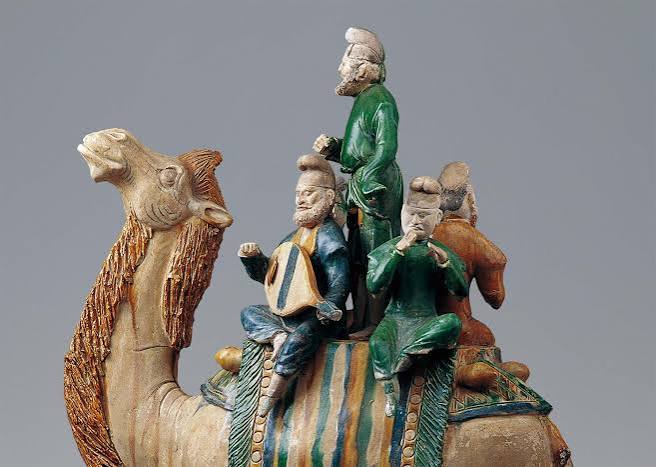
Long before the Silk Road became a byword for exotic goods and cultural exchange, a network of city-states in Central Asia had already turned trade into an art form. The Sogdians, an Eastern Iranian people from the fertile valleys of modern Uzbekistan and Tajikistan, were the master middlemen of Eurasia for over five centuries. Their language became the lingua franca of the Silk Road, their merchants reached the courts of Byzantium and Chang’an, and their ideas religious, artistic, and technological flowed across continents.
Yet, despite their outsized influence, the Sogdians remain a footnote in most history books. They never built an empire, raised a massive army, or left behind monumental architecture. Instead, they built something more durable: a commercial and cultural network that held Eurasia together. This is the story of how a people without a state shaped the course of world history, and why their legacy still matters today.
Who Were the Sogdians?
The Sogdians were an Eastern Iranian people who inhabited Sogdiana, a region centered on the Zarafshan River Valley in modern-day Uzbekistan and Tajikistan. Their major cities—Samarkand, Bukhara, and Panjakent—were not capitals of a unified kingdom but independent city-states that cooperated for commercial gain. They spoke Sogdian, an Eastern Iranian language written in a script adapted from Aramaic, which later evolved into the Uyghur and Mongolian scripts.
Their civilization flourished from roughly the 6th century BCE to the 10th century CE, with a golden age between the 4th and 8th centuries CE. Sogdiana sat at the crossroads of the steppe nomads to the north, Persia to the west, India to the south, and China to the east. This geographic position made them natural intermediaries, but their success was not just luck—it was a deliberate strategy of cultural and commercial adaptability.
The Trading Network That Connected Continents
The Sogdians were the dominant middlemen of the Silk Road for over 500 years. They controlled trade routes that linked China, India, Persia, and the Mediterranean, handling goods like silk, glassware, spices, precious metals, horses, and even slaves. Their commercial networks stretched from Byzantium in the west to Chang’an (modern Xi’an) in the east, with diaspora communities established at every major trading post along the way.
What set the Sogdians apart was their business acumen. They developed sophisticated commercial practices, including partnership agreements, credit instruments, and long-distance agency relationships. These were not just informal arrangements—they were legally binding contracts that facilitated trade across vast distances. The Sogdians essentially operated as proto-capitalists, creating a framework for commerce that would later be adopted by other cultures.
The Ancient Letters: A Window into Sogdian Life
In 1907, a cache of Sogdian letters was discovered in a watchtower near Dunhuang, China. Known as the Ancient Letters, they date from the early 4th century CE and offer a rare first-person glimpse into the Sogdian world. The letters reveal the everyday concerns of merchants, including trade disputes, family matters, and the disruptions caused by political instability. One letter, written by a Sogdian merchant named Nanai-Vandak, describes the chaos following the fall of the Han Dynasty and the collapse of trade routes. These letters are invaluable historical documents, showing that the Sogdians were not just faceless traders but real people dealing with the same challenges we face today: market volatility, political risk, and the struggle to maintain connections across borders.
Cultural Transmitters: More Than Merchants
The Sogdians were not just carriers of goods; they were carriers of ideas. They played a pivotal role in transmitting Buddhism from India to China, translating numerous sutras into Chinese. One prominent figure, Kang Senghui, was a Sogdian Buddhist monk who helped spread Buddhism in southern China in the 3rd century CE. They also carried Manichaeism and Nestorian Christianity eastward, while practicing Zoroastrianism themselves.
Their artistic influence was equally profound. The murals of Panjakent and Afrasiab are among the richest visual records of Silk Road life, depicting scenes of trade, warfare, and mythology. These works blended Persian, Indian, and Chinese influences, creating a unique Sogdian style that would later inspire the art of the Tang Dynasty and beyond.
The An Lushan Rebellion: A Sogdian Who Shook China
Perhaps the most dramatic impact the Sogdians had on world history came through a man named An Lushan. Born in 703 CE to a Sogdian father and a Turkic mother, An Lushan rose to become a powerful general in the Tang Dynasty. In 755 CE, he launched a massive rebellion that nearly toppled the dynasty, plunging China into a devastating civil war that killed millions. The An Lushan Rebellion, as it came to be known, not only shattered the Tang’s golden age but also disrupted the Silk Road trade that the Sogdians had built their fortunes on. This event was a turning point in Sogdian history, marking the beginning of their decline.
Decline and Legacy
The Arab conquest of Sogdiana in the 8th century was the beginning of the end. Qutayba ibn Muslim’s armies captured Samarkand in 712 CE, and a series of Sogdian revolts against Arab rule in the 720s-740s were ultimately unsuccessful. The An Lushan Rebellion further devastated Sogdian communities in China, and the rise of maritime trade routes shifted commercial power away from the overland Silk Road. By the 10th century, the Samanid Empire had absorbed Sogdiana, and the Sogdian language gradually gave way to Persian and Turkic.
Yet the Sogdian legacy endures. Their script influenced the Uyghur and Mongolian writing systems. Their commercial practices laid the groundwork for modern international trade. And their role as cultural intermediaries helped shape the religious and artistic landscape of Asia. The Sogdians may have vanished as a distinct people, but their impact on Eurasian history is undeniable.
The Sogdians were the unseen architects of the Silk Road, a people who built bridges between civilizations without ever building an empire. Their story reminds us that history is often shaped not by kings and generals but by merchants and translators who move goods, ideas, and beliefs across borders. In an age of globalization, the Sogdians offer a powerful lesson: that the most enduring connections are forged not by conquest but by commerce and cultural exchange.
Summary
- The Sogdians were an Eastern Iranian people from Central Asia who dominated Silk Road trade for over 500 years.
- They never formed a unified empire, organizing instead as a network of city-states like Samarkand and Bukhara.
- Their language became the lingua franca of the Silk Road, and they were key transmitters of Buddhism, Manichaeism, and Nestorian Christianity.
- The Ancient Letters, discovered near Dunhuang, offer a rare first-hand look at their trade operations and daily life.
- Their decline came after the Arab conquest and the An Lushan Rebellion, but their legacy lives on in commercial practices and cultural transmission.
FAQ
Q: Who were the Sogdians?
A: The Sogdians were an Eastern Iranian people who lived in Sogdiana, a region in modern-day Uzbekistan and Tajikistan, from the 6th century BCE to the 10th century CE. They were renowned as the dominant traders of the Silk Road.
Q: What made the Sogdians such successful traders?
A: Their success lay in their sophisticated business practices, including partnership agreements, credit instruments, and long-distance agency relationships. They also controlled key trade routes and established diaspora communities across Eurasia.
Q: How did the Sogdians influence religion and culture?
A: They transmitted Buddhism from India to China, translating sutras into Chinese, and also carried Manichaeism and Nestorian Christianity eastward. Their art and murals blended Persian, Indian, and Chinese styles, influencing the artistic traditions of the Silk Road.
Q: What was the An Lushan Rebellion and why is it significant?
A: The An Lushan Rebellion was a massive uprising in Tang China led by An Lushan, a general of Sogdian-Turkic origin. It nearly toppled the dynasty and disrupted Silk Road trade, contributing to the decline of Sogdian influence.
Q: Why did the Sogdians disappear?
A: The Arab conquest in the 8th century, combined with the An Lushan Rebellion and the rise of maritime trade routes, weakened their networks. By the 10th century, they were assimilated into Persian and Turkic cultures.
Leave a Reply