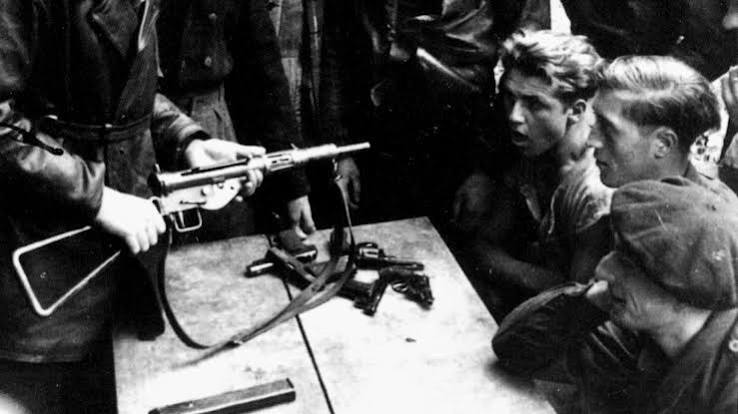
In the gray dawn of a Nazi-occupied European city, a schoolteacher walks to work with a loaf of bread under her arm. Hidden inside the crust are microdots containing German troop positions. She is not a soldier, not a trained agent just an ordinary woman who decided to fight back. Across the continent, millions of civilians faced a stark choice: submit to occupation or resist. A brave minority chose the latter, becoming spies, couriers, forgers, and saboteurs in clandestine networks that would help shape the outcome of World War II.
This is the story of those ordinary people farmers, postal workers, clergy, students, housewives who transformed themselves into intelligence operatives. They operated in the shadows, faced unimaginable risks, and their efforts, though often overlooked, were vital to the Allied war effort. From the Dutch resistance’s tragic Englandspiel to the Polish cryptologists who cracked Enigma, these networks showed that courage could be found in the most unexpected places.
The Making of a Spy
Resistance networks were not born from thin air. They emerged from the brutal reality of Nazi occupation systematic repression, forced labor, food shortages, and mass murder. For many, the decision to resist was a moral response to witnessing atrocities. A teacher in Lyon who saw a neighbor dragged away for hiding a Jewish child might decide that silence was no longer possible.
Patriotism also played a role. After conventional armies surrendered, resistance became a continuation of national defense. For communists, especially after Germany invaded the Soviet Union in June 1941, resistance was an ideological imperative. But perhaps the most common path into the resistance was through personal networks—a friend, a family member, a trusted priest or teacher already involved. Trust was the currency of recruitment.
These new spies came from every walk of life. Railway workers could observe troop movements. Postal workers could intercept communications. Farmers knew the terrain and could hide fugitives. Women, often overlooked by German patrols, served as couriers, carrying messages and supplies under the noses of the occupiers.
The Cell Structure: Safety in Compartments
Resistance networks operated on a cell structure. Each member knew only a few others a courier might know one contact, who knew another, and so on. If one person was captured, the rest of the network remained safe. This compartmentalization was crucial for survival.
The tradecraft was often basic but effective. Lemon juice or milk could serve as invisible ink. Messages were hidden in personal ads, dead drops, or brush passes—handing documents to a contact in passing, as if by accident. Early in the war, couriers were the primary method of communication, carrying information across cities and borders. Later, wireless radio operators, often trained in Britain and parachuted in, became vital—but also extremely dangerous. German direction-finding units could locate transmitters within minutes, making the operator’s life expectancy tragically short.
The Comet Line: A Highway to Freedom
One of the most remarkable networks was the Réseau Comète, or Comet Line, which smuggled downed Allied airmen from Belgium and France across the Pyrenees into neutral Spain. Run by a young Belgian woman named Andrée De Jongh, the Comet Line saved roughly 800 airmen. The route was perilous: airmen had to be hidden, fed, and moved through checkpoints with forged papers. The network relied on a chain of safe houses, each run by ordinary families who risked their lives every time they opened their doors.
Of the ~200 agents who worked on the line, about 30 were killed or died in concentration camps. The cost was high, but the impact was undeniable—returning pilots and crew could fly again, and the intelligence they carried was invaluable.
The Englandspiel Disaster
Not all resistance efforts succeeded. The Dutch resistance suffered a catastrophic blow in the Englandspiel, or “England Game,” which ran from 1942 to 1944. German military intelligence, the Abwehr, captured Dutch agents and used them to send false messages to London. For almost two years, the British SOE sent supplies, money, and new agents—directly into German hands. Dozens of agents were captured and executed. The disaster was a stark lesson in the dangers of amateur espionage and the fragility of trust.
The Polish Enigma
The Polish Home Army (Armia Krajowa) ran one of the largest underground intelligence operations, but perhaps their greatest contribution was intellectual. In the 1930s, Polish cryptologists—Marian Rejewski, Henryk Zygalski, and Jerzy Różycki—broke early Enigma codes. In 1939, as war loomed, they passed their work to British intelligence. This breakthrough laid the foundation for Bletchley Park’s later successes, which shortened the war by years. Ordinary mathematicians, not trained spies, had changed the course of history.
The Danish Rescue
In October 1943, the Danish resistance organized one of the most extraordinary acts of rescue of the war. When the Nazis ordered the roundup of Danish Jews, the resistance, with help from ordinary citizens, evacuated over 7,000 Jews to neutral Sweden. Fishermen sailed their boats across the Øresund, hiding families below decks. This was not intelligence gathering, but it was resistance in its purest form—a moral stand that saved thousands of lives.
Women: The Invisible Spies
Women were often the backbone of resistance networks. Their roles as couriers were particularly vital because they were less likely to be searched or suspected. A woman with a basket of groceries or a baby carriage could move through checkpoints with relative ease. Women also ran safe houses, forged documents, and provided medical care. Many paid the ultimate price—arrest, torture, and execution in concentration camps.
The gender angle is striking: in many networks, women were more numerous than men, and their contributions were essential to survival. Yet after the war, their stories were often overlooked, their heroism downplayed.
The Moral Complexity
Resistance was not without its moral ambiguities. Some actions, such as assassinations, provoked brutal reprisals against civilian populations. The question of whether such actions were justified remains debated. The line between collaboration and resistance was not always clear—many ordinary people collaborated, out of fear, opportunism, or ideology. The resistance was a minority, perhaps 1–2% of the population in most occupied countries.
But for those who joined, the choice was often clear: to resist was to affirm humanity in the face of inhumanity. They were not professional soldiers, but they became spies, saboteurs, and lifelines for the persecuted. Their courage was not born of training, but of conviction.
The resistance networks were a testament to the power of ordinary people under extraordinary pressure. They did not have the training of professional spies, but they had something else: a deep-seated commitment to freedom and justice. Their actions, whether cracking codes or hiding a downed pilot, made a tangible difference in the war. As we look back, we see not just the heroics, but the human cost—the arrests, the torture, the deaths. Yet their legacy endures, a reminder that even in the darkest times, ordinary people can choose to become extraordinary.
Summary
- Resistance networks in Nazi-occupied Europe were composed of ordinary civilians—teachers, farmers, housewives, and students—who engaged in espionage, sabotage, and rescue operations.
- The Comet Line saved roughly 800 downed Allied airmen, at the cost of about 30 agents killed or dead in concentration camps.
- The Polish cryptologists broke Enigma codes in the 1930s, providing a crucial head start to British intelligence.
- The Denmark resistance evacuated over 7,000 Jewish citizens to neutral Sweden in October 1943, a remarkable moral and logistical feat.
- Women played a vital role as couriers, using their perceived innocence to move intelligence and supplies under German noses.
FAQ
Q: What was the Englandspiel?
A: The Englandspiel was a German counterintelligence operation that ran from 1942 to 1944, in which the Abwehr captured Dutch resistance agents and used them to send false messages to London, leading to the capture and death of dozens of agents.
Q: How did ordinary people learn spy craft?
A: They learned basic techniques like invisible ink, dead drops, and coded messages through word-of-mouth, training from Allied intelligence officers, or trial and error. Many learned on the job, relying on caution and the network’s cell structure for safety.
Q: Were women really less suspected?
A: Yes, German patrols were often less thorough in searching women, especially those with children or groceries, making them ideal couriers. This allowed women to play a disproportionately large role in intelligence networks.
Q: Did all resistance networks have Allied support?
A: Many did, particularly from the British SOE and MI6, and later the American OSS. However, support was not always reliable, as the Englandspiel disaster showed, and some networks operated with minimal outside help.
Q: What happened to resistance members after the war?
A: Many returned to civilian life, but their contributions often went unrecognized for years. Some were persecuted by new communist regimes in Eastern Europe, while others struggled with the trauma of their experiences. Many were eventually honored, but not all.
Leave a Reply