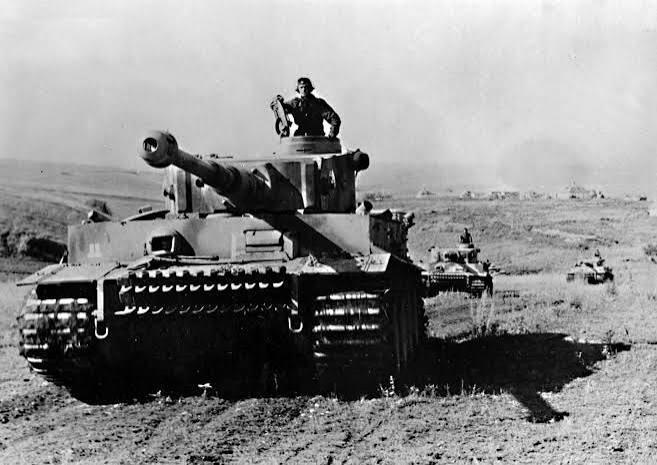
On the morning of July 5, 1943, the quiet fields around the Russian city of Kursk erupted in fire. Over 2 million soldiers, 6,000 tanks, and 5,000 aircraft were about to collide in the largest armored battle in history. The outcome would decide not just the fate of the Eastern Front, but the entire war.
A Salient in the Steppe
The winter of 1942–43 had been catastrophic for Germany. Stalingrad had shattered the Sixth Army, and the Red Army’s counteroffensive had pushed the front line westward. By spring, a massive bulge 150 miles wide and 100 miles deep had formed around Kursk, a city in western Russia. It was a tempting target for Hitler: pinch it off, and he would shorten his lines, destroy several Soviet armies, and regain the initiative.
Operation Citadel was born. But the Germans waited. They waited for new weapons the Panther tank, the Ferdinand tank destroyer, and improved Tigers. The delay, from May to July, was fatal. It gave the Soviets time to dig in.
Meanwhile, Soviet intelligence both the “Lucy” spy ring in Switzerland and intercepts of German communications had laid the German plan bare, down to the hour of the attack. Marshal Georgy Zhukov and his commanders decided on a bold strategy: let the Germans exhaust themselves against deep defenses, then unleash their own offensives.
The Soviets built not one, not two, but three successive defensive belts, stretching up to 100 miles deep. They dug over 3,000 miles of trenches, laid 400,000 mines, and created thousands of anti-tank strongpoints. Behind the salient, they massed the Steppe Front, a strategic reserve of over half a million men ready to counterattack.
The Storm Breaks
At dawn on July 5, 1943, the Germans struck. In the north, General Walter Model’s 9th Army pushed south. In the south, Field Marshal Erich von Manstein’s 4th Panzer Army and Army Detachment Kempf drove north. Their goal: meet east of Kursk and trap the entire Soviet defense.
The Germans expected speed. They found a wall. In the north, they advanced only 6 to 9 miles in eleven days. In the south, they pushed 20 to 25 miles, but at a terrible cost. The Panthers broke down, the Ferdinands were vulnerable to infantry attacks, and the minefields were denser than anything the Wehrmacht had seen.
By July 11, the southern pincer had reached the village of Prokhorovka. There, on July 12, the climax came.
Prokhorovka: The Cauldron of Steel
History remembers Prokhorovka as a single, epic charge of Soviet tanks into the German line. The reality was more chaotic. Roughly 600 to 800 Soviet tanks from the 5th Guards Tank Army slammed into 300 to 400 German tanks from the II SS Panzer Corps. But it was not a neat battle line; it was a series of confused, close-range engagements, often at distances of less than 100 yards.
Tanks fired point-blank. Crews abandoned their vehicles, some to be crushed by the advancing columns. The dust and smoke were so thick that commanders lost sight of their own units. By day’s end, the Germans had lost perhaps 100 tanks, the Soviets more than 300. Tactically, it was a German success. Strategically, it was a Soviet victory: the German advance had been stopped dead.
Recent scholarship, including the work of Karl-Heinz Frieser and Valeriy Zamulin, has reframed Prokhorovka as a “tactical draw” or even a German tactical win. But the outcome was unambiguous. The Wehrmacht never again launched a strategic offensive in the East.
The Turning of the Tide
Even as the tanks clashed at Prokhorovka, the Soviets were launching their own offensives. Operation Kutuzov struck the German-held Orel salient to the north on July 12. Operation Rumyantsev followed on August 3, targeting Belgorod and Kharkov. The Germans, already bleeding from Citadel, were forced into a fighting retreat.
By August 23, when the battle officially ended, the Red Army had pushed the front line back decisively. The Soviet Union had won its first summer offensive of the war. The strategic initiative passed permanently to the Soviets, never to return.
The cost was staggering. Soviet casualties ranged from 180,000 to 250,000 killed, missing, or wounded—some estimates go higher. The Germans lost 50,000 to 60,000 men, with 700 to 1,200 tanks destroyed or damaged beyond repair. But the numbers tell only part of the story.
The Human Cost
Behind the statistics were soldiers like the conscripted peasants and workers who filled the Red Army’s ranks. They fought with extraordinary bravery, often with little training and less equipment. They held their ground against the Panzer divisions, sometimes with nothing more than anti-tank rifles and Molotov cocktails. Their sacrifice was enormous, but it was not in vain.
The German soldiers, too, fought with skill and determination. But their army was overstretched, short on fuel and replacements, and now facing a Red Army that had learned the bitter lessons of 1941 and 1942.
The Battle of Kursk was not just a battle of machines; it was a battle of will. And in the end, the Soviet will proved stronger.
Why Kursk Matters
Kursk was the largest tank battle in history, but it was also the turning point of the war in Europe. Before Kursk, the Wehrmacht had always managed to regain the initiative after a setback. After Kursk, it never did. The Red Army’s victory set the stage for the march to Berlin.
For historians, Kursk remains a rich field of study. The debate over Prokhorovka—was it a Soviet triumph or a German tactical success?—continues to this day. What is not in doubt is the outcome: the largest armored clash in history ended in a decisive Soviet strategic victory, and the course of World War II was changed forever.
Lessons from the Steppe
The battle also offers enduring lessons. Intelligence and preparation mattered more than technological superiority. The Germans had better tanks, but the Soviets had better intelligence, better defenses, and better reserves. The delay to wait for new weapons gave the enemy time to prepare, a classic mistake. And the ability to absorb losses and keep fighting—that, too, was a decisive factor.
As the dust settled over the Kursk salient, the world knew: the war had turned. The Red Army was coming west, and nothing would stop it.
Kursk was the last great German offensive, and the first Soviet summer victory. It broke the Wehrmacht’s back and set the stage for the Red Army’s march to Berlin. The largest tank battle in history was more than a battle; it was the moment the Eastern Front shifted forever.
Summary
- The Battle of Kursk, from July 5 to August 23, 1943, was the largest armored engagement in history, involving over 2 million troops and 6,000–8,000 tanks.
- The Germans delayed Operation Citadel to wait for new tanks, giving the Soviets time to build three defensive belts with 3,000 miles of trenches and 400,000 mines.
- The climactic tank clash at Prokhorovka on July 12, 1943, was a tactical draw but a strategic Soviet victory, halting the German advance.
- The Soviet counter-offensives (Kutuzov and Rumyantsev) forced the Germans into retreat, and the Red Army won its first summer offensive, seizing permanent initiative.
- Casualties were heavy: 180,000–250,000 Soviet and 50,000–60,000 German troops, with 700–1,200 German tanks lost.
FAQ
Q: Why is the Battle of Kursk considered the largest tank battle?
A: It involved an estimated 6,000 to 8,000 tanks and self-propelled guns from both sides, more than any other battle in history, including the earlier tank engagements of World War II.
Q: Was the tank battle at Prokhorovka a Soviet victory?
A: Tactically, the Germans may have inflicted higher losses, but strategically, the Soviets stopped the German advance. Recent scholarship calls it a tactical draw or even a German tactical success, but it was a Soviet operational victory.
Q: What role did intelligence play in the Soviet victory?
A: Soviet intelligence, including the “Lucy” spy ring and intercepts, provided detailed warning of the German plan, allowing the Soviets to prepare extensive defenses and mass reserves.
Q: How many casualties were there at Kursk?
A: Soviet losses were between 180,000 and 250,000 killed, missing, or wounded (some estimates up to 800,000 including sick). German losses were about 50,000 to 60,000, with 700 to 1,200 tanks destroyed.
Q: What was the outcome of the Battle of Kursk?
A: It was a decisive Soviet strategic victory. The Wehrmacht’s last major offensive capability on the Eastern Front was broken, and the Red Army seized the strategic initiative permanently.
Leave a Reply