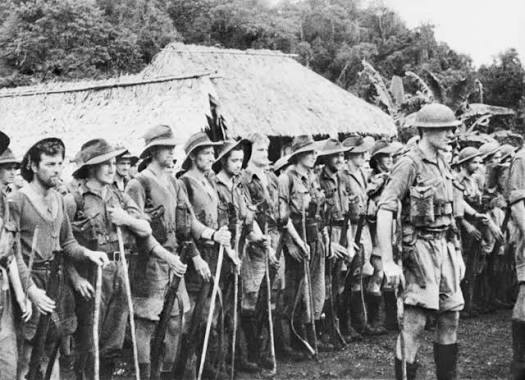
In July 1942, a Japanese army landed on the northern coast of Papua New Guinea, aiming to cross the Owen Stanley Range and capture Port Moresby. The only route was a 96-kilometer footpath that clawed over razorback ridges and through fetid jungle. For four months, Australian soldiers many of them teenage conscripts fought a desperate delaying action along that track, and in the end, they did what no other Allied force had yet done: they halted a Japanese land offensive and forced it into retreat.
The Kokoda Track Campaign was a war of extremes: heat and cold, mud and blood, courage and exhaustion. It was fought by men with little food and less sleep, against an enemy that seemed unstoppable. But the battle was not won by Australians alone it depended on the labor of Papuan villagers who carried supplies forward and wounded men back. Their story, too, is part of the track’s brutal legacy.
The Gate to Australia
By early 1942, Japan had swept through Southeast Asia. Rabaul had fallen, and Lae and Salamaua were in enemy hands. Port Moresby, on the southern coast of Papua, was the last Allied base between Japan and Australia. It was a critical staging point for any counteroffensive and a perfect launch pad for an invasion of Australia itself.
The Japanese first tried to take Port Moresby by sea. That plan was shattered at the Battle of the Coral Sea in May 1942, so they devised an overland approach. The South Seas Detachment, led by Major General Tomitaro Horii, would land on the north coast at Gona and Buna, cross the Owen Stanley Range, and strike Port Moresby from the rear.
Their intelligence said the track was passable and resistance would be light. Both assumptions were wrong.
A Track That Breaks Men
The Kokoda Track is not a road; it is a footpath that climbs to 2,190 meters at Mount Bellamy. It twists through dense jungle, over steep ridges, and along razorback spurs. Rain falls almost daily, turning the ground into deep mud. In the lowlands, the heat is tropical; at altitude, the nights are near freezing. There are no vehicles everything, from ammunition to food to wounded men, moves by foot.
The first Australians to fight on the track were members of the 39th Battalion, a militia unit made up mostly of teenage conscripts many were 18 or 19 years old. They were untrained, under-equipped, and outnumbered, but they had one job: delay the Japanese long enough for experienced AIF troops to return from the Middle East.
They did their job. From the first contact at Awala on 23 July 1942, the 39th fought a series of rearguard actions, falling back from one ridge to the next. They destroyed bridges, set ambushes, and slowed the Japanese advance at every step.
The Long Retreat to Ioribaiwa
The Japanese pushed hard. By late August, they had driven the Australians back to Ioribaiwa Ridge, just 40 kilometers from Port Moresby. From that ridge, soldiers could see the lights of the city—and the Coral Sea beyond. It was the closest the Japanese ever came to their objective.
But the advance had already stalled. The Japanese supply line stretched back over the mountains, and they were running out of food and ammunition. Meanwhile, the AIF’s 7th Division was arriving from the Middle East, fresh and well-equipped. The tide was about to turn.
On 14 September, the Japanese received orders to withdraw. The Guadalcanal campaign was consuming resources, and the South Seas Detachment was overextended. The retreat became a nightmare: starving, diseased, and harassed by Australian patrols, thousands of Japanese soldiers died on the track.
The Recapture of Kokoda
The Australians went on the offensive. On 2 November 1942, they recaptured Kokoda village and its airstrip—the first significant victory of the campaign. But the fighting was far from over. The Japanese retreated to the coast, where they fortified the Buna–Gona beachhead. The battle there, from November 1942 to January 1943, was even more brutal than the mountain campaign—a slog through swamps and bunkers that cost thousands of lives.
By the time the campaign ended, the Australians had lost about 625 killed and 1,055 wounded. More than 4,000 were evacuated sick, most with malaria and dysentery. The Japanese lost around 6,500 dead—many from starvation and disease during the retreat. Of the roughly 16,000 men they deployed, only a fraction survived.
The Fuzzy Wuzzy Angels
The campaign would have been impossible without the Papuan villagers who served as carriers and stretcher-bearers. They carried supplies forward, often under fire, and carried wounded Australians back to safety. The troops called them “Fuzzy Wuzzy Angels” for their hair and their kindness.
Their contribution was extraordinary. But it also came at a cost. Many were conscripted or coerced into service, and they suffered casualties and displacement. After the war, they were largely forgotten, and their post-war neglect remains a point of contention in Australian–Papua New Guinean relations.
A Defining National Story
For Australians, Kokoda has become a national narrative—a story of endurance, mateship, and courage. It is often compared to Gallipoli, but with a crucial difference: Kokoda was a defensive victory on Australia’s doorstep. It stopped the Japanese advance and proved that the AIF could fight and win in the most brutal conditions imaginable.
For Japan, the campaign is a lesser-known tragedy—a costly failure driven by overreach and underestimation. For Papua New Guinea, it is a story of resilience and sacrifice, but also of exploitation and broken promises.
The track itself remains. It is now a pilgrimage site for trekkers, who walk the same ridges and mud, often in awe of what the soldiers endured. The Kokoda Track is a monument to the men who fought there, the villagers who helped them, and the terrible cost of war in the jungle.
The Kokoda Track Campaign was a turning point in the Pacific War. It proved that the Japanese army could be stopped on land, and it secured Port Moresby as a base for the Allied counteroffensive. But its true legacy lies in the men who fought and the Papuans who carried them—ordinary people pushed to extraordinary limits in a place that seemed designed to break them.
Summary
- The Kokoda Track Campaign (July–November 1942) was a series of engagements along a 96-kilometer footpath in Papua New Guinea.
- Australian forces, including the 39th Battalion militia, halted a Japanese overland advance on Port Moresby and forced a retreat.
- The campaign was fought in extreme conditions: dense jungle, steep mountains, mud, and constant rain.
- Australian casualties: ~625 killed, ~1,055 wounded, ~4,000+ sick. Japanese: ~6,500 dead, many from starvation and disease.
- Papuan villagers, known as “Fuzzy Wuzzy Angels,” served as carriers and stretcher-bearers, playing a vital role.
FAQ
Q: How long is the Kokoda Track?
A: The Kokoda Track is approximately 96 kilometers (60 miles) long.
Q: Who fought in the Kokoda Track Campaign?
A: The campaign was fought between Australian forces (including AIF and militia units) and the Imperial Japanese Army, primarily the South Seas Detachment.
Q: What was the outcome of the Kokoda Track Campaign?
A: The Allies achieved a strategic victory. The Japanese advance on Port Moresby was halted and reversed, marking a turning point in the Pacific War.
Q: What were the main causes of casualties?
A: In addition to combat, disease—especially malaria and dysentery—was a major killer. Many Japanese died from starvation and disease during the retreat.
Q: What role did Papuan villagers play?
A: Papuan villagers served as carriers, stretcher-bearers, and guides, transporting supplies and wounded soldiers. They were essential to the campaign, though many were conscripted or coerced into service.
Leave a Reply