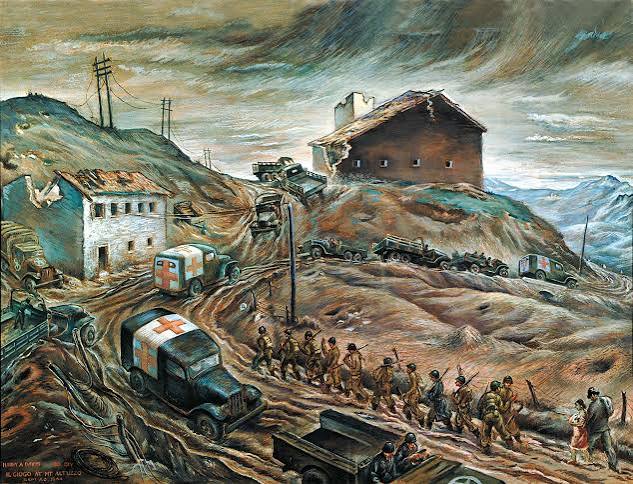
On September 9, 1943, as American troops waded ashore at Salerno, they expected a quick march up Italy’s boot. Instead, they walked into a meat grinder that would chew up 20 months of their lives and 312,000 Allied casualties. The Italian Campaign became the longest, muddiest, and most brutal slog of the Western war yet it barely registers in popular memory.
Why? Because the day Rome finally fell June 4, 1944 was the day before D-Day. The headlines, and history, moved on to Normandy. But the soldiers who fought from Sicily to the Alps knew: Italy was no soft underbelly. It was a fortress of mountains, mud, and German steel.
A Soft Underbelly? Churchill’s Miscalculation
Winston Churchill called Italy the “soft underbelly” of the Axis. He convinced the Allies at the Casablanca Conference in January 1943 that knocking Italy out would open the Mediterranean, secure shipping lanes, and force Germany to divert divisions from the Eastern Front. The Americans, led by General George Marshall, saw it as a distraction from the cross-Channel invasion they wanted. The compromise: invade Italy, but with limited resources Overlord would remain the priority.
That compromise would haunt every Allied soldier who fought in Italy. They got just enough troops to start a campaign, but never enough to finish it quickly. By the time the fighting ended, Italy had become a secondary theater, stripped of divisions for other fronts, yet still expected to pin down German forces.
Kesselring’s Genius: Turning Mountains into Fortresses
Field Marshal Albert Kesselring, Germany’s defensive mastermind, did what Hitler initially thought impossible: he turned the Italian peninsula into a fortress. Rather than retreating to the Alps, Kesselring chose to defend south of Rome, using the Apennine Mountains a spine of ridges and peaks running the length of Italy as natural defensive lines.
He built not one, but six successive lines: the Volturno, Barbara, Bernhardt, Winter, Gustav, and finally the Gothic Line. Each was a network of bunkers, minefields, pre-registered artillery, and interlocking fields of fire. Kesselring’s strategy was simple: delay, bleed, and make the Allies pay for every inch. He demolished roads, blew bridges, and flooded valleys. His troops counterattacked viciously, and his artillery was so well-coordinated that Allied soldiers learned to fear the whistle of incoming shells.
The Gustav Line, anchored on the ancient Benedictine monastery of Monte Cassino, was the strongest. It blocked the road to Rome, and for four months in early 1944, it stopped the Allies cold.
The Four Battles of Monte Cassino: Blood on the Mountain
Monte Cassino was a 1,700-foot peak dominating the Liri Valley. The Germans had dug into the slopes, and from the summit, they could see every Allied move. Four times the Allies threw themselves against it.
The first battle, in January 1944, was a series of frontal assaults across the Rapido River. The 36th Texas Division tried to cross under machine-gun fire and artillery, losing over 2,000 men in a single day. The second battle, in February, saw the Allies bomb the ancient monastery to rubble—but the Germans simply moved into the ruins, making the position even stronger. The third and fourth battles, in March and May, finally broke through with the help of Polish, Indian, and Free French troops. The Polish Corps raised their flag over the ruins on May 18, 1944. But by then, the mountain was a lunar landscape, and the Allied casualty count was over 50,000.
Anzio: The Amphibious Gamble That Stalled
In January 1944, the Allies tried to outflank the Gustav Line with a surprise landing at Anzio, 40 miles south of Rome. The plan was bold: land troops behind German lines, cut their supply routes, and force them to abandon Monte Cassino. But the Allied commander, Major General John Lucas, moved cautiously, fearing a repeat of Salerno. He paused to consolidate, and that pause was fatal.
Kesselring reacted with shocking speed, rushing reinforcements to ring the beachhead. For four months, the Allies were trapped in a pocket, bombarded by artillery and counterattacked relentlessly. The beach was nicknamed “the largest self-supporting POW camp in the world.” It wasn’t until May 1944, when the Allies finally broke out and linked up with the main advance, that the Anzio stalemate ended. The breakout cost 30,000 Allied casualties.
The Mud: The Third Enemy
If the Germans were the first enemy, the mud was the second. Autumn 1943 and winter 1944 were among the wettest in Italian history. Roads turned to quagmires, vehicles bogged down to their axles, and infantry slogged through knee-deep muck that clung to boots and froze at night. A Canadian officer wrote: “The mud is not just mud. It’s a thick, sticky paste that swallows men whole.”
Supplies had to be carried by mules and men over mountains. Artillery pieces sank into the earth, and tanks were useless off the roads. At Cassino, the Rapido River flooded, turning the valley into a swamp. The weather was as much an enemy as Kesselring, and it never let up.
Rome Falls—But Nobody Notices
On June 4, 1944, American troops of the 5th Army entered Rome. The city was free, the first Axis capital to fall. But the celebration was short-lived. Two days later, on June 6, Allied forces landed in Normandy. The news cycle, and history, moved on. The Italian Campaign was suddenly old news.
General Mark Clark, commanding the 5th Army, chose to drive on Rome rather than trap the retreating German 10th Army at the Hitler Line. That decision has been debated ever since. Clark wanted the glory of taking Rome, but it let Kesselring escape with his forces to fight another day. The fall of Rome was a victory, but it was a hollow one—the war in Italy would drag on for another 11 months.
The Gothic Line: The Stalemate That Almost Broke the Allies
After Rome, the Allies pushed north, but they were exhausted and under-resourced. In August 1944, Operation Dragoon—the invasion of southern France—pulled seven Allied divisions out of Italy. The campaign was now a sideshow.
Kesselring retreated to the Gothic Line, a massive defensive belt across the Apennines near Florence. The Allies threw themselves against it in September 1944, breaking through at the Gothic Line’s weakest point in the east, but then stalled. The winter of 1944–45 was one of the coldest on record. Snow buried the mountains, and both sides dug in. The fighting ground to a halt, with neither side able to move.
The Final Push: Operation Grapeshot
In April 1945, the Allies launched their final offensive, Operation Grapeshot. With the war in Europe nearly over, they finally had the resources to end it. The British 8th Army and the U.S. 5th Army, now including Brazilian, Indian, Polish, and Italian co-belligerent units, broke through the Gothic Line and drove into the Po Valley. On April 28, Italian partisans captured and executed Mussolini. On May 2, German forces in Italy surrendered unconditionally—two days after Hitler’s death in Berlin.
The campaign was over. It had lasted 20 months, longer than North Africa and Normandy combined, and had cost over 312,000 Allied casualties and 434,000 German. Tens of thousands of Italian civilians had died in the crossfire, and the country’s infrastructure and cultural heritage lay in ruins.
Why “Forgotten”?
The Italian Campaign has been called the “forgotten front” for good reason. It was overshadowed by D-Day, which happened the day after Rome fell. It was drained of resources for the sake of Overlord and Dragoon. And it never delivered the decisive strategic payoff Churchill promised. Instead, it became a grinding war of attrition, a series of bloody fights for hills and rivers that didn’t even have names most people recognize.
But the soldiers who fought there never forgot. They remembered the mud, the mountains, and the unrelenting German defense. They remembered that Italy was not a soft underbelly—it was a hard shell, and cracking it cost more than anyone expected.
The Italian Campaign may not have the iconic imagery of D-Day or the Bulge, but it was one of the most brutal theaters of World War II. It proved that no front was easy, and that the cost of victory is often paid in forgotten places. The mud of Italy washed away the blood, but the memory of those 20 months lives on in the men who fought there—and in the history that finally remembers them.
Summary
- The Italian Campaign lasted 20 months (July 1943–May 1945), longer than North Africa or Normandy-to-Elbe.
- Allied casualties were ~312,000; German ~434,000; Italian civilians in the tens of thousands.
- Kesselring’s defensive lines, especially the Gustav Line at Monte Cassino, turned Italy into a fortress.
- The fall of Rome on June 4, 1944, was overshadowed by D-Day on June 6.
- After Operation Dragoon, Italy became a secondary theater, yet still pinned down hundreds of thousands of Germans.
FAQ
Q: Why is the Italian Campaign called the ‘forgotten front’?
A: Because it was overshadowed by D-Day (which occurred two days after Rome fell), drained of resources for other fronts, and lacked a decisive strategic payoff. The popular narrative focused on Normandy and the Eastern Front.
Q: What was the toughest part of fighting in Italy?
A: The combination of mountainous terrain, relentless mud, and a brilliant German defensive strategy. The Apennines and rivers made every advance a brutal uphill fight, and the winter weather made conditions miserable.
Q: How did the Allies finally win?
A: Through overwhelming resources in the final offensive (Operation Grapeshot, April 1945), combined with German forces being weakened by the broader collapse of the Third Reich. The Germans surrendered on May 2, 1945.
Q: What was the role of Italian partisans?
A: They fought a guerrilla war against German and Fascist forces, harassing supply lines and eventually capturing and executing Mussolini on April 28, 1945.
Q: Did the campaign achieve its strategic goals?
A: Partially. It knocked Italy out of the war and tied down German divisions, but it didn’t lead to a quick victory. The Allies’ resources were diverted to Overlord, and Italy became a secondary front.
Leave a Reply