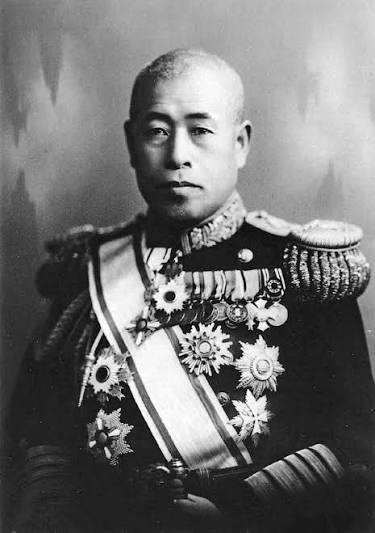
On December 7, 1941, Japanese carrier aircraft devastated the U.S. Pacific Fleet at Pearl Harbor. The man who planned that attack, Admiral Isoroku Yamamoto, had spent years warning his own government that such a war would end in disaster. He knew America’s industrial might firsthand—he had studied at Harvard and served as a naval attaché in Washington. Yet he followed orders, launching a war he believed Japan could not win.
Yamamoto’s life is a study in contradictions. He was a gambler who calculated odds with cold precision, a samurai descendant who embraced modern aviation, and a reluctant warrior who became his nation’s most famous naval commander. His story offers a window into how Japan hurtled toward war, and why one of its most brilliant military minds couldn’t stop it.
The Making of a Naval Strategist
Isoroku Yamamoto was born in 1884 into a low-ranking samurai family in Nagaoka, Japan. His birth name was Isoroku Takano, but he was later adopted into the Yamamoto clan—a traditional practice to preserve a family name. From an early age, he was shaped by the strict values of the samurai class: discipline, honor, and loyalty to the emperor.
He entered the Imperial Japanese Naval Academy in 1901, graduating in the midst of the Russo-Japanese War. At the Battle of Tsushima in 1905, he lost two fingers on his left hand—a wound that earned him the nickname “Eighty Sen” from geisha and gamblers, mocking the cost of a manicure. But the battle also taught him a lesson that would define his career: modern naval warfare was changing, and those who adapted would prevail.
After the war, Yamamoto rose through the ranks, attending the Naval War College and then serving as a naval attaché in Washington, D.C., from 1919 to 1921. He even took courses at Harvard University. This American experience left a lasting impression. He traveled widely, studied the country’s industries and shipyards, and understood that the United States had vast resources Japan simply couldn’t match.
The Reluctant Advocate for Aviation
Back in Japan, Yamamoto became a vocal proponent of naval aviation. In the 1920s and 1930s, most senior officers still worshipped the battleship, seeing it as the ultimate weapon. Yamamoto argued otherwise. He pushed for the development of aircraft carriers and long-range bombers, insisting that airpower would dominate future conflicts.
His advocacy put him at odds with the navy’s traditionalists. But Yamamoto’s record and intellect earned him respect. By 1939, he was appointed Commander-in-Chief of the Combined Fleet, Japan’s main battle force.
He also opposed the Tripartite Pact with Nazi Germany and fascist Italy, signed in 1940. Yamamoto believed that aligning with these powers would inevitably drag Japan into a war with the United States and Britain—a conflict he was convinced Japan would lose. His opposition made him enemies among ultranationalist military officers and civilians. He received death threats and required a personal bodyguard.
The Plan for Pearl Harbor
Despite his misgivings, when the decision to go to war was made, Yamamoto threw his skill behind it. He conceived the attack on Pearl Harbor as a preemptive strike to cripple the U.S. Pacific Fleet. His goal wasn’t to conquer America—it was to buy Japan six months to a year of free rein in Southeast Asia, time to fortify its conquests and hopefully negotiate a favorable peace.
He reportedly told Prime Minister Fumimaro Konoe, “If I am told to fight regardless of the consequences, I shall run wild for the first six months or a year, but I have utterly no confidence for the second or third year.”
On December 7, 1941, the plan unfolded with devastating precision. Japanese carrier aircraft sank or damaged eight battleships, destroyed nearly 200 aircraft, and killed over 2,400 Americans. The attack achieved its immediate objective, but it also galvanized the United States. Instead of negotiating, America declared war and entered World War II with a fury Yamamoto had feared.
The Turning Point: Midway
Yamamoto’s next major operation was the Battle of Midway in June 1942. His plan was complex, designed to lure the U.S. carriers into a trap. It backfired catastrophically. On June 4, 1942, American dive bombers found the Japanese fleet with its aircraft rearming and refueling. In a single day, Japan lost four aircraft carriers—the heart of its naval aviation.
The defeat at Midway is often cited as the turning point of the Pacific War. Yamamoto was not solely responsible; the plan was a product of the naval staff’s overconfidence. But his reputation as a flawless strategist suffered. From then on, Japan was on the defensive, fighting a grinding war of attrition in the Solomon Islands.
The Final Mission
By April 1943, Yamamoto was directing operations around Guadalcanal. He decided to make an inspection tour of forward bases to boost morale. American intelligence intercepted and decrypted his travel schedule. President Franklin D. Roosevelt reportedly approved a mission to shoot him down—Operation Vengeance.
On April 18, 1943, a squadron of U.S. Army P-38 Lightning fighters ambushed Yamamoto’s transport aircraft near Bougainville Island. The plane was shot down, killing Yamamoto and several others. He was 59 years old.
His death was a significant blow to Japanese morale. Ironically, some Japanese hardliners who had once threatened his life saw his demise as a blessing. They had considered him too moderate, too willing to compromise with the West.
Admiral Chester Nimitz, commander of the U.S. Pacific Fleet, later paid tribute to his fallen adversary: “He was one of the ablest officers in the Japanese Navy.” Nimitz understood that Yamamoto’s death was more than a tactical victory—it was the removal of a brilliant mind from an enemy that could ill afford to lose him.
A Contradictory Legacy
Isoroku Yamamoto remains one of the most enigmatic figures of World War II. He was a man who loved gambling but faced the ultimate stakes of war. He warned against a conflict he knew was unwinnable, yet he fought with uncompromising resolve. He embraced modern aviation while honoring ancient samurai traditions.
His story is not just a military biography. It’s a lesson in how individuals can be caught in the machinery of history, forced to choose between their conscience and their duty. Yamamoto chose duty, and in doing so, he helped write one of the most tragic chapters of the 20th century.
Yamamoto’s prediction proved tragically accurate. Japan ran wild for six months, but after two years, the industrial might of America overwhelmed it. His death in 1943 spared him from witnessing his nation’s ruin, but it also robbed him of the chance to see his warnings fully vindicated. Today, he is remembered not only as a brilliant tactician but as a man who saw the abyss clearly—and was powerless to pull his country back from its edge.
Summary
- Isoroku Yamamoto was the Japanese admiral who planned the attack on Pearl Harbor, despite warning that Japan couldn’t win a long war against the U.S.
- He was a visionary advocate for naval aviation, pushing for carrier-based airpower when battleships still dominated naval thinking.
- He opposed Japan’s alliance with Germany and Italy, leading to death threats from ultranationalists.
- The Battle of Midway in 1942 was a decisive Japanese defeat, often blamed in part on Yamamoto’s overly complex plan.
- He was killed in 1943 when American fighters shot down his transport plane, a mission code-named Operation Vengeance.
FAQ
Q: Why did Yamamoto plan the attack on Pearl Harbor if he opposed war with the U.S.?
A: Yamamoto believed that if Japan went to war, it had to strike first and hard to disable the U.S. Pacific Fleet. He hoped a surprise attack would buy time for Japan to secure its conquests and negotiate a favorable peace. Despite his personal opposition, he followed orders and executed the plan with full commitment.
Q: How did Yamamoto lose his fingers?
A: He lost two fingers on his left hand during the Battle of Tsushima in 1905, a major naval victory against Russia. The injury was a badge of honor and also gave him the nickname “Eighty Sen,” referring to the cost of a manicure at the time.
Q: What was Operation Vengeance?
A: Operation Vengeance was the American mission to shoot down Yamamoto’s aircraft. U.S. intelligence intercepted and decoded his travel plans, and on April 18, 1943, P-38 Lightning fighters ambushed and killed him near Bougainville Island.
Q: How did Yamamoto’s death affect the war?
A: Yamamoto’s death was a major morale blow to Japan. He was highly respected as a brilliant strategist, and his loss weakened the Imperial Japanese Navy’s leadership. Some historians also argue it deprived Japan of one of its most capable commanders during a critical phase of the war.
Q: What was Yamamoto’s view on the Tripartite Pact?
A: Yamamoto strongly opposed Japan’s alliance with Germany and Italy in 1940. He believed it would inevitably lead to war with the United States and Britain, a conflict he thought Japan could not win. His opposition made him a target for ultranationalist extremists.
Leave a Reply