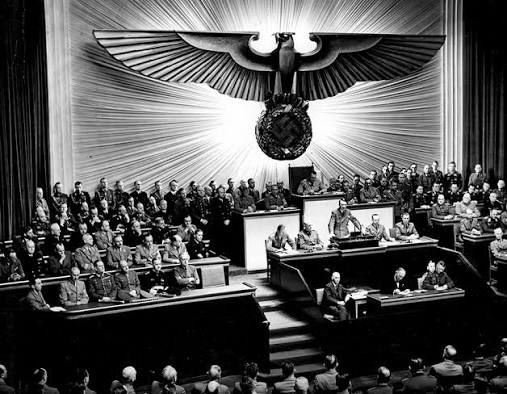
On December 11, 1941, four days after Japanese bombers devastated the U.S. Pacific Fleet at Pearl Harbor, Adolf Hitler stood before the Reichstag in Berlin and declared war on the United States. It was a decision that would seal the fate of the Third Reich, yet at the time, it seemed to many including Hitler himself like a calculated, even inevitable, move. But why did Hitler, already bogged down in a brutal war against the Soviet Union and Britain, willingly add the industrial might of America to his list of enemies? The answer lies in a toxic mix of ideology, miscalculation, and strategic desperation.
To understand Hitler’s decision, one must look beyond the formal texts of treaties and into the Führer’s own racial fantasies and geopolitical delusions. He saw America as a weak, mongrelized nation, incapable of fighting a real war. He believed that war with the U.S. was coming anyway, so why not seize the moment? Yet his gamble backfired catastrophically, uniting the world’s greatest powers against Germany and ensuring its ultimate defeat. This is the story of how Hitler’s hubris turned a tactical opportunity into a strategic disaster.
The Pact That Didn’t Bind
When Japan attacked Pearl Harbor on December 7, 1941, Hitler had no legal obligation to join the war. The Tripartite Pact, signed in September 1940, committed Germany, Italy, and Japan to defend one another only if one of them was attacked. Japan was the aggressor, not the victim. Germany’s ambassador to Japan, Eugen Ott, had even been instructed to urge Japan to avoid war with the U.S. unless absolutely necessary. Yet within hours of the attack, Hitler’s Foreign Minister, Joachim von Ribbentrop, began pressing for a declaration of war, and Hitler was eager to comply.
Why? For Hitler, the pact was never just a legal instrument; it was a declaration of solidarity among the “have-not” nations against the Anglo-American world order. In his December 11 speech, he framed the war as a cosmic struggle between the “Jewish-capitalist” world, led by Roosevelt, and National Socialist Germany. He listed grievances: U.S. violations of neutrality, the Lend-Lease program, and Roosevelt’s “warmongering.” He wanted to show that Germany stood by its Axis partners, even at the cost of plunging into a two-front war.
But there was more than ideology at play. Hitler and his generals genuinely believed that the United States was a paper tiger. They thought the U.S. was militarily weak, politically divided, and would take years to mobilize its industrial might. In Hitler’s racial worldview, America was a “mongrel” nation, dominated by Jews and incapable of true military greatness. He once told his generals, “The American is like a child—he needs to be led, and he has no idea what he wants.” Such contempt blinded him to the reality of American production capacity.
The Atlantic Undeclared War
The formal declaration was, in many ways, just a formality. The U.S. and Germany had been fighting an undeclared naval war in the Atlantic for months. U.S. destroyers were escorting convoys to Britain, and they had exchanged fire with German U-boats. In September 1941, the USS Greer was attacked by a German submarine after being tracked by a British plane. In October, the USS Reuben James was torpedoed and sunk with the loss of 100 American sailors. Hitler had ordered his U-boats to avoid provoking the U.S., but Roosevelt was pushing the envelope, ordering the Navy to “shoot on sight” any German warships in U.S. defensive zones.
Hitler’s restraint was a strategic choice. He hoped to keep America out of the war until the Soviet Union was conquered. But by late 1941, Operation Barbarossa had stalled before Moscow, and the Wehrmacht was suffering massive casualties. The war in the East was not going as planned, and Hitler needed a victory somewhere. Declaring war on America gave him the chance to unleash unrestricted submarine warfare in the Atlantic, cutting Britain’s lifeline before the U.S. could intervene effectively. He also hoped that tying down American forces in the Pacific would relieve pressure on Germany.
The Great Miscalculation
Hitler’s decision was based on a profound misreading of the situation. He believed that the U.S. could not project meaningful military power into Europe before 1944 or 1945, by which time he expected to have conquered the USSR and secured Europe. He was convinced that Roosevelt would have entered the war eventually anyway, so why not act first and appear decisive? In his mind, the declaration was a preemptive strike, not a gamble.
But Hitler underestimated the U.S. in every way. He failed to grasp the speed and scale of American mobilization. Within months, U.S. factories were producing more war materiel than Germany, Japan, and Italy combined. He also misjudged the political will of the American people. While isolationism had been strong before Pearl Harbor, the attack—and Germany’s declaration—united the country behind the war effort. Roosevelt and Churchill were relieved; Churchill later wrote that he “slept the sleep of the saved” upon hearing the news. The German declaration solved the political problem of how to bring the U.S. into the European war when public opinion was focused on revenge against Japan.
The Aftermath: A United Enemy
The declaration on December 11, 1941, formally merged the European and Pacific theaters into one global conflict. The U.S. Congress reciprocated with a declaration of war against Germany on the same day. For Hitler, the move was meant to solidify the Axis and encourage Japan to tie down British and American forces. But it had the opposite effect: it ensured that the U.S., Britain, and the Soviet Union would fight as allies against Germany, with the full weight of American industrial power committed to Europe.
Historians have long viewed Hitler’s declaration as one of the greatest strategic blunders of the war. It was a miscalculation so profound that it turned a difficult war into an impossible one. Hitler’s racial ideology and his contempt for American democracy blinded him to the facts. He saw the U.S. as a weak, divided nation, but in reality, it was a sleeping giant. When it awakened, it destroyed the Third Reich.
Hitler’s declaration of war on America was not a rational act of statecraft but a product of his ideological delusions and strategic desperation. He believed he was being decisive, but he was actually signing his own death warrant. The decision unified the Allies, unleashed American industrial might against Germany, and ultimately ensured the fall of the Third Reich. It remains a chilling example of how hubris and miscalculation can turn a moment of opportunity into a catastrophe.
Summary
- Germany was not obligated by the Tripartite Pact to declare war on the U.S., as Japan was the aggressor at Pearl Harbor.
- Hitler viewed war with America as inevitable and wanted to appear decisive, while also seeking to unleash unrestricted submarine warfare.
- Hitler’s racial ideology led him to underestimate American military capability and resolve.
- The U.S. and Germany were already engaged in an undeclared naval war in the Atlantic before the formal declaration.
- The declaration backfired strategically, uniting the U.S., Britain, and the USSR against Germany and ensuring American industrial might was turned against the Third Reich.
FAQ
Q: Was Germany forced to declare war on the U.S. by the Tripartite Pact?
A: No. The pact required mutual assistance only if a member was attacked. Japan was the aggressor at Pearl Harbor, so Germany had no legal obligation to declare war.
Q: Why did Hitler believe the U.S. was weak?
A: Hitler held a racialized view of America, seeing it as a ‘mongrel nation’ dominated by Jews and incapable of true military greatness. He also believed the U.S. would take years to mobilize and was politically divided by isolationism.
Q: What was the immediate impact of Hitler’s declaration?
A: The U.S. Congress declared war on Germany on the same day, formally merging the European and Pacific theaters into one global conflict. It also relieved Roosevelt and Churchill, who saw it as a solution to bringing the U.S. into the European war.
Q: Did the U.S. and Germany have any prior hostilities before Pearl Harbor?
A: Yes. The U.S. and Germany were engaged in an undeclared naval war in the Atlantic, with U.S. destroyers escorting convoys and exchanging fire with German U-boats, including incidents like the USS Greer and the sinking of the USS Reuben James.
Q: How do historians view Hitler’s decision?
A: Most historians view it as one of the greatest strategic blunders of the war, as it united the U.S., Britain, and the USSR against Germany and ensured the full weight of American industrial power would be brought to bear on the Third Reich.
Leave a Reply