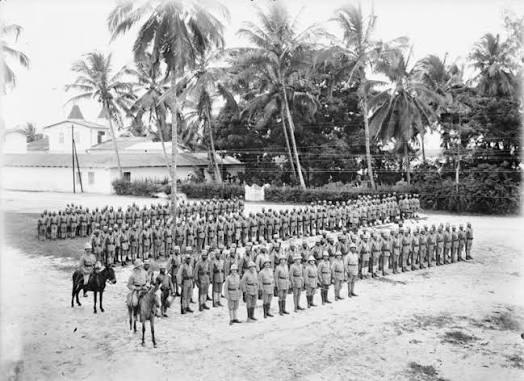
When the guns fell silent on the Western Front on November 11, 1918, one German commander refused to lay down his arms. General Paul von Lettow-Vorbeck, leading a small force of European officers and African soldiers in the jungles of East Africa, continued fighting for two more weeks. He finally surrendered on November 25, 1918, not because he was defeated, but because a British officer showed him a newspaper announcing the Armistice.
That surrender marked the end of the East African Campaign, a four-year conflict that stretched from the beaches of Tanzania to the mountains of Mozambique. It was a war of ambushes, disease, and endurance—a guerrilla war that cost the lives of over 100,000 African porters and tied down hundreds of thousands of Allied troops. Yet it remains one of the least-known chapters of World War I.
The Opening Blow: The Battle of Tanga
The campaign began in earnest on November 2, 1914, when a British-Indian expeditionary force of about 8,000 men landed near the port of Tanga, on the coast of German East Africa. The British expected a quick victory against a small colonial garrison. Instead, they were met by Lettow-Vorbeck’s force of about 1,000 German officers and Askaris—professional African soldiers who were marksmen and disciplined fighters.
Over two days of chaotic fighting in the jungle, the British were routed. The Askaris, armed with modern rifles and trained in bush warfare, outflanked the British and sent them fleeing back to their ships, leaving behind weapons, ammunition, and even medical supplies. The Battle of Tanga was a humiliating defeat for the British Empire and set the tone for the entire campaign: the Germans, though heavily outnumbered, were better led, better trained, and better adapted to the environment.
Lettow-Vorbeck’s Strategy: Tie Down, Don’t Conquer
Lettow-Vorbeck, a Prussian aristocrat and a veteran of colonial wars, understood that he could not hold the colony against the full might of the British Empire. His goal was simpler and more strategic: to tie down as many Allied troops as possible, for as long as possible, thereby diverting resources from the Western Front. He once said, “We must fight on as long as we can, and when we can no longer fight, we must die.”
To achieve this, he adopted a guerrilla strategy. He avoided pitched battles, melted into the jungle or mountains, struck at supply lines and isolated outposts, and then vanished. His troops lived off the land, supplemented by captured Allied supplies. They moved quickly, often covering 20 miles a day through trackless bush, and they knew the terrain intimately.
The Askaris, who numbered about 11,000–12,000 at the peak, were not conscripts. They were volunteers, drawn from the local population, and they were fiercely loyal to Lettow-Vorbeck. They were equipped with modern rifles, including captured British ones, and they were trained to a standard that made them the equal of any European soldier in Africa.
The Allied Response: A Costly Escalation
The British initially underestimated the campaign, sending small forces that were easily outmaneuvered. After Tanga, they escalated dramatically. By 1916, under the command of General Jan Smuts, a South African statesman-soldier, the Allies had amassed over 130,000 troops—including more than 60,000 South Africans and 40,000 Indians—against a German force that never exceeded about 15,000.
Smuts’s strategy was to encircle and crush the Germans in a vast pincer movement. But the terrain was against him. The campaign was fought in some of the most disease-ridden country on Earth: malaria, dysentery, and sleeping sickness were rampant. Quinine, the antimalarial drug, was in short supply. More Allied soldiers died of disease than of German bullets. By 1917, Smuts’s South African troops were withdrawn, exhausted and decimated, and replaced by African and Belgian forces who were better acclimatized.
The Carrier Corps: The Invisible Backbone
Behind the front lines, an even larger tragedy unfolded. The Allies relied on over 1 million African porters, known as the Carrier Corps, to carry supplies on their heads through the trackless bush. These porters were often conscripted by force, and they faced brutal conditions. They had no medical care, inadequate food, and were frequently exposed to the same diseases that killed soldiers.
Estimates suggest that over 100,000 porters died—from disease, starvation, and exhaustion. Their mortality rate in some units was as high as 20–30%. This human catastrophe went largely unrecorded at the time, and it remains one of the most tragic and underreported statistics of the war.
The German side also used forced labor, but on a smaller scale. Both armies stripped the land as they moved, causing famine and suffering for the local population.
The Pursuit Across Africa
By 1917, Lettow-Vorbeck was being pursued relentlessly by Allied forces. He led his men south into Portuguese East Africa (Mozambique), where they raided Portuguese garrisons for supplies and evaded capture. In 1918, he turned north again, invading Northern Rhodesia (Zambia). Even as the war in Europe was ending, his force was still operational, still evading the Allies, and still fighting.
The campaign finally ended on November 25, 1918, when Lettow-Vorbeck surrendered at Abercorn, Northern Rhodesia—two weeks after the Armistice. He surrendered only after being shown a newspaper that confirmed the war was over. His force was intact, undefeated in the field, and had achieved its goal: tying down over 130,000 Allied troops for four years.
The Legacy: A Masterclass in Guerrilla Warfare
The East African Campaign is studied today in military academies as a case study in asymmetric warfare. Lettow-Vorbeck is often called the “master of guerrilla war,” and his tactics anticipated many of the insurgencies of the 20th century. He used small, mobile forces, indigenous soldiers, and the environment to neutralize a vastly superior enemy.
But the campaign’s legacy is also one of devastation. The local population suffered enormously—from disease, famine, and violence. The Carrier Corps deaths are a dark chapter in colonial history, and the campaign’s impact on East Africa was felt for decades.
In the end, the East African Campaign was a war that should not have been fought, and yet it was fought with extraordinary tenacity on both sides. It was a war of attrition in the worst possible conditions, and it ended not with a decisive battle, but with a quiet surrender in the African bush.
The East African Campaign was a strange and brutal side show of World War I. It was a guerrilla war that defied the conventional narratives of the Western Front, and it was fought with a ferocity and endurance that are hard to fathom. Lettow-Vorbeck’s surrender was not a defeat but a recognition that the war was over. His campaign remains a testament to the power of asymmetric warfare—and a sobering reminder of the human cost of colonial conflict.
Summary
- The East African Campaign lasted from August 1914 to November 1918, making it one of the longest continuous campaigns of WWI.
- German forces, never exceeding about 15,000 men, tied down over 130,000 Allied troops using guerrilla tactics.
- The Battle of Tanga (1914) was a disastrous British defeat that set the tone for the campaign.
- Over 1 million African porters served the Allies, and an estimated 100,000+ died from disease, starvation, and exhaustion.
- Lettow-Vorbeck surrendered on November 25, 1918, two weeks after the Armistice, with his force still undefeated in the field.
FAQ
Q: Why didn’t Lettow-Vorbeck surrender at the Armistice?
A: He was deep in the bush of Northern Rhodesia and had no reliable communication with the outside world. He only learned of the Armistice when a British officer showed him a newspaper, and he surrendered two weeks later on November 25, 1918.
Q: How many troops were involved on each side?
A: The Germans never had more than about 14,000–15,000 men, including 3,000 German officers and NCOs. The Allies committed over 130,000 troops at various points, including South Africans, Indians, Africans, and Belgians.
Q: What was the role of the Carrier Corps?
A: The Carrier Corps were African porters conscripted by the British to carry supplies. Over 1 million served, and more than 100,000 died from disease, starvation, and exhaustion.
Q: Was the campaign a German victory?
A: In a military sense, the Germans were never decisively defeated in the field, but they ultimately lost the colony. The campaign is considered a strategic victory for the Allies because the German force surrendered, but it came at a huge cost.
Q: Why is the campaign studied in military academies?
A: It is a classic example of guerrilla warfare—how a small, mobile force can tie down a much larger enemy using terrain, indigenous troops, and unconventional tactics. Lettow-Vorbeck’s campaign is often cited as a model for asymmetric warfare.
Leave a Reply