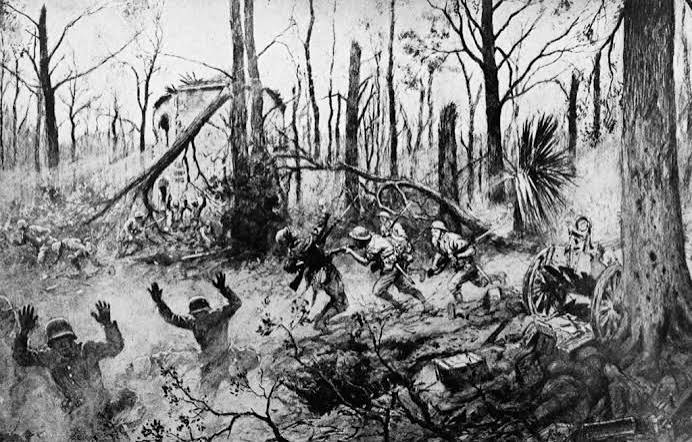
On June 26, 1918, a short message crackled across the wire: “Woods now entirely — US Marine Corps.” The words ended a brutal three-week struggle for a patch of forest in northern France, but they also marked the moment the US Marine Corps announced itself on the world stage. Belleau Wood was not just a battle; it was a crucible that transformed raw American troops into battle-hardened veterans and gave the Marines their enduring reputation as elite shock troops.
The fight came at a desperate time. Germany’s Spring Offensive had pushed Allied lines to the breaking point, and Paris lay within striking distance. Into this breach stepped the 4th Marine Brigade, a force of roughly 8,000 men who would face machine-gun fire, poison gas, and some of the toughest terrain on the Western Front. By the time the wood fell, they had suffered over 5,000 casualties — but they had stopped the German advance cold.
The Road to Belleau Wood
In the spring of 1918, the Western Front was on the verge of collapse. With Russia out of the war, Germany transferred nearly 50 divisions to France, hoping to win a decisive victory before American troops could tip the balance. The third German offensive, Operation Blücher-Yorck, smashed through Allied lines along the Aisne River on May 27, driving toward Paris.
The Americans were green. The US had entered the war in April 1917, but by spring 1918, only a handful of divisions were ready for combat. The 2nd Division was one of them, and it included the 4th Marine Brigade — the only Marine brigade in the American Expeditionary Forces. Initially used for rear-area security, the Marines were rushed to the front when the Germans broke through.
By June 1, they were digging in along the Paris-Metz highway, blocking the road to the capital. The terrain favored the defender: Belleau Wood sat on a ridge overlooking the Marne Valley, a dense tangle of trees, boulders, and ravines that made it a natural fortress. But the Marines were untested, and the Germans were confident they could brush aside these inexperienced colonials.
“Retreat? Hell, We Just Got Here!”
The first days of June were a trial by fire. German attacks slammed into Marine positions along the highway, but the Americans held. It was during this period that Capt. Lloyd Williams of the 5th Marines supposedly delivered the line that would become legend. When a French officer suggested his men pull back, Williams reportedly replied: “Retreat? Hell, we just got here!”
The Germans soon learned that the Marines were not going to be easy prey. But holding the line was only the beginning. On June 6, the Allies launched the first major American offensive of the war, with the Marines ordered to take Belleau Wood itself.
The attack was a disaster in the making. The Marines had to cross open wheat fields swept by machine-gun fire from the wood’s edge. They advanced in waves, and the casualties were horrific. The 6th Marine Regiment’s commander, Lt. Col. Albertus Catlin, was shot through the lungs almost immediately. By day’s end, the Marines had suffered 1,087 casualties — the bloodiest single day in Marine Corps history to that point.
Fighting in the “Devil’s Wood”
What followed was weeks of brutal, close-quarters combat inside the wood. The terrain made artillery support nearly useless; the fighting devolved into small-unit actions where men relied on grenades, bayonets, and raw courage.
One of the most famous moments came when Gunnery Sgt. Dan Daly, a two-time Medal of Honor recipient, rallied his men for an assault on a German machine-gun nest. According to accounts, he shouted: “Come on, you sons of bitches! Do you want to live forever?” The Marines surged forward and took the position.
The Germans, for their part, were stunned by the ferocity of the Americans. They had expected inexperienced troops who would break under fire. Instead, they faced men who kept coming despite devastating losses. German reports referred to the Marines as “devil dogs” — a nickname that stuck.
But the fighting was far from one-sided. The Marines were repeatedly counterattacked, and the wood changed hands several times. Between June 13 and June 21, the battle ground to a stalemate as both sides pounded each other with artillery. The Marines were exhausted, their units shattered, but they refused to give up.
The Final Push
By late June, fresh American troops were brought up, and the Allies launched a renewed offensive. The Marines, despite their losses, were determined to finish the job. On June 26, after a final assault, the wood was declared secure. The message — “Woods now entirely — US Marine Corps” — signaled the end of the battle.
The cost had been staggering. The 2nd Division as a whole lost nearly 10,000 men, including over 1,800 killed. The Marine Brigade alone suffered more than 5,000 casualties, with over 1,000 dead. German losses were estimated at over 10,000, though exact numbers remain disputed.
But the victory had strategic significance beyond the bloodshed. The German drive on Paris was halted, and the Allies had proven that American troops could fight — and win — against the best the German army could throw at them. The battle also marked a turning point in the war, as the initiative shifted to the Allies.
The Legacy of Belleau Wood
The battle’s impact on the US Marine Corps was profound. Before 1918, the Marines were a small, often overlooked branch of the US military. After Belleau Wood, they were recognized as an elite fighting force, feared by their enemies and respected by their allies. The French government renamed the forest “Bois de la Brigade de Marine” in honor of the Marines’ sacrifice.
But the legacy is also one of sorrow. The Marines who fought at Belleau Wood were volunteers and regulars who had signed up for a war they believed was just. They faced horrors — poison gas, machine guns, and hand-to-hand combat — that would haunt them for the rest of their lives. Many never made it home.
The battle also served as a lesson in leadership and tenacity. Gen. John J. Pershing, commander of the AEF, had insisted on keeping American units together, and Belleau Wood validated that decision. It showed that American troops, when properly led, could match the veteran armies of Europe.
Why It Still Matters
Today, Belleau Wood is a site of pilgrimage for Marines, who visit to pay tribute to their predecessors. The battle is taught in military academies as an example of how determination and tactical flexibility can overcome difficult odds. It also stands as a reminder of the human cost of war — the thousands of young men who died in a forest that, by all accounts, was not worth the sacrifice in purely strategic terms.
But at the time, the stakes were existential. If the Germans had broken through, Paris could have fallen, and the war might have ended differently. The Marines at Belleau Wood held the line, and in doing so, they helped turn the tide of World War I. Their baptism of fire was not just a test — it was a transformation.
The Battle of Belleau Wood was a brutal, costly victory that proved the mettle of the US Marine Corps. It was a fight fought with raw courage against a determined enemy, in a forest that became a graveyard for thousands. But it was also a turning point, both for the war and for the Marines. The legends born there — Daly’s battle cry, Williams’s defiance — still echo through the Corps today. Belleau Wood was not just a battle; it was a defining moment that shaped the identity of the United States military for a century.
Summary
- The Battle of Belleau Wood (June 1–26, 1918) was the first major offensive by US Marines in World War I, halting the German advance toward Paris.
- The 4th Marine Brigade suffered over 5,000 casualties (more than half their strength), with the bloodiest day on June 6 costing 1,087 men.
- Key figures included Capt. Lloyd Williams (“Retreat? Hell, we just got here!”) and Gunnery Sgt. Dan Daly (“Come on, you sons of bitches! Do you want to live forever?”).
- The victory proved American troops could fight effectively, boosting Allied morale and leading the French to rename the wood “Bois de la Brigade de Marine.”
- The battle cemented the Marines’ reputation as an elite fighting force, earning them the nickname “Devil Dogs” from the Germans.
FAQ
Q: What was the ‘baptism of fire’ for the US Marines?
A: It refers to the Battle of Belleau Wood in June 1918, the first major combat test for American Marines in World War I. They were thrown into a desperate fight to stop a German offensive and proved their toughness despite heavy losses.
Q: How many Marines died at Belleau Wood?
A: The 4th Marine Brigade suffered approximately 1,062 killed and 5,183 wounded or missing out of about 8,000 men — a casualty rate of over 60%.
Q: What is the origin of the term ‘Devil Dogs’?
A: German soldiers, impressed by the Marines’ ferocity, reportedly called them ‘Teufel Hunden’ (devil dogs), a nickname that stuck in American lore.
Q: Why was Belleau Wood strategically important?
A: It sat on a ridge overlooking the Marne Valley, and controlling it was crucial for blocking the German drive toward Paris. The battle halted that advance.
Q: How did the battle affect the US Marine Corps’ reputation?
A: It transformed the Marines from a small, secondary force into an elite infantry unit, solidifying their role as shock troops and leading to the French renaming the forest in their honor.
Leave a Reply