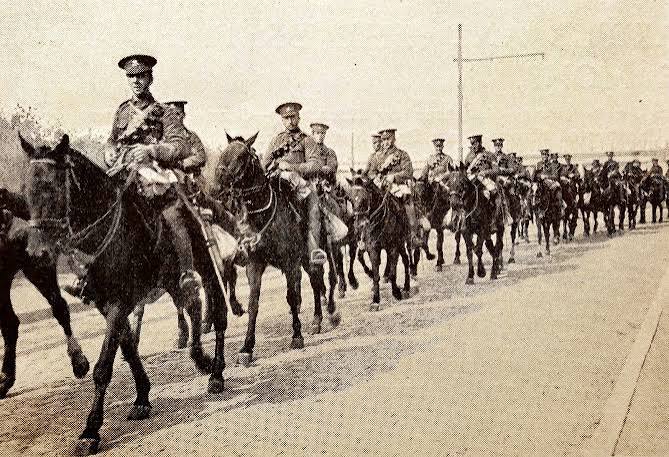
In the first two weeks of August 1914, over a million men marched into battle along the Franco-German border, expecting a swift victory. Instead, they walked into a meat grinder. The Battle of the Frontiers—a series of five clashes from the Vosges to the Sambre River—produced casualties that shocked the world and set the stage for four years of trench warfare.
This was not a single engagement, but a cascade of offensive disasters. The French, following their Plan XVII, launched massed infantry attacks in bright blue coats and red trousers. The Germans, executing the Schlieffen Plan’s right-wing sweep, met them with machine guns and artillery. By the end of August, both sides had lost hundreds of thousands of men, and the war had already broken every pre-war expectation.
The Plans That Failed
Before the war, every power had a plan, and every plan was wrong.
Germany’s Schlieffen Plan assumed a two-front war. It called for a massive right-wing sweep through neutral Belgium, swinging around Paris to encircle the French army within six weeks. To achieve this, the left wing in Alsace-Lorraine was deliberately weakened. The plan was a gamble on speed.
France’s Plan XVII was built on the cult of the offensive (offensive à outrance). Joffre, the French commander-in-chief, concentrated his armies on the German border, planning a rapid thrust into Lorraine and Alsace. He largely ignored the Belgian frontier, assuming the Germans would not violate Belgian neutrality. This assumption was catastrophic.
When Germany invaded Belgium on August 4, Britain declared war, honoring the 1839 Treaty of London. The British Expeditionary Force (BEF), a small professional army of about 80,000 men, began deploying to Maubeuge, on the French left flank.
The Five Battles
Mulhouse: A Brief Triumph
On August 7, the French VII Corps crossed into Alsace and captured Mulhouse on August 8. The city was liberated, church bells rang, and the tricolor flew. Then the German counterattack came. By August 10, the French were driven back, and Mulhouse was lost. The first French offensive was already a failure, but Joffre was not discouraged.
Lorraine: The Bloody Nose
From August 14, the French First and Second Armies advanced into Lorraine. They met the German Sixth and Seventh Armies in a series of engagements. The French infantry, in their conspicuous uniforms, advanced in dense columns, only to be mowed down by machine guns and artillery. By August 20, the French were in retreat, having suffered 20,000 casualties in a single day. The Germans had held their weakened left flank, but the plan’s architect, Moltke, was already shifting troops away from the decisive right wing.
The Ardennes: Into the Trap
The French Third and Fourth Armies advanced into the Ardennes forest on August 21, expecting weak German forces. Instead, they ran into the German Fourth and Fifth Armies. The dense woods negated French artillery, while German machine guns and infantry tactics proved superior. The French were decisively defeated, losing 40,000 men in two days. The attack was based on faulty intelligence; Joffre believed the Germans were not there.
Charleroi and Mons: The Left Flank Collapses
While the Ardennes battle raged, the French Fifth Army, under General Lanrezac, and the BEF, under Sir John French, faced German Second and Third Armies along the Sambre River. On August 21-23, the German assault forced the French Fifth Army to retreat, breaking the Allied left flank. The BEF, positioned near Mons, was ordered to hold their ground.
At Mons, on August 23, the British fought their first major engagement. The German First Army attacked in dense formations, and the British infantry, with their rapid rifle fire, inflicted heavy losses—the Germans thought they were facing machine guns. The British held for a day, losing 1,600 men, but then began a long retreat.
The Fog of War and the Culture of the Offensive
Commanders operated with almost no reliable intelligence. Aerial reconnaissance was in its infancy, and reports were often exaggerated or false. Joffre, in particular, was slow to accept the scale of the disaster. He had been so committed to the offensive that he dismissed reports of German strength in Belgium, believing his own armies were winning.
This was not just a cultural arrogance; it was a doctrine. The French army had been taught that the offensive spirit could overcome firepower. But the reality of modern weapons—quick-firing artillery, machine guns, and bolt-action rifles—meant that massed infantry assaults were suicidal. The French lost 140,000 soldiers in the first two weeks, a number that shocked the world. German casualties were comparable, between 90,000 and 120,000.
The BEF’s experience was different. At Mons, they demonstrated the effectiveness of disciplined, aimed fire. But the subsequent retreat was a grueling ordeal. Sir John French, the British commander, became increasingly reluctant to cooperate with the French, and at one point considered retreating all the way to the coast. Only Joffre’s personal intervention at a meeting on August 26 prevented a complete breakdown of the alliance.
The German Gamble Begins to Unravel
Despite their tactical victories, the Germans were already deviating from the Schlieffen Plan. Moltke, worried about the Eastern Front and the Russian advance, transferred corps from the right wing to the east and to Lorraine. These corps would have been decisive in the sweep around Paris.
Moreover, the German First Army, under General von Kluck, was exhausted after weeks of marching and fighting. Its supply lines were stretched, and it was far ahead of the rest of the army. The German high command, operating with its own fog of war, believed the campaign was nearly won. They were wrong.
The Road to the Marne
The Battle of the Frontiers ended on August 24, but the war did not pause. The Allied armies were in full retreat, heading toward the Marne River. The British and French fell back over 200 miles, fighting rear-guard actions and enduring terrible heat and exhaustion.
Joffre, finally acknowledging the disaster, sacked dozens of generals and reorganized his armies. He created a new Ninth Army under Ferdinand Foch, and he prepared a counterattack. By September 6, the German right wing was so overextended and weakened that it was vulnerable. The First Battle of the Marne would halt the German advance and end any hope of a quick victory.
A Battle of Lost Illusions
The Battle of the Frontiers was a brutal lesson in the realities of modern war. The tactics that had won colonial wars and the Franco-Prussian War were obsolete. The technology of the industrial age had made the battlefield a killing ground. The losses were staggering: nearly 300,000 casualties on both sides in two weeks. And yet, the war would only get worse.
In the coming months, the trenches would stretch from the North Sea to Switzerland. The Western Front would become a static, grinding war of attrition. The Battle of the Frontiers was not just the war’s opening shots; it was the prologue to a century of industrial warfare.
The Battle of the Frontiers was a catastrophic opening act. It shattered pre-war illusions, bled the French army white, and exposed the flaws in every plan. But it also set the stage for the Marne, where the German advance was finally halted. The lessons of August 1914—that firepower dominates, that offensives are costly, and that intelligence is never perfect—would be learned only through years of bloodshed.
Summary
- The Battle of the Frontiers was a series of five battles (Mulhouse, Lorraine, Ardennes, Charleroi, Mons) fought August 7–24, 1914.
- The French Plan XVII and German Schlieffen Plan both failed strategically: the French suffered 140,000–160,000 casualties, the Germans 90,000–120,000.
- The BEF’s disciplined rifle fire at Mons inflicted heavy German casualties, but the Allies were forced into a general retreat.
- German commander Moltke weakened the decisive right wing, a mistake that contributed to their defeat at the Marne.
- The battle shattered the doctrine of the offensive and led to the trench warfare that defined the Western Front.
FAQ
Q: Why is it called ‘The Battle of the Frontiers’?
A: It’s a collective term for five battles fought along the French and Belgian borders in August 1914, not a single battle. They are grouped together because they were part of the same strategic confrontation.
Q: What was Plan XVII?
A: It was France’s pre-war offensive plan, which focused on a rapid thrust into Alsace-Lorraine. It ignored the possibility of a German invasion through Belgium, a fatal oversight.
Q: What was the Schlieffen Plan?
A: Germany’s plan to avoid a two-front war by quickly defeating France through a right-wing sweep through Belgium, then turning east to fight Russia. It assumed France would surrender in six weeks.
Q: Why did the French wear blue and red uniforms?
A: The French army believed in the ‘offensive spirit’ and thought that bright colors would intimidate the enemy. In reality, it made them easy targets for German machine guns and artillery.
Q: What was the significance of the BEF at Mons?
A: It was the British Expeditionary Force’s first major battle. Their rapid rifle fire was so effective that the Germans believed they faced machine guns. Although they had to retreat, it proved the professionalism of the British regulars.
Leave a Reply