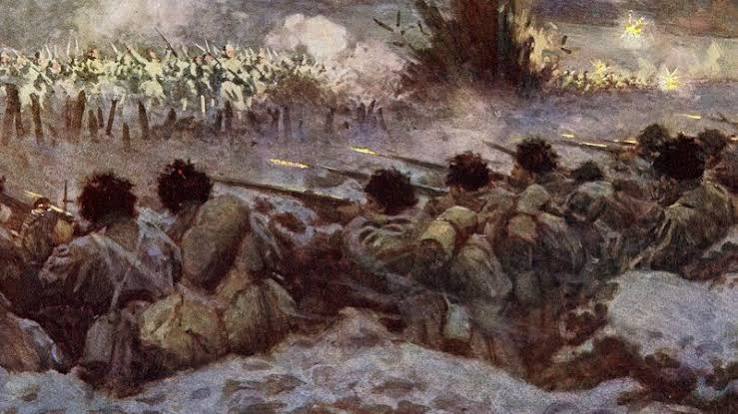
On February 21, 1916, at 7:15 AM, the German army unleashed over 2 million shells on a narrow front near the French fortress city of Verdun. The bombardment lasted nine hours, and the sound was heard 100 miles away. By the time it stopped, the landscape had been transformed into a lunar crater field, and the battle that followed would not end for 303 days.
Verdun was not just another battle on the Western Front. It became the ultimate symbol of the futility and horror of World War I—a battle fought not for territory, but for national pride and the destruction of an army. When it was over, an estimated 700,000 to 800,000 soldiers were dead, wounded, or missing, and the front line had barely moved.
The Strategy of Bleeding France White
Verdun was the brainchild of Erich von Falkenhayn, the German Chief of Staff. By late 1915, the Western Front was a stalemate of trenches and barbed wire. Germany faced a war of attrition against the Allies, who had more manpower and industrial capacity. Falkenhayn believed France was the weaker link in the Allied chain. In a December 1915 memorandum to the Kaiser, he argued that by attacking a position the French could not abandon—for reasons of strategy and national honor—Germany could force the French army to “bleed to death.”
Verdun was the perfect target. It was a fortified salient jutting into German lines, a historic fortress city on the Meuse River that had guarded the route to Paris since Roman times. Its loss would be a psychological blow and open a corridor into the French rear. Falkenhayn’s plan was not to capture Verdun itself, but to draw the French army into a battle of attrition where German artillery would slaughter them.
The German preparations were massive. Over 1,200 artillery pieces, including 420mm “Big Bertha” howitzers, were massed along an 8-mile front. The initial bombardment was designed to be so overwhelming that it would crush French morale and allow a rapid infantry advance. The Germans also had a secret weapon: the new flamethrower, used for the first time in large numbers.
The Fortresses That Were Supposed to Be Obsolete
Verdun was ringed by a series of forts built after the Franco-Prussian War of 1870. Fort Douaumont and Fort Vaux were the most formidable, with thick concrete and steel armor. But by 1916, the French high command, led by General Joseph Joffre, had stripped many of these forts of their heavy artillery, believing they were obsolete in the age of modern siege guns. The forts were undermanned and poorly supplied.
This was a critical mistake. On February 25, just four days after the attack began, a small German raiding party captured Fort Douaumont—the largest and most powerful fort on the Verdun perimeter—without firing a shot. The French were shocked. The fort’s fall was a major blow to French morale and gave the Germans a strong defensive position.
Fort Vaux would hold out longer, but not by much. Its commander, Major Sylvain Eugène Raynal, and his garrison defended the fort for seven days in June, fighting in the dark, flooded corridors, and communicating with the outside world by carrier pigeon. When they finally surrendered, they were down to their last canteen of water.
The Sacred Way and the Noria System
After the initial German advance, the French reacted with desperation. General Philippe Pétain was given command of the 2nd Army and tasked with holding Verdun at all costs. Pétain understood that the key to survival was logistics. The city was nearly surrounded, with only one road connecting it to the rear—a narrow, two-lane road from Bar-le-Duc.
Pétain organized an around-the-clock convoy of trucks to keep the road open. At its peak, a truck passed every 14 seconds, delivering 1,800 tons of supplies and 2,000 troops per day. The road became known as the “Voie Sacrée” (Sacred Way), and it was the lifeline of the French defense. Without it, Verdun would have fallen in weeks.
Pétain also implemented the “noria” system—a rotation of divisions. Instead of leaving units in the line until they were destroyed, he cycled them through the battle for short periods, then pulled them back to rest and refit. Over the course of the battle, 70% of the entire French army passed through Verdun. This kept morale relatively intact and ensured that no single unit bore the full brunt of the slaughter.
The Human Cost: A Hell on Earth
Verdun was a battle of matériel, but it was fought by flesh and blood. The soldiers on both sides described it as “hell on earth.” The constant artillery bombardment churned the ground into a muddy, cratered moonscape. Bodies were buried and reburied by each new shell. The wounded often drowned in mud-filled craters. Rats and lice were constant companions.
The psychological toll was immense. French soldier René Benjamin wrote: “You have to have seen Verdun to understand what war really is. It’s not war; it’s apocalypse.” A German soldier described the battlefield as “a sea of mud, blood, and iron.”
The battle also took a toll on the officers who would later become famous. Charles de Gaulle was a young French captain at Verdun. He was captured by the Germans in March 1916 and spent the rest of the war as a prisoner of war. On the German side, a young lieutenant named Friedrich Paulus fought at Verdun; he would later command the German 6th Army at Stalingrad.
The Failure of Attrition
The battle dragged on for months, with neither side able to achieve a decisive breakthrough. The Germans captured the village of Fleury in June, coming within 2.5 miles of Verdun, but they could not take the city itself. The French counterattacked in October, recapturing Fort Douaumont and Fort Vaux. By December, the front line had returned to roughly where it had started in February.
The strategic outcome was a French victory, but at a staggering cost. French casualties numbered about 377,000, while German casualties were about 337,000. Falkenhayn’s plan to bleed France white had failed—Germany had bled nearly as much as its enemy. The battle also failed to prevent the Allied offensive on the Somme, which began in July 1916 and further drained German resources.
Historians today debate whether Falkenhayn’s “bleed France white” memo was a genuine strategy or a post-hoc justification for a failed breakthrough attempt. Crown Prince Wilhelm, who commanded the German 5th Army, later wrote that he believed the goal was to capture Verdun, not to bleed the French. The evidence is ambiguous, but the result is clear: Verdun was a military and human disaster for both sides.
The Legacy of Verdun
Verdun became a symbol of French resistance and sacrifice. The phrase “Ils ne passeront pas” (“They shall not pass”)—attributed to General Robert Nivelle, who succeeded Pétain—became a rallying cry for the entire war. In France, Verdun is still remembered as the quintessential battle of World War I, a place where the nation’s soul was tested and preserved.
The battle had political consequences as well. In France, Joffre was replaced as Commander-in-Chief by Nivelle in December 1916, partly due to the perceived mishandling of Verdun. In Germany, Falkenhayn was dismissed as Chief of Staff in August 1916, replaced by Paul von Hindenburg and Erich Ludendorff.
Today, the battlefield of Verdun is a memorial to the dead. The remains of 130,000 unidentified soldiers lie in the Douaumont Ossuary, a bone house built after the war. The ground is still scarred by craters and littered with unexploded shells, making it one of the most dangerous places in France—a century later, it is still too dangerous to farm or walk freely.
The Battle in Numbers
- 303 days: the length of the battle
- 2 million: shells fired in the first 24 hours
- 1,200+: German artillery pieces massed
- 70%: percentage of the French army that served at Verdun
- 14 seconds: the interval between trucks on the Voie Sacrée
- 800,000: approximate total casualties
- 300,000+: estimated dead on both sides
Verdun was a battle that should never have been fought, and once fought, could not be stopped. It was a product of industrial warfare, where the logic of attrition trumped human life. The battle’s legacy is not a glorious victory, but a grim reminder of what happens when nations commit to total war. Today, Verdun stands as a warning—a silent, scarred landscape that tells us that some battles are not won, but survived.
Summary
- The Battle of Verdun lasted from February 21 to December 18, 1916, approximately 303 days, making it the longest battle of World War I.
- German Chief of Staff Erich von Falkenhayn designed the attack to “bleed France white” through attrition, but the plan backfired, costing Germany nearly as many casualties as France.
- French commander Philippe Pétain organized the Voie Sacrée supply road and a division rotation system that kept the French army functioning, becoming a symbol of French endurance.
- The battle resulted in an estimated 700,000–800,000 total casualties, with about 300,000–400,000 dead, and ended with the front line nearly unchanged.
- Verdun became a powerful symbol of the futility of war, memorialized by the Douaumont Ossuary and the phrase “Ils ne passeront pas.”
FAQ
Q: Why was Verdun so important to the French?
A: Verdun was a historic fortress city on the Meuse River, guarding the route to Paris. It had been a bastion since Roman times and was a point of French national pride. Its loss would have been a psychological blow and opened a corridor into the French rear.
Q: What was the “Voie Sacrée”?
A: The Voie Sacrée was a single road from Bar-le-Duc to Verdun that was kept open by continuous truck convoys. At peak, a truck passed every 14 seconds, delivering 1,800 tons of supplies and 2,000 troops per day. It was the lifeline of the French defense.
Q: Did the Germans actually aim to capture Verdun?
A: There is debate. Falkenhayn’s plan was to “bleed France white” through attrition, not necessarily to capture the city. However, Crown Prince Wilhelm and field commanders believed the goal was to take Verdun itself. The plan’s failure led to Falkenhayn’s dismissal.
Q: How many soldiers died at Verdun?
A: Estimates of total casualties (killed, wounded, missing) range from 700,000 to 800,000. Of those, about 300,000 to 400,000 were killed, with French losses around 377,000 and German around 337,000.
Q: What is the Douaumont Ossuary?
A: The Douaumont Ossuary is a memorial building near Verdun that contains the remains of at least 130,000 unidentified soldiers from the battle. It was built after the war as a resting place for the dead of both sides.
Leave a Reply