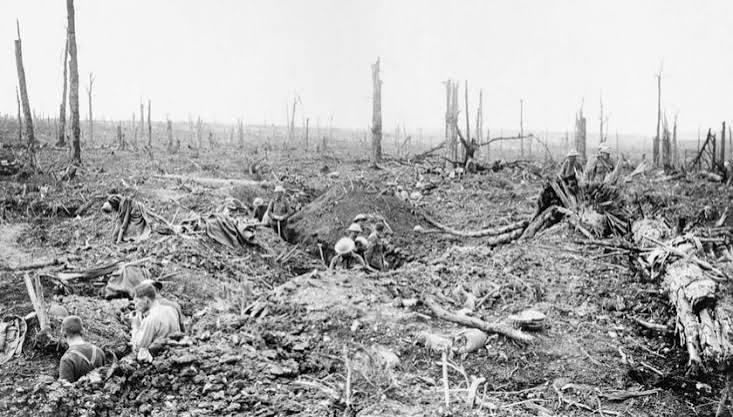
On July 1, 1916, at 7:30 AM, British infantry climbed out of their trenches along a 25-mile front in northern France and walked into machine-gun fire. By nightfall, nearly 57,000 of them were casualties—19,000 dead—the worst single-day loss in British military history. The Battle of the Somme would drag on for another 140 days, cost over a million lives, and move the front line barely six miles. It has since become the enduring symbol of the First World War’s senseless slaughter.
But was the Somme truly futile? Or did the horror obscure a grim necessity? The battle’s legacy is contested: in popular memory, it stands for incompetent generals and wasted youth; in revisionist histories, it emerges as a brutal but vital learning curve that ultimately won the war. This article explores the facts, the interpretations, and why the Somme still haunts us a century later.
The Plan That Failed Before It Began
The Somme offensive was conceived as a joint Anglo-French strike to break the stalemate on the Western Front. But the German assault on Verdun in February 1916 bled the French army white, so the burden shifted to the British Expeditionary Force under General Sir Douglas Haig. The plan was straightforward: a seven-day artillery bombardment—1.5 million shells—would destroy German barbed wire, trenches, and artillery. Then infantry would advance in orderly lines, expecting little resistance.
The bombardment did little of what it promised. Many shells were duds. German deep dugouts, some 40 feet below ground, sheltered soldiers from the blast. When the guns lifted, the Germans emerged to man their machine guns. British troops, each carrying about 60 pounds of equipment, were ordered to walk—not run—across no man’s land. They were mown down in rows.
By the end of the first day, the British had gained almost no ground. The French, attacking on the southern sector, fared better, but the overall offensive had already failed its primary objective: a quick breakthrough.
The Human Cost: More Than a Million Casualties
The battle ground on for 141 days. By the time it ended on November 18, the Allies had advanced just six miles at the deepest point. The price: approximately 420,000 British Empire casualties, 200,000 French, and around 500,000 German—roughly 1.1 million men killed, wounded, or missing.
To put that in perspective, that’s about the entire population of a city like San Jose, California, in 1916, either dead or maimed. The Germans, though defending, suffered nearly as much as the attackers—their losses were equally irreplaceable.
The First Tanks: A Glimmer of the Future
On September 15, 1916, at Flers-Courcelette, the British deployed the first tanks in warfare—the Mark I. These lumbering machines were meant to crush barbed wire and cross trenches, but they were mechanically unreliable, broke down frequently, and moved at walking pace. They had limited tactical impact in the battle, but they signaled a new era of mechanized warfare that would mature by 1918.
A Battle of Attrition: Who Won?
In terms of territory, the Somme was a draw. In terms of attrition, it was a mutual bloodbath. The German army, however, lost many of its best pre-war regulars—veterans who could not be replaced. German commanders like Crown Prince Rupprecht recognized the battle as a strategic defeat in the sense that their army was bled white. The British, meanwhile, learned painful lessons in artillery coordination, infantry tactics, and logistics, evolving into the force that would eventually break the Hindenburg Line in 1918.
The Futility Narrative: Poetry, Film, and the ‘Donkeys’
The Somme became the archetype of war’s futility not just because of the numbers, but because of how it was remembered. The official film The Battle of the Somme (1916) brought images of the dead and wounded to British cinemas. Soldier-poets like Wilfred Owen and Siegfried Sassoon captured the horror in verse—Owen’s “Dulce et Decorum Est” described gas victims drowning in their own lungs. In 1963, Alan Clark’s The Donkeys popularized the “lions led by donkeys” trope, painting General Haig as a butcher. This narrative dominated for decades.
The Revisionist View: A Grim Necessity
More recent historians—Gary Sheffield, William Philpott, John Terraine—argue that the Somme was not futile. They point out that it inflicted irreplaceable losses on the German army, relieved pressure on Verdun, and forced the British army to modernize. The high ground captured around Thiepval and Pozières, though small, was strategically useful. Haig’s attritional strategy, they argue, was the only way to win a war of this scale—there was no cheap victory.
But even revisionists admit the cost was staggering. The “futility” label may be a moral judgment, but it reflects a human reality: over a million families lost sons, husbands, brothers, and the ground gained could be walked in an afternoon.
The Somme’s Legacy in German Memory
In Germany, the Somme is less celebrated but no less painful. For German soldiers, it was a defensive ordeal—they suffered massive casualties from Allied artillery. The experience refined their “elastic defense” tactics, but the human cost was devastating. German memory focuses on the Verdun battlefield more often, but the Somme’s dead are equally mourned in collective remembrance.
Why the Somme Still Matters
The Somme remains a touchstone because it asks uncomfortable questions. Was the sacrifice a noble cause or a senseless waste? Can a battle be both necessary and futile? The answer may be that it was both—a brutal necessity in a war that had no easy exits, but also a tragedy of immense proportion. As we mark a century since, the Somme’s lesson is not that war is avoidable, but that its costs must be counted in human terms before we commit to it.
The Battle of the Somme was not a victory or a defeat in the conventional sense—it was a catastrophic wound on the body of Europe. Its legacy as a symbol of futility is both a warning and a memorial. To understand the Somme is to understand the First World War’s terrible arithmetic: millions of lives for mere miles of mud. Yet even in that horror, the Somme also shows human endurance and the painful process of learning. The Somme will never be forgotten because it embodies the ultimate cost of war.
Summary
- The Battle of the Somme lasted from July 1 to November 18, 1916, with over 1.1 million total casualties.
- The first day remains the bloodiest in British military history: ~57,470 casualties, including 19,240 killed.
- The Allies gained only about 6 miles of ground, failing to break German lines.
- The battle saw the first use of tanks in warfare, at Flers-Courcelette on September 15, 1916.
- Popular memory frames the Somme as futile, but revisionist historians argue it was a necessary attritional step toward Allied victory in 1918.
FAQ
Q: Why is the Battle of the Somme considered a symbol of futility?
A: Because of its massive casualties (over 1.1 million) for minimal territorial gains (6 miles), combined with the failure of the initial plan and the perception of incompetent leadership, particularly General Haig. The battle came to epitomize the senseless slaughter of trench warfare.
Q: What was the bloodiest day of the Somme?
A: July 1, 1916, the first day of the battle, when the British suffered approximately 57,470 casualties, including 19,240 killed—the worst one-day loss in British military history.
Q: Did the Battle of the Somme have any positive outcomes?
A: Yes, according to revisionist historians. It relieved pressure on the French at Verdun, inflicted irreplaceable losses on the German army, and forced the British army to develop effective modern tactics that contributed to the Allied victory in 1918. It also saw the first use of tanks.
Q: How did the German experience of the Somme differ?
A: The Germans experienced the Somme as a defensive ordeal, suffering heavy casualties from Allied artillery. They refined their defensive tactics but lost many irreplaceable pre-war regulars, which weakened their army in the long run.
Q: How did the Somme shape public memory of World War I?
A: Through film (the 1916 documentary The Battle of the Somme) and the poetry of soldiers like Wilfred Owen and Siegfried Sassoon, the Somme became the archetype of war’s horror and futility, shaping anti-war sentiment for generations.
Leave a Reply