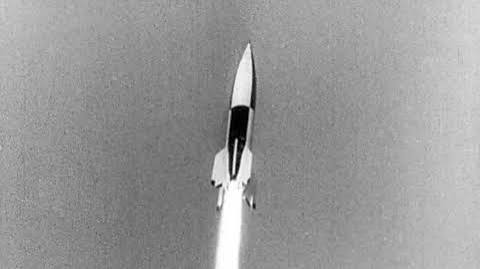
In the autumn of 1944, Londoners had grown used to the wail of air-raid sirens. But on September 8, at 6:43 p.m., a new terror struck without warning. A 14-meter missile, flying faster than sound, slammed into the quiet residential street of Chiswick, killing three people and leaving a crater six meters deep. There was no siren, no drone of engines just a sudden, shattering explosion. The V-2, the world’s first operational ballistic missile, had arrived.
This weapon, built by slave labor in a subterranean factory, was a desperate gamble by a failing regime. It did not change the course of the war. Yet its engineering a liquid-fueled rocket with gyroscopic guidance became the seed from which both the Cold War’s intercontinental missiles and the Apollo Moon missions grew. The V-2 is a story of contradictions: a horrific instrument of terror that also marked humanity’s first tentative step toward space.
A Rocket Born from the Ashes of Versailles
The story begins not in the chaos of 1944, but in the mid-1930s, in the pine forests of Peenemünde on Germany’s Baltic coast. There, a young engineer named Wernher von Braun led a team of the Army’s research center, tasked with building a weapon that could strike enemies without risking a single aircraft. The Treaty of Versailles had crippled Germany’s conventional military, but rocketry was unregulated. Von Braun, then only in his twenties, had a grander vision: spaceflight. The army, however, wanted a bomb.
Their early attempts the A-1, A-2, and A-3 were test beds for the technologies that would become the A-4. The critical breakthrough came with the engine. The A-4 used a turbopump to feed 75% ethanol and liquid oxygen into a combustion chamber, generating 25 tons of thrust. This was not a simple pressure-fed system; it was a complex, high-performance machine that could push a 12.5-ton rocket to the edge of space.
On October 3, 1942, the A-4 first flew successfully, reaching an altitude of 83 kilometers high enough to be considered the beginning of outer space. Von Braun reportedly declared, “We have invaded space with our rocket.” For the first time, a human-made object had breached the threshold of the cosmos, even if only for a few minutes.
A Vengeance Weapon—And a Failure
The weapon was a strategic failure. Its warhead carried just one ton of Amatol explosive—a fraction of what a single bomber could deliver. Its guidance system relied on gyroscopes and an integrating accelerometer, but accuracy was abysmal: the circular error probable was about 17 kilometers. In practice, the V-2 could hit a city, but not a specific target within it.
From September 1944 to March 1945, the Germans launched roughly 3,200 V-2s against London, Antwerp, and other cities. In London, 2,754 people were killed; in Antwerp, 1,736. The numbers were tragic, but they did not move the needle of the war. The economist’s view is stark: the resources poured into the V-2 program—materials, engineers, and the lives of thousands of forced laborers—could have been used to build jet fighters or anti-aircraft guns that might have actually defended Germany.
The V-2 was also a psychological weapon, but its effect was blunted by its own silence. It fell faster than sound, giving no warning. The unpredictability bred fear, but also a grim resignation. It was, in the words of one observer, “an answer to the question of whether the war could be won by technology alone—and the answer was no.”
The Dark Underbelly: Mittelwerk and Dora
To build the rockets, the Nazis moved production to an underground factory in the Harz mountains, called Mittelwerk. The workforce was supplied by the Dora-Mittelbau concentration camp. Prisoners—Jews, Poles, Soviets, and others—were worked to death in horrific conditions. They were starved, beaten, and executed. The death toll among the laborers is estimated at 12,000 to 20,000, far exceeding the number of people killed by the weapon in London and Antwerp combined.
The contrast is one of the most uncomfortable aspects of the V-2’s legacy. The same technology that would one day take humans to the Moon was built on the backs of enslaved people who were treated as expendable components. When the war ended, the Allies would capture the technology and the engineers, but the moral stain remained—and was quickly swept aside in the geopolitical calculus of the Cold War.
The Race to Capture the Rocket
As the Third Reich crumbled, both the Americans and the Soviets scrambled to get their hands on the V-2. Von Braun and his team, anticipating defeat, made a calculated decision: they surrendered to the Americans. In May 1945, von Braun and about 500 engineers crossed into US lines. Operation Paperclip brought them to the United States, where they were put to work on missile development, their Nazi pasts quietly erased.
The US also captured about 100 complete V-2s and tons of components. The Soviets, arriving later, found the Mittelwerk site stripped but took the remaining infrastructure and several engineers. Both superpowers used the V-2 as a starting point for their own ballistic missile programs. The result was the intercontinental ballistic missile—the V-2’s direct descendant—that became the backbone of Cold War deterrence.
From Terror to Discovery: The V-2 in the American Desert
In the immediate postwar years, captured V-2s were launched from White Sands, New Mexico, not as weapons, but as research vehicles. On October 24, 1946, a V-2 carrying a DeVry camera took the first photograph of Earth from space, capturing the curvature of the planet from an altitude of 105 kilometers. The image was grainy, but it changed the way humanity saw itself.
These launches were the first steps of the American space program. Von Braun and his team eventually moved to NASA’s Marshall Space Flight Center, where they developed the Saturn V—the rocket that carried Apollo astronauts to the Moon. The lineage is direct: the A-4’s engine technology, guidance concepts, and engineering expertise all fed into the Saturn V. The V-2 was not just a weapon; it was the prototype for every large liquid-fueled rocket that followed.
The V-2’s Contradictory Legacy
The V-2 is a study in contradictions. As a weapon, it was a terrible failure. As an engineering achievement, it was a triumph. As a product of slave labor, it was a crime against humanity. As a stepping stone to space, it was a catalyst.
Today, the V-2 is remembered not for its military impact, which was minimal, but for the way it opened a new era. It was the first human-built object to reach the edge of space, and it paved the way for the Apollo program. Yet its legacy is forever tainted by the Mittelwerk and the thousands who died building it. The rocket that carried humanity’s first glimpse of Earth from above was also a monument to human cruelty.
In the end, the V-2 teaches us that technological progress is never morally neutral. The same knowledge that can destroy a city can also carry a camera to the edge of space. The choice of how to use it lies with us.
The V-2 was a weapon born of desperation, built on suffering, and destined to fail in its immediate purpose. Yet it also lit a path to the stars. On September 8, 1944, a rocket fell on London; on July 20, 1969, a rocket carried humans to the Moon. The thread connecting those two moments is unbroken—and it runs through the dark heart of the Third Reich. This is the paradox of the V-2: it was a terror weapon that inadvertently gave humanity a future among the stars.
Summary
- The V-2 (A-4) was the first operational ballistic missile, first launched successfully on October 3, 1942, from Peenemünde, and first used against London on September 8, 1944.
- It was a military failure: poor accuracy (CEP ~17 km), small warhead, and enormous cost diverted resources from more effective weapons.
- More people died building the V-2 (est. 12,000–20,000 forced laborers at Mittelwerk) than were killed by its use (~2,754 in London, ~1,736 in Antwerp).
- The V-2’s technology and engineers, captured by the US and USSR, directly launched the Cold War missile race and the space race; von Braun’s team later developed the Saturn V.
- A V-2 launched at White Sands in 1946 took the first photograph of Earth from space, marking the beginning of space exploration.
FAQ
Q: How many V-2 rockets were built and launched?
A: Approximately 5,700–6,000 were produced, mostly by forced laborers at Mittelwerk. Around 3,200–3,700 were launched against Allied targets.
Q: What was the V-2’s accuracy?
A: Very poor. The circular error probable (CEP) was about 17 kilometers (10.5 miles), meaning it could hit a city but not a specific target.
Q: Why was the V-2 called a ‘Vengeance Weapon’?
A: The Nazi propaganda ministry, led by Joseph Goebbels, named it Vergeltungswaffe 2 (Vengeance Weapon 2) as part of a campaign to present it as retaliation for Allied bombing of German cities.
Q: How did the V-2 contribute to the space race?
A: The V-2 was the first human-made object to reach the edge of space, and its technology was used in early US and Soviet missile programs. Wernher von Braun and his team later developed the Saturn V rocket for NASA.
Q: What were the living conditions for the forced laborers who built the V-2?
A: They were horrific. Workers at Dora-Mittelbau were starved, beaten, and worked to death; the mortality rate was estimated at 12,000–20,000, higher than in many other camps.
Leave a Reply