In the summer of 1939, with war clouds gathering over Europe, a group of Polish mathematicians handed their British and French counterparts a gift that would alter the course of history: a working replica of the German Enigma machine. The Poles had been breaking German ciphers for years, but as the threat of invasion loomed, they chose to share their hard-won secrets. That act of trust set in motion a chain of events that would lead to the cracking of the Nazis’ most secret communications and, arguably, shorten the war by years.
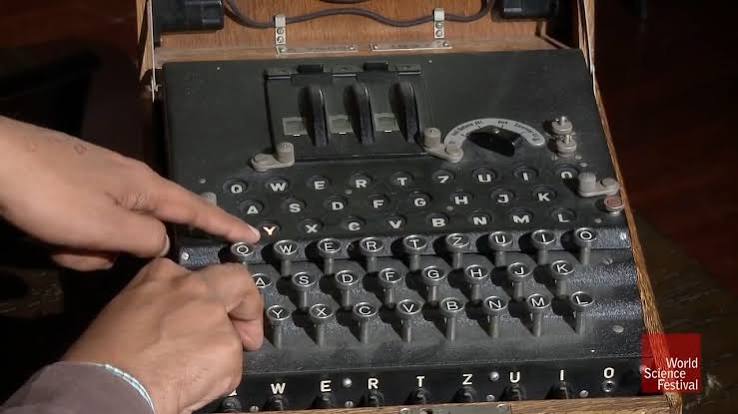
The Enigma machine, a portable device that looked like a typewriter inside a wooden box, was supposed to be unbreakable. Its complex system of rotors and a plugboard generated an astronomical number of possible settings roughly 158 quintillion. Yet, through a combination of mathematical brilliance, operator error, and sheer determination, codebreakers at Bletchley Park in England managed to break it, producing intelligence codenamed ULTRA that gave the Allies a decisive edge. This is the story of that achievement.
The Machine and Its Secrets
Arthur Scherbius, a German engineer, patented the Enigma in 1918, envisioning it as a secure business encryption device. But the German military saw its potential and adopted it in the late 1920s, refining it throughout the 1930s. By World War II, it was the standard for all branches of the Wehrmacht, the SS, and intelligence services.
The machine’s brilliance lay in its mechanics. Three to five rotors scrambled each letter, advancing after every keypress to create a new substitution for the next letter. A plugboard, the Steckerbrett, swapped pairs of letters before and after the rotor scramble, adding another layer of complexity. A reflector sent the signal back through the rotors in reverse, ensuring that encryption and decryption were identical processes a clever design that simplified use but also created a vulnerability.
The key space was staggering: with 3 rotors chosen from 5, 26 possible ring settings per rotor, and 10 plugboard cables, there were about 158 quintillion possible settings. Even with the fastest computers of the time, brute-force decryption seemed impossible. The Germans were confident in their machine’s invincibility. They were wrong.
The Polish Breakthrough
The first cracks appeared in Warsaw, not London. In 1932, Marian Rejewski, a 27-year-old mathematician at the Polish Cipher Bureau, used pure mathematics specifically group theory and permutations to reconstruct the Enigma’s rotor wirings without ever seeing a machine. He and his colleagues Henryk Zygalski and Jerzy Różycki developed methods to decrypt German messages, and they built a device called the “bomba” to speed up the process. For seven years, the Poles read German traffic, making them the unsung heroes of the Enigma story.
But their success was fragile. In 1938, the Germans added two extra rotors and changed procedures, making the Polish bomba obsolete. As the threat of war grew, the Poles decided to share their knowledge with their allies. At a secret meeting in Pyry, near Warsaw, in July 1939, they handed over their machines and methods. This was the crucial handoff that allowed the British to take the next step.
Bletchley Park and the Bombe
At Bletchley Park, a Victorian mansion in the English countryside, the Government Code and Cypher School (GC&CS) had been quietly working on Enigma, but without the Polish insights, they had made little progress. The Polish contribution was the spark they needed. Under the leadership of mathematician Alan Turing and Gordon Welchman, a classicist turned codebreaker, the British refined the Polish methods and built a new machine: the Bombe.
The Bombe was not a computer it was an electromechanical device designed to test rotor settings at high speed. It exploited known plaintext, or “cribs,” which were predictable phrases in German messages, such as weather reports or “Heil Hitler” salutations. The Bombe would try possible rotor settings, looking for a configuration that produced the crib in the ciphertext. When it found a hit, it stopped, and the operators would test the setting manually.
Turing and Welchman also introduced key insights. The “Herivel tip,” named after a young codebreaker named John Herivel, exploited the lazy habits of German operators who often chose obvious rotor starting positions, like their initials or repeated letters, known as “cillies.” These shortcuts gave the codebreakers a way in.
The Battle for Naval Enigma
The Army and Air Force Enigmas were broken relatively early in the war, but the Naval Enigma proved far more difficult. The German Navy used more complex procedures and had its own codebooks. The breakthrough came in 1941, when the British captured codebooks from the U-boat U-110. Combined with the use of “short signal” weather reports, the codebreakers finally cracked naval Enigma. This was a turning point in the Battle of the Atlantic, as the Allies could now track U-boat positions and reroute convoys to avoid attack.
The Human Machine
Bletchley Park grew from a small team of academics to a sprawling operation employing over 10,000 people, most of them women. They worked in shifts around the clock, in huts and blocks scattered across the estate. The atmosphere was one of intense secrecy and intellectual ferment, a mix of mathematicians, classicists, chess champions, and crossword puzzle solvers. They were bound by the Official Secrets Act, and many took the secret to their graves.
The intelligence they produced, codenamed ULTRA, was so sensitive that its use was strictly controlled. Even Winston Churchill knew that revealing its source would compromise the operation. ULTRA informed major decisions, from the North African campaign to the D-Day landings, and it saved countless lives.
The Colossus Connection
It is often wrongly assumed that Colossus, the world’s first programmable electronic computer, was built to crack Enigma. In fact, Colossus was designed for a different, even more complex German cipher: the Lorenz, used for strategic-level communications. But Colossus, built at Bletchley Park in 1943–44, was a direct descendant of the codebreaking culture that Turing and his colleagues created. It demonstrated that machines could be used for more than just brute-force checking—they could be programmed to solve problems.
The Impact and the Legacy
The exact impact of ULTRA is still debated, but estimates suggest that it shortened the war by 2 to 4 years and saved millions of lives. The breaking of Enigma was not just a technical triumph; it was a testament to human ingenuity and collaboration. The Polish mathematicians who started it, the British codebreakers who refined it, and the thousands of workers who kept the operation running all contributed to a victory that was as much intellectual as military.
The story of Enigma is a reminder that even the most secure systems can be vulnerable, not just to mathematical genius, but to human error. The German operators’ lazy habits and predictable phrases were their undoing. And the codebreakers’ willingness to share knowledge, even across national boundaries, proved that cooperation can overcome seemingly insurmountable odds.
The Enigma machine was a marvel of engineering, but it was not unbreakable. The combined efforts of Polish, British, and other Allied codebreakers turned a cipher that seemed impenetrable into a fountain of intelligence. Their work not only shortened the war but also laid the groundwork for the digital age. The next time you send an encrypted message, remember the cryptanalysts of Bletchley Park who proved that no code is truly unbreakable.
Summary
- The Enigma machine used rotors and a plugboard to create a cipher with 158 quintillion possible settings.
- Polish mathematician Marian Rejewski cracked the cipher in 1932 using pure mathematics, a crucial but often overlooked contribution.
- At Bletchley Park, Alan Turing and Gordon Welchman designed the Bombe to automate testing of rotor settings, using cribs and operator errors.
- Naval Enigma was broken in 1941 after the capture of codebooks from U-boat U-110, turning the tide in the Battle of the Atlantic.
- ULTRA intelligence shortened the war by an estimated 2–4 years and saved millions of lives.
FAQ
Q: What was the Enigma machine?
A: A rotor-based cipher machine used by Nazi Germany during WWII to encrypt and decrypt secret messages. It was invented by Arthur Scherbius and adopted by the German military in the late 1920s.
Q: How did the Poles break Enigma first?
A: In 1932, Marian Rejewski used group theory and permutation mathematics to reconstruct the rotor wirings without seeing the machine. He and his colleagues developed the ‘bomba’ and ‘Zygalski sheets’ to decrypt German messages.
Q: What was the difference between the Bombe and Colossus?
A: The Bombe was an electromechanical machine used to break Enigma by testing rotor settings. Colossus was a programmable electronic computer built to break the Lorenz cipher, a different, more complex German system.
Q: How did ULTRA intelligence affect the war?
A: ULTRA gave the Allies advance knowledge of German plans, helping in campaigns like the Battle of the Atlantic and D-Day. Estimates suggest it shortened the war by 2–4 years and saved millions of lives.
Q: Why was Enigma considered unbreakable?
A: The key space of 158 quintillion settings made brute-force attacks impossible with manual methods. However, operator errors and predictable phrases (cribs) provided vulnerabilities that codebreakers exploited.
Leave a Reply