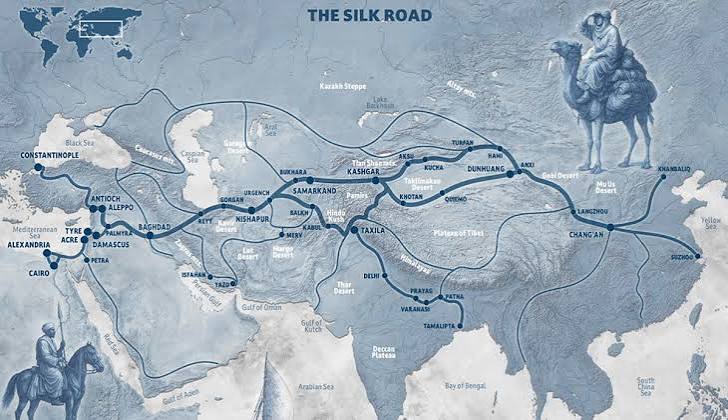
When we think of the Silk Road, images of camel caravans laden with Chinese silk and Roman glass often come to mind. But who actually drove these caravans? The answer, for centuries, was the Sogdians a people from Central Asia who were the ultimate middlemen of the ancient world. They were not just traders; they were diplomats, translators, and cultural catalysts who linked the great empires of China, Persia, and Byzantium.
Yet today, their name is barely known outside specialist circles. This article uncovers the story of these unsung traders, from their bustling city-states on the Zeravshan River to their far-flung colonies in China, revealing how they helped shape the course of Eurasian history.
Who Were the Sogdians?
The Sogdians were an Eastern Iranian people who inhabited Sogdiana, a region centered on the fertile Zeravshan River valley in what is now Uzbekistan and Tajikistan. Their heartland was a patchwork of independent city-states, including Samarkand, Bukhara, and Panjakent. Unlike their neighbors, the Sogdians never formed a unified empire. Instead, they built a network of commercially driven cities, each governed by local lords known as afshins. This decentralized structure proved to be an advantage: it allowed them to act as neutral intermediaries between rival powers, trusted by all sides.
Their language, Sogdian, was an Eastern Iranian tongue written in a script derived from Aramaic. Remarkably, this script later influenced the development of the Uyghur and Mongolian alphabets, a lasting legacy of their cultural reach. From the 6th century BCE to the 10th century CE, the Sogdians rose and fell, with their golden age spanning the 4th to 8th centuries CE.
Masters of the Silk Road
The Sogdians dominated the central section of the Silk Road, controlling trade routes that linked China, India, Persia, and the Byzantine Empire. Their caravans carried a vast array of goods: silk, spices, glassware, precious metals, horses, and even slaves. They established merchant colonies, known as karvansarai networks, along the routes, with significant communities in Dunhuang, Turfan, and Chang’an (modern Xi’an). Some even ventured as far as the Korean Peninsula.
But their trade was not limited to luxury goods. They were instrumental in the exchange of ideas and technologies. For instance, they helped transmit papermaking technology westward, a revolutionary development that would transform the Islamic world and Europe. They also dealt in horses, which were crucial for the Tang military, and jade from Khotan, prized in China.
The Sogdians’ rise to prominence began under the Kushan Empire (1st–3rd centuries CE) and peaked during the early Tang Dynasty (7th–8th centuries CE). The Tang’s expansion into Central Asia created a stable political environment that fostered long-distance trade. The Sogdians also forged a vital alliance with the Turkic Khaganates, serving as administrators, scribes, and diplomats. In effect, they managed the political economy of the steppe, bridging the nomadic and sedentary worlds.
The Cultural Intermediaries
The Sogdians were more than just merchants; they were the primary translators and cultural brokers between the Indian, Persian, Chinese, and Turkic worlds. Their religious tolerance was remarkable—they practiced Zoroastrianism, Buddhism, Manichaeism, and Nestorian Christianity, often simultaneously. This openness made them uniquely suited to bridge diverse cultures.
One of their most significant contributions was the transmission of Buddhism from India to China. Sogdian monks, such as Kang Senghui in the 3rd century CE, traveled to China and helped translate numerous Sanskrit texts into Chinese. They played a similar role for Manichaeism and Nestorian Christianity, spreading these faiths along the Silk Road.
Their artistic legacy is equally rich. The murals of Panjakent and Afrasiab (near Samarkand) provide some of the most vivid visual records of Silk Road life, depicting scenes of trade, feasting, and mythology. These paintings offer a window into the cosmopolitan world the Sogdians inhabited.
Sogdians in Chinese Courts
Sogdians wielded significant political power in China, serving as military generals, court advisors, and even imperial consorts. The most dramatic example is An Lushan, a Sogdian-Turkic general who led a massive rebellion against the Tang Dynasty in 755 CE. The An Lushan Rebellion nearly toppled the dynasty and caused millions of deaths, fundamentally weakening Tang authority and disrupting the very trade networks the Sogdians had built.
The rebellion also marked a turning point for the Sogdians in China. After its suppression, anti-Sogdian sentiment grew, and many Sogdians assimilated into Chinese society, losing their distinct identity over time.
The Fall of the Sogdians
The decline of the Sogdians was a gradual process, driven by two major forces. First, the Arab conquest of Transoxiana in the early 8th century CE eroded their political independence. The last ruler of Panjakent, Divashtich, resisted the invasion but was defeated and killed in 722 CE. Many Sogdians converted to Islam and were assimilated into Persian and Turkic cultures.
Second, the collapse of Tang authority after the An Lushan Rebellion disrupted their trade networks in China. By the 10th century, the Sogdian language had largely died out, replaced by Persian and Turkic dialects. The Samanid Empire (819–999 CE) absorbed the remnants of Sogdian culture, and the once-thriving merchant communities faded into history.
Yet their legacy endured. The Sogdians left an indelible mark on the regions they touched, from the scripts of Central Asia to the spread of Buddhism and the artistic traditions of the Silk Road. They were the connective tissue of the ancient world, and their story is a testament to the power of trade and cultural exchange.
The Sogdians may not have built grand empires or left behind monumental architecture, but their impact on Eurasian history is undeniable. As the unsung traders of the Silk Road, they facilitated the exchange of goods, ideas, and beliefs that shaped the development of entire civilizations. Their story reminds us that history is often driven not by kings and conquerors, but by the merchants and middlemen who connect the world.
Summary
- The Sogdians were an Eastern Iranian people from Central Asia who dominated Silk Road trade between the 4th and 8th centuries CE.
- They acted as cultural brokers, transmitting Buddhism, Manichaeism, and Nestorian Christianity, as well as artistic and literary traditions, between East and West.
- Their decentralized city-states allowed them to remain neutral intermediaries among powerful empires like the Tang, Sassanian Persia, and the Byzantine Empire.
- Sogdians held significant political power in China, exemplified by An Lushan, whose rebellion in 755 CE nearly toppled the Tang Dynasty.
- The Arab conquest and the collapse of Tang authority led to their decline, but their legacy persists in scripts, art, and the flow of ideas across Eurasia.
FAQ
Q: Why are the Sogdians considered “unsung” traders?
A: Despite their crucial role as the main middlemen of the Silk Road, the Sogdians are not as well-known as the Romans, Chinese, or Persians. Their decentralized political structure and eventual assimilation into other cultures meant they left no single dominant empire to preserve their fame.
Q: What did the Sogdians trade besides silk?
A: They traded a wide variety of goods, including horses, jade, glassware, spices, precious metals, and slaves. They also helped transmit technologies like papermaking.
Q: How did the Sogdians influence the spread of Buddhism?
A: Sogdian monks and translators, such as Kang Senghui, played a key role in translating Buddhist texts from Sanskrit into Chinese, making the religion accessible to Chinese audiences. They also facilitated cultural exchange along the trade routes.
Q: What was the An Lushan Rebellion and why is it significant?
A: The An Lushan Rebellion (755–763 CE) was a massive uprising led by An Lushan, a Sogdian-Turkic general, against the Tang Dynasty. It nearly toppled the dynasty, caused millions of deaths, and weakened Tang control over Central Asia, disrupting Silk Road trade.
Q: When did the Sogdian civilization decline?
A: The Sogdians began to decline in the early 8th century with the Arab conquest of Transoxiana. Their language and culture gradually disappeared over the following centuries, assimilating into Persian and Turkic populations by the 10th century.
Leave a Reply