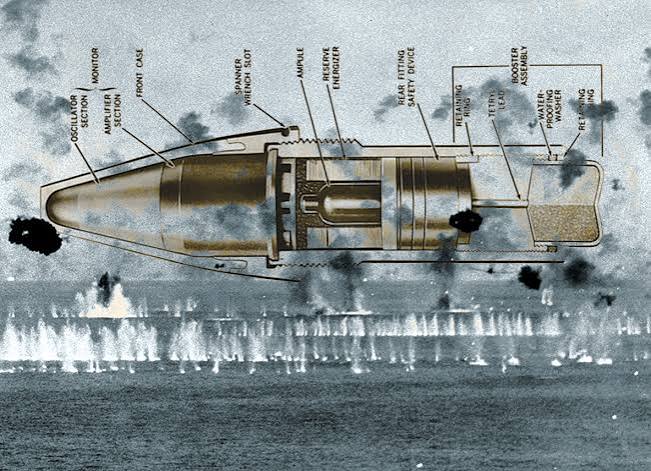
In the spring of 1945, off the coast of Okinawa, a U.S. Navy sailor watched a Japanese Zero dive toward his ship. The anti-aircraft guns opened fire, but the shells weren’t aimed to hit the plane—they were set to explode in the air, filling the sky with shrapnel. Yet this time, something was different. The shells didn’t burst at a pre-set altitude. They waited until the plane was close, then detonated with deadly precision, shredding the Zero before it could release its payload or crash into the deck.
That difference was the proximity fuze, a tiny radar inside each shell that made it ‘smart’ for the first time in history. Developed in utmost secrecy, it was arguably as important as the atomic bomb in ending World War II and it was the key to stopping the kamikaze onslaught that threatened to turn the tide in the Pacific.
The Problem: A Shell That Couldn’t Hit a Plane
By 1940, aircraft had become faster and more maneuverable than ever. Anti-aircraft guns fired shells that exploded either on impact or after a preset time, calculated by a gunner who had to guess the aircraft’s speed, altitude, and direction. Against a diving Zero or a high-flying bomber, that guess was often wrong. A shell that exploded too early produced a harmless puff of smoke; too late, and it fell into the sea. The U.S. Navy calculated that it took about 2,500 rounds of standard 5-inch ammunition to down a single aircraft. That was an unacceptable ratio when Japanese planes were intentionally crashing into American ships.
The solution required a fundamental change: a fuze that could sense the target and detonate at the optimal moment. That meant putting a radar transmitter and receiver inside a shell small enough to fit in a 5-inch gun, rugged enough to survive the 20,000g shock of being fired, and cheap enough to produce by the millions.
The Innovation: A Radar in Every Shell
The idea was proposed by British scientists, who shared their cavity magnetron—a device that generated high-frequency radio waves with the United States in 1940 as part of the Tizard Mission. This breakthrough made it possible to miniaturize radar. The U.S. Navy’s National Defense Research Committee, under the leadership of Dr. Merle Tuve at Johns Hopkins University’s Applied Physics Laboratory, took on the challenge.
The result was the VT fuze, short for ‘variable time.’ Each fuze contained a tiny radio transmitter that sent out a signal. When the shell approached a target, the signal bounced back, and the fuze detonated the shell within 20 to 70 feet of the aircraft close enough for the shrapnel to be lethal. The first successful test was in January 1942, and by 1943, factories were mass-producing them.
The Secret Weapon: Guarding the Secret
The proximity fuze was one of the most closely guarded secrets of World War II. The U.S. military was terrified that if an unexploded shell fell into enemy hands, the Germans or Japanese would reverse-engineer the technology. So, the fuze was used only over water where the shells would sink into the ocean and only against aircraft. Its use over land was forbidden until the Battle of the Bulge in December 1944, when the U.S. Army, desperate against a surprise German offensive, got permission to use VT-fuzed artillery. The results were devastating: shells that exploded in the air above German infantry in the open caused horrific casualties and helped break the offensive.
The secrecy extended even to allies. The British had helped develop the technology, but the U.S. initially restricted sharing details, a source of tension. Only after the fuze’s success was undeniable did the U.S. relax the restrictions.
The Kamikaze Crisis: A Turning Point at Okinawa
The kamikaze campaign began in earnest in October 1944, during the Battle of Leyte Gulf. By the time the U.S. invaded Okinawa in April 1945, the Japanese were launching mass waves of suicide planes. The attacks were devastating: in the first weeks, kamikazes sank or damaged dozens of ships, killing thousands of sailors. The U.S. Navy was facing a crisis that threatened the entire invasion.
The proximity fuze was the answer. When VT-fuzed shells were used in the anti-aircraft guns, the kill probability per round increased by four to five times. The Navy’s radar-directed fire control, combined with VT fuzes, meant that a shell didn’t have to hit the plane it just had to get close. Japanese pilots reported that American shells seemed to ‘explode in their faces’ with uncanny accuracy, a psychological blow as much as a physical one. By the end of Okinawa, the VT fuze had helped the Navy shoot down thousands of kamikaze planes, turning the tide.
The Industrial Miracle: A Billion-Dollar Investment
Developing the fuze was only half the battle. Producing it in the quantities needed was another. The program cost roughly $1 billion in 1940s dollars comparable to the Manhattan Project. By 1945, U.S. factories, including those run by Sylvania and Raytheon, were producing over 1 million fuzes per month. Each one contained fragile vacuum tubes that had to survive the shock of being fired. It was a triumph of industrial engineering, turning a complex electronic device into a cheap, reliable component.
The Legacy: From War to Peace
After the war, the proximity fuze’s technology found peacetime uses. It was adapted for weather radar, air traffic control, and modern artillery. But its greatest impact was on the battlefield. Some historians, like Ralph Baldwin, argue that it was the second most important secret weapon of World War II, after the atomic bomb. While the bomb ended the war, the proximity fuze saved countless American lives and helped secure victory in the Pacific.
The proximity fuze was a weapon of genius, born of scientific collaboration and industrial might. It didn’t just improve anti-aircraft fire it transformed it, turning a desperate defense into a lethal shield. In the dark days of the kamikaze campaign, it was the difference between defeat and victory. And yet, it remains one of the least-known secrets of the war, a silent hero that saved thousands of lives and helped end the conflict.
Summary
- The proximity fuze (VT fuze) used a miniature radar to detonate shells near targets, making anti-aircraft fire 4-5 times more effective.
- Developed in secret by the U.S. Navy and NDRC, it cost ~$1 billion and was produced at a rate of 1 million per month by 1945.
- It played a crucial role against kamikazes at Okinawa, where it helped shoot down thousands of planes.
- Its use was restricted to over-water operations to keep it secret, until the Battle of the Bulge.
- Post-war, the technology was adapted for weather radar and air traffic control.
FAQ
Q: What is a proximity fuze?
A: A proximity fuze, or VT fuze, is a radar-based detonator that explodes a shell when it comes within 20-70 feet of its target, rather than on impact or after a preset time.
Q: How did the proximity fuze work?
A: Each fuze contained a tiny radio transmitter and receiver. The transmitter sent out a signal; when it bounced back off a target, the fuze triggered the explosion.
Q: Why was it so secret?
A: The U.S. feared that if an unexploded shell fell into enemy hands, they could reverse-engineer the technology. So it was only used over water until late in the war.
Q: How effective was it against kamikazes?
A: VT-fuzed shells increased kill probability by 4-5 times compared to time fuzes, and were a primary defense at Okinawa, helping to defeat the kamikaze campaign.
Q: What was the post-war impact?
A: The technology was adapted for weather radar, air traffic control, and modern artillery, leaving a lasting legacy beyond the battlefield.
Leave a Reply