On April 1, 1945, Easter Sunday, the largest amphibious assault of the Pacific War hit the beaches of Okinawa. The first waves of Marines and soldiers scrambled ashore expecting a slaughter. Instead, they found silence—no artillery, no machine-gun fire, no Japanese. The beaches were empty.
That silence was the opening move in a deliberate Japanese strategy. Lt. Gen. Mitsuru Ushijima had ordered his 32nd Army to abandon the shoreline and dig into the island’s southern hills, turning Okinawa into a fortress designed not to repel the invasion, but to bleed it dry. What followed was an 82-day ordeal that would kill more than 12,000 Americans, over 77,000 Japanese soldiers, and—by most estimates—more than 100,000 Okinawan civilians. It was the last and bloodiest battle of World War II, and it changed the calculus for invading Japan itself.
The Silent Beaches
The U.S. Tenth Army, commanded by Lt. Gen. Simon Bolivar Buckner Jr., put 183,000 troops ashore in the first wave—more than the Normandy landings. The fleet offshore numbered over 1,300 ships, including the British Pacific Fleet’s Task Force 57, which covered the southern flank. Yet the Hagushi beaches on the island’s west coast were eerily quiet. The Japanese had not fired a shot.
Ushijima, a seasoned commander, had rejected the old doctrine of annihilating invaders at the water’s edge. He knew the U.S. Navy’s overwhelming firepower would chew up any beach defense. Instead, he pulled his forces south, into a network of caves, tunnels, and pillboxes carved into the ridges around Shuri Castle. His operations officer, Col. Hiromichi Yahara, had argued for a pure war of attrition—no counterattacks, just relentless defense. Ushijima agreed, and the island’s fate was sealed.
The Southern Fortress
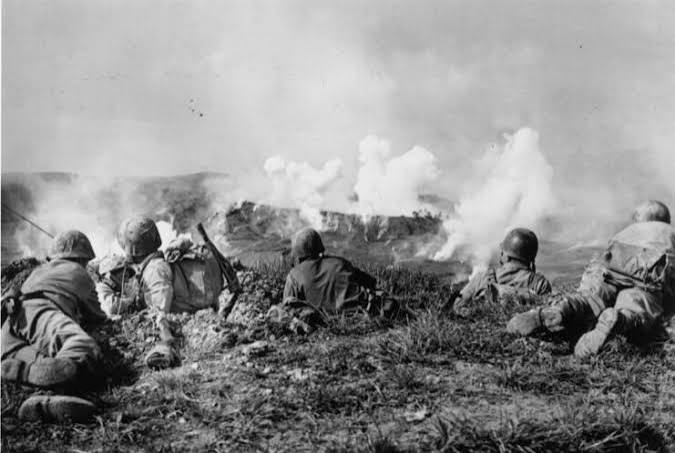
For the first three weeks, the battle seemed almost routine. The 1st and 6th Marine Divisions swept north, clearing the Motobu Peninsula by mid-April with light resistance. The army’s 7th and 96th Infantry Divisions moved south and hit the outer edges of the Shuri Line. That’s where the war turned ugly.
Kakazu Ridge, Sugar Loaf Hill, Conical Hill, and the Maeda Escarpment—nicknamed Hacksaw Ridge—became names written in blood. The Japanese had fortified every approach, with interlocking fields of fire that turned each hill into a meat grinder. Progress was measured in yards, not miles. The 96th Division alone took 1,500 casualties taking Hacksaw Ridge, a 400-foot escarpment defended by a single Japanese battalion.
Then the rain came. The spring typhoons turned the battlefield into a quagmire. Tanks sank to their hulls in mud. Supply trucks bogged down. Wounded men drowned in shell craters. One Marine officer wrote, “The mud is our worst enemy. It’s like fighting in a swamp that’s been churned by a million hooves.”
The Shuri Line was a masterpiece of defensive engineering. Ushijima had spent months building it, with tunnels that linked the ridges so troops could move underground without exposure. The Japanese defenders—roughly 100,000 strong, including 20,000 Okinawan conscripts—were ordered not to surrender. They fought until they were killed, or killed themselves.
The Kamikaze Storm
While the ground troops bled for every ridge, the U.S. Navy faced its own nightmare. The Japanese launched the largest kamikaze campaign of the war—over 1,400 sorties against the invasion fleet. The destroyer USS Laffey survived six kamikaze hits and four bomb strikes on April 16, earning the nickname “The Ship That Would Not Die.” But many ships weren’t so lucky. Over 36 U.S. ships were sunk and 368 damaged, including 14 destroyers lost to kamikazes.
The most dramatic moment came on April 7, when the super-battleship Yamato sortied on a one-way mission. She was the largest battleship ever built, but without air cover she was a floating target. U.S. carrier aircraft swarmed her, and she went down with more than 3,700 crew. It was the end of the Imperial Japanese Navy as a fighting force.
The Counteroffensive That Failed
By early May, Ushijima faced a dilemma. His defenses were holding, but the constant shelling and bombing were grinding down his troops. His staff officers, led by chief of staff Lt. Gen. Isamu Chō, demanded a counterattack. Yahara argued against it, warning that it would waste irreplaceable men. Ushijima sided with Chō.
On May 4, the Japanese launched a mass assault. It was a disaster. The Americans had anticipated it, and their artillery and naval guns tore the attackers apart. The counteroffensive cost Ushijima thousands of men and, critically, his artillery ammunition. When it failed, the Shuri Line was doomed.
The Collapse of the Shuri Line
Throughout May, the U.S. Tenth Army ground forward. The 1st Marine Division took Sugar Loaf Hill after days of brutal fighting—the hill changed hands so many times that the ground was literally carpeted with bodies. The 7th Infantry Division finally broke through at Conical Hill, outflanking the Shuri Line from the east. By the end of May, Ushijima’s position was untenable. He ordered a withdrawal south, to the last defensive position at the Kiyan Peninsula.
The retreat was a bloody affair. The Japanese abandoned thousands of wounded who couldn’t move—many of them killed themselves rather than be captured. The Americans pursued, and the fighting degenerated into a series of desperate, suicidal stands in caves and ravines.
The Last Days and the Civilian Catastrophe
By mid-June, the end was near. Ushijima’s remaining forces were cornered in the south. On June 18, Lt. Gen. Buckner was killed by a piece of coral shrapnel while observing the final assault—the highest-ranking U.S. general killed in the Pacific. His death was a bitter irony: the man who had ordered the invasion died just days before it ended.
On June 22, Ushijima and Chō performed ritual suicide in a cave near Mabuni Hill. With them died the last organized resistance. The U.S. declared victory that day, though mopping-up operations continued for weeks.
The true horror of Okinawa was the civilian toll. The Japanese military had conscripted Okinawans as laborers and, in many cases, as human shields. They also distributed grenades to civilians, encouraging them to commit suicide rather than surrender. As the battle collapsed into the southern tip of the island, tens of thousands of civilians were caught in the crossfire, killed by artillery, bombing, starvation, or their own hands. Estimates range from 40,000 to 150,000 dead—roughly a quarter to a third of the pre-war population. The exact number will never be known.
The Legacy: A Warning of What Was to Come
Okinawa was the bloodiest battle of the Pacific War. The U.S. lost over 12,500 killed and 38,000 wounded—more than at Iwo Jima and Guadalcanal combined. The Japanese lost nearly all of their 100,000-man garrison, with only a few thousand surrendering, most of them Okinawan conscripts.
The cost was so staggering that it directly influenced the decision to use the atomic bomb. The planned invasion of Japan, Operation Downfall, was expected to cost millions of casualties on both sides. Okinawa proved that the Japanese would fight to the last man, and that civilians would die in massive numbers. When President Harry Truman authorized the atomic bombings of Hiroshima and Nagasaki in August 1945, his decision was shaped in part by the horrific preview that Okinawa had provided.
The Battle of Okinawa was not just a military victory—it was a revelation. It showed the world the brutal lengths the Japanese would go to defend their homeland, and the terrible price the Allies would pay to take it. The island’s capture gave the U.S. a staging base for the invasion of Japan, but the battles’ casualties made that invasion almost unthinkable. In the end, Okinawa’s 82 days of hell may have saved millions of lives by making the atomic bomb seem like the lesser evil. It remains a sobering reminder of the true cost of war.
Summary
- The Battle of Okinawa lasted 82 days, from April 1 to June 22, 1945, and was the largest amphibious assault of the Pacific War.
- The Japanese deliberately ceded the beaches and fought from fortified positions in the south, inflicting massive casualties on U.S. forces.
- Over 12,500 Americans were killed and 38,000 wounded; Japanese military deaths exceeded 77,000, with most refusing to surrender.
- An estimated 100,000–150,000 Okinawan civilians died, many from forced suicides and crossfire.
- The battle’s horrific toll influenced the decision to use atomic bombs on Hiroshima and Nagasaki in August 1945.
FAQ
Q: How long did the Battle of Okinawa last?
A: The ground combat lasted 82 days, from April 1 to June 22, 1945. Naval operations and kamikaze attacks continued into late July.
Q: Why was the Battle of Okinawa so bloody?
A: The Japanese abandoned beach defense and built a deep, fortified line in the south, fighting from caves and tunnels. They also launched mass kamikaze attacks against the U.S. fleet. The combination of fanatical resistance, difficult terrain, and heavy civilian presence led to catastrophic casualties.
Q: How many people died at Okinawa?
A: U.S. deaths were about 12,500, with 38,000 wounded. Japanese military deaths were between 77,000 and 110,000. Civilian deaths are estimated at 40,000–150,000, with the most common figure around 100,000–150,000.
Q: What was the Shuri Line?
A: The Shuri Line was a series of heavily fortified Japanese defensive positions in southern Okinawa, centered around Shuri Castle. It included tunnels, caves, and pillboxes, and was the main battleground of the battle.
Q: How did the battle affect the decision to drop the atomic bomb?
A: The massive casualties at Okinawa convinced U.S. leaders that an invasion of Japan would be prohibitively costly. This influenced the decision to use atomic bombs to force Japan’s surrender without an invasion.