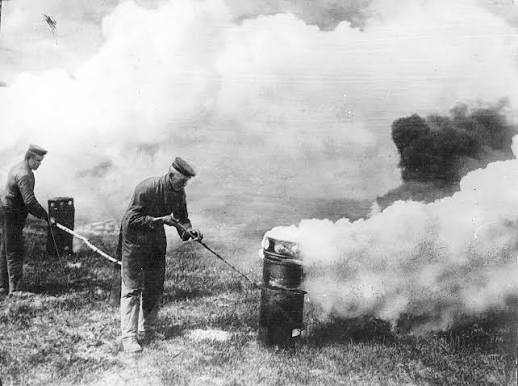
At 5:00 PM on April 22, 1915, a strange greenish-yellow cloud began to roll across no-man’s-land near Ypres, Belgium. It wasn’t smoke from artillery or a weather phenomenon—it was chlorine gas, released from thousands of cylinders by German troops. Within minutes, French colonial soldiers were choking, coughing up blood, and collapsing in the trenches. The first large-scale chemical attack in history had begun, and it would change the nature of warfare forever.
The attack was a desperate attempt to break the deadlock of trench warfare, where millions of soldiers faced each other across a wasteland of mud and barbed wire. For months, both sides had tried frontal assaults, artillery barrages, and even the first use of tear gas, but nothing had moved the front line more than a few miles. The German High Command, facing a shortage of conventional explosives and a naval blockade, turned to science for a solution. The result was a weapon so terrifying that it would later be banned by international treaty, but not before it had killed and maimed thousands.
The Weapon: Chlorine Gas
Chlorine gas is a simple chemical—a yellow-green gas with a pungent, suffocating odor. When inhaled, it reacts with water in the lungs to form hydrochloric acid, which burns and destroys lung tissue. Even at low concentrations, it causes violent coughing, chest pain, and shortness of breath. At higher concentrations, it can cause death by asphyxiation. The gas is heavier than air, so it tends to settle in trenches and dugouts, making them death traps.
The German military had been experimenting with chemical agents since the beginning of 1915. On January 31, they tried using xylyl bromide (a type of tear gas) in shells at the Battle of Bolimov, but the cold weather caused the liquid to freeze, and the gas failed to vaporize. The commander of the 4th Army, Albrecht von Württemberg, then suggested using chlorine gas from pressurized cylinders, a method that had been tested at the German Army’s chemical weapons facility. The plan was ambitious: dig in thousands of cylinders along the front line, wait for a favorable wind, and release the gas in a massive cloud that would drift toward the Allied trenches.
The man behind the weapon was Fritz Haber, a brilliant chemist who would later win the Nobel Prize for his work on nitrogen fixation. Haber was a fervent patriot who believed that science could win the war. He personally oversaw the placement of the cylinders and the training of the troops who would release them. His wife, Clara Immerwahr, also a chemist, was so horrified by his work that she committed suicide in May 1915, reportedly in protest.
The Attack: Chaos at Ypres
The Ypres Salient was a bulge in the Allied line that had been held since the First Battle of Ypres in November 1914. It was a vulnerable position, surrounded on three sides by German-held high ground, and the Allies had been reinforcing it with troops from France and the British Empire. On April 22, the German 4th Army faced French colonial troops from Algeria and Morocco, as well as the Canadian Division, which had recently arrived from training in England.
At 5:00 PM, the Germans opened the valves on 5,730 cylinders, releasing 168 tons of chlorine gas. The cloud, about 6 kilometers wide, drifted slowly toward the Allied lines, carried by a light wind. The effect was instantaneous. The French colonial troops, who had no protection, began to choke and panic. Many fled, leaving a gap of about 4 miles in the Allied line. The Canadians, on the left flank, were also hit, but they managed to hold on, partly because some soldiers improvised by urinating on handkerchiefs and holding them over their mouths—the ammonia in urine neutralized the chlorine.
Within the first hour, an estimated 6,000 Allied soldiers were affected, and between 800 and 1,000 died, many from asphyxiation. The greenish-yellow cloud was followed by German infantry, but they advanced cautiously, wearing gas masks or holding cloths over their faces, and they were slowed by the fear of the gas and the need to wait for it to dissipate. This hesitation gave the Allies time to seal the breach with counterattacks, and the German breakthrough was contained.
The Aftermath: A New Era of Warfare
The attack at Ypres was a tactical failure for the Germans—they did not achieve the strategic breakthrough they had hoped for. But it was a strategic turning point in the war. The Allies were outraged by the use of poison gas, which they saw as a barbaric violation of the Hague Conventions of 1899 and 1907, which prohibited the use of “poison or poisoned weapons.” The Germans argued that the conventions did not explicitly ban chemical clouds or shells, but the international community was not convinced. The British and French governments used the attack as a propaganda tool, describing the suffering of the victims in lurid detail to galvanize public opinion against Germany.
The attack also sparked a chemical weapons arms race. By the end of 1915, the Allies had developed their own gas masks and were producing chlorine gas. In September 1915, the British launched their own gas attack at the Battle of Loos, with mixed results due to wind shifts. Throughout the war, both sides developed more potent agents, including phosgene and mustard gas, which caused even more horrific injuries. By the end of the war, chemical weapons had killed an estimated 90,000 soldiers and injured over a million more.
The legacy of Ypres is a cautionary tale about the intersection of science and warfare. Fritz Haber, who was later awarded the Nobel Prize in Chemistry in 1918, would become a controversial figure, condemned by some for his role in developing chemical weapons and admired by others for his contributions to agriculture. His wife’s suicide, in protest of his work, remains a poignant symbol of the moral dilemmas posed by scientific progress in wartime.
The use of poison gas at Ypres also led to the Geneva Protocol of 1925, which banned the use of chemical and biological weapons in war. The protocol was a step forward, but it did not prevent the use of chemical weapons in later conflicts, such as the Iran-Iraq War in the 1980s and the Syrian Civil War in the 2010s. The ghost of Ypres still haunts the modern battlefield.
The first use of poison gas at Ypres was a watershed moment in military history. It demonstrated that science could create weapons of mass destruction, and it set a precedent for the use of chemical agents in warfare. The attack was a tactical failure, but it had a profound strategic impact, galvanizing the Allies and leading to an arms race in chemical warfare. The suffering of the soldiers at Ypres, many of whom died gasping for air in the trenches, remains a powerful reminder of the human cost of technological innovation in war.
Summary
- On April 22, 1915, Germany launched the first large-scale poison gas attack in history at Ypres, using 168 tons of chlorine gas from 5,730 cylinders.
- The attack created a 4-mile gap in the Allied lines, but German infantry were slow to advance, allowing the Allies to seal the breach.
- Around 6,000 Allied soldiers were affected within the first hour, with 800–1,000 deaths, mostly among French colonial troops.
- The attack was planned by General Erich von Falkenhayn and developed by chemist Fritz Haber, whose wife later committed suicide in protest.
- The use of gas was condemned as a violation of the Hague Conventions, leading to the development of gas masks and an arms race in chemical weapons, culminating in the Geneva Protocol of 1925.
FAQ
Q: What was the first poison gas used in World War I?
A: Chlorine gas, released from pressurized cylinders by German forces at the Second Battle of Ypres on April 22, 1915.
Q: How did soldiers protect themselves from the gas?
A: Initially, soldiers had no protection. Some improvised by urinating on handkerchiefs and holding them over their mouths, as the ammonia in urine neutralized the chlorine. Later, both sides developed effective gas masks.
Q: Why did the Germans use poison gas?
A: Germany was facing a stalemate on the Western Front and a shortage of conventional explosives. The German High Command saw chemical weapons as a potential war-winning technology and believed it would shorten the war.
Q: Was the use of poison gas a violation of international law?
A: The Hague Conventions of 1899 and 1907 prohibited the use of “poison or poisoned weapons,” but the language was ambiguous regarding gas. Germany argued that it was not explicitly banned, but the Allies condemned it as a violation of international law.
Q: What was the long-term impact of the gas attack at Ypres?
A: The attack led to the development of more lethal chemical agents, such as phosgene and mustard gas, and the eventual ban on chemical weapons in the Geneva Protocol of 1925. It also highlighted the moral and ethical dilemmas of scientific research in wartime.
Leave a Reply