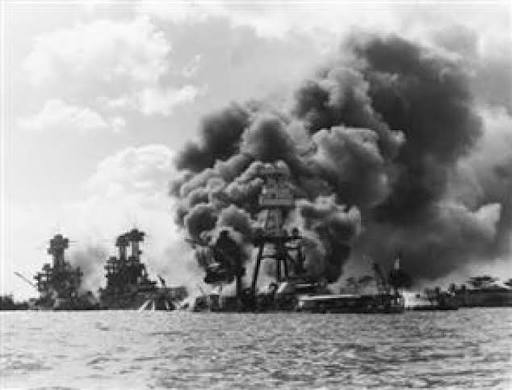
At 7:48 a.m. on December 7, 1941, the first wave of Japanese aircraft descended on Pearl Harbor, turning a quiet Sunday morning into a scene of fire and steel. When the attack ended, 2,403 Americans lay dead, eight battleships were sunk or damaged, and the U.S. Pacific Fleet was in ruins. The question that has haunted historians ever since is not how Japan managed such a feat, but why the United States with its codebreakers, its spies, and its warnings was so completely unprepared.
The answer lies not in a single failure, but in a cascade of them: fragmented intelligence, bureaucratic rivalry, and a stubborn belief that Pearl Harbor was an impossible target. The pieces of the puzzle were on the table, but no one assembled them in time.
The Morning of December 7, 1941
The first wave of 183 Japanese aircraft fighters, bombers, and torpedo planes came in low over the Ko’olau Range, catching the U.S. Pacific Fleet at anchor in Battleship Row. Within minutes, the USS Arizona was ripped apart by a 1,760-pound armor-piercing bomb that ignited its forward magazine, killing 1,177 crewmen. The USS Oklahoma capsized after multiple torpedo hits, trapping hundreds below deck. By 9:45 a.m., when the second wave of 170 aircraft withdrew, the harbor was a graveyard of smoke and oil fires.
The official toll: 2,403 dead, 1,178 wounded, 188 aircraft destroyed. All eight battleships were either sunk or damaged though six would later be raised and refitted. The attack was a tactical masterpiece, but strategically it was a blunder: the U.S. aircraft carriers were at sea, the oil storage tanks were untouched, and the shipyards remained operational. Yet on that day, the United States had suffered its worst military disaster in history.
The Intelligence That Was There
The story of the intelligence failures begins long before the first bomb fell. By 1941, American cryptanalysts had achieved a remarkable feat: they had broken Japan’s highest-level diplomatic cipher, codenamed MAGIC. This gave Washington the ability to read secret messages between Tokyo and its embassies, including the Japanese embassy in Washington, D.C.
MAGIC was a goldmine, but it had a critical blind spot: it covered diplomacy, not military operations. The Japanese Navy’s operational code, JN-25, remained largely unbroken. American codebreakers had made some progress on JN-25, but not enough to read fleet movements in real time. As a result, the U.S. could see the diplomatic tea leaves but not the naval battle fleet.
What the U.S. did have were other clues. In late November 1941, traffic analysts at the Navy’s radio intelligence stations noticed something alarming: Japanese aircraft carriers and battleships had gone silent. The Japanese fleet had been emitting a steady stream of radio signals; suddenly, nothing. This was a classic sign of a major operation ships observing strict radio silence to hide their movement. But where were they going? The analysts couldn’t say.
The Japanese strike force, under Vice Admiral Chuichi Nagumo, had departed Japan on November 26, taking a northern Pacific route far from commercial shipping lanes and U.S. patrols. The fleet maintained absolute radio silence throughout the 3,500-mile journey. The U.S. had no radar network in Hawaii only a mobile SCR-270 radar unit in training so there was no electronic tripwire.
The Warnings That Were Ignored
Between late November and December 7, a series of warnings were sent to U.S. commanders, but each was diluted by assumptions and miscommunication.
November 27, 1941: Chief of Naval Operations Harold Stark sent a “war warning” to Pacific commanders, including Admiral Husband Kimmel in Hawaii. The message stated: “This dispatch is to be considered a war warning. Negotiations with Japan have ceased… An aggressive move by Japan is expected within the next few days.” The message went on to say that Japan might attack the Philippines, Malaya, or the Dutch East Indies—but made no mention of Pearl Harbor. Kimmel, like most officers, took the warning seriously but focused on the likely targets in Southeast Asia.
December 6, 1941: The first 13 parts of a 14-part Japanese diplomatic message—a final note breaking off negotiations—were intercepted and decoded by U.S. intelligence. By 9:30 p.m., they were on President Roosevelt’s desk. The President read them and remarked to an aide, “This means war.” But the final, 14th part—the actual declaration of war—was not decoded until the morning of December 7. It was delivered to the White House at around 2:00 p.m., hours after the attack had begun.
The “Winds” message was another missed signal. The Japanese had coded a hidden phrase in their radio broadcasts that would indicate whether war was imminent with the United States, Britain, or the Soviet Union. The phrase for the United States was “east wind, rain.” On December 6, American intercept stations picked up a broadcast containing the phrase, but the decoding and translation were delayed. By the time it was fully understood, the attack was already underway.
The Fog of Bureaucracy
Even when intelligence was available, it was siloed. The Army and Navy had separate intelligence systems that rarely shared information. In Washington, the FBI, the Office of Naval Intelligence (ONI), and Army G-2 each worked independently. In Hawaii, Admiral Kimmel and Lieutenant General Walter Short—the Army commander—had a strained relationship and communicated sparingly.
One of the most glaring examples of this fragmentation occurred on the morning of December 7. At 7:02 a.m., a radar operator at the Opana Point mobile unit detected a large formation of aircraft approaching from the north—the first wave of the Japanese attack. The operator called the Army’s Information Center, but the officer on duty, Lieutenant Kermit Tyler, assumed it was a flight of B-17 bombers scheduled to arrive from the mainland. He told the operator, “Don’t worry about it.” The warning was never passed to the Navy. The radar contact was the last, clearest signal, and it was dismissed.
The Investigations and the Verdict
In the aftermath, the U.S. government launched at least nine official investigations between 1941 and 1946. The first was the Roberts Commission, appointed by Roosevelt in December 1941. It concluded that there had been “dereliction of duty” by Kimmel and Short, but it did not find a conspiracy.
Subsequent investigations—including the Army Pearl Harbor Board, the Navy Court of Inquiry, and the Joint Congressional Committee (1945–46)—produced similar findings. They cited failures of command, communication, and judgment. The Army and Navy commanders had not taken adequate precautions, and Washington had failed to provide them with clear, actionable intelligence. But the investigations were unanimous on one point: there was no evidence that Roosevelt or other top officials had prior knowledge of the attack and deliberately withheld it.
The “conspiracy theory” that FDR knew and allowed the attack to happen has been thoroughly debunked by historians. No credible evidence has ever surfaced to support it. The reality is more mundane and more tragic: a series of errors, assumptions, and missed signals compounded into catastrophic surprise.
Lessons That Went Unlearned—Until Later
The Pearl Harbor failures led to a major overhaul of U.S. intelligence. The military and civilian intelligence agencies were reorganized, and a unified command structure was created in the Pacific. The CIA was established in 1947, in part to ensure that intelligence was centralized and shared.
But the deeper lesson—that intelligence is only as good as the people who act on it—remains as relevant today as it was in 1941. The attack on Pearl Harbor was not a failure of collection; it was a failure of analysis, communication, and imagination. The United States had the pieces, but it could not see the picture.
The attack on Pearl Harbor was a tragedy of misjudgment, not a conspiracy. The intelligence failures that allowed the Japanese strike to succeed were rooted in human error, bureaucratic rivalry, and a strategic assumption that Pearl Harbor was an unlikely target. The lessons of December 7, 1941, are not just historical footnotes; they are a sobering reminder that even the best intelligence can be rendered useless if it is not shared, analyzed, and acted upon.
Summary
- The U.S. had broken Japanese diplomatic codes (MAGIC) but not the naval operational code (JN-25), leaving a critical gap in intelligence.
- Multiple warnings were sent in late November 1941, but they focused on Southeast Asian targets, not Pearl Harbor.
- The “Winds” message and the 14-part diplomatic note were intercepted but not fully acted upon in time.
- A radar contact on the morning of December 7 was dismissed as a flight of B-17s.
- Nine official investigations concluded there were failures of command and communication, but no conspiracy.
FAQ
Q: Did the U.S. have any warning that Japan would attack Pearl Harbor?
A: Yes, but the warnings were indirect. The U.S. had intercepted Japanese diplomatic messages indicating a breakdown in negotiations, and a “war warning” was sent to Pacific commanders on November 27, 1941. However, none of these warnings specifically mentioned Pearl Harbor, and the U.S. military assumed Japan would strike Southeast Asia.
Q: What was MAGIC intelligence?
A: MAGIC was the code name for U.S. intelligence derived from breaking the Japanese diplomatic cipher machine, known as Purple. It allowed the U.S. to read high-level diplomatic messages between Tokyo and its embassies, but it did not include military or naval operational traffic.
Q: Did President Roosevelt know about the attack in advance?
A: No. Claims that FDR deliberately withheld intelligence to force the U.S. into war are a conspiracy theory with no supporting evidence. Multiple investigations concluded that while there were intelligence failures, there was no prior knowledge of the attack on Pearl Harbor.
Q: Why did the U.S. not expect an attack on Pearl Harbor?
A: The prevailing assumption was that Japan would attack British or Dutch possessions in Southeast Asia—such as Malaya or the Dutch East Indies—to secure oil and resources. Pearl Harbor was considered too far from Japan and too heavily defended for a carrier raid, so it was ruled out as a likely target.
Q: What were the main intelligence failures?
A: The main failures were: the inability to read JN-25, the naval code; poor communication between Army and Navy intelligence; the dismissal of the radar contact on December 7; and the delay in decoding the “Winds” message and the final part of the Japanese diplomatic note.
Leave a Reply