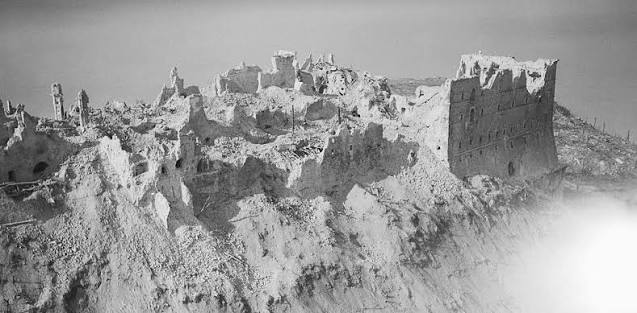
On February 15, 1944, 229 B-17 Flying Fortresses darkened the sky over Monte Cassino. In a single morning, they dropped 1,400 tons of bombs on a 1,400-year-old Benedictine monastery, reducing it to a heap of broken stone and dust. The decision to bomb would become one of the most controversial acts of the Italian campaign and it would hand the German defenders an advantage they exploited ruthlessly.
What followed was a four-month ordeal of blood and mud, a series of four Allied assaults against the Gustav Line, the formidable German defensive wall anchoring on that ruined hilltop. By the time the fighting ended on May 18, 1944, roughly 55,000 Allied soldiers and 20,000 Germans had been killed, wounded, or gone missing. The abbey, once a symbol of faith and learning, had become a graveyard.
The Gates of Italy
After the Allied invasion of Italy in September 1943, the Germans fell back to a chain of fortifications stretching across the boot from the Tyrrhenian Sea to the Adriatic. This was the Gustav Line, and its keystone was Monte Cassino a 520-meter peak 130 kilometers southeast of Rome, commanding the entrance to the Liri Valley. The terrain was a defender’s dream: steep mountains, narrow valleys, and winter rain that turned the ground to sludge.
On the summit stood a monastery founded in 529 AD by St. Benedict himself. The abbey was the birthplace of the Benedictine order, a treasure house of manuscripts, art, and relics. For centuries, it had survived Lombards, Saracens, and earthquakes. Now it faced a new kind of destruction.
The German command had promised the Vatican they would not occupy the abbey, and they kept that promise initially. But its position made it a natural observation post, and the Allies, suspecting the worst, prepared to eliminate it.
The First Battle: A Bloody Introduction
The first assault began on January 17, 1944. U.S. II Corps and British X Corps tried to outflank the position, pushing up the Rapido River and across the mountains. The weather was brutal cold rain, fog, and snow. The Germans, entrenched in bunkers and minefields, held their ground. After nearly a month of fighting, the Allies had gained almost nothing but casualties. The first battle was a failure.
The second battle opened with a decision that would echo through history. On February 15, the bombers came. The official justification: intelligence suggested German observation posts in the abbey. That intelligence was flawed. The abbey was empty of German troops.
The bombing killed hundreds of Italian civilians who had taken refuge inside—estimates suggest around 2,000 civilians died in the bombing and the ensuing chaos. Survivors fled into the mountains or into the German lines. When the smoke cleared, the abbey was rubble. And only then did the Germans move in—not because they had been driven out, but because the ruins offered perfect defensive cover.
The Second Battle: Rubble as a Fortress
The infantry assault that followed the bombing was a disaster. The Allies expected the ruins to be easy to take; instead, the rubble created a labyrinth of defensive positions. German paratroopers of the elite 1st Parachute Division moved into the ruins and made them impregnable. The second battle ended in failure.
The third battle, in March, saw New Zealand Corps hammer the town of Cassino below the abbey with a massive artillery barrage, then fight house-to-house through the streets. It was brutal, close-quarters combat, but the abbey held. The third battle, too, failed.
The Fourth Battle: Breaking the Line
The final assault, Operation Diadem, began on May 11. This time, the Allies coordinated a multi-national offensive. French forces under General Juin broke through the mountains to the north, punching a hole in the German line. British and Indian troops fought through the town. And Polish II Corps, commanded by General Władysław Anders, attacked the abbey from the northeast.
The Poles had a personal stake: many were veterans who had been deported to Siberia, then freed to fight for their homeland. They attacked the heights with fury. The German paratroopers, exhausted and out of ammunition, finally fell back. On May 18, Polish soldiers raised their flag over the ruins.
The Gustav Line had collapsed. Rome was liberated on June 4, just two days before D-Day.
The Aftermath: Rebuilding and Remembering
The cost was staggering: about 55,000 Allied casualties and 20,000 German. Add roughly 2,000 dead civilians. The abbey itself lay in ruins, its treasures—many evacuated to the Vatican by German officers before the bombing—survived the war in crates.
After the war, the monastery was rebuilt using original materials where possible. The Italian government and private donors funded the reconstruction, which was completed in the 1950s. Today, it stands again, a place of prayer and memory, though the scars of 1944 remain visible in the surrounding cemetery and the town below.
The debate over the bombing has never fully settled. Was it a military necessity, or a tragic mistake that killed civilians and made the German defense stronger? Many historians argue it was a strategic error—the rubble was more defensible than the intact abbey would have been. Others point to the fog of war, the genuine fear of observation posts, and the pressure to break the stalemate. What is certain is that the Battle of Monte Cassino became a symbol of the Italian campaign’s brutality: a four-month siege where the ancient and the modern collided, and the ancient lost.
The Battle of Monte Cassino was not a single engagement but a series of four, each more desperate than the last. It ended not with a strategic masterstroke but with the grinding advance of infantry and the courage of soldiers from Poland, India, France, Britain, and the United States. The abbey they fought over was rebuilt, but the memory of what happened there—the bombing, the rubble, the thousands of graves—endures as a reminder of what war costs.
Summary
- The Battle of Monte Cassino was a four-month series of assaults (January 17 – May 18, 1944) to break the German Gustav Line in Italy.
- The Allies bombed the ancient Benedictine abbey on February 15, 1944, with 1,400 tons of bombs, turning it into rubble and inadvertently creating a stronger defensive position for the Germans.
- Four major battles were fought, with Polish II Corps finally capturing the ruins on May 18, 1944.
- Casualties were heavy: ~55,000 Allied and ~20,000 German dead, wounded, or missing, plus ~2,000 Italian civilian deaths.
- The abbey was rebuilt after the war, and the bombing remains a controversial decision debated by historians.
FAQ
Q: Why was the abbey bombed?
A: The Allies believed German observation posts were located in the abbey, which would have allowed artillery spotting over the front lines. Intelligence later proved this was not the case; the abbey was unoccupied at the time of the bombing.
Q: Did the Germans use the abbey before the bombing?
A: No. German commanders, including Field Marshal Albert Kesselring, had agreed with the Vatican to keep the abbey out of the defensive line. They only occupied the ruins after the bombing, using the rubble as a fortress.
Q: How many civilians died?
A: Approximately 2,000 Italian civilians, many of whom had taken refuge in the abbey, were killed during the bombing and the subsequent fighting.
Q: What was the outcome of the battle?
A: The Allies broke the Gustav Line, opening the road to Rome, which was captured on June 4, 1944. The battle was a costly but strategic success.
Q: Is the abbey still standing today?
A: Yes, the abbey was rebuilt in the 1950s using original materials where possible, and it functions as a monastery and a memorial to those who died in the battle.
Leave a Reply