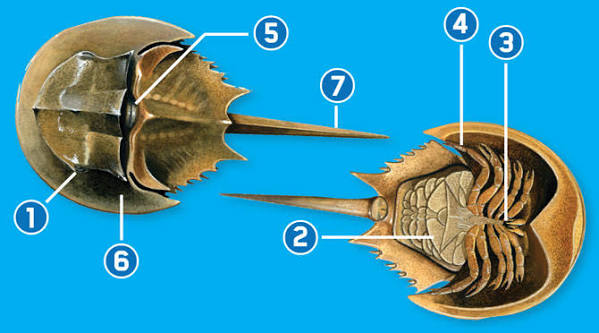
Every time you receive a vaccine, an IV drip, or an implantable medical device, you owe a debt to a creature that looks more like a science-fiction alien than a savior. The Atlantic horseshoe crab, with its armored shell and spiky tail, has been quietly protecting human health for over half a century. Its blue blood contains a substance so sensitive to bacterial contamination that it has become the gold standard for testing the safety of injectable medicines worldwide.
This ancient animal, which has roamed the oceans for 450 million years, now plays a role in modern medicine that no synthetic alternative has fully replaced. From the discovery of its clotting mechanism in the 1950s to the multi-million-dollar industry that harvests half a million crabs each year, the horseshoe crab’s story is a remarkable intersection of evolution, biology, and public health.
A Living Fossil with a Secret
Horseshoe crabs are not crabs at all. They belong to a group called chelicerates, making them closer relatives to spiders and scorpions than to the crustaceans we typically find on a seafood platter. Their lineage dates back to the Ordovician period, around 450 million years ago, long before the first dinosaurs. This ancient pedigree has earned them the nickname ‘living fossils,’ but their most valuable trait is not their age—it’s their blood.
Unlike human blood, which is red because of iron-based hemoglobin, horseshoe crab blood is a striking blue. This comes from hemocyanin, a copper-based molecule that transports oxygen. But the color is just the beginning. The blood contains a single type of cell, called amebocytes, which are packed with granules. When these cells encounter bacterial toxins, they release a clotting factor that turns the blood into a gel-like mass. This primitive immune response is extraordinarily sensitive, capable of detecting minuscule amounts of endotoxins—toxic substances released by certain bacteria—at concentrations as low as parts per trillion.
The horseshoe crab is a true unsung hero of modern medicine. Its unique biology has provided a safety net for pharmaceutical testing for over 50 years, protecting millions of patients from the dangers of bacterial contamination. As we look to the future, the challenge is to balance this vital medical use with the conservation of a species that has survived for hundreds of millions of years. The story of the horseshoe crab is a reminder that sometimes the most unexpected creatures hold the keys to our well-being.
Summary
- Horseshoe crabs are ancient chelicerates, more closely related to spiders than crabs, and their blue blood contains amebocytes that clot in the presence of bacterial endotoxins.
- In 1968, scientists isolated Limulus Amebocyte Lysate (LAL), a reagent derived from horseshoe crab blood that detects endotoxins with incredible sensitivity.
- LAL is the FDA-approved standard for testing all injectable drugs, vaccines, and medical devices for bacterial contamination, ensuring patient safety.
- Around 500,000 horseshoe crabs are harvested annually for their blood, with a mortality rate of 10-30% during the bleeding process.
- The Atlantic horseshoe crab is listed as Vulnerable, and conservation efforts aim to balance biomedical needs with ecological sustainability.
FAQ
Q: Why is horseshoe crab blood blue?\nA: Horseshoe crab blood is blue because it uses hemocyanin, a copper-based protein, to transport oxygen, unlike human blood which uses iron-based hemoglobin and appears red.\n\nQ: How does the LAL test work?\nA: LAL (Limulus Amebocyte Lysate) is a reagent made from horseshoe crab blood cells. When exposed to bacterial endotoxins, it forms a gel clot, indicating contamination. It is so sensitive it can detect endotoxins at parts per trillion.\n\nQ: Are horseshoe crabs harmed by the bleeding process?\nA: Yes, some crabs die from the bleeding process, with mortality rates estimated between 10-30%. The stress of capture and handling can also contribute to higher mortality.\n\nQ: Can the LAL test be replaced?\nA: There is a synthetic alternative called recombinant Factor C (rFC), but it has not been fully adopted due to regulatory hurdles and industry preferences. Efforts are ongoing to promote its use to reduce reliance on horseshoe crabs.\n\nQ: What other ecological roles do horseshoe crabs play?\nA: Horseshoe crab eggs are a critical food source for migratory shorebirds, such as the red knot, which rely on them during their long migrations.
Leave a Reply