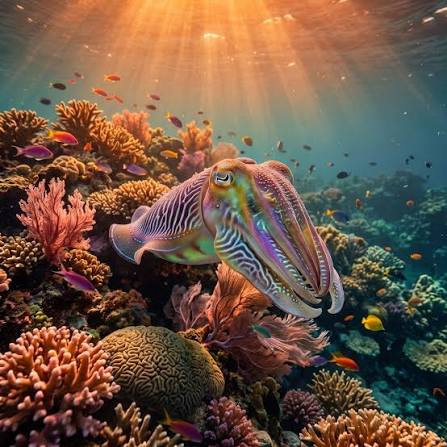
Imagine being able to change your skin’s color, pattern, and even texture in less than a second—and doing it all without seeing color. That’s the reality for cuttlefish, marine mollusks that are among the ocean’s most skilled illusionists. Their camouflage is so precise that they can blend into a bed of gravel or mimic a piece of algae, fooling both predators and prey.
But here’s the twist: cuttlefish are colorblind. They have only one type of light-detecting cell in their eyes, yet they match the colors of their surroundings with stunning accuracy. This contradiction has puzzled scientists for decades and is a perfect window into the extraordinary adaptations that evolution can produce.
In this article, we’ll explore how cuttlefish achieve their rapid color changes, why they need such sophisticated disguise, and what their tricks reveal about the nature of perception and deception.
The Cuttlefish: A Soft Target with a Smart Defense
Cuttlefish belong to the same class as octopuses and squid cephalopods but they’re distinct enough to warrant their own order, Sepiida. About 120 species exist, ranging from the tiny dwarf cuttlefish (Sepia bandensis) at just 5 centimeters long to the giant Australian cuttlefish (Sepia apama), which can reach 50 centimeters in mantle length and weigh over 10 kilograms. Despite their size range, all cuttlefish share a short lifespan of just one to two years, making their sophisticated behaviors all the more remarkable.
Unlike many mollusks, cuttlefish have no external shell to protect them. Instead, they have an internal, chambered structure called the cuttlebone—the familiar white, chalky object you might give to a pet bird. The cuttlebone is filled with gas and liquid, allowing the cuttlefish to control its buoyancy. But without a hard outer shell, they’re vulnerable. Their soft bodies are a tempting meal for dolphins, seals, sharks, and larger fish. To survive, they’ve evolved one of the most dynamic camouflage systems in the animal kingdom.
The Three-Layer Skin System
The secret to a cuttlefish’s quick-change act lies in three types of specialized skin cells, each playing a distinct role.
Chromatophores are the workhorses of color change. These are tiny sacs filled with pigment—yellow, red, or brown/black—surrounded by muscle fibers. When the muscles contract, the sac stretches out, showing more color; when they relax, the sac shrinks to a tiny dot, hiding the color. What makes chromatophores special is that they’re controlled directly by nerves from the brain, allowing for lightning-fast changes. A cuttlefish can shift its entire appearance in about 200 to 700 milliseconds—faster than the blink of an eye.
Leucophores are cells that scatter and reflect ambient light, producing white and structural coloration. They’re like tiny mirrors that bounce back the surrounding light, helping the cuttlefish match the brightness and even the color of its background.
Iridophores are layered reflector cells that create iridescent and structural colors—those shimmering blues, greens, and metallic sheens. They work through thin-film interference, the same phenomenon that creates rainbows on soap bubbles. These cells can produce colors that no pigment could achieve.
But the cuttlefish doesn’t stop at color. It can also change the texture of its skin using papillae—muscular projections that can be extended to mimic bumps, coral, or seaweed. A cuttlefish resting on a rocky reef can sprout small bumps to match the rock’s surface, or smooth out for a sandy bed.
Why So Fast? Predator and Prey
Cuttlefish are both hunter and hunted, and their camouflage serves dual purposes. As prey, they rely on camouflage to avoid being seen by predators. They can blend into almost any background, using a combination of background matching (resembling the general color and pattern of the surroundings) and disruptive coloration (high-contrast patterns that break up their body outline, so a predator sees a random pattern rather than a cuttlefish shape). They can even masquerade as inanimate objects like a piece of algae or a rock.
As predators themselves, cuttlefish use camouflage to stalk their prey—small fish, crabs, and shrimp. They creep up slowly, their skin shifting to match the surroundings, then strike with two retractable tentacles that shoot out to grab the victim. They also employ a dramatic display called the “passing cloud,” where waves of dark coloration sweep across their body. This is thought to hypnotize or confuse prey, making it easier to catch.
Camouflage also plays a role in reproduction. Males display vivid, changing patterns to court females and to intimidate rival males. In a remarkable twist, some males use dual-sided signaling: they show female-like coloration on one side of their body to sneak past dominant males while displaying male patterns on the other side to attract females. It’s a clever trick that would make any spy proud.
The Colorblind Paradox
Here’s where the story gets truly puzzling. Cuttlefish have a single type of photoreceptor in their eyes, meaning they see the world in shades of gray—they are colorblind. Yet they can match the colors of their backgrounds with remarkable fidelity. How can a colorblind animal produce color patterns that seem to require color perception?
This paradox has stumped scientists for years. One hypothesis is that cuttlefish don’t need to see color to match it; instead, they might use the brightness and texture of the background as cues. Another idea is that they might sense color through their skin itself—some cephalopods have light-sensitive proteins in their skin, which could help them detect and respond to light without “seeing” it. But the exact mechanism remains unknown.
Recent research by Roger Hanlon and colleagues at the Marine Biological Laboratory in Woods Hole has used high-speed video and machine vision to analyze cuttlefish camouflage patterns. They’ve found that cuttlefish can produce dozens of distinct body patterns, each composed of multiple components like spots, stripes, mottling, and uniform coloration. The ability to choose and combine these patterns based on visual input is a complex feat that likely involves higher-level processing in the brain.
A Brain for Disguise
Cuttlefish have the largest brain-to-body ratio of any invertebrate. Their brains contain around 500 million neurons, far fewer than the 86 billion in humans, but enough to coordinate millions of chromatophores in real time. The control system is distributed: motor neurons in the brain send signals directly to chromatophore muscles via peripheral nerves, allowing for both whole-body waves of color and fine local control.
This neural architecture enables cuttlefish to adapt their camouflage to almost any environment. They can match the fine details of a background, such as the exact size and spacing of pebbles on the ocean floor. They can also make decisions about what pattern to use based on the visual scene—a process that requires memory and learning.
Cuttlefish also exhibit fascinating behaviors that hint at complex cognition. They have sleep-like states with distinct color patterns, and research suggests they might dream. During REM-like sleep, their skin displays patterns associated with foraging or mating, as if they’re replaying the day’s events.
The Evolution of Deception
Cephalopods diverged from other mollusks about 500 million years ago. The coleoid lineage—which includes cuttlefish, squid, and octopus—split from shelled cephalopods like the nautilus around 400 million years ago. The loss of an external shell was a major evolutionary trade-off: it made these animals more mobile and agile, but it left them vulnerable. This vulnerability drove the evolution of dynamic camouflage as a primary defense.
The sophisticated camouflage system of cuttlefish is a premier example of convergent evolution with vertebrates. They evolved complex eyes, brains, and learning abilities independently of the vertebrate lineage, yet these features are remarkably similar to those of fish, birds, and mammals. This convergence highlights the power of natural selection to find similar solutions to common problems.
Camouflage in Action: A Closer Look
To appreciate the cuttlefish’s skill, consider the giant Australian cuttlefish. During breeding season, thousands gather off the coast of South Australia, creating a spectacular display of color changes as males compete for females. A male can rapidly switch from a bold, zebra-striped pattern to a subtle, mottled appearance as it approaches a female, responding to her cues in real time.
In laboratory experiments, cuttlefish have been shown to match artificial backgrounds with startling accuracy. When placed on a checkerboard pattern, they produce a body pattern with sharp, contrasting squares. When placed on a sandy bottom, they adopt a smooth, mottled look. They can even mimic the size and shape of objects, such as making their arms look like small leaves.
One of the most astonishing feats is their ability to match three-dimensional textures. By extending papillae, they can make their skin look rough and bumpy, matching the coral or rock they’re resting on. This combination of color, pattern, and texture makes them virtually invisible to predators and prey alike.
The Limits of Camouflage
Despite their remarkable abilities, cuttlefish are not perfect. Their camouflage is most effective against predators with color vision, like many fish and birds. Some predators, like dolphins and seals, use echolocation or other senses that can detect cuttlefish regardless of their visual disguise. In such cases, cuttlefish rely on their ink cloud and jet propulsion as backup defenses.
Their colorblindness also imposes limitations. While they can match the average color of a background, they might struggle with complex, high-contrast scenes that require precise color discrimination. Yet, they seem to manage remarkably well, suggesting that their camouflage system is more about fooling viewers’ perception than achieving perfect color matching.
What We Can Learn from Cuttlefish
The cuttlefish’s camouflage is not just a biological curiosity; it has inspired practical applications. Engineers have studied their skin to develop adaptive camouflage for military use, creating materials that can change color and pattern in response to surroundings. Scientists have also looked to cuttlefish for insights into how brains process visual information and make complex decisions with limited resources.
Moreover, cuttlefish challenge our understanding of perception. Their colorblindness yet ability to produce color raises fundamental questions about what it means to see and understand the environment. They remind us that the brain’s interpretation of sensory input is key, not just the raw data.
In the end, the cuttlefish is a master of illusion, a soft-bodied creature that has turned vulnerability into an art form. Its rapid color changes are a testament to the power of evolution to create solutions that seem almost magical. As research continues, we may finally unravel the mystery of how a colorblind animal can paint its skin with such precision—and in doing so, learn more about the intricate dance between perception, brain, and environment.
Cuttlefish are not just remarkable animals; they are a window into the endless creativity of evolution. Their ability to change color, pattern, and texture in under a second, despite being colorblind, defies our expectations and expands our understanding of what is possible in nature. As researchers continue to decode the neural and physiological mechanisms behind their camouflage, we gain not only insight into cephalopod intelligence but also inspiration for technologies that could change how we interact with our surroundings. The cuttlefish reminds us that even the most hidden creatures can teach us profound lessons about survival, adaptation, and the power of disguise.
Summary
- Cuttlefish are marine mollusks that can change color, pattern, and texture in under a second, using specialized skin cells called chromatophores, leucophores, and iridophores.
- They use camouflage to hide from predators and to stalk prey, as well as for mating displays, including dual-sided signaling to sneak past rivals.
- Despite being colorblind, cuttlefish match background colors with high fidelity, a paradox that remains unresolved.
- Their camouflage is controlled by a sophisticated nervous system, with the largest brain-to-body ratio of any invertebrate.
- Cuttlefish have inspired technological applications in adaptive camouflage and offer insights into visual processing and perception.
FAQ
Q: How fast can a cuttlefish change color?
A: Cuttlefish can change their appearance in about 200 to 700 milliseconds, which is faster than the blink of an eye.
Q: Why are cuttlefish colorblind but still match colors?
A: This is a known paradox. Scientists hypothesize that they might use brightness and texture cues, or they might sense light through their skin, but the exact mechanism is still unknown.
Q: What are chromatophores?
A: Chromatophores are sacs of pigment surrounded by muscle fibers. When the muscles contract, the sac expands, showing color; when they relax, the color disappears. They are controlled by nerves, allowing for rapid changes.
Q: How do cuttlefish use camouflage to hunt?
A: They stalk prey by blending into the background, then strike with retractable tentacles. They also use a ‘passing cloud’ display, which involves rapid waves of dark coloration that may hypnotize or confuse prey.
Q: Can cuttlefish change their skin texture?
A: Yes, they can extend muscular projections called papillae to make their skin look bumpy or smooth, helping them match the texture of their surroundings.