The same climate forces that are making weather more extreme are also reshaping the ground beneath farmers’ feet. Rising temperatures, erratic rainfall, and shifting pest ranges are not distant threats—they are already cutting into yields in many regions, with projections of 5–30% losses by mid-century if farming systems don’t adapt. In response, a growing toolbox of digital and genetic technologies promises to help crops survive heat, drought, and floods, and to help farmers use water, fertilizer, and pesticides more precisely.
At the center of this shift are two very different kinds of tools: artificial intelligence (AI) and biotechnology. AI processes vast streams of satellite images, soil sensor readings, and weather forecasts to guide day-to-day decisions, while biotech—from CRISPR gene editing to engineered microbes—changes the crops themselves to withstand stress. Together, they form the backbone of what researchers call climate-resilient agriculture (CRA).
This is not a simple story of tech saving the day. Adoption is uneven, costs are real, and there are deep disagreements about whether high-tech solutions are the best path forward, especially for the world’s 500 million smallholder farmers. But the core question is urgent: can we grow enough food for a hotter planet without wrecking the ecosystems we depend on? This article lays out what AI and biotech can and cannot do, based on current evidence and real-world examples.
What Climate-Resilient Agriculture Actually Means
Climate-resilient agriculture is a set of practices and technologies designed to help farms anticipate, absorb, and recover from climate shocks—droughts, floods, heatwaves, and new pest outbreaks—while keeping productivity and ecosystem health intact. It is not a single technique but a framework that includes better soil management, water conservation, crop diversification, and, increasingly, digital and genetic tools.
The need is stark. Agriculture contributes roughly 22–25% of global greenhouse gas emissions (IPCC), yet it is also one of the sectors most exposed to climate impacts. Without adaptation, yields of major crops could fall by 5–30% by 2050, depending on the region and crop. For example, wheat yields in sub-Saharan Africa could drop by up to 22% under high-emission scenarios, while rice in South Asia faces threats from both flooding and salinity.
What makes CRA different from past approaches? The Green Revolution of the mid-1900s relied on high-yield seeds, synthetic fertilizers, and irrigation—but those systems are energy-intensive, water-hungry, and increasingly brittle in the face of extreme weather. CRA aims to build resilience into the system itself, not just boost output.
AI in the Field: Precision, Prediction, and Speed
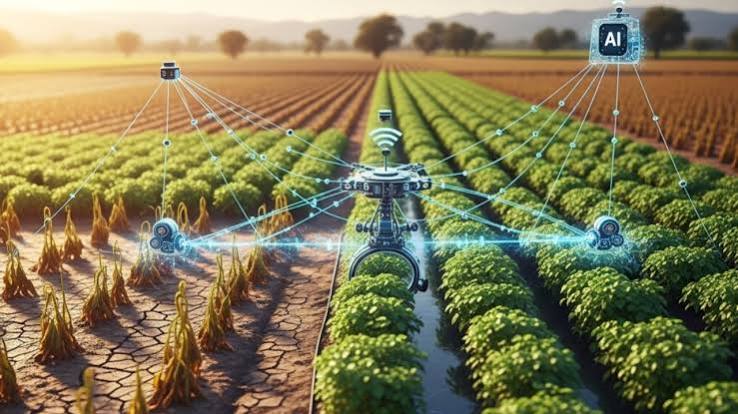
Artificial intelligence is being deployed across the agricultural cycle, from planting to post-harvest logistics. The most visible use is precision agriculture—using machine learning to analyze data from satellites, drones, soil sensors, and local weather stations to tell farmers exactly when to water, how much fertilizer to apply, and when to plant. This can slash water use by 30–50% in some systems, and cut nutrient runoff into nearby waterways.
Predictive modeling is another core AI role. Machine learning models can forecast pest outbreaks, disease spread, and yield outcomes under different climate scenarios. For instance, by combining weather data with pest life-cycle models, AI can warn farmers days or weeks ahead of a locust swarm or a fungal outbreak, allowing targeted interventions rather than blanket pesticide spraying. This reduces chemical exposure for farmers and consumers, which is a direct health benefit.
AI is also accelerating crop breeding. Traditional breeding can take 10–15 years to produce a new variety. AI-driven genomic selection can cut that to 3–5 years by identifying which genetic markers are linked to drought tolerance or heat resistance, then guiding crossbreeding. This is not about creating GMOs in the lab—it’s about making conventional breeding far more efficient.
Finally, supply chain optimization uses AI to predict demand, optimize storage conditions, and route food to markets, reducing post-harvest losses that in some regions waste up to 40% of perishable produce.
Biotech: Gene Editing, Microbes, and RNA Interference
Biotechnology offers a different kind of tool: modifying the crop itself. CRISPR gene editing is the most talked-about. Unlike older genetic modification, which inserts foreign DNA, CRISPR makes precise cuts in a plant’s own genome, allowing scientists to turn off or modify specific genes. Researchers have used it to develop heat-tolerant wheat, salt-tolerant rice, and varieties with improved nutritional profiles. Because CRISPR edits are often indistinguishable from natural mutations, they are subject to lighter regulation in some countries, but the debate is ongoing.
Genetically modified (GM) crops have been in commercial use for decades, and some are explicitly designed for climate resilience. Drought-tolerant maize (known as DroughtGard in the US) and pest-resistant Bt cotton and brinjal (eggplant) are prime examples. As of 2019, biotech crops were grown on about 190 million hectares globally (ISAAA), but adoption is heavily concentrated in the Americas, with Europe and Africa far behind due to regulatory barriers and public skepticism.
Microbiome engineering is a newer frontier. Instead of altering the crop, scientists modify the soil or seed microbiome—the community of bacteria and fungi that live around roots. Startups like Pivot Bio have developed seed coatings with nitrogen-fixing microbes that provide a natural fertilizer source, reducing dependence on synthetic nitrogen, which is both energy-intensive and a major source of nitrous oxide, a potent greenhouse gas.
Gene silencing using RNA interference (RNAi) offers a way to control pests without chemical pesticides. By spraying RNA molecules that match a pest’s essential genes, farmers can stop insects from reproducing or surviving, with little effect on non-target organisms. This is still early-stage, but it could dramatically reduce chemical loads in farming.
Key Players and the Current Adoption Gap
Research and deployment are being driven by international agricultural centers like CIMMYT (wheat and maize) and IRRI (rice) under the CGIAR umbrella, as well as the Food and Agriculture Organization (FAO) of the UN. In the private sector, companies like ClimateAI provide climate risk analytics, while Pivot Bio and Benson Hill focus on microbial and gene-edited solutions.
Adoption, however, is wildly uneven. AI-driven precision agriculture is common on large farms in the US, EU, and Australia, where farms are big enough to afford the equipment and data services. For the millions of smallholders in sub-Saharan Africa and South Asia, such tools are often out of reach—both because of cost and because the digital infrastructure (internet, data coverage, weather stations) is sparse. Biotech crops face a different barrier: public acceptance and regulation. While GM crops are grown widely in the Americas, many countries in Europe and Africa have restrictive policies, despite scientific consensus on their safety for human consumption.
The Debate: Is High-Tech the Answer or a Distraction?
Not everyone agrees that AI and biotech are the best route to climate resilience.
Proponents argue that we need to produce more food on less land to spare forests and biodiversity, and that precision and gene editing are essential to that intensification. They point to concrete wins: precision irrigation saving up to 50% water, CRISPR speeding up breeding timelines, and GM crops reducing pesticide use. They also note that climate change is coming faster than conventional breeding can keep up.
Skeptics and precautionary voices raise concerns about corporate control of seed systems. If a handful of companies own the patents on drought-tolerant genes, farmers become dependent on buying new seeds every year, and local seed-saving traditions are undermined. There is also the question of genetic uniformity—if millions of hectares are planted with a single drought-tolerant variety, a new pest or disease could wipe out an entire harvest. Long-term ecological effects of gene-edited organisms are not fully known, and the digital divide could leave the world’s poorest farmers behind, widening inequality.
Agroecological advocates offer a different vision. Instead of high-tech inputs, they argue, resilience comes from biodiversity, healthy soil, and local knowledge. Polycultures (growing multiple crops together), cover cropping, and farmer-led seed saving are seen as more robust and equitable, because they rely on what farmers already have rather than what they must buy. They point to evidence that diverse farming systems cope better with extreme weather and provide more stable nutrition.
The truth may be that both approaches are needed, but they are not equally accessible. High-tech tools will help large-scale commercial farms adapt, but smallholders may benefit more from agroecological practices and participatory breeding, where farmers themselves select for traits that matter in their local conditions.
The Health Connection: Why Resilience Is a Nutrition Issue
Climate-resilient agriculture is not just about yields; it is about human health. When crops fail or become less nutritious, malnutrition rises, especially among children and pregnant women. Studies show that elevated CO₂ levels reduce protein, zinc, and iron content in staple crops like wheat and rice by 5–15%. A resilient crop that maintains its nutritional profile under stress is a direct health intervention.
Reducing pesticide use through AI-guided precision spraying or RNAi can lower the risk of chemical exposure for farmworkers and consumers. And by stabilizing food supply, CRA helps prevent the price spikes that lead to food insecurity and diet-related diseases.
The “4 per 1000” initiative ties into this—by increasing soil carbon by 0.4% per year, we could offset a significant chunk of annual emissions while improving soil water-holding capacity, which is good for both climate and crops.
What Needs to Happen Next
For AI and biotech to contribute to climate-resilient agriculture on a global scale, several conditions must be met. First, investment in digital infrastructure in low-income countries is essential—affordable internet, weather stations, and soil sensors. Second, regulatory frameworks for gene-edited crops need to be science-based and proportionate, balancing safety with the need for innovation. Third, intellectual property models must ensure that smallholder farmers are not locked out; public-private partnerships and open-source seed banks are promising avenues. Finally, agroecological practices should be integrated with high-tech tools, not treated as alternatives—there is room for both.
The path forward is not about choosing sides between AI and biotech versus agroecology. It is about ensuring that the tools we have are deployed where they can do the most good, and that the benefits reach those who face the greatest climate risk.
Climate change is already reshaping agriculture, and the window for adaptation is narrow. AI and biotech offer powerful, evidence-backed ways to make farming more resilient—saving water, predicting pest outbreaks, and breeding crops that can survive heat and drought. But technology alone cannot solve the problem. The real challenge is making these tools accessible and appropriate for the farmers who need them most, while preserving the biodiversity and local knowledge that are equally vital to resilience. The future of farming will likely be a blend of high-tech precision and time-tested agroecology, and the decisions we make now about regulation, investment, and equity will determine whether that blend feeds a hotter world.
Summary
- AI-driven precision agriculture can cut water use by 30–50% and reduce fertilizer and pesticide inputs through targeted application.
- Predictive models using machine learning help forecast pest outbreaks and yield outcomes, enabling early intervention.
- Biotech tools like CRISPR, GM crops, and microbiome engineering are developing drought-, heat-, and salt-tolerant varieties faster than conventional breeding.
- Adoption is uneven: high-income countries lead in AI, while biotech crops are grown on ~190 million hectares but face regulatory and public acceptance barriers in many regions.
- Climate resilience is directly tied to nutrition security—resilient crops maintain yields and nutrient content, reducing malnutrition and diet-related disease.
FAQ
Q: Is AI used on actual farms today, or is it experimental?
A: AI is already in commercial use, especially on large farms in North America, Europe, and Australia—for example, precision irrigation systems that adjust watering based on sensor data and satellite imagery. It is also used by agribusinesses to forecast pest risks and optimize supply chains. However, it is far less common on smallholder farms in low-income countries due to cost and infrastructure gaps.
Q: Are GM and CRISPR crops safe to eat?
A: Major scientific bodies, including the World Health Organization and the U.S. National Academies of Sciences, have concluded that GM foods currently on the market are safe to eat. CRISPR-edited crops are newer, but because they often involve minor changes to the plant’s own DNA, many scientists view them as similar to conventional breeding. Still, regulatory approval is required in most countries before they can be grown or sold.
Q: Will biotech crops make farmers dependent on big corporations?
A: There is a real risk. If drought-tolerant seeds are patented, farmers may have to buy new seeds each year instead of saving them. However, public research institutions and some startups are developing open-source or royalty-free varieties, and many countries are working on policies to prevent corporate monopolies over seed systems.
Q: Can agroecology feed the world without high-tech inputs?
A: Agroecological methods—like intercropping, cover cropping, and composting—can boost resilience and yields in many contexts, especially for smallholders. But they require knowledge, labor, and land, and they may not keep pace with the speed of climate change on large commercial farms. Most experts agree we need a combination of approaches.
Q: How does climate-resilient agriculture affect human health?
A: By stabilizing food production and maintaining nutrient levels in crops, CRA helps prevent malnutrition and food insecurity. Reducing pesticide use through precision spraying or RNAi reduces chemical exposure for farmers and consumers. Also, resilient farms can help reduce greenhouse gas emissions, which benefits health in the long term.