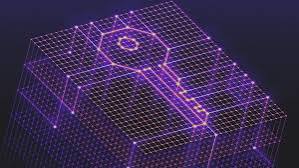
Imagine trying to find the shortest path in a maze where the walls keep shifting. That’s the core challenge behind lattice-based cryptography, a family of algorithms designed to be secure even against quantum computers. As quantum technology advances, the encryption that protects your emails, bank transactions, and private messages is at risk. Lattice-based cryptography offers a mathematical solution that could keep your data safe in the quantum age.
This article explains how lattice-based cryptography works, why it’s considered quantum-resistant, and how it’s already being deployed to protect the internet’s future. We’ll break down the complex math into simple analogies, look at the real-world standards being adopted, and address common questions about this critical technology.
The Quantum Threat to Modern Encryption
Most of the internet’s security relies on math problems that are easy to do but hard to undo. For example, it’s easy to multiply two large prime numbers, but given their product, finding those primes is incredibly time-consuming. This is the basis of RSA encryption.
Quantum computers, however, change the game. In 1994, mathematician Peter Shor developed an algorithm that could factor large numbers efficiently on a quantum computer. This means RSA, along with other popular methods like Elliptic Curve Cryptography (ECC), would be broken. An attacker with a sufficiently powerful quantum computer could decrypt intercepted messages, forge signatures, and impersonate websites.
This isn’t just a theoretical concern. Security agencies warn about “harvest now, decrypt later” attacks, where adversaries collect encrypted data today, anticipating that they’ll be able to decrypt it in the future. The clock is ticking for a solution.
What Are Lattices? A Simple Analogy
A lattice is a mathematical structure that looks like an infinite grid of points in space. Think of a 2D lattice as a sheet of graph paper extending infinitely in all directions, with points at every intersection. In higher dimensions, lattices become abstract but follow the same principle: a repeating, regular arrangement of points.
The security of lattice-based cryptography relies on two hard problems:
- Shortest Vector Problem (SVP): Given a lattice, find the shortest non-zero vector (the shortest distance from one point to another).
- Closest Vector Problem (CVP): Given a lattice and a target point, find the lattice point closest to that target.
These problems sound simple, but they become incredibly hard in high dimensions. There is no known efficient algorithm, even for quantum computers, to solve them. This is the foundation of lattice-based security.
The Magic of Noise: Learning With Errors
Modern lattice-based schemes build on a problem called Learning With Errors (LWE), introduced by Oded Regev in 2005. Here’s the idea:
Imagine you have a secret vector (a list of numbers) that you want to keep private. You create equations that relate this secret to other numbers, but you intentionally add small, random errors to the equations. Solving the system without knowing the exact errors is nearly impossible. The errors act like a fog that hides the secret.
This “noise” is controlled — it’s small enough that someone with the correct key can filter it out, but large enough that an attacker cannot. This clever trick makes LWE-based encryption both secure and practical.
NIST’s Selection: The New Standards
In 2016, the U.S. National Institute of Standards and Technology (NIST) launched a global competition to find post-quantum cryptographic algorithms. After years of evaluation, in August 2024, NIST published final standards for four algorithms:
- ML-KEM (based on CRYSTALS-Kyber) for key encapsulation, which is used to establish shared secrets securely.
- ML-DSA (based on CRYSTALS-Dilithium) and FN-DSA (based on Falcon) for digital signatures.
- SLH-DSA (based on SPHINCS+) is a hash-based backup, not lattice-based, but included for diversity.
These standards are now the go-to recommendations for organizations looking to secure their systems against quantum threats.
Real-World Adoption: Already Happening
Lattice-based cryptography isn’t just theory — it’s being deployed. Companies like Google, Cloudflare, and Amazon have been testing hybrid schemes that combine classical and post-quantum algorithms to ensure compatibility and security during the transition.
One notable example is Signal, the messaging app, which uses a protocol called PQXDH that incorporates Kyber. This means your private messages are already protected against future quantum attacks. Similarly, Linux distributions and web browsers are beginning to support these new algorithms.
The transition is gradual because it requires updating infrastructure worldwide. But the momentum is real, and lattice-based cryptography is leading the charge.
Performance and Trade-offs
One reason lattice-based schemes are favored is their efficiency. They have relatively small key sizes and fast operations compared to other post-quantum families like code-based or hash-based cryptography. However, they are still larger and slower than RSA or ECC, which could be a concern for devices with limited resources, like IoT sensors.
Researchers are actively working on optimizing implementations and reducing overhead. There’s also ongoing debate about parameter choices and side-channel resistance, but so far, lattice-based schemes are considered robust.
The Future: Beyond Encryption
Lattice-based cryptography also enables advanced features that classical methods cannot easily provide, such as fully homomorphic encryption (FHE). FHE allows computations on encrypted data without decrypting it, which could revolutionize cloud computing and data privacy.
As quantum computing research progresses, the need for quantum-safe cryptography will only grow. Lattice-based methods offer a versatile and secure foundation for the post-quantum world.
Lattice-based cryptography is not just a stopgap but a long-term solution for securing our digital future. With NIST’s standards in place and companies already integrating these algorithms, the shift to quantum-safe encryption is underway. By understanding the basic principles behind lattices and LWE, you can appreciate the elegance of this solution and why it gives us confidence in the face of quantum threats.
Summary
- Lattice-based cryptography relies on hard math problems (SVP, CVP) that even quantum computers can’t solve efficiently.
- The Learning With Errors (LWE) problem introduces controlled noise, making encryption secure and practical.
- NIST selected ML-KEM, ML-DSA, and FN-DSA as lattice-based standards in August 2024.
- Real-world deployment is already happening, with Signal, Google, and Cloudflare testing or using lattice-based algorithms.
- These schemes offer a good balance of security, performance, and versatility, including advanced features like fully homomorphic encryption.
FAQ
Q: What is a lattice in simple terms?
A: A lattice is like an infinite grid of points in space. Think of graph paper extending forever, but in higher dimensions. The security relies on how hard it is to find the shortest distance between points or the closest point to a target.
Q: Why are current encryption methods vulnerable to quantum computers?
A: Shor’s algorithm can efficiently factor large numbers and solve discrete logarithms, which breaks RSA and ECC. Lattice problems don’t have such efficient quantum solutions.
Q: Is lattice-based cryptography already in use?
A: Yes, it’s being rolled out. For example, Signal messaging uses Kyber, and NIST published final standards in 2024 that companies are adopting.
Q: Are lattice-based algorithms slower than traditional ones?
A: They’re a bit larger and slower than RSA/ECC, but still efficient enough for most applications. Researchers are working on optimizations for constrained devices.
Q: Can lattice-based encryption be broken by future quantum computers?
A: No known algorithm exists, but cryptographers continuously analyze the schemes. That’s why NIST chose multiple algorithms and encourages crypto agility — to be able to switch if one is ever broken.